
BuddhistCatholicContemplativeEvangelicalGeneral ChristianHinduJewishLatter-day SaintMuslimNew VisionsProgressive Christian
Beliefs
- Buddhist
- Catholic
- Contemplative
- Evangelical
- General Christian
- Hindu
- Jewish
- Latter-day Saint
- More Voices
- Muslim
- New Visions
- Pagan
- Progressive Christian
Topics
- Religion News
- Food and Religion
- Sports and Religion
- Religious Art
- Religious Music and Entertainment
- Religious Events
- History and Religion
- Style and Religion
- Politics and Religion
- Women in Religion
- Recreation Outdoors and Religion
- Business Finance and Religion
- Careers Workplace and Religion
- Education and Religion
- Family Parenting and Religion
- Health Fitness and Religion
- Home and Religion
- Relationships and Religion
- Technology and Religion
- Travel and Religion
Columnists
- Buddhist Columnists
- Business Finance and Religion Columnists
- Careers Workplace and Religion Columnists
- Catholic Columnists
- Contemplative Columnists
- Education and Religion Columnists
- Evangelists Columnists
- Family Parenting and Religion Columnists
- General Christian Columnists
- Health Fitness and Religion Columnists
- Hindu Columnists
- History and Religion Columnists
- Home and Religion Columnists
- Jewish Columnists
- More Voices Columnists
- Latter Day Columnists
- Muslim Columnists
- New Visions Columnists
- Nonreligious Columnists
- Pagan Columnists
- Politics and Religion Columnists
- Progressive Columnists
- Recreation Outdoors and Religion Columnists
- Relationships and Religion Columnists
- Religion News Columnists
- Religious Art Columnists
- Religious Events Columnists
- Religious Music and Entertainment Columnists
- Sports and Religion Columnists
- Style and Religion Columnists
- Technology and Religion Columnists
- Travel and Religion Columnists
- Women in Religion Columnists
Resource Library
- 2026 Calendar
- Library of World Religions
- The 100 Most Holy Places on Earth
- Patheos Answers
- Podcasts
- Videos
- Faith Leaders Database
- Anglican Episcopalian
- Bahai
- Baptist
- Buddhism
- Christianity
- Confucianism
- Eastern Orthodoxy
- Hinduism
- Holiness and Pentecostal
- ISKCON
- Islam
- Judaism
- Lutheran
- Methodist
- The Church of Jesus Christ of Latter-day Saints
- New Age
- Paganism
- Presbytarian and Reformed
- Protestantism
- Religion Behind the Scenes
- Roman Catholic
- Scientology
- Shia Islam
- Sikhism
- Sufism
- Sunni Islam
- Taoism
- Zen
- See all religions
Research Tools
 Ad-Free & Subscriber Log-In Subscription Support
Ad-Free & Subscriber Log-In Subscription Support
Follow Patheos 

- Trending:
- Forgiveness
- |
- Marriage
- |
- Consciousness
- |
- Death Penalty
- |
- Election
- |
- Halloween

-
About the Authors
- Home
- Evangelical
- The Three Journeys of the Christian Liberal Arts
The Three Journeys of the Christian Liberal Arts
Last updated on: May 2, 2017 at 1:18 am by Chris Gehrz
The Three Journeys of the Christian Liberal Arts 2017-05-01T21:43:00-04:00 Chris Gehrz
Patheos Explore the world's faith through different perspectives on religion and spirituality! Patheos has the views of the prevalent religions and spiritualities of the world.
Over the weekend I gave the keynote address for the annual Honors Symposium at Crown College, a Christian and Missionary Alliance school west of Minneapolis. (Thanks to Michial Farmer for inviting me to speak!) Here’s a slightly abridged version of my remarks.
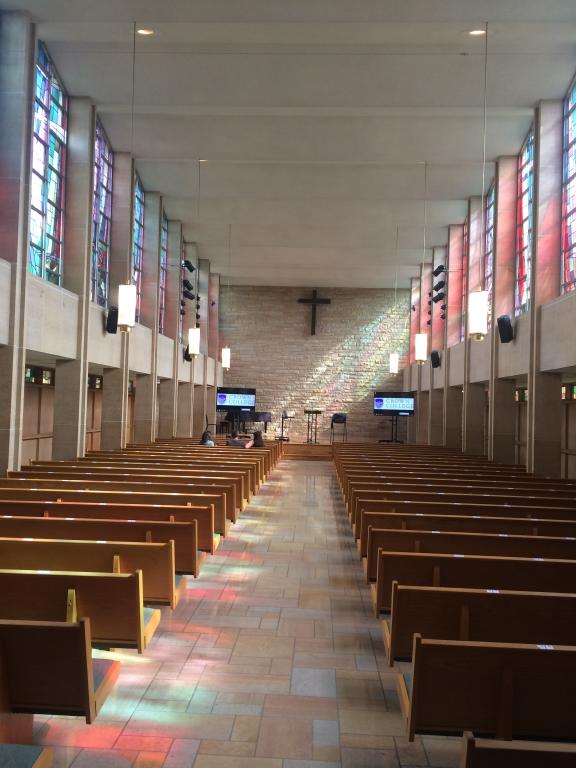
I spoke in the Chapel at Crown, which occupies a former Jesuit campus – CC BY-NC-SA 4.0 (Chris Gehrz)
There are many ways we could talk about the importance of the liberal arts in a Christian setting like this. I should probably share statistics on salary and employment, or quotations about citizenship and civic virtue. But the most liberal artsy way to explain the liberal arts is to give you a metaphor: the liberal arts as a set of journeys — conveyed via examples from history, poetry, art, philosophy, and Scripture.
In particular, I want to reflect on Matthew 2:1-12. I’ll grant you that April is a weird time of year to talk about the Three Wise Men, but bear with me. See I’ve been chewing on something since January.
I was in London, England, a couple days into a three-week travel course on World War I. It was Friday night, and somehow I managed to talk two of our students into joining me at St Martin-in-the-Fields, a beautiful old Anglican church by Trafalgar Square. We’d come to celebrate Epiphany, the beginning of the Christian season that follows Christmas, the weeks when we reflect on how Jesus Christ was revealed as God-with-Us — first, to three mysterious wise men, or Magi, from the East.
The tradition at St Martin’s is that the Epiphany homily is broken into three parts, with hymns, poetry, and choral music in between. This year, the preacher (Alastair McKay) reflected on the three journeys of the Magi, as reported in Matthew 2.
As I listened to Revd McKay, it struck me that the three journeys he was narrating were journeys I’d taken, journeys that will be taken by anyone who opens themselves to the transformative power of the educational model known as the Christian liberal arts.
First, we journey to Jerusalem
In the time of King Herod, after Jesus was born in Bethlehem of Judea, wise men from the East came to Jerusalem, asking, “Where is the child who has been born king of the Jews? For we observed his star at its rising, and have come to pay him homage.” When King Herod heard this, he was frightened, and all Jerusalem with him… (Mt 2:1-3, NRSV)
Like the Queen of Sheba and Alexander the Great before them, the Magi come from outside the story of Israel to visit the city of David. They leave the part of the world where the Jews once lived in exile, forced to sing songs of Jerusalem, and come to Zion.

El Greco, “The Adoration of the Wise Men” (1568) – Wikimedia
It’s no small thing to take this journey. When T.S. Eliot told his version of the “Journey of the Magi,” he began by cribbing five bleak lines from the 17th century Anglican bishop Lancelot Andrewes:
“A cold coming we had of it,
Just the worst time of the year
For a journey, and such a long journey:
The ways deep and the weather sharp,
The very dead of winter.”
But even as they dream in their weariness of “summer palaces on slopes… / And the silken girls bringing sherbet,” Eliot’s Magi continue on. For this is a journey of anticipation and commitment; this journey is a pilgrimage.
I don’t know how many of you will ever go to Jerusalem itself. (I haven’t.) But in our own ways, we all set out for a Jerusalem — we all of us set our hearts on a place that embodies our loftiest aspirations and most impossible imaginings. Whatever hard work, suffering, or sacrifice is required, we’ll do it in order to get to this Jerusalem.
For some of you, that’s the journey that brought you to this campus. You might be the first person in your family to go to college. Crown might have been your dream years before you sent in your application. At the very least, you saw it as opening a door to the freedom of adulthood, and letting you take the first step on your path to a profession or a marriage.
And I hope whatever it cost you to come here has been worth it. I do.
But ultimately, the journey to Jerusalem is both a journey of anticipation and a journey of disappointment.
The Magi come to a holy mountain where religion and politics fuse in unholy ways. They come to the city that Jesus laments: “…kills the prophets and stones those who are sent to it” (Matt 23:37). Rather than finding the true king, the Magi arrive in the court of a conniving tyrant who rules at the mercy of his Roman overlords. In search of power and justice, they find weakness masquerading as might. Solomon once sang of a king who would ”defend the cause of the poor of the people, give deliverance to the needy, and crush the oppressor” (Ps 72:4), but Herod is willing to commit mass murder in order to keep that Lord from taking his throne.
Likewise, the first journey of the Christian liberal arts is a journey of disenchantment. You will find — or have already — that this college, like Bethel and every other institution associated with Christ’s church, falls short. You will find — or already have — that this country has not always used power well, that it has betrayed its ideals as often as it has fulfilled them, that its leaders bear at least a passing resemblance to Herod and his masters.
Harder yet, even if you can do what Socrates thought difficult and convince others that the unexamined life is not worth living, you’ll find that the examined life is hard to endure, that there are aspects of your own life that don’t stand up to such scrutiny. If I’ve learned nothing else from my studies, it’s that history holds up a mirror to our own lives: and the reflection we see is uglier than we’d wish it to be.
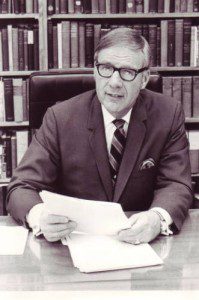
Carl Lundquist – CC BY-NC 3.0 (Bethel University Digital Library)
At Bethel we often say that the liberal arts are liberating arts. Which is lovely — but liberation is painful. Bethel’s longest-serving president, Carl Lundquist, said that such studies free us from “the chains of ignorance, provincialism, bigotry and narrowness.” But part of us prefers those chains; they can seem safe and comfortable when you’re being confronted with the vast array of blind spots, false assumptions, and misplaced priorities that come into focus as we study the liberal arts. Just as the Israelites begged to go back into slavery rather than enter the wilderness of their exodus, we’ll be tempted to abandon this journey and retreat to ignorance, provincialism, bigotry, and narrowness.
Indeed, Eliot’s Magi are nearly disillusioned by the experience:
A hard time we had of it.
At the end we preferred to travel all night,
Sleeping in snatches,
With the voices singing in our ears, saying
That this was all folly.
Similar voices may have echoed in your ears, shouting that it’s folly to spend four years following this star. That this kind of study doesn’t lead to a job, or at least one that won’t pay off your loans, that it distracts you from the Gospel and seduces you to the ways of the world.
But the three wise men did not turn back. Weary and disenchanted as they were, they continued. And so should you, for there is a second journey.
Second, we journey to Bethlehem
Then Herod secretly called for the wise men and learned from them the exact time when the star had appeared. Then he sent them to Bethlehem, saying, “Go and search diligently for the child; and when you have found him, bring me word so that I may also go and pay him homage.” When they had heard the king, they set out; and there, ahead of them, went the star that they had seen at its rising, until it stopped over the place where the child was. When they saw that the star had stopped, they were overwhelmed with joy. On entering the house, they saw the child with Mary his mother; and they knelt down and paid him homage. Then, opening their treasure chests, they offered him gifts of gold, frankincense, and myrrh. (Matt 2:8-11)

3rd c. sarcophagus showing the Magi with Mary and Jesus – Wikimedia
Bethlehem may have been the city of David, but it was no great metropolis. Few people of the ancient world set their hearts on visiting a town that, according to the prophet Micah, was “one of the little clans of Judah” (Mic 5:2). And yet that’s where the star guides the Magi. They are led not to a palace in Jerusalem but a nondescript house in Bethlehem; they do not find a king and his court, but a child, his peasant mother, and carpenter father.
And they are “overwhelmed with joy.” They fall to their knees in worship and give him the best gifts they can offer.
And so shall we all. For this is their second journey: an unexpected, unplanned trip in which they finally found what they’d been looking for the whole time, in the least likely place.
What is your Bethlehem, asked Revd McKay? Where — to your complete surprise — will you encounter Jesus Christ?
This is the second journey of the Christian liberal arts as well. Having disenchanted and disillusioned you, these studies now bring you to the unexpected joy of knowing Jesus Christ. Having seen the world more clearly, you now glimpse the light that no darkness can overcome.
Consider an unlikely example as I go back to that travel course to Europe, where we study a world war that took fifteen million lives and set the stage for a sequel that took four times as many — including 6 million Jewish lives in the Holocaust. We talk about faith, but as we move on from London to the Western Front and end in Munich and Dachau, we mostly we talk about how and why humans kill humans, how that killing is mourned and remembered, and how it reshapes everything from literature to manufacturing, technological innovation to artistic styles.
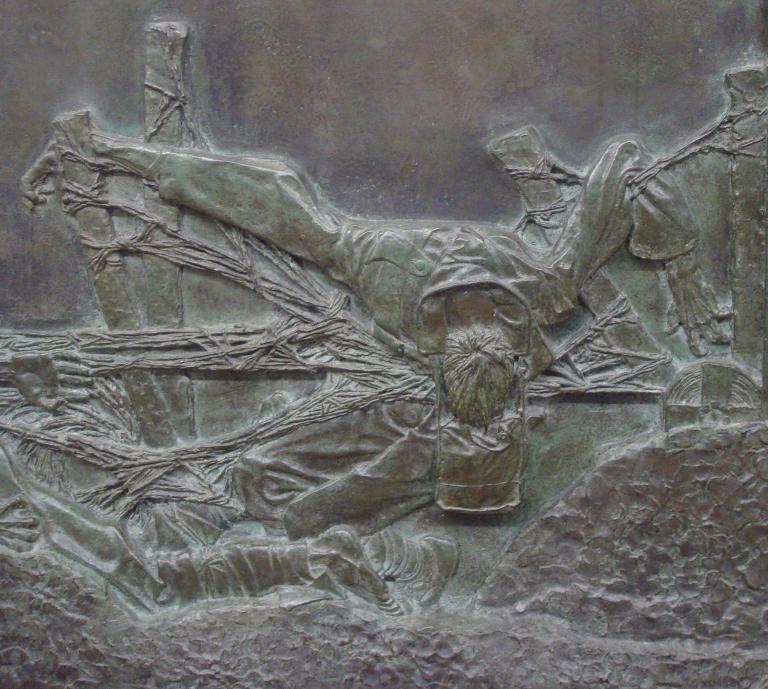
Detail of Charles Sargeant Jagger, “No Man’s Land” (1920)
If you study that history, you’ll see crosses everywhere, at memorial after memorial and cemetery after cemetery. But you’ll also see the people who make up the Body of Christ being crucified. For example, I’ll never forget coming to Charles Sargeant Jagger’s relief “No Man’s Land” in the Tate Britain gallery, seeing a dead soldier with outstretched arms entangled in barbed wire, and immediately being brought back to the gruesome sight of Christ crucified in The Isenheim Altarpiece.
Worse yet, you’ll see members of that same Body crucifying others. As when you enter the Catholic Chapel of the Mortal Agony of Christ at Dachau and think of all those killed in the Holocaust by supposed followers of Jesus.
Sometimes you see an image of God rendered as negative space because his absence is so painfully obvious, and you’re reminded that his inspired scripture include bitter words of unrestrained lament:
I am one who has seen affliction
under the rod of God’s wrath;
he has driven and brought me
into darkness without any light;
against me alone he turns his hand,
again and again, all day long. (Lam 3:1-3)

Dawn at Delville Wood Cemetery near Longueval, France – CC BY-NC-SA 4.0 (Chris Gehrz)
But then you see the sun dawning over five thousand graves on the Somme and your heart wants to sing with Zechariah:
By the tender mercy of our God,
the dawn from on high will break upon us,
to give light to those who sit in darkness and in the shadow of death,
to guide our feet into the way of peace. (Luke 1:78-79)
You see London’s Cenotaph, are told that its name is from the Greek for “empty tomb,” and find yourself with the women that first Easter. You think of resurrection and remember that even the author of Lamentations, with his soul “bowed down within me,” knew that the “steadfast love of the Lord never ceases, his mercies never come to an end” (Lam 3:21, 22).
I often tell my students that the most important objective in any course I teach is not listed on the syllabus. It can’t be, for I can’t plan it (or assess it). Not the acquisition of knowledge or the cultivation of research, critical thinking, or writing skills — above all else, my goal is that my students will encounter Jesus Christ.
And that encounter will leave them changed. Their studies will be part of their ongoing conversion, as they turn towards the one in whom “we live and move and have our being” (Acts 17:28) and grow to be more like him.
That’s what we mean when we promise prospective students a transformative education, when we quote the apostle Paul and tell students that the best defense against being “conformed to this world” is the “renewing of your minds” (Rom 12:2). We mean that they will take a journey to Bethlehem and find Christ.
What we don’t emphasize enough is that such an encounter is costly (not just in a financial sense), or that such change can be frightening. This journey is like the quest of The Hobbit. At least as the film version begins, a nervous Bilbo Baggins asks the wizard Gandalf, “Can you promise that I will come back?” “No,” replies Gandalf. “And if you do, you will not be the same.”
As T.S. Eliot’s poem finishes, the last of his Magi asks what their journey was all for:
…were we led all that way for
Birth or Death? There was a Birth, certainly,
We had evidence and no doubt. I had seen birth and death,
But had thought they were different; this Birth was
Hard and bitter agony for us, like Death, our death.
Indeed, the journey to Bethlehem is an encounter with new life — but the Magi must know that death is not so far away, for one of their gifts is myrrh, used in the ancient world to embalm corpses.
It’s a hard word to hear. Few of us come to college and take an American lit or Asian history course in order to die. But if what we’re doing is a kind of conversion to a Christ who was both crucified and resurrected, then we should expect that life comes from death. As Paul wrote earlier in Romans: “Do you not know that all of us who have been baptized into Christ Jesus were baptized into his death? Therefore we have been buried with him by baptism into death, so that, just as Christ was raised from the dead by the glory of the Father, so we too might walk in newness of life” (Rom 6:3-4).
At the end of his quest, Bilbo is not the same… but he does survive and come back to the Shire. And that takes us to our final journey.
Third, we journey home
This is the part of the story that Matthew is least interested in — or knows the least about. He dismisses the Magi from his gospel with a single verse: “And having been warned in a dream not to return to Herod, they left for their own country by another road” (Mt 2:12).
 That’s it. We don’t know how that journey went, or even which country was their own; we don’t know what they reported of their time in Judea, or how it was received. All we can do is speculate — and people have. A work of early Christian apocrypha known as the Revelation of the Magi says that the star carries them back to their mythical homeland of Shir, where Christ appears to the people — preparing the way, years later, for the Apostle Thomas to evangelize them on his journey towards India.
We don’t know that. But Matthew’s few words do tell us three important things. First, the Magi didn’t go back to Jerusalem — having been disenchanted, they knew better. Second, they didn’t stay in Bethlehem, tempting as it must have been to remain in the presence of Emmanuel. (Who wouldn’t want to remain “overwhelmed by joy”?) Instead, they left; wherever home was, they went there.
Except that it can’t have felt quite like home. Here’s how Eliot speculates:
We returned to our places, these Kingdoms,
But no longer at ease here, in the old dispensation,
With an alien people clutching their gods.
I should be glad of another death.
And your education will end in a similar fashion. You won’t go back to whatever was your Jerusalem: you know better. But you won’t stay in the Bethlehem of your education, tempting as it will be to keep paying Crown tuition. And while you might live in your parents’ basement for a time… You can’t really go home again. You will go out knowing better than you ever have that you are a “peculiar people” (1 Pet 2:9, KJV), sent out into the world as “ambassadors for Christ” (2 Cor 5:20).
But the key is that you do go out. The key is that you give God the same answer as the prophet Isaiah: “Here am I; send me!” (Isa 6:8).
But where? In which direction? There’s no map for this journey, no signpost, no GPS… There’s only a voice, calling you to him and sending you out in his name.
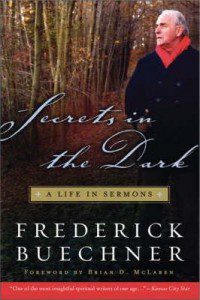
I’m quoting from “The Calling of Voices” (1969), one of the sermons collected in Secrets in the Dark
Unfortunately, as the Presbyterian pastor and novelist Frederick Buechner said once, while preaching on Isaiah 6, “our lives are full of all sorts of voices calling us in all sorts of directions. Some of them are voices from inside and some of them are voices from outside. The more alive and alert we are, the more clamorous our lives are. Which do we listen to? What kind of voice do we listen for?”
You are being sent out into a noisy world, “where there are so many voices and they all in their ways sound so promising.” None is louder than “the great blaring, boring, banal voice of our mass culture, which threatens to deafen us all by blasting forth that the only thing that really matters about your work is how much it will get you in the way of salary and status…”
But this is your chance. Before you’re encumbered by too many responsibilities and obligations, think about your education as a relatively quiet space in which you have the once-in-a-lifetime opportunity to tune your ears to hear God’s voice — in Scripture and theology, but also in the cadences of poetry and music, in the narratives of history and theatre, in the song of birds and bubbling of test tubes, in the cries of those who suffer.
If Buechner is right, then the sound of God’s call on your life is actually like a vocal duet: the sound of two different voices singing two different notes with two different timbres — and one ultimate purpose.
First, we should go “[w]here we most need to go,” follow “the voice of our own gladness,” and do that which “leaves us with the strongest sense of sailing true north and of peace, which is much of what gladness is…”
Second, we should go “where we are most needed,” into a world with “so much drudgery, so much grief, so much emptiness and fear and pain,” and offer ourselves in service.
And if, Buechner concludes, you answer to those two voices, you will take up “the calling of all of us, the calling to be Christs.”
What does this have to do with the Christian liberal arts? Buechner advises us to “keep our lives open,” but it’s hard to do that if you track yourself into a professional path admitting little personal exploration. As it happens, the broad study of the liberal arts both helps you know yourself more deeply, so that you’re better able to discern that “true north” that is specific to you, and in disenchanting you, it helps you recognize the grief and pain that you can alleviate, the emptiness that you can fill.
“With the drawing of this Love and the voice of this Calling,” wrote T.S. Eliot in another, more famous of his poems, “We shall not cease from exploration…” Of course, that’s from the conclusion to “Little Gidding,” the last of Eliot’s Four Quartets, which happened to be the conclusion of the Epiphany service at St Martin’s. It seems like a good place to end this talk as well:
And the end of all our exploring
Will be to arrive where we started
And know the place for the first time.
Through the unknown, unremembered gate
When the last of earth left to discover
Is that which was the beginning;
At the source of the longest river
The voice of the hidden waterfall
And the children in the apple-tree
Not known, because not looked for
But heard, half-heard, in the stillness
Between two waves of the sea.
Quick now, here, now, always—
A condition of complete simplicity
(Costing not less than everything)
And all shall be well and
All manner of thing shall be well
When the tongues of flames are in-folded
Into the crowned knot of fire
And the fire and the rose are one.
As you continue or conclude your education, may you journey in faith, led by God’s calling voice toward the unseen intersection of gladness and need, trusting that all manner of thing shall indeed be well.
May you journey in hope, risking disenchantment to discover unexpected joy that costs not less than everything.
May you journey in love, coming to know Christ more deeply and to be Christ to others, until your exploring ends at your beginning and we know fully, having been fully known.
Amen.
Previous Post

May 1, 2017
Languages of Command
Next Post

May 3, 2017 Top Ten Bible Verses in Medieval England
Browse Our Archives
Select a Category abolitionism Abortion Abraham Joshua Heschel Abraham Kuyper Abraham Lincoln Academia Activism Adam Renberg Advent Adventist africa African American Religion Agnes Howard Albert Camus American History American Religious History American Revolution American West Anabaptists Ancient History Andrea Turpin Andrei Tarkovsky Anglicanism Annales Ansley Lillian Quiros anti-Catholicism Antisemitism Anxious Bench apologetics Apparitions Arash Azizi Archaeology archives art Artificial Intelligence Asia Asian Americans Augustine Authors Bad Bunny Baptism Baptists Barack Obama Battle of Hastings Benjamin Franklin Bernard-Henri Levy Beth Allison Barr Beth Moore Bethany Mannon Bible Bill Cunningham Billy Graham Black Music Bob Dylan Body Boenhoffer Books Breastfeeding Bruce Springsteen C.S. Lewis Calvinism Cancel Culture Capitalism Carmelites Catholicism Cedric Robinson Cesar Chavez Charismaticism charity Charles Dickens Charles Lindbergh Che Guevara Chicago Children Chinese Christianity Chris Gehrz Christ Christian death Christian Higher Education Christian life Christian Nation Christian Nationalism Christianity Today Christmas Church life Church Practice cinema Civil Religion Civil Rights Movement Civil War civility Classics Climate Change Cold War Colonial Mexico colonialism Comer Communism community complementarianism Conference on Faith and History Congregationalism Conspiracies Conspiracy Conversion Narratives Coronavirus Costa Rica Council of Nicaea Covid-19 Creation Critical Race Theory Crusades Culture culture wars Daniel K. Williams David Barton David Swartz Death Ways death with dignity DEI democracy Democratic Party Devotion Digital Age Diplomacy discipleship diversity Donald Trump Drama Dua Lipa Early Church early modern Early modern Catholicism Easter Eastern Christianity economic exploitation Education elections Elie Wiesel Elizabeth II Elizabeth Taylor emotions Empire Engineering England enslavement Entertainment Episcopal Church Erica Ramirez eschatology Eurocentrism Evangelicalism Evangelicals Exegesis Family Feminism Film Flannery O'Connor folk music Food Foreign Policy founding fathers Franciscans Franciscus Junius fundamentalism Funerals G.K. Chesterton Gender Genocide genre geography George W. Bush George Washington George Whitefield Global Christianity Global church Grief Guadalupe guest post Guest Post gun control gun violence Gustavo Gutierrez Hamid Dabashi Harold John Ockenga Harvest Hate Hawaiian Christianity Healing health care Heather Cox Richardson Hell Heresy Hermeneutics Higher Education Hinduism Hippocratic oath Historical Fiction Historical Methodology Historical Profession Historical Profession Historical Theology Historical Thinking historiography Holidays Holocaust horror movies Human rights Humanitarian Work humanities Hummingbirds Hungary hymns Imago Dei Immigration Injustice Interviews Iran Islam Islamophobia Israel Ivan's Childhood Jacob Randolph James Bratt Janine Giordano Drake Japanese history Japanese Literature Jean Paul Sartre Jesse Miranda Jesus Jesus Christ Jimmy Carter Joan Baez Joan Didion Joanne Freeman João B. Chaves Joao Chaves Joey Cochran John Calvin John Fea John Tillotson John Turner Johnny Cash Jonathan Edwards Jonathan Tran Joseph Smith Josh Howerton Journalism Jr. Judaism Jürgen Moltmann Just War Justice Justin Brierley Karl Barth Katelyn Beaty koi ponds Kris Kristofferson Kristin Kobes Du Mez Latin American Religious History Latino Americans Lectio Divina Leisure Lent Leonard Cohen liberal arts liberalism Liberation Theology Linda Ronstadt Lisa Clark Diller Literature Lou Reed Lynchings Lynneth Miller Renberg Mainline Protestantism Malcolm Foley Marilyn Monroe Maritime history Mark Noll Marriage Martin Luther Martin Luther King Martyrdom Marxism Mary Masih Alinejad mass shootings material culture medieval Christianity Medieval Ethiopia Melissa Borja memory Mennonites Mental Health Mental Illness Methodism Mexican Americans Mexicans Mike Madrid Miles Mullin Min Jin Lee Miscarriage Missionaries Mister Rogers Mitt Romney modernity Monasticism Mormonism Motherhood Mothers of the Church Moving Music Musicals Nadya Williams Nahua Christianity Native Americans Natsume Sōseki New Contributor New England New Year New York Nico Non-Violent Protest Orthodoxy pacifism Paleo Evangelicals Palestinians Parenting Patti Smith Paul Kingsnorth Pedro Calderón de la Barca Pentecostalism Philip Jenkins Phillis Wheatley physician-assisted suicide pilgrimage Pilgrims pluralism Plutocracy Poetry Politics Pope Francis Pope Leo XIV post-modernism prayer preaching Presbyterians prosperity gospel Protest Public history Publishing Puritans purity culture Quakers race Race Massacres Racial Capitalism racial reconciliation racialization Racism Raha Bahloulipour Re-Enchantment reading Reformation Refugees religion and the university religion and war Religious Freedom Religious Nones Religious Pluralism Religious Symbols religious violence Republican Party Revival Rita Coolidge Ritual Roger Williams Roman Catholic church Royalty Russell Moore same-sex marriage Sarah Irving-Stonebraker Scandinavia Science Science and Technology Scopes trial Scriptural Interpretation secularism Selena Quintanilla seminary Seventh-Day Adventists sexual morality Sexuality Sikhs Silence slaveholders theology Slavery Slavoj Zizek social justice Social Media Southern Baptist Convention Southern Religion Spain Spiritual Autobiography Spiritual but not religious Spiritual Discipline Sports Stanley Hauerwas Suffering Summer Camps Sunday Night Odds and Ends Supernatural Supreme Court Syriac Christianity Tal Howard Taylor Swift Teaching Technology Television Thanksgiving The Beatles The Mission theater TheoBros Theology Thomas Dixon Thomas Jefferson Thomas Kidd Thomas Merton Tim Gloege Tim Walz Tom Holland Tourism tradition Tragedy Translation Transnationalism Travel Trump Ukraine Uncategorized Unitarians United Methodist Church US History Vanessa Chan Velvet Underground Verónica A. Gutiérrez Veronica Gutierrez Vikings Violence Virgin Mary Virtue Virtue ethics Visions Voting War WCTU Wendell Berry Westminster Assembly White Evangelicalism Wildfires Winnie the Pooh Witches women Women in Ministry Women's and Gender Studies Work Worship writing Yasunari Kawabata Zena Hitz
Select a Month October 2026 September 2026 August 2026 July 2026 June 2026 May 2026 April 2026 March 2026 February 2026 January 2026 December 2025 November 2025 October 2025 September 2025 August 2025 July 2025 June 2025 May 2025 April 2025 March 2025 February 2025 January 2025 December 2024 November 2024 October 2024 September 2024 August 2024 July 2024 June 2024 May 2024 April 2024 March 2024 February 2024 January 2024 December 2023 November 2023 October 2023 September 2023 August 2023 July 2023 June 2023 May 2023 April 2023 March 2023 February 2023 January 2023 December 2022 November 2022 October 2022 September 2022 August 2022 July 2022 June 2022 May 2022 April 2022 March 2022 February 2022 January 2022 December 2021 November 2021 October 2021 September 2021 August 2021 July 2021 June 2021 May 2021 April 2021 March 2021 February 2021 January 2021 December 2020 November 2020 October 2020 September 2020 August 2020 July 2020 June 2020 May 2020 April 2020 March 2020 February 2020 January 2020 December 2019 November 2019 October 2019 September 2019 August 2019 July 2019 June 2019 May 2019 April 2019 March 2019 February 2019 January 2019 December 2018 November 2018 October 2018 September 2018 August 2018 July 2018 June 2018 May 2018 April 2018 March 2018 February 2018 January 2018 December 2017 November 2017 October 2017 September 2017 August 2017 July 2017 June 2017 May 2017 April 2017 March 2017 February 2017 January 2017 December 2016 November 2016 October 2016 September 2016 August 2016 July 2016 June 2016 May 2016 April 2016 March 2016 February 2016 January 2016 December 2015 November 2015 October 2015 September 2015 August 2015 July 2015 June 2015 May 2015 April 2015 March 2015 February 2015 January 2015 December 2014 November 2014 October 2014 September 2014 August 2014 July 2014 June 2014 May 2014 April 2014 March 2014 February 2014 January 2014 December 2013 November 2013 October 2013 September 2013 August 2013 July 2013 June 2013 May 2013 April 2013 March 2013 February 2013 January 2013 December 2012 November 2012 October 2012 September 2012 August 2012 July 2012 June 2012 May 2012
Follow Us!
TAKE THE
Religious Wisdom Quiz
Which Old Testament book is entirely written as a dialogue between God and a prophet?
Select your answer to see how you score.
Amos Zechariah Malachi Habakkuk
Related posts from Anxious Bench
Corrupting the Youth? What Universities Are Really For

Epic Fury in the End-Times: Exploring Pentecostal War...
Hope in December: A Holocaust Survivor's Story
Waterlilly: Kinship, History, and the Novel
TRENDING AT PATHEOS Evangelical

Swimfan: Forgotten Aughts Pleasures
This is a recovery effort. In 2002, My Big Fat Greek Wedding...

Top Three Anti-Catholic Lies About Catholicism
This is my initial transcript for the video, "THE 3 WORST...

Pope Leo Celebrates Mass for Nurses & Docs...
I don't have any idea how he did it, but Pope Leo...

The Sermon on the Mount, Part I: Matthew...
The Sermon on the Mount, Part I (Matthew 4:12-5:12) St. Matthew moves...

What's up from Crossway: Reviewing some of their latest A few weeks...

Janie Learns the Way of the Cross: A...
Teaching children about Jesus' Passion can be challenging. Many parents and educators...
view all Evangelical blogs
Ad-Free & Subscriber Log-In Subscription Support
- About Us
- 2026 Calendar
- Videos
- Podcasts
- Library of World Religions
- Faith In Media Tracker
- Advertise With Us
- Write for Us
- Privacy Policy
- Terms of Service
- Do Not Sell My Data
- Contact Us
- Radiant Digital
- Manage Newsletter Subscriptions
- Unsubscribe From Notifications
- Sitemap
Copyright 2008-2026, Patheos. All rights reserved.
Subscription Support Ad-Free & Subscriber Log-In
Follow Patheos