
BuddhistCatholicContemplativeEvangelicalGeneral ChristianHinduJewishLatter-day SaintMuslimNew VisionsProgressive Christian
Beliefs
- Buddhist
- Catholic
- Contemplative
- Evangelical
- General Christian
- Hindu
- Jewish
- Latter-day Saint
- More Voices
- Muslim
- New Visions
- Pagan
- Progressive Christian
Topics
- Religion News
- Food and Religion
- Sports and Religion
- Religious Art
- Religious Music and Entertainment
- Religious Events
- History and Religion
- Style and Religion
- Politics and Religion
- Women in Religion
- Recreation Outdoors and Religion
- Business Finance and Religion
- Careers Workplace and Religion
- Education and Religion
- Family Parenting and Religion
- Health Fitness and Religion
- Home and Religion
- Relationships and Religion
- Technology and Religion
- Travel and Religion
Columnists
- Buddhist Columnists
- Business Finance and Religion Columnists
- Careers Workplace and Religion Columnists
- Catholic Columnists
- Contemplative Columnists
- Education and Religion Columnists
- Evangelists Columnists
- Family Parenting and Religion Columnists
- General Christian Columnists
- Health Fitness and Religion Columnists
- Hindu Columnists
- History and Religion Columnists
- Home and Religion Columnists
- Jewish Columnists
- More Voices Columnists
- Latter Day Columnists
- Muslim Columnists
- New Visions Columnists
- Nonreligious Columnists
- Pagan Columnists
- Politics and Religion Columnists
- Progressive Columnists
- Recreation Outdoors and Religion Columnists
- Relationships and Religion Columnists
- Religion News Columnists
- Religious Art Columnists
- Religious Events Columnists
- Religious Music and Entertainment Columnists
- Sports and Religion Columnists
- Style and Religion Columnists
- Technology and Religion Columnists
- Travel and Religion Columnists
- Women in Religion Columnists
Resource Library
- 2026 Calendar
- Library of World Religions
- The 100 Most Holy Places on Earth
- Patheos Answers
- Podcasts
- Videos
- Faith Leaders Database
- Anglican Episcopalian
- Bahai
- Baptist
- Buddhism
- Christianity
- Confucianism
- Eastern Orthodoxy
- Hinduism
- Holiness and Pentecostal
- ISKCON
- Islam
- Judaism
- Lutheran
- Methodist
- The Church of Jesus Christ of Latter-day Saints
- New Age
- Paganism
- Presbytarian and Reformed
- Protestantism
- Religion Behind the Scenes
- Roman Catholic
- Scientology
- Shia Islam
- Sikhism
- Sufism
- Sunni Islam
- Taoism
- Zen
- See all religions
Research Tools
 Ad-Free & Subscriber Log-In Subscription Support
Ad-Free & Subscriber Log-In Subscription Support
Follow Patheos 

- Trending:
- Forgiveness
- |
- Marriage
- |
- Consciousness
- |
- Death Penalty
- |
- Election
- |
- Halloween

-
About the Authors
- Home
- Evangelical
- A Dispatch from Trump Country: The Past and Politics
A Dispatch from Trump Country: The Past and Politics
Last updated on: October 11, 2016 at 9:08 am by Chris Gehrz
A Dispatch from Trump Country: The Past and Politics 2016-10-11T09:08:49-04:00 Chris Gehrz
Patheos Explore the world's faith through different perspectives on religion and spirituality! Patheos has the views of the prevalent religions and spiritualities of the world.
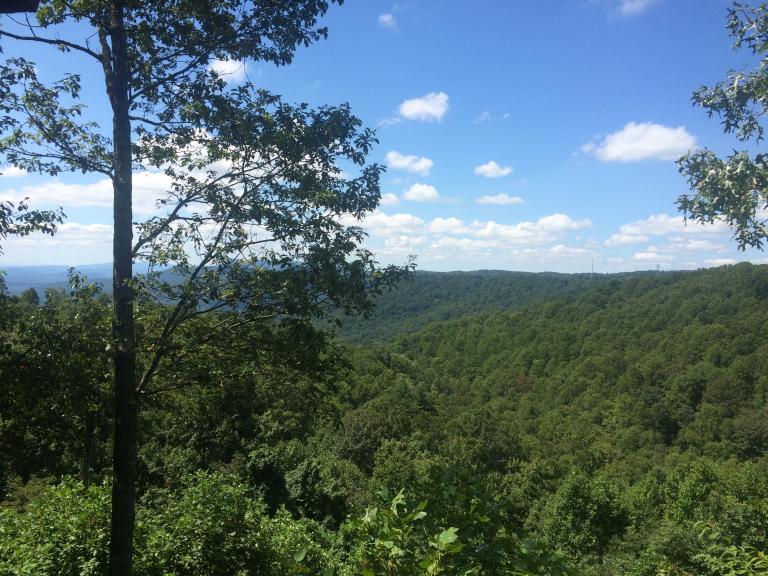
The view out my sabbatical “office” — i.e., the back porch of a cabin overlooking North Carolina from 3,000 feet up – All photos in this post by Chris Gehrz (CC BY-NC-SA 4.0)
For my fall sabbatical, my family has been blessed with the opportunity to spend four months living in one of the most beautiful parts of the country: the Blue Ridge Mountains of southwestern Virginia.
It’s an area I know fairly well; my parents moved here from Minnesota twenty-three years ago. (The other reason for this move: lots of Oma and Opa time for our kids!) But while I knew this to be one of the reddest parts of a largely blue state, I didn’t realize just how strongly most people down here supported Donald Trump.
According to the RealClearPolitics average of five polls conducted before the Access Hollywood recording was released, Hillary Clinton has a comfortable 9-point lead over Trump in Virginia. To some extent, she might benefit from choosing a Virginia senator (and former governor) for her running mate, but that’s unlikely to help her in Carroll County (where we’re living) and the counties surrounding it.
County
% Voting for Tim Kaine in 2005 Gubernatorial Election
% Voting for Tim Kaine in 2012 U.S. Senate Election
% Voting for Donald Trump in 2016 Republican Primary
Bland
36.9%
28.5%
55.0%
Carroll
38.9%
32.1%
53.5%
Grayson
40.3%
34.0%
51.8%
Patrick
41.7%
32.6%
46.8%
Pulaski
46.5%
39.6%
50.7%
Wythe
37.8%
33.1%
53.7%
ALL VIRGINIA
51.7%
52.8%
34.7%
In the Christopher Newport University poll that came out last Monday, Trump was down by seven points across the whole state and leads in only one region: the Southwest, where he’s up by 15 points even with Libertarian candidate Gary Johnson polling 11%.
Here and at my own blog, I’ve made abundantly clear my own opposition to Trump’s candidacy. But if empathy (however difficult to achieve) is indeed central to our discipline, then historians like me should seek to understand Trump’s supporters.
So why — in a state that is fairly solidly in Clinton’s column and whose Republican primary voters almost gave a rare victory to Marco Rubio — are the people of southwestern Virginia so much more likely to back Donald Trump?
* * * * *
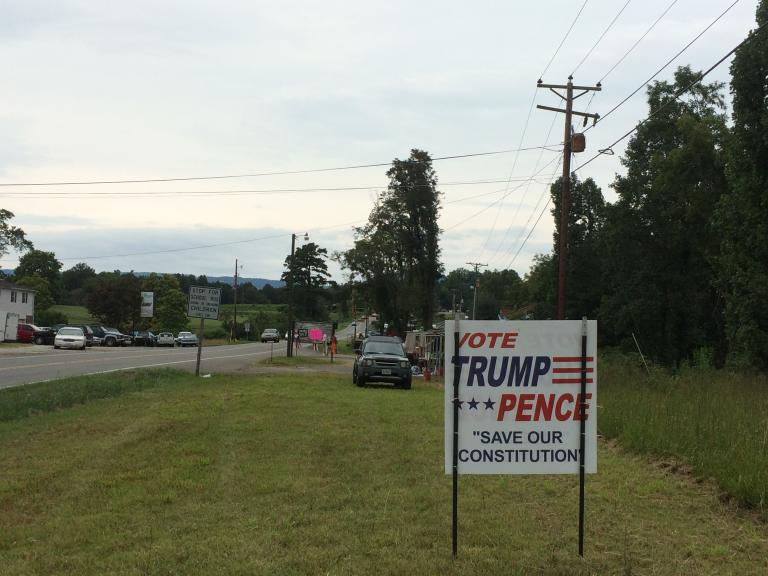
Trump-Pence sign in Cana, Virginia
If we were staying a bit further to the west, I’d suspect that energy policy is the distinguishing factor. During primary season Trump promised voters in neighboring West Virginia that he would reopen closed coal mines in Appalachia, and he won majorities of the primary vote in the four coal-producing Virginia counties on the Kentucky border, nearing 70% in Buchanan County. Meanwhile, voters there are suspicious of Clinton’s promise to spend $30 billion to help the region move away from coal mining (much like a previous effort tried to wean Virginia farmers from tobacco). Despite personal ties to Appalachia and a great deal of campaigning four years ago, Tim Kaine did poorly in these counties while running for the Senate, and in the vice-presidential debate Mike Pence made a point of criticizing President Obama for waging a “war on coal.”
Indeed, coal production in Virginia has plummeted in the last few years, and this spring the local newspaper featured a piece on the geological and other reasons for that decline. But we’re living on the fringes of coal country, where the loss of non-mining blue-collar jobs is the more pressing issue.
In the first debate, Trump’s strongest moment probably came early on, when he blamed the loss of manufacturing jobs on trade deals negotiated under Democratic presidents. Whether that (or his pledge that he can bring those jobs back) is true or not, it’s a concern that resonates in counties like the one where my parents live. In 2007, Pulaski Furniture Company completed the shutdown of its plant in its namesake town, and according to the Roanoke Times, began to import its products.
At the end of the day, though, I suspect that Trump is tapping into something deeper than grievances about trade or energy policy. We could certainly talk about religion (in a region where Baptist, Pentecostal, and other conservative churches are omnipresent), or race (in the whitest part of Virginia). But because I’m a historian, I keep thinking about something that runs deeper than rational political calculation: how people make meaning of the past.
* * * * *
Coming from a Midwestern suburb where our 1952-built house is considered old, coming east can feel like a time warp. You drive over trails blazed by Daniel Boone and pass through cities older than the Constitution. You tune in to a North Carolina radio station advertising itself as the home for “Old Time String Music” and stumble upon a recording of a temperance sermon by a fiery Holiness preacher who’s been dead for years.
You get to explain to your children why Americans fly the battle flag of a rebellion that was defeated over 150 years ago. (It was while living in the Blue Ridge that Tony Horwitz met the Civil War reenactors who inspired him to write Confederates in the Attic.) Fortunately, we’re headed home before Christmas and won’t have to answer questions about Virginia placing Lee-Jackson Day at the other end of a long weekend from Martin Luther King, Jr. Day.
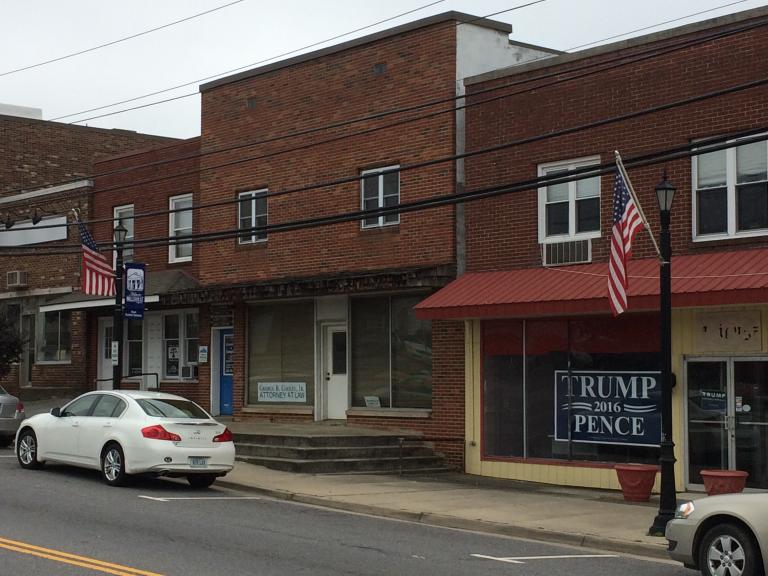
From the “Historic” district of Hillsville, county seat of Carroll County
Pulaski is actually younger than Reconstruction, but like most towns around here, signs proclaim its downtown to be “historic.” Indeed, the buildings on the town’s quiet Main Street seem like artifacts from another time, much like the now-empty furniture factory down the hill from my parents’ Victorian house.
What to do with such “historic” districts seems like a common problem in the region, with some towns willing to contemplate rather desperate changes. According to longtime Richmond Times-Dispatch reporter Rex Bowman, Pulaski’s leaders once considered one older resident’s idea of turning downtown into a Polish village, an imagined past honoring the largely Scots-Irish town’s namesake: a Polish noble who fought and died on the American side in the Revolutionary War.
While it makes clear his affection for the people in a region he loves “above all places on earth,” Bowman’s book, Blue Ridge Chronicles, is permeated with wistful descriptions of decay: not just shuttered shops on Main Streets, but other businesses made obsolete by technological, demographic, and economic change. (In our own travels, I’ve lost count of the number of times we’ve driven by an abandoned farmhouse or barn crumbling in on itself as grasses and trees begin to reclaim the land.) Even a village called Novelty has “its heyday behind it.”
So the past is ever present — and constantly evoking a complicated web of feelings: pride and shame, regret and resilience, defiance and despair.
Some have tried to embrace change. For example, burgeoning STEM programs at Virginia Tech in Blacksburg have led to southwestern Virginia being rebranded as the state’s “Technology Corridor.”
But in Pulaski, as in so many other towns, most revitalization efforts have instead doubled down on nostalgia. Nothing came of the proposed Polish makeover, but at the well-done new transportation museum, my kids watch O-gauge trains chug through an 80-foot model of Pulaski as it looked sixty years ago. (The museum stands kitty-corner from a train depot that last welcomed passengers in the 1970s, still unused after years of talk about linking Pulaski by rail with more prosperous cities like Blacksburg and Roanoke.) Perhaps the most successful growth industry was antiquing, which experienced a boom that has since abated. The theatre on Main Street, first built in 1911, has been renovated; its next three events are a screening of an old horror movie, a veterans concert featuring big band music, and a Johnny Cash tribute.
* * * * *

Not everyone in the region thinks Trump is any better an option than Clinton…
There’s something admirable about this commitment to the past. It contrasts sharply with the way that people in my part of the country simply clear ruins out of the way of the newest eight-lane freeway, big box business, or row of McMansions. As Peggy Bendroth points out in The Spiritual Practice of Remembering, that’s one reason those of us who live in cities and suburbs so often feel detached from any sense of collective memory.
And while it may seem ironic that people whose identity is so tied up with the past are looking hopefully to a real estate developer, it’s not hard to see why they resonate with Trump’s promise to “Make America Great Again.” (Or why there’s such a gap here with Democratic voters — many of whom named years as recent as, well, 2016 when asked just when America was at its greatest.) Stripped of complexity and nuance, the language of nostalgia may rankle historians like me; and continued commitment to Confederate “heritage” is increasingly hard to stomach in a post-Charleston America. But that kind of meaning-making is hardly an unusual strategy for coping with uncontrollable change. “Besides enhancing an acceptable present,” observed David Lowenthal in the original edition of The Past Is a Foreign Country, “the past offers alternatives to an unacceptable present.”
So even a supremely unacceptable candidate can, as Ronald Brownstein has argued, deploy nostalgia in such a way as to “touch the pervasive sense of loss among many of his supporters—the belief that the changes molding modern America have marginalized them economically, demographically, and culturally.”
Cross-posted at The Pietist Schoolman
Previous Post

October 10, 2016
The Problem with Protecting our Wives and Daughters
Next Post

October 11, 2016 Saying Farewell to Books and Culture
Browse Our Archives
Select a Category abolitionism Abortion Abraham Joshua Heschel Abraham Kuyper Abraham Lincoln Academia Activism Adam Renberg Advent Adventist africa African American Religion Agnes Howard Albert Camus American History American Religious History American Revolution American West Anabaptists Ancient History Andrea Turpin Andrei Tarkovsky Anglicanism Annales Ansley Lillian Quiros anti-Catholicism Antisemitism Anxious Bench apologetics Apparitions Arash Azizi Archaeology archives art Artificial Intelligence Asia Asian Americans Augustine Authors Bad Bunny Baptism Baptists Barack Obama Battle of Hastings Benjamin Franklin Bernard-Henri Levy Beth Allison Barr Beth Moore Bethany Mannon Bible Bill Cunningham Billy Graham Black Music Bob Dylan Body Boenhoffer Books Breastfeeding Bruce Springsteen C.S. Lewis Calvinism Cancel Culture Capitalism Carmelites Catholicism Cedric Robinson Cesar Chavez Charismaticism charity Charles Dickens Charles Lindbergh Che Guevara Chicago Children Chinese Christianity Chris Gehrz Christ Christian death Christian Higher Education Christian life Christian Nation Christian Nationalism Christianity Today Christmas Church life Church Practice cinema Civil Religion Civil Rights Movement Civil War civility Classics Climate Change Cold War Colonial Mexico colonialism Comer Communism community complementarianism Conference on Faith and History Congregationalism Conspiracies Conspiracy Conversion Narratives Coronavirus Costa Rica Council of Nicaea Covid-19 Creation Critical Race Theory Crusades Culture culture wars Daniel K. Williams David Barton David Swartz Death Ways death with dignity DEI democracy Democratic Party Devotion Digital Age Diplomacy discipleship diversity Donald Trump Drama Dua Lipa Early Church early modern Early modern Catholicism Easter Eastern Christianity economic exploitation Education elections Elie Wiesel Elizabeth II Elizabeth Taylor emotions Empire Engineering England enslavement Entertainment Episcopal Church Erica Ramirez eschatology Eurocentrism Evangelicalism Evangelicals Exegesis Family Feminism Film Flannery O'Connor folk music Food Foreign Policy founding fathers Franciscans Franciscus Junius fundamentalism Funerals G.K. Chesterton Gender Genocide genre geography George W. Bush George Washington George Whitefield Global Christianity Global church Grief Guadalupe Guest Post guest post gun control gun violence Gustavo Gutierrez Hamid Dabashi Harold John Ockenga Harvest Hate Hawaiian Christianity Healing health care Heather Cox Richardson Hell Heresy Hermeneutics Higher Education Hinduism Hippocratic oath Historical Fiction Historical Methodology Historical Profession Historical Profession Historical Theology Historical Thinking historiography Holidays Holocaust horror movies Human rights Humanitarian Work humanities Hummingbirds Hungary hymns Imago Dei Immigration Injustice Interviews Iran Islam Islamophobia Israel Ivan's Childhood Jacob Randolph James Bratt Janine Giordano Drake Japanese history Japanese Literature Jean Paul Sartre Jesse Miranda Jesus Jesus Christ Jimmy Carter Joan Baez Joan Didion Joanne Freeman João B. Chaves Joao Chaves Joey Cochran John Calvin John Fea John Tillotson John Turner Johnny Cash Jonathan Edwards Jonathan Tran Joseph Smith Josh Howerton Journalism Jr. Judaism Jürgen Moltmann Just War Justice Justin Brierley Karl Barth Katelyn Beaty koi ponds Kris Kristofferson Kristin Kobes Du Mez Latin American Religious History Latino Americans Lectio Divina Leisure Lent Leonard Cohen liberal arts liberalism Liberation Theology Linda Ronstadt Lisa Clark Diller Literature Lou Reed Lynchings Lynneth Miller Renberg Mainline Protestantism Malcolm Foley Marilyn Monroe Maritime history Mark Noll Marriage Martin Luther Martin Luther King Martyrdom Marxism Mary Masih Alinejad mass shootings material culture medieval Christianity Medieval Ethiopia Melissa Borja memory Mennonites Mental Health Mental Illness Methodism Mexican Americans Mexicans Mike Madrid Miles Mullin Min Jin Lee Miscarriage Missionaries Mister Rogers Mitt Romney modernity Monasticism Mormonism Motherhood Mothers of the Church Moving Music Musicals Nadya Williams Nahua Christianity Native Americans Natsume Sōseki New Contributor New England New Year New York Nico Non-Violent Protest Orthodoxy pacifism Paleo Evangelicals Palestinians Parenting Patti Smith Paul Kingsnorth Pedro Calderón de la Barca Pentecostalism Philip Jenkins Phillis Wheatley physician-assisted suicide pilgrimage Pilgrims pluralism Plutocracy Poetry Politics Pope Francis Pope Leo XIV post-modernism prayer preaching Presbyterians prosperity gospel Protest Public history Publishing Puritans purity culture Quakers race Race Massacres Racial Capitalism racial reconciliation racialization Racism Raha Bahloulipour Re-Enchantment reading Reformation Refugees religion and the university religion and war Religious Freedom Religious Nones Religious Pluralism Religious Symbols religious violence Republican Party Revival Rita Coolidge Ritual Roger Williams Roman Catholic church Royalty Russell Moore same-sex marriage Sarah Irving-Stonebraker Scandinavia Science Science and Technology Scopes trial Scriptural Interpretation secularism Selena Quintanilla seminary Seventh-Day Adventists sexual morality Sexuality Sikhs Silence slaveholders theology Slavery Slavoj Zizek social justice Social Media Southern Baptist Convention Southern Religion Spain Spiritual Autobiography Spiritual but not religious Spiritual Discipline Sports Stanley Hauerwas Suffering Summer Camps Sunday Night Odds and Ends Supernatural Supreme Court Syriac Christianity Tal Howard Taylor Swift Teaching Technology Television Thanksgiving The Beatles The Mission theater TheoBros Theology Thomas Dixon Thomas Jefferson Thomas Kidd Thomas Merton Tim Gloege Tim Walz Tom Holland Tourism tradition Tragedy Translation Transnationalism Travel Trump Ukraine Uncategorized Unitarians United Methodist Church US History Vanessa Chan Velvet Underground Verónica A. Gutiérrez Veronica Gutierrez Vikings Violence Virgin Mary Virtue Virtue ethics Visions Voting War WCTU Wendell Berry Westminster Assembly White Evangelicalism Wildfires Winnie the Pooh Witches women Women in Ministry Women's and Gender Studies Work Worship writing Yasunari Kawabata Zena Hitz
Select a Month October 2026 September 2026 August 2026 July 2026 June 2026 May 2026 April 2026 March 2026 February 2026 January 2026 December 2025 November 2025 October 2025 September 2025 August 2025 July 2025 June 2025 May 2025 April 2025 March 2025 February 2025 January 2025 December 2024 November 2024 October 2024 September 2024 August 2024 July 2024 June 2024 May 2024 April 2024 March 2024 February 2024 January 2024 December 2023 November 2023 October 2023 September 2023 August 2023 July 2023 June 2023 May 2023 April 2023 March 2023 February 2023 January 2023 December 2022 November 2022 October 2022 September 2022 August 2022 July 2022 June 2022 May 2022 April 2022 March 2022 February 2022 January 2022 December 2021 November 2021 October 2021 September 2021 August 2021 July 2021 June 2021 May 2021 April 2021 March 2021 February 2021 January 2021 December 2020 November 2020 October 2020 September 2020 August 2020 July 2020 June 2020 May 2020 April 2020 March 2020 February 2020 January 2020 December 2019 November 2019 October 2019 September 2019 August 2019 July 2019 June 2019 May 2019 April 2019 March 2019 February 2019 January 2019 December 2018 November 2018 October 2018 September 2018 August 2018 July 2018 June 2018 May 2018 April 2018 March 2018 February 2018 January 2018 December 2017 November 2017 October 2017 September 2017 August 2017 July 2017 June 2017 May 2017 April 2017 March 2017 February 2017 January 2017 December 2016 November 2016 October 2016 September 2016 August 2016 July 2016 June 2016 May 2016 April 2016 March 2016 February 2016 January 2016 December 2015 November 2015 October 2015 September 2015 August 2015 July 2015 June 2015 May 2015 April 2015 March 2015 February 2015 January 2015 December 2014 November 2014 October 2014 September 2014 August 2014 July 2014 June 2014 May 2014 April 2014 March 2014 February 2014 January 2014 December 2013 November 2013 October 2013 September 2013 August 2013 July 2013 June 2013 May 2013 April 2013 March 2013 February 2013 January 2013 December 2012 November 2012 October 2012 September 2012 August 2012 July 2012 June 2012 May 2012
Follow Us!
TAKE THE
Religious Wisdom Quiz
What sign marked the houses to be spared during Passover?
Select your answer to see how you score.
A dove symbol A red ribbon Blood on doorposts A lit candle
Related posts from Anxious Bench
"Nations are made by men, not paper constitutions"

Donald Trump, Canada, and the Deep Roots of...
In the Midst of a Theological Crisis
TRENDING AT PATHEOS Evangelical

Emotion in Early Christianity by Andrew Crislip
Andrew Crislip’s Emotion in Early Christianity examines an often overlooked dimension of...

16 Spiritual Touchstones for a More Grounded Life
After decades of spiritual study, here are 16 principles I try...

Catholic Evangelization: Sharing Your Faith Every Day
Welcome back to the Graceful Awakening mini-series called, “From Faith to Mission.” ...

The Pillar of the Boatmen: the Ancient Monument...
The Pillar of the Boatmen is a Romano-Gaulish sculpture that dates from...

In one sense walking into Westminster Abbey is like walking down the...

'Super Scam Me' Exposes AI Jon Bon Jovi...
Leslie Pickett believed she was in a relationship with Jon Bon Jovi....
view all Evangelical blogs
Ad-Free & Subscriber Log-In Subscription Support
- About Us
- 2026 Calendar
- Videos
- Podcasts
- Library of World Religions
- Faith In Media Tracker
- Advertise With Us
- Write for Us
- Privacy Policy
- Terms of Service
- Do Not Sell My Data
- Contact Us
- Radiant Digital
- Manage Newsletter Subscriptions
- Unsubscribe From Notifications
- Sitemap
Copyright 2008-2026, Patheos. All rights reserved.
Subscription Support Ad-Free & Subscriber Log-In
Follow Patheos