
BuddhistCatholicContemplativeEvangelicalGeneral ChristianHinduJewishLatter-day SaintMuslimNew VisionsProgressive Christian
Beliefs
- Buddhist
- Catholic
- Contemplative
- Evangelical
- General Christian
- Hindu
- Jewish
- Latter-day Saint
- More Voices
- Muslim
- New Visions
- Pagan
- Progressive Christian
Topics
- Religion News
- Food and Religion
- Sports and Religion
- Religious Art
- Religious Music and Entertainment
- Religious Events
- History and Religion
- Style and Religion
- Politics and Religion
- Women in Religion
- Recreation Outdoors and Religion
- Business Finance and Religion
- Careers Workplace and Religion
- Education and Religion
- Family Parenting and Religion
- Health Fitness and Religion
- Home and Religion
- Relationships and Religion
- Technology and Religion
- Travel and Religion
Columnists
- Buddhist Columnists
- Business Finance and Religion Columnists
- Careers Workplace and Religion Columnists
- Catholic Columnists
- Contemplative Columnists
- Education and Religion Columnists
- Evangelists Columnists
- Family Parenting and Religion Columnists
- General Christian Columnists
- Health Fitness and Religion Columnists
- Hindu Columnists
- History and Religion Columnists
- Home and Religion Columnists
- Jewish Columnists
- More Voices Columnists
- Latter Day Columnists
- Muslim Columnists
- New Visions Columnists
- Nonreligious Columnists
- Pagan Columnists
- Politics and Religion Columnists
- Progressive Columnists
- Recreation Outdoors and Religion Columnists
- Relationships and Religion Columnists
- Religion News Columnists
- Religious Art Columnists
- Religious Events Columnists
- Religious Music and Entertainment Columnists
- Sports and Religion Columnists
- Style and Religion Columnists
- Technology and Religion Columnists
- Travel and Religion Columnists
- Women in Religion Columnists
Resource Library
- 2026 Calendar
- Library of World Religions
- The 100 Most Holy Places on Earth
- Patheos Answers
- Podcasts
- Videos
- Faith Leaders Database
- Anglican Episcopalian
- Bahai
- Baptist
- Buddhism
- Christianity
- Confucianism
- Eastern Orthodoxy
- Hinduism
- Holiness and Pentecostal
- ISKCON
- Islam
- Judaism
- Lutheran
- Methodist
- The Church of Jesus Christ of Latter-day Saints
- New Age
- Paganism
- Presbytarian and Reformed
- Protestantism
- Religion Behind the Scenes
- Roman Catholic
- Scientology
- Shia Islam
- Sikhism
- Sufism
- Sunni Islam
- Taoism
- Zen
- See all religions
Research Tools
 Ad-Free & Subscriber Log-In Subscription Support
Ad-Free & Subscriber Log-In Subscription Support
Follow Patheos 

- Trending:
- Forgiveness
- |
- Marriage
- |
- Consciousness
- |
- Death Penalty
- |
- Election
- |
- Halloween

-
About the Authors
- Home
- Evangelical
- Football at Christian Colleges and Universities
Football at Christian Colleges and Universities
Last updated on: September 4, 2016 at 3:57 pm by Chris Gehrz
Football at Christian Colleges and Universities 2016-09-04T15:57:44-04:00 Chris Gehrz
Patheos Explore the world's faith through different perspectives on religion and spirituality! Patheos has the views of the prevalent religions and spiritualities of the world.
This is my first autumn at The Anxious Bench, and I’m steeling myself to endure all sorts of college football talk. After all, four of my Anxious Bench colleagues (David, Kristin, Tim, and John — who even shares his name with a Notre Dame defensive back) earned doctorates from 10th ranked Notre Dame, whose Fighting Irish will begin their quest for their ninth national championship tomorrow with a rare Sunday night game. And while #23 Baylor (employer of Beth and Philip, plus my predecessor Tommy Kidd — another Notre Dame grad) figures to be down this year after a turbulent offseason, the Bears steamrolled last night’s visitors from Northwestern (LA) State and could well compete for their third Big XII championship in four years.
But it’s worth remembering that neither is all that representative of college football. Unlike Notre Dame, most college football programs do not take in $86 million in annual revenues, 2nd only to the school UND will play tomorrow night: the University of Texas at Austin. Unlike Baylor, most universities do not spend a quarter-billion dollars on a new stadium, not to mention $50 million on other football facilities. And unlike either school, most Christian and church-related colleges and universities either play in lower levels of competition or don’t field teams at all.
* * * *
As I’ve already established here, I work for a less famous Baptist “BU.” Playing in the shadow of a rather hapless Big Ten program, Bethel University has been a perennial regional power in Division III of the National Collegiate Athletic Association (NCAA), which permits no athletic scholarships and garners little media attention. Led by long-time coach Steve Johnson, the Royals open their season today against the University of Dubuque, the reigning champion of Iowa Intercollegiate Athletic Conference.
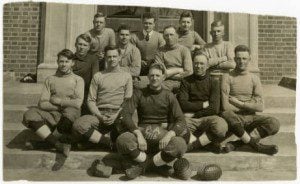
Facilities improved a bit when a $10,000 check from railroad tycoon James J. Hill let Bethel move to a new campus across from the Minnesota State Fair Grounds – CC BY-NC 3.0 (Bethel University Digital Library)
Bethel students have been playing football since before the school became a four-year college (1947). The oldest yearbook (1909) in our excellent digital library complains that then-Bethel Academy “had no grounds” for football practice “except the lawn around the building and this was greatly damaged thereby.” This was no small matter to the student-editors, who placed athletic competition at the center of Bethel’s historic commitment to forming “whole and holy persons“:
We admire the motto of the Y.M.C.A.: Mind, body, and spirit. This motto, if followed up closely, will give us a perfect man as far as man can be perfect. The development of the mind is what we primarily come to school for, and yet we must not forget that the other two are equally as important, in fact more important. It is unnecessary to mention the importance of spiritual development, for we all know that a man without a clean soul has but little to live for. These first two essentials, mind and spirit, have received due attention at Bethel Academy, but in order to develope [sic] the mind and spirit, development of the body is absolutely necessary. We must remember that the body is the temple of the spirit. When we think of the beauty of the human body which is the image of the Creator himself, it would be an unpardonable crime to neglect its preservation and development, which many of us do.
Just four years after the deaths of nineteen college football players precipitated a presidential intervention, the editors of The Acorn insisted that neglecting such competition was potentially ruinous for a Christian school: “We are not only hurting ourselves but breaking the laws of nature, the result of which lowers our ability to accomplish things in this world.”
There have been critics through the years. For example, in 1956 a seminary student dared to ask readers of The Bethel Clarion:
Is it spiritually healthy for a Christian to participate in football for no other reason than for the glory and love of the game? Is it spiritually healthy for a Christian college to support a sport, which is by its very nature antagonistic to the ideas and principles of Christ?
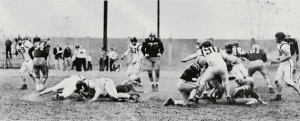
Bethel went 1-6 in 1956, but the yearbook insisted that “while it is fun to have a winning team this is not the only purpose in football at Bethel” – CC BY-NC 3.0 (Bethel University Digital Library)
As far as I know, there’s never been a serious move to eliminate football from Bethel’s athletic program. But it’s worth noting that Bethel is relatively unusual as an avowedly Christian university fielding a football team. As far as I can tell, about 60% of the institutions in the evangelical Council for Christian Colleges & Universities (CCCU) don’t play America’s most popular, lucrative, expensive sport on the intercollegiate level.
The list of non-football schools in the CCCU includes such consortium pillars as Calvin College (where Kristin teaches), Asbury University (David’s employer), and Gordon College (Agnes and Tal’s former academic home). Calvin revisited the possibility of starting a football team in 2011-2012 (a previous attempt was rejected in 1987), but the college’s board decided to put off a vote. Some Christian colleges once had football teams, but decided that the cost (financial, if not spiritual) was too high. Most recent was King College (now University), in 2003. Several current CCCU members discontinued their football programs in the turbulent decade after World War II, including Cedarville, Erskine, Huntington, and tiny York College of Nebraska.
Why is football so rare among Christian colleges and universities?
First, we should remember that it’s not actually all that unusual for American institutions of higher learning to go without gridirons. Almost half of the nearly 1,400 members of the NCAA and the National Association of Intercollegiate Athletics (NAIA) don’t have football programs. After all, the sport is tremendously expensive, often helping to drive up student cost and promising uncertain returns on investment. And because of the gender equity requirements of Title IX, adding a men-only sport like football would require the school to take steps to keep athletic participation proportionate to student enrollment. (And most Christian colleges have significantly more female than male students.)
But some concerns are more specific to the religious contexts of Christian educational institutions. Goshen College and Eastern Mennonite University, two of the Anabaptist institutions that withdrew from the CCCU last year over their hiring of LGBT employees, have never played football. (When Goshen began tentatively to embrace competitive sports in the late 1950s, it instead added soccer, which Mennonite historian Theron Schlabach once called “a pacifist form of football.”) Four years ago, Cedarville’s athletic department began to weigh the pros and cons of restarting a football team. A survey by the student newspaper found mixed response. For example, while 84% of respondents thought such a move would attract more students to campus, half that number worried that many such newcomers “would fail to embrace our Christian culture.”
Other evangelical commentators worry about the physical, psychological, and spiritual costs of the sport, prompting this FAQ item from the Calvin task force:
12. Is the “aggression level” associated with football accurate, necessary, different than other sports, and/or especially difficult to justify from a Christian perspective?
The last part of this question assumes that there is a clear negative correlation between appropriate Christian behaviors and increasingly aggressive behaviors—the more Christian something is, the less aggression there is, and vice-versa. This is not the place to dispute this assertion, other than to point out that the context of behavior is important.
In this discussion of football at Calvin, a better question is whether there is a fundamental conflict between excellently played Division III football and a Christian world- and life- view. To that question, based both on data and a review of comparison schools, the answer seems to be “no.” Calvin hosts other sports with similar characteristics that might be termed “aggressive”—high contact sports, sports with similar injury rates, sports which encourage fan loyalty and expression, and other characteristics.
Indeed, it seems that the football tide may be turning in Christian higher ed. Since 2008 nine CCCU members have added football teams:
- NCAA Division I: Houston Baptist (2013)
- NCAA Division II: Oklahoma Baptist (2013)
- NCAA Division III: George Fox (2014)
- NAIA: Dordt and Kentucky Christian (2008); Bluefield (2012); Warner (2013); Missouri Baptist and Southeastern (2014)
And fast-growing Indiana Wesleyan, now the largest member of the CCCU, plans to add an NAIA football team in the fall of 2018. “This is about mission,” said IWU athletic director Mark DeMichael:
This is about what God has called us to do at Indiana Wesleyan University. We are so blessed to have head coaches in our department right now that are first experts in their field, are master leaders and master tacticians in their sport, but first and foremost they are men and women of God who have been called to a ministry through coaching in college. That mission has enabled them to be used by God to turn out incredible young men and women who are going out into the world serving God in whatever profession He has called them to do.
 But Steve Moniaci, DeMichael’s counterpart at Houston Baptist, had a more pragmatic explanation for his institution spending $10 million to start up a Huskies football squad, plus another million dollars in annual expenses:
Why are we doing this? The whys are pretty simple. We’re trying to grow this institution… Study after study has shown that one way to attract more attention is to have a robust athletic department. The leader in the clubhouse is college football.
And HBU hopes to improve relatively low alumni engagement and raise its profile in a state with no shortage of colleges and universities. As Moniaci put it, “If you’re in Texas and you’re not playing football, it almost begs the question, ‘Why aren’t you?'”
As far as I know, Houston Baptist is the only CCCU school competing even in the second tier of Division I. But the non-CCCU institution that bills itself as “the largest Christian university in the world” has spent an enormous amount of money trying to join the likes of Notre Dame and Baylor in the Football Bowl Subdivision. “This investment will pay dividends for generations because it will shine a light on our core mission to train champions for Christ like nothing else can,” Liberty University president Jerry Falwell, Jr. told Christianity Today in December 2012. “We see top-tier college athletics as a mission field.”
(In 2014 Falwell told USA Today that adding football would help “show people Liberty’s not Oral Roberts, it’s Baylor.” As I argued at my own blog last year, investment in football has been central for the leadership of both Liberty and Baylor as they aspire to be something like “the Protestant Notre Dame.”)
Others in the CCCU aren’t so sure Christian colleges can afford that kind of investment, or should seek that kind of spotlight. Brian Bolt, the kinesiology professor who chaired the Football Feasibility Task Force, told CT that
Evangelicals have wholeheartedly embraced sport in the name of spreading the Gospel, using the formula winning equals fame, fame equals exposure, exposure equals souls for Christ… Exposure of this sort runs the very real risk of fundamentally changing the message. How Liberty handles this conundrum will ultimately determine its success.
“When it works,” said Gordon president Michael Lindsay in the same article, “the return on the investment can be tremendous. But without early wins and patient support, the investment can cost the institution not only its riches—but also its reputation.”

Baylor’s McLane Stadium – CC BY-SA 4.0 (Djyueng)
And as Baylor has found out this year, football can damage the reputation of a Christian university even when there’s no shortage of on-field success and off-field support. This time last year, as people continued to debate the impact of concussions in football and news started to break about a Baylor player convicted of sexual assault, I suggested that “it’s an open question whether avowedly Christian institutions ought to be participating in a brand of football that risks dehumanizing or debasing those who participate in it — or tempts institutions to compromise their convictions for the sake of competitive success.” Then this year the scandal at Baylor broke wide open, as a damning external review commissioned by the school’s board of regents led to Baylor parting ways with president Ken Starr, athletic director Ian McCaw, and football coach Art Briles.
So I think I ought to conclude this post the same way I concluded a similar one written at this time last year:
I’m leery of pushing too hard here. I’ve seen — and previously written about — the educational benefits of sports at schools like Bethel. What I’d heard of Art Briles before this summer [2015] was only positive. But as we enter what ESPN Radio host Mike Greenberg this morning predicted would be “a magnificent weekend of college football,” I wonder if readers agree that there’s a level (the Football Bowl Series subdivision? lower?) at which the cost of sustaining such magnificence requires a Christian university to run an unacceptably high risk of compromising its mission and values.
If you’d like to comment on this or other Anxious Bench posts, please note that World Table is having some problems with Firefox as it operates on Macs, and their best efforts to resolve the issue have not yet worked. If you do run into problems, try an alternate browser, such as Chrome or Safari. Thanks!
Previous Post

September 2, 2016
American History: Writing the Present?
Next Post
September 5, 2016 Birth Advice from Leo Tolstoy
Browse Our Archives
Select a Category abolitionism Abortion Abraham Joshua Heschel Abraham Kuyper Abraham Lincoln Academia Activism Adam Renberg Advent Adventist africa African American Religion Agnes Howard Albert Camus American History American Religious History American Revolution American West Anabaptists Ancient History Andrea Turpin Andrei Tarkovsky Anglicanism Annales Ansley Lillian Quiros anti-Catholicism Antisemitism Anxious Bench apologetics Apparitions Arash Azizi Archaeology archives art Artificial Intelligence Asia Asian Americans Augustine Authors Bad Bunny Baptism Baptists Barack Obama Battle of Hastings Benjamin Franklin Bernard-Henri Levy Beth Allison Barr Beth Moore Bethany Mannon Bible Bill Cunningham Billy Graham Black Music Bob Dylan Body Boenhoffer Books Breastfeeding Bruce Springsteen C.S. Lewis Calvinism Cancel Culture Capitalism Carmelites Catholicism Cedric Robinson Cesar Chavez Charismaticism charity Charles Dickens Charles Lindbergh Che Guevara Chicago Children Chinese Christianity Chris Gehrz Christ Christian death Christian Higher Education Christian life Christian Nation Christian Nationalism Christianity Today Christmas Church life Church Practice cinema Civil Religion Civil Rights Movement Civil War civility Classics Climate Change Cold War Colonial Mexico colonialism Comer Communism community complementarianism Conference on Faith and History Congregationalism Conspiracies Conspiracy Conversion Narratives Coronavirus Costa Rica Council of Nicaea Covid-19 Creation Critical Race Theory Crusades Culture culture wars Daniel K. Williams David Barton David Swartz Death Ways death with dignity DEI democracy Democratic Party Devotion Digital Age Diplomacy discipleship diversity Donald Trump Drama Dua Lipa Early Church early modern Early modern Catholicism Easter Eastern Christianity economic exploitation Education elections Elie Wiesel Elizabeth II Elizabeth Taylor emotions Empire Engineering England enslavement Entertainment Episcopal Church Erica Ramirez eschatology Eurocentrism Evangelicalism Evangelicals Exegesis Family Feminism Film Flannery O'Connor folk music Food Foreign Policy founding fathers Franciscans Franciscus Junius fundamentalism Funerals G.K. Chesterton Gender Genocide genre geography George W. Bush George Washington George Whitefield Global Christianity Global church Grief Guadalupe guest post Guest Post gun control gun violence Gustavo Gutierrez Hamid Dabashi Harold John Ockenga Harvest Hate Hawaiian Christianity Healing health care Heather Cox Richardson Hell Heresy Hermeneutics Higher Education Hinduism Hippocratic oath Historical Fiction Historical Methodology Historical Profession Historical Profession Historical Theology Historical Thinking historiography Holidays Holocaust horror movies Human rights Humanitarian Work humanities Hummingbirds Hungary hymns Imago Dei Immigration Injustice Interviews Iran Islam Islamophobia Israel Ivan's Childhood Jacob Randolph James Bratt Janine Giordano Drake Japanese history Japanese Literature Jean Paul Sartre Jesse Miranda Jesus Jesus Christ Jimmy Carter Joan Baez Joan Didion Joanne Freeman João B. Chaves Joao Chaves Joey Cochran John Calvin John Fea John Tillotson John Turner Johnny Cash Jonathan Edwards Jonathan Tran Joseph Smith Josh Howerton Journalism Jr. Judaism Jürgen Moltmann Just War Justice Justin Brierley Karl Barth Katelyn Beaty koi ponds Kris Kristofferson Kristin Kobes Du Mez Latin American Religious History Latino Americans Lectio Divina Leisure Lent Leonard Cohen liberal arts liberalism Liberation Theology Linda Ronstadt Lisa Clark Diller Literature Lou Reed Lynchings Lynneth Miller Renberg Mainline Protestantism Malcolm Foley Marilyn Monroe Maritime history Mark Noll Marriage Martin Luther Martin Luther King Martyrdom Marxism Mary Masih Alinejad mass shootings material culture medieval Christianity Medieval Ethiopia Melissa Borja memory Mennonites Mental Health Mental Illness Methodism Mexican Americans Mexicans Mike Madrid Miles Mullin Min Jin Lee Miscarriage Missionaries Mister Rogers Mitt Romney modernity Monasticism Mormonism Motherhood Mothers of the Church Moving Music Musicals Nadya Williams Nahua Christianity Native Americans Natsume Sōseki New Contributor New England New Year New York Nico Non-Violent Protest Orthodoxy pacifism Paleo Evangelicals Palestinians Parenting Patti Smith Paul Kingsnorth Pedro Calderón de la Barca Pentecostalism Philip Jenkins Phillis Wheatley physician-assisted suicide pilgrimage Pilgrims pluralism Plutocracy Poetry Politics Pope Francis Pope Leo XIV post-modernism prayer preaching Presbyterians prosperity gospel Protest Public history Publishing Puritans purity culture Quakers race Race Massacres Racial Capitalism racial reconciliation racialization Racism Raha Bahloulipour Re-Enchantment reading Reformation Refugees religion and the university religion and war Religious Freedom Religious Nones Religious Pluralism Religious Symbols religious violence Republican Party Revival Rita Coolidge Ritual Roger Williams Roman Catholic church Royalty Russell Moore same-sex marriage Sarah Irving-Stonebraker Scandinavia Science Science and Technology Scopes trial Scriptural Interpretation secularism Selena Quintanilla seminary Seventh-Day Adventists sexual morality Sexuality Sikhs Silence slaveholders theology Slavery Slavoj Zizek social justice Social Media Southern Baptist Convention Southern Religion Spain Spiritual Autobiography Spiritual but not religious Spiritual Discipline Sports Stanley Hauerwas Suffering Summer Camps Sunday Night Odds and Ends Supernatural Supreme Court Syriac Christianity Tal Howard Taylor Swift Teaching Technology Television Thanksgiving The Beatles The Mission theater TheoBros Theology Thomas Dixon Thomas Jefferson Thomas Kidd Thomas Merton Tim Gloege Tim Walz Tom Holland Tourism tradition Tragedy Translation Transnationalism Travel Trump Ukraine Uncategorized Unitarians United Methodist Church US History Vanessa Chan Velvet Underground Verónica A. Gutiérrez Veronica Gutierrez Vikings Violence Virgin Mary Virtue Virtue ethics Visions Voting War WCTU Wendell Berry Westminster Assembly White Evangelicalism Wildfires Winnie the Pooh Witches women Women in Ministry Women's and Gender Studies Work Worship writing Yasunari Kawabata Zena Hitz
Select a Month October 2026 September 2026 August 2026 July 2026 June 2026 May 2026 April 2026 March 2026 February 2026 January 2026 December 2025 November 2025 October 2025 September 2025 August 2025 July 2025 June 2025 May 2025 April 2025 March 2025 February 2025 January 2025 December 2024 November 2024 October 2024 September 2024 August 2024 July 2024 June 2024 May 2024 April 2024 March 2024 February 2024 January 2024 December 2023 November 2023 October 2023 September 2023 August 2023 July 2023 June 2023 May 2023 April 2023 March 2023 February 2023 January 2023 December 2022 November 2022 October 2022 September 2022 August 2022 July 2022 June 2022 May 2022 April 2022 March 2022 February 2022 January 2022 December 2021 November 2021 October 2021 September 2021 August 2021 July 2021 June 2021 May 2021 April 2021 March 2021 February 2021 January 2021 December 2020 November 2020 October 2020 September 2020 August 2020 July 2020 June 2020 May 2020 April 2020 March 2020 February 2020 January 2020 December 2019 November 2019 October 2019 September 2019 August 2019 July 2019 June 2019 May 2019 April 2019 March 2019 February 2019 January 2019 December 2018 November 2018 October 2018 September 2018 August 2018 July 2018 June 2018 May 2018 April 2018 March 2018 February 2018 January 2018 December 2017 November 2017 October 2017 September 2017 August 2017 July 2017 June 2017 May 2017 April 2017 March 2017 February 2017 January 2017 December 2016 November 2016 October 2016 September 2016 August 2016 July 2016 June 2016 May 2016 April 2016 March 2016 February 2016 January 2016 December 2015 November 2015 October 2015 September 2015 August 2015 July 2015 June 2015 May 2015 April 2015 March 2015 February 2015 January 2015 December 2014 November 2014 October 2014 September 2014 August 2014 July 2014 June 2014 May 2014 April 2014 March 2014 February 2014 January 2014 December 2013 November 2013 October 2013 September 2013 August 2013 July 2013 June 2013 May 2013 April 2013 March 2013 February 2013 January 2013 December 2012 November 2012 October 2012 September 2012 August 2012 July 2012 June 2012 May 2012
Follow Us!
TAKE THE
Religious Wisdom Quiz
According to James, what is pure and undefiled religion?
Select your answer to see how you score.
To love your neighbor as yourself To care for orphans and widows in their distress and keep oneself from being polluted by the world To pray without ceasing To obey all the commandments
Related posts from Anxious Bench
Angelina Grimké and the Turmoils of Perfection
On Different Educations and the Global Church

Waterlilly: Kinship, History, and the Novel
Is Christian Education Meant to Protect or Expand?
TRENDING AT PATHEOS Evangelical

Emotion in Early Christianity by Andrew Crislip
Andrew Crislip’s Emotion in Early Christianity examines an often overlooked dimension of...

16 Spiritual Touchstones for a More Grounded Life
After decades of spiritual study, here are 16 principles I try...

Catholic Evangelization: Sharing Your Faith Every Day
Welcome back to the Graceful Awakening mini-series called, “From Faith to Mission.” ...

The Pillar of the Boatmen: the Ancient Monument...
The Pillar of the Boatmen is a Romano-Gaulish sculpture that dates from...

In one sense walking into Westminster Abbey is like walking down the...

'Super Scam Me' Exposes AI Jon Bon Jovi...
Leslie Pickett believed she was in a relationship with Jon Bon Jovi....
view all Evangelical blogs
Ad-Free & Subscriber Log-In Subscription Support
- About Us
- 2026 Calendar
- Videos
- Podcasts
- Library of World Religions
- Faith In Media Tracker
- Advertise With Us
- Write for Us
- Privacy Policy
- Terms of Service
- Do Not Sell My Data
- Contact Us
- Radiant Digital
- Manage Newsletter Subscriptions
- Unsubscribe From Notifications
- Sitemap
Copyright 2008-2026, Patheos. All rights reserved.
Subscription Support Ad-Free & Subscriber Log-In
Follow Patheos