
BuddhistCatholicContemplativeEvangelicalGeneral ChristianHinduJewishLatter-day SaintMuslimNew VisionsProgressive Christian
Beliefs
- Buddhist
- Catholic
- Contemplative
- Evangelical
- General Christian
- Hindu
- Jewish
- Latter-day Saint
- More Voices
- Muslim
- New Visions
- Pagan
- Progressive Christian
Topics
- Religion News
- Food and Religion
- Sports and Religion
- Religious Art
- Religious Music and Entertainment
- Religious Events
- History and Religion
- Style and Religion
- Politics and Religion
- Women in Religion
- Recreation Outdoors and Religion
- Business Finance and Religion
- Careers Workplace and Religion
- Education and Religion
- Family Parenting and Religion
- Health Fitness and Religion
- Home and Religion
- Relationships and Religion
- Technology and Religion
- Travel and Religion
Columnists
- Buddhist Columnists
- Business Finance and Religion Columnists
- Careers Workplace and Religion Columnists
- Catholic Columnists
- Contemplative Columnists
- Education and Religion Columnists
- Evangelists Columnists
- Family Parenting and Religion Columnists
- General Christian Columnists
- Health Fitness and Religion Columnists
- Hindu Columnists
- History and Religion Columnists
- Home and Religion Columnists
- Jewish Columnists
- More Voices Columnists
- Latter Day Columnists
- Muslim Columnists
- New Visions Columnists
- Nonreligious Columnists
- Pagan Columnists
- Politics and Religion Columnists
- Progressive Columnists
- Recreation Outdoors and Religion Columnists
- Relationships and Religion Columnists
- Religion News Columnists
- Religious Art Columnists
- Religious Events Columnists
- Religious Music and Entertainment Columnists
- Sports and Religion Columnists
- Style and Religion Columnists
- Technology and Religion Columnists
- Travel and Religion Columnists
- Women in Religion Columnists
Resource Library
- 2026 Calendar
- Library of World Religions
- The 100 Most Holy Places on Earth
- Patheos Answers
- Podcasts
- Videos
- Faith Leaders Database
- Anglican Episcopalian
- Bahai
- Baptist
- Buddhism
- Christianity
- Confucianism
- Eastern Orthodoxy
- Hinduism
- Holiness and Pentecostal
- ISKCON
- Islam
- Judaism
- Lutheran
- Methodist
- The Church of Jesus Christ of Latter-day Saints
- New Age
- Paganism
- Presbytarian and Reformed
- Protestantism
- Religion Behind the Scenes
- Roman Catholic
- Scientology
- Shia Islam
- Sikhism
- Sufism
- Sunni Islam
- Taoism
- Zen
- See all religions
Research Tools
 Ad-Free & Subscriber Log-In Subscription Support
Ad-Free & Subscriber Log-In Subscription Support
Follow Patheos 

- Trending:
- Forgiveness
- |
- Marriage
- |
- Consciousness
- |
- Death Penalty
- |
- Election
- |
- Halloween
 Anima Mea
- Home
- Catholic
- Angels of the Resurrection and Their Dazzling Glory
Angels of the Resurrection and Their Dazzling Glory
Last updated on: August 21, 2020 at 10:52 pm by Peter Darcy
Angels of the Resurrection and Their Dazzling Glory 2020-08-21T22:52:51-04:00 Peter Darcy
Patheos Explore the world's faith through different perspectives on religion and spirituality! Patheos has the views of the prevalent religions and spiritualities of the world.
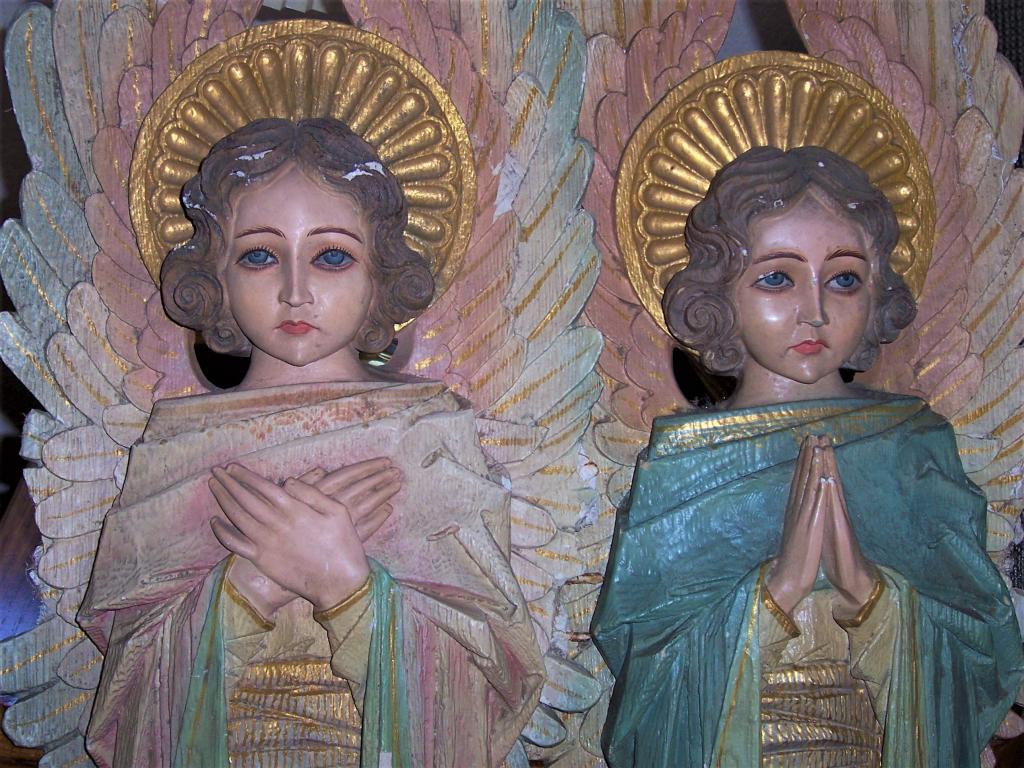
Image taken by author.
How would you react to meeting an angel who descended to earth like lightning before your very eyes?
If you were superhuman or supremely holy you might sit down and have a conversation with him or check out his “dazzling robes” as the Gospel of Luke describes them (Luke 24:4), but you would be the only person in history ever to react that casually to an angel.
From the evidence of scripture, most human beings who meet angels fall down in abject terror, or run away, or try to worship them because they are so magnificent. Angels are filled with so much…there is no other word for it…glory, that encountering them is always an overwhelming experience for sinful, flesh-bound humans.
Now imagine meeting an angel on the very day of the Resurrection itself. Talk about glory.
The ultimate witnesses
It is quite astounding that no human being witnessed the central event of human history: the Resurrection of Jesus Christ from the dead. But the angels did. They actually saw Him rising from the dead – wow.
Then, because of their unique mystical vantage point, the angels became the witnesses to the witnesses of the Resurrection, the men and women who declared the Good News of eternal life to the nations.
Since the humans didn’t see the event with their own eyes, they had to put faith in the visible proof of that event: the empty tomb. Once they saw it, they were able to believe the fact of the Resurrection and proclaim it.
All four gospels recount the moment that angels and humans met at the empty tomb, so let’s look at a few of the fascinating details of these angel-human encounters. Then we’ll try to answer the question of how each of these accounts describes a different angel appearance.
Matthew (one angel)
Only in the Gospel of Matthew do we find out that it was an angel who rolled away the stone at the entrance to Christ’s tomb. The Sanhedrin’s guards “became like dead men” when the angel performed his mighty deed! Imagine this scene:
And behold, there was a great earthquake; for an angel of the Lord descended from heaven, approached, rolled back the stone, and sat upon it. His appearance was like lightning and his clothing was white as snow. The guards were shaken with fear of him and became like dead men. (Matthew 28:2-4)
Matthew definitely wins the prize for pageantry: an earthquake, an angel descending from heaven in a bolt of lightning, brilliant robes, calmly walking over to the tomb and moving a gigantic rock like it was a pebble.
Then the ultimate cool: he sat on the rock he had just moved! A total boss of an angel. But all in a day’s work for him. If the guards were “shaken with fear”, they had good reason to be.
From his perch on the rock next to the entryway, the angel provides confirmation of the history-shattering event that took place there shortly before. Gesturing toward the open door, he instructs the women to look into the empty tomb and then go make their joyful announcement to the Apostles.
He caps off his mission with this formality: “Behold, I have told you.” In other words, “I did my job, here, ladies. Now you do yours.” Angels don’t beat around the bush.
Mark (one angel) and Luke (two angels)
Mark’s Gospel also features a single angel, and this one, too, faithfully carries out his task of announcing the great event and telling the women to bring the message to the disciples. In this case, the stone is already gone and the women meet him inside the empty tomb:
When they looked up, they saw that the stone had been rolled back; it was very large. On entering the tomb they saw a young man sitting on the right side, clothed in a white robe, and they were utterly amazed. (Mark 16:4-5)
Two angels appear in Luke. Here, the stone is gone, the women view the empty tomb, and only then do they meet the angels, who appeared as if out of thin air:
[The women] found the stone rolled away from the tomb; but when they entered, they did not find the body of the Lord Jesus. While they were puzzling over this, behold, two men in dazzling garments appeared to them. They were terrified and bowed their faces to the ground. (Luke 24:2-5)
Luke’s angels greeted the women’s stunned reaction with my favorite line in scripture: “Why do you seek the Living One among the dead?” This is pure angelic poetry.
John (two angels)
John’s account is short, but he adds a few details not found in any other Gospel. The two angels who met the women inside the tomb positioned themselves at each end of the stone slab, as if to shine a spotlight on the two cloths that had covered His Body, the facecloth and the shroud. This added an extra level of confirmation of Christ’s Resurrection from the dead:
But Mary stayed outside the tomb weeping. And as she wept, she bent over into the tomb and saw two angels in white sitting there, one at the head and one at the feet where the body of Jesus had been. And they said to her, “Woman, why are you weeping?” (John 20:11-13)
Overcome by grief, Mary Magdalene seems not to have been afraid of the angels (or if she was, we are not told), but perhaps that was because her Lord was near. She turned from the angels and immediately encountered the Risen Jesus, who she mistook for the gardener. And we know the rest of the story.
What to make of the varying details
One angel, two angels, inside the tomb, outside the tomb, fear, amazement, words, questions, Jesus, the gardener. Which of the four accounts is the true description of the actual event?
Well, if we recognize that they are all partial accounts of a single experience, like the four gospels themselves, we can see how they form a complete picture. Eyewitnesses to accidents and other occurrences often give different descriptions of the same event, so we may be asking too much of the human reporters to converge on all the details. The same holds true for the evangelists who wrote down the stories many years later.
We could only know the literal truth of the encounters if we ourselves had been there and saw each of the marvelous details, but we will have to get all those details in heaven! The overall truth of the event rests in the harmonization of the accounts to form a single dynamic picture.
But there is another way to consider the divergent accounts: an angelic encounter can never be adequately described in human words. The experience is like being drawn into a mystical tableau or heavenly drama. Words fail. It can only “painted” like a picture according to the artist’s perception. After all, how do you describe supernatural glory?
The magnificence of the angels
What image do we get of angels through these four mystical paintings, then? Very simply, an image of unearthly magnificence.
The angels are bright shards of Christ’s glory: their words communicate the Word; their garments radiate His Light; their very beings are His Authority itself.
The angels are faithful messengers: they communicated the one thing that God wanted to make sure the humans got absolutely clear from the start: that His Son rose from the dead – as He said He would. The event that shook the world was not left to the vagaries of human interpretation or speculation.
Behold the empty tomb! In all four encounters, the women see with their own eyes a tomb that only minutes or hours before had held a dead body.
The angels are also effective evangelizers: they firmly launch the Christian evangelization of the world from that spot by sending the women to report the matter faithfully to the disciples. They even give them the precise words to say. From there, the angels assist the Church in the proclamation of the Good News of salvation, as the rest of the New Testament makes abundantly clear.
Angels along the way
All this talk of angels brings an old memory to mind. One of my schools had a religious brother for its librarian, Brother Francis. He was the nicest man you ever wanted to meet and lived with a permanent angelic smile on his face. This was all the more remarkable since I knew he grew up as an orphan in the Depression and had known his share of hardship and tombs.
Each time I would see him, his face would light up, and, of course, I couldn’t help but smile in return. Then, after I had fallen into his radiant smile trap, Brother would say, “Now there’s a man who looks like he believes in the Resurrection!”
I’m convinced the good brother was really an angel of the Resurrection in disguise (minus the dazzling robes). Or if not, he was as close as a human can get to being one. He was one of those humble but brilliant witnesses to the indomitable power of Christ’s love, and how blessed I was to have been in his orbit for a time.
But, you know, I have an actual angel witness at my side at all times. Was my guardian angel there at the Resurrection too? He must have been. They all were there. Which of the angels would have sat out that event?
So, although I cannot see his glory right now, I can call on him for assistance in being a witness to the greatest event in human history. My witness may not have the impact of Mary Magdalene’s or that of the Apostles, but I can be a witness to others in the way Brother Francis was to me: he witnessed joy, holiness, prayerfulness, utter assurance of life in Christ, an indomitable spirit, graciousness in all things.
I must paint my own mystical tableau, starting now. I’ll ask my angel’s help. I have seen the empty tomb.
Previous Post
November 26, 2020
Forgiveness is For Losers
Next Post

August 10, 2020 God as Scrooge
Browse Our Archives
Select a Category Angels Prayer Spirituality
Select a Month November 2020 August 2020
Follow Us!
TAKE THE
Religious Wisdom Quiz
What did Jesus use to feed the 5,000?
Select your answer to see how you score.
Manna from heaven Five loaves and two fish A basket of quail Grapes and figs
Related posts from Anima Mea

Life-Giving Spiritual Friendship

TRENDING AT PATHEOS Catholic

Creation, Preservation, and Teleology in Catholic Theology
As I write this, it is very early Monday morning. Like millions...

The Parable Of The Sower And The Word...
One of Christ’s most famous parables is that of the sower who...

Rejecting Doom: Christian Hope And Human Action
Christianity is a religion of hope. We are to have hope and...

Why I Choose the Eucharist Over the Sermon
Choose the Eucharist, Not the Sermon What are we supposed to get...

5 Design Elements Found in Spiritually Rooted Homes
Putting Spirituality Into Home Decor Our homes are more than our living...

Credo: A Story of God Told with the...
About 10 years ago, I began to imagine a personal "Credo" that...
view all Catholic blogs
Ad-Free & Subscriber Log-In Subscription Support
- About Us
- 2026 Calendar
- Videos
- Podcasts
- Library of World Religions
- Faith In Media Tracker
- Advertise With Us
- Write for Us
- Privacy Policy
- Terms of Service
- Do Not Sell My Data
- Contact Us
- Radiant Digital
- Manage Newsletter Subscriptions
- Unsubscribe From Notifications
- Sitemap
Copyright 2008-2026, Patheos. All rights reserved.
Subscription Support Ad-Free & Subscriber Log-In
Follow Patheos