
BuddhistCatholicContemplativeEvangelicalGeneral ChristianHinduJewishLatter-day SaintMuslimNew VisionsProgressive Christian
Beliefs
- Buddhist
- Catholic
- Contemplative
- Evangelical
- General Christian
- Hindu
- Jewish
- Latter-day Saint
- More Voices
- Muslim
- New Visions
- Pagan
- Progressive Christian
Topics
- Religion News
- Food and Religion
- Sports and Religion
- Religious Art
- Religious Music and Entertainment
- Religious Events
- History and Religion
- Style and Religion
- Politics and Religion
- Women in Religion
- Recreation Outdoors and Religion
- Business Finance and Religion
- Careers Workplace and Religion
- Education and Religion
- Family Parenting and Religion
- Health Fitness and Religion
- Home and Religion
- Relationships and Religion
- Technology and Religion
- Travel and Religion
Columnists
- Buddhist Columnists
- Business Finance and Religion Columnists
- Careers Workplace and Religion Columnists
- Catholic Columnists
- Contemplative Columnists
- Education and Religion Columnists
- Evangelists Columnists
- Family Parenting and Religion Columnists
- General Christian Columnists
- Health Fitness and Religion Columnists
- Hindu Columnists
- History and Religion Columnists
- Home and Religion Columnists
- Jewish Columnists
- More Voices Columnists
- Latter Day Columnists
- Muslim Columnists
- New Visions Columnists
- Nonreligious Columnists
- Pagan Columnists
- Politics and Religion Columnists
- Progressive Columnists
- Recreation Outdoors and Religion Columnists
- Relationships and Religion Columnists
- Religion News Columnists
- Religious Art Columnists
- Religious Events Columnists
- Religious Music and Entertainment Columnists
- Sports and Religion Columnists
- Style and Religion Columnists
- Technology and Religion Columnists
- Travel and Religion Columnists
- Women in Religion Columnists
Resource Library
- 2026 Calendar
- Library of World Religions
- The 100 Most Holy Places on Earth
- Patheos Answers
- Podcasts
- Videos
- Faith Leaders Database
- Anglican Episcopalian
- Bahai
- Baptist
- Buddhism
- Christianity
- Confucianism
- Eastern Orthodoxy
- Hinduism
- Holiness and Pentecostal
- ISKCON
- Islam
- Judaism
- Lutheran
- Methodist
- The Church of Jesus Christ of Latter-day Saints
- New Age
- Paganism
- Presbytarian and Reformed
- Protestantism
- Religion Behind the Scenes
- Roman Catholic
- Scientology
- Shia Islam
- Sikhism
- Sufism
- Sunni Islam
- Taoism
- Zen
- See all religions
Research Tools
 Ad-Free & Subscriber Log-In Subscription Support
Ad-Free & Subscriber Log-In Subscription Support
Follow Patheos 

- Trending:
- Forgiveness
- |
- Marriage
- |
- Consciousness
- |
- Death Penalty
- |
- Election
- |
- Halloween

- Home
- General Christian
- Religious Art
- Analyzing Religious Art Series Part Three: A Deeper Exploration
Analyzing Religious Art Series Part Three: A Deeper Exploration
Last updated on: August 7, 2023 at 12:25 pm by Melissa Ingoldsby
Analyzing Religious Art Series Part Three: A Deeper Exploration 2023-08-07T12:25:41-04:00 Melissa Ingoldsby
Patheos Explore the world's faith through different perspectives on religion and spirituality! Patheos has the views of the prevalent religions and spiritualities of the world.
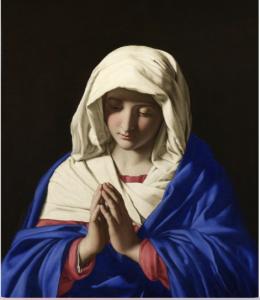
The Virgin in Prayer by Sassoferrato, 1640-1650. National Gallery, London.
Picture courtesy of Wikimedia Commons
Analyzing Religious Art Series: A Deeper Exploration
In this ongoing series for An Exhibition Of Art History, I am going to be analyzing famous works of religious art. The focus will be religious symbolism, the history of the piece, biblical history and reference and my personal interpretation of the piece. I hope you enjoy this series as it will take on a wide variety of artistic expressions and spiritual avenues. Each article will represent one piece to keep a clean and deep understanding of it’s history and message. My first article explored the famous work of Rembrandt, The Return Of the Prodigal Son.
The second article of the series focused on The Calling of Saint Matthew by Caravaggio. You may follow this link to read more.

This article will be discussing The Virgin in Prayer by Giovanni Battista Salvi da Sassoferrato.
The Virgin in Prayer: a powerful prayer in ultramarine
Giovanni Battista Salvi da Sassoferrato, created this oil on canvas (c. 1640–1650) as a result of a reformatory movement in the Roman Catholic Church, (15th-16th century) that focused on independent worship and individual devotion and dedication to prayer.
Sassoferrato is pointed by many as the master of painting The Virgin In Prayer, as his many iterations of the image have been in use in Venice, London, Strasbourg, Stockholm and Bergamo. All of these iterations have the same figure and black background with slight variations, shading, additions such as a halo and other such shadows and coloration deepened or lightened.
The original that is located in the National Gallery, London, UK, has the most intense palette of ultramarine blue, red and white, with the background an deep, rich black. The way the folds of her robe gently touch her porcelain, luminous skin look life-like and almost drenched in a sense of hyper-realism, with the shadows of the fabric drawn with precision along the lines of the angelic, bowed head, has the look of a photograph.
David Clayton from the online platform New Liturgical Movement had this to say, elucidating further on the themes of light and darkness: “This painting, like the painting of St Gregory the Great by Vignali described last week, is in the baroque style of the 17th century. Again, drawing on the themes from the Divine Office, we see the sharp contrast between light and dark, symbolizing the Light overcoming the darkness, and again like the Vignali painting, the face is in partial shadow, ensuring that this is distinct in style from a portrait (I described the reasons behind this in more detail in the earlier posting).”
As we see the sharp lines of light and darkness extenuated in a contrasting manner that almost feels shocking, the beauty of The Virgin’s deep ultramarine robe seems to sink all anxiety, fear and doubt into oblivion. One of the most expensive blues used by Renaissance painters, this hue of ultramarine is derived from the lapis lazuli stone from the mines of Afghanistan. This deep, rich blue symbolizes holiness, the Word of God and humility, Heaven and the sky.
I strongly feel that the overwhelming majority of the ultramarine used in this piece gives the impression not only of the implicit nature of The Virgin figure bowing her head in deep prayer, but of the mood of the piece itself. This piece gives off a very calming sense of love and humility, I feel. The deep, rich lapis lazuli that is enriched in The Virgin’s robes is like a deep breath of fresh air, of spiritual renewal. It is the mortality of our very nature that gives us the opportunity to keep ourselves in touch with our ego, our pride, and as such, we can find ourselves again in prayer with God.
2018 Mary in Prayer by Tyler Ballon
My impressions of the mid sixteenth century Virgin in Prayer by Sassoferrato is one of deep contemplation for the inspiration of individual prayer. I feel that the simplistic mastery of limited coloration with deep shadow in the style of Baroque truly gives a powerful insight into the spiritual, healing nature of prayer.
In another piece I had written about modern Renaissance Religious art, I had found a singular artist I was truly astounded by in part by his skillful mastery of the Renaissance chiaroscuro, and by the way he recreated famous religious art in an original way.
Tyler Ballon created Mary in Prayer in 2018, and I can’t help but feel this beautiful piece recreates the simple love, grace and devotion of independent prayer. An African-American woman is seated with an open book of scriptures, as her eyes are focused and heavy in contemplation, looking heavenward, as her hands are at her sides and open. This is meant to represent her openly receiving the Holy Spirit.
I find that the iconic and truly radiant figure of The Virgin/Mary in both iterations of modern and 16th-17th century history to be truly inspired and utterly brimming with spiritual life and love. I urge you to look to both for guidance in your own spiritual spaces, and to seek comfort in that individual need for graceful devotional prayer.
General Christian
Catholic

About Melissa Ingoldsby
Melissa Ingoldsby is a 32 year old author for Resurgence Novels of her debut horror drama I am Bexley. She lives in the STL region and is avid reader of mystery, romance and horror, a cinema fan and part time writer for Vocal and has many self published books on Amazon. You can read more about the author here.
Previous Post
July 25, 2023
Analyzing Religious Art Series Part Two: A Deeper Exploration
Next Post
August 7, 2023 Analyzing Religious Art Series Part Four: A Deeper Exploration
Recent Comments
Browse Our Archives
Select a Category 2024 Paris Olympics Angels and demons Anti-heroes in media Artistic spiritualty Bojack Horseman Book of Job (Bibical scripture) Catholic Christian books Christian Films Christian Gaming for Children Christian imagery in art Christian Online Gaming Christian paintings Christianity Christmas movies David Lynch Faith and Mental Health Faith in film family Family Holiday films Fellini Roma French culture French Impressionist art French landscape Gender roles in film gender studies Good Omens Gospel messages in music Gospel music Grief Grief in media Hanukkah healing Healing in music Historical fictional horror film Horror movie soundtracks Impressionist art Jazz Lars Von Trier Life of Pi Live art installation Love Mental Health awareness mental illness modern Christian book adaptations into film Morality Mortality movie Nativity scene Nina Simone Notre-Dame Cathderal of Paris Nymphomaniac Olympics Personal faith Poetry Pop culture religious art religious art in Catholicism Religious entertainment Religious explorations Religious gender roles religious imagery in film Religious music Renaissance art sacrifice Seasonal Holidays self-image in media social commentary South Park Spiritual art Spiritual Poetry Spirituality spirituality in books Spirituality in film Surrealist film trauma Uncategorized Verses in self-image
Select a Month May 2025 February 2025 October 2024 August 2024 June 2024 May 2024 March 2024 February 2024 December 2023 November 2023 October 2023 September 2023 August 2023 July 2023 June 2023 May 2023
Follow Us!
TAKE THE
Religious Wisdom Quiz
Who was the only female judge of Israel?
Select your answer to see how you score.
Esther Ruth Hannah Deborah
Related posts from An Exhibition of Art History

Entertainment
Faith, Mystery, and the Supernatural in Lynch’s world

Entertainment
What does love have to do with it?

Entertainment
The Christmas Story Christmas and how it broke...
Entertainment
The Expression of Grief in Trembles: A Spiritual...
TRENDING AT PATHEOS Religious Art

"Les Diabolique" and Transgression
Alongside something like Arrival, Vertigo, or Charade, Les Diaboliques is a...

"The Plague Dogs" and Mortality
So, flashback to the late 70s, early 80s. Walt Disney Studios is...

With the recent and highly successful release of Christopher Nolan’s epic film,...

"L'avventura" and Human Weakness
Today's piece is going to be a little different for a few...

I first want to apologize for not posting or writing anything. I'm...

I've engaged in the multi-year project of reading through the Church Fathers,...
view all Religious Art blogs
What Are Your Thoughts?leave a comment
Ad-Free & Subscriber Log-In Subscription Support
- About Us
- 2026 Calendar
- Videos
- Podcasts
- Library of World Religions
- Faith In Media Tracker
- Advertise With Us
- Write for Us
- Privacy Policy
- Terms of Service
- Do Not Sell My Data
- Contact Us
- Radiant Digital
- Manage Newsletter Subscriptions
- Unsubscribe From Notifications
- Sitemap
Copyright 2008-2026, Patheos. All rights reserved.
Subscription Support Ad-Free & Subscriber Log-In
Follow Patheos