
BuddhistCatholicContemplativeEvangelicalGeneral ChristianHinduJewishLatter-day SaintMuslimNew VisionsProgressive Christian
Beliefs
- Buddhist
- Catholic
- Contemplative
- Evangelical
- General Christian
- Hindu
- Jewish
- Latter-day Saint
- More Voices
- Muslim
- New Visions
- Pagan
- Progressive Christian
Topics
- Religion News
- Food and Religion
- Sports and Religion
- Religious Art
- Religious Music and Entertainment
- Religious Events
- History and Religion
- Style and Religion
- Politics and Religion
- Women in Religion
- Recreation Outdoors and Religion
- Business Finance and Religion
- Careers Workplace and Religion
- Education and Religion
- Family Parenting and Religion
- Health Fitness and Religion
- Home and Religion
- Relationships and Religion
- Technology and Religion
- Travel and Religion
Columnists
- Buddhist Columnists
- Business Finance and Religion Columnists
- Careers Workplace and Religion Columnists
- Catholic Columnists
- Contemplative Columnists
- Education and Religion Columnists
- Evangelists Columnists
- Family Parenting and Religion Columnists
- General Christian Columnists
- Health Fitness and Religion Columnists
- Hindu Columnists
- History and Religion Columnists
- Home and Religion Columnists
- Jewish Columnists
- More Voices Columnists
- Latter Day Columnists
- Muslim Columnists
- New Visions Columnists
- Nonreligious Columnists
- Pagan Columnists
- Politics and Religion Columnists
- Progressive Columnists
- Recreation Outdoors and Religion Columnists
- Relationships and Religion Columnists
- Religion News Columnists
- Religious Art Columnists
- Religious Events Columnists
- Religious Music and Entertainment Columnists
- Sports and Religion Columnists
- Style and Religion Columnists
- Technology and Religion Columnists
- Travel and Religion Columnists
- Women in Religion Columnists
Resource Library
- 2026 Calendar
- Library of World Religions
- The 100 Most Holy Places on Earth
- Patheos Answers
- Podcasts
- Videos
- Faith Leaders Database
- Anglican Episcopalian
- Bahai
- Baptist
- Buddhism
- Christianity
- Confucianism
- Eastern Orthodoxy
- Hinduism
- Holiness and Pentecostal
- ISKCON
- Islam
- Judaism
- Lutheran
- Methodist
- The Church of Jesus Christ of Latter-day Saints
- New Age
- Paganism
- Presbytarian and Reformed
- Protestantism
- Religion Behind the Scenes
- Roman Catholic
- Scientology
- Shia Islam
- Sikhism
- Sufism
- Sunni Islam
- Taoism
- Zen
- See all religions
Research Tools
 Ad-Free & Subscriber Log-In Subscription Support
Ad-Free & Subscriber Log-In Subscription Support
Follow Patheos 

- Trending:
- Forgiveness
- |
- Marriage
- |
- Consciousness
- |
- Death Penalty
- |
- Election
- |
- Halloween

- Home
- General Christian
- Religious Art
- Analyzing Religious Art Series Part Two: A Deeper Exploration
Analyzing Religious Art Series Part Two: A Deeper Exploration
Last updated on: July 25, 2023 at 1:00 pm by Melissa Ingoldsby
Analyzing Religious Art Series Part Two: A Deeper Exploration 2023-07-25T13:00:16-04:00 Melissa Ingoldsby
Patheos Explore the world's faith through different perspectives on religion and spirituality! Patheos has the views of the prevalent religions and spiritualities of the world.
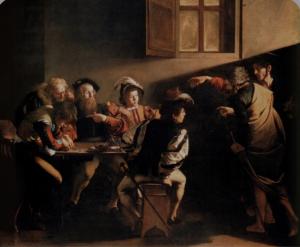
Caravaggio, Michelangelo Merisi da – The Calling of Saint Matthew – 1599-1600 (hi res).jpg
Picture courtesy of Wikimedia Commons
Analyzing Religious Art Series: A Deeper Exploration
In this series for An Exhibition Of Art History, I am going to be analyzing famous works of religious art. The focus will be religious symbolism, the history of the piece, biblical history and reference and my personal interpretation of the piece. I hope you enjoy this series as it will take on a wide variety of artistic expressions and spiritual avenues. Each article will represent one piece to keep a clean and deep understanding of it’s history and message. My first article explored the famous work of Rembrandt, The Return Of the Prodigal Son.
This article will represent The Calling of Saint Matthew by Caravaggio. The painting follows the Gospel of Matthew (Matthew 9:9): “Jesus saw a man named Matthew at his seat in the custom house, and said to him, “Follow me”, and Matthew rose and followed Him.”

The Calling of Saint Matthew: (Caravaggio) A Church Commission 10 Years in the making
Ten years before the completion of Caravaggio’s Matthew in 1600, Cardinal Matthieu Cointerel (in Italian, Matteo Contarelli) set into motion the exact specifications for the commission in his will(along with the funds). The impending commissions would be placed in The Church of St. Louis of the French, Rome. Cardinal Matthieu Cointerel had a unique vision to create themes related to his namesake, Saint Matthew.
With frescoes by the late Mannerist artist Giuseppe Cesari, covering the dome of the chapel, the establishment of a knowledgeable and familiar artistic flair was called upon. Cesari, Caravaggio’s former employer, was however was caught up in the royal and papal patronage and was unable to accomplish this commission.
Cardinal Francesco Del Monte, Caravaggio’s patron and also the prefect of the Fabbrica of St Peter’s (the Vatican office for Church property), took it upon himself to obtain Caravaggio for the first major church commission.
The deeply biblical history behind a intriguing cast of characters
The spiritual awakening represented as a beam of light that Caravaggio cast upon the two figures(Jesus Christ and Saint Peter) entering the custom house draws a mirroring effect to the man Jesus is pointing to, whom is represented as Matthew, the tax collector. This beam of light can be used as a way to have our main characters be obviously directed by the eye, and can also be used as a symbolic and religious divination of how we are to view them. Matthew is seated with four other men, whom we do not know their identity.
The Bible verses that inspired the painting are as follows: (MATTHEW 9)
9 Passing along, Jesus saw a man at his work collecting taxes. His name was Matthew. Jesus said, “Come along with me.” Matthew stood up and followed him.
10-11 Later when Jesus was eating supper at Matthew’s house with his close followers, a lot of disreputable characters came and joined them. When the Pharisees saw him keeping this kind of company, they had a fit, and lit into Jesus’ followers. “What kind of example is this from your Teacher, acting cozy with crooks and misfits?”
12-13 Jesus, overhearing, shot back, “Who needs a doctor: the healthy or the sick? Go figure out what this Scripture means: ‘I’m after mercy, not religion.’ I’m here to invite outsiders, not coddle insiders.”
Identity of Matthew: interpretations that create everlasting lessons
The lesson behind Matthew 9 seems to beg the question of how Jesus saw the common man and his faults, as well as the company Jesus often kept. He sought out disreputable characters and people who were outsiders, the lepers of society that many judged and distanced themselves from. The extent of Jesus Christ’s deeply spiritual light can shine upon the dregs of society as a forgiving and hospitable beam, whereas anyone who casts unfair judgment would be given teachings on mercy and forgiveness. I find this lesson to be truly inspired and humanistic, as we are all fallible and want and need forgiveness. Through the ever lasting grace and love of Jesus Christ, one can find atonement and forgiveness for our sins with God.
In the placement of Matthew, there are two interpretations of which man seated actually is Saint Matthew. The bearded man who’s face is visible and has the surprised expression is designated as Saint Matthew by most writers. He is seemingly pointing to himself and his expression carries the declaration of, “Who, me?” when responding to Jesus’ call.
Based upon two other works in the same series(The Inspiration of Saint Matthew, and The Martyrdom of Saint Matthew), this theory of the bearded, surprised man being Saint Matthew is solidified as we see him in the other pieces firmly represented as the famous Saint.
The more modern interpretation is that the slumped over figure with an agonized expression is Saint Matthew and the bearded man is pointing at him and asking, “Him?” in regard to Jesus’ summons.
First and last impressions
Pope Francis, as a young man would visit San Luigi to view and contemplate The Calling of Saint Matthew by Caravaggio. His response to the outstretched arm of Christ and Matthew’s response was, “This is me, a sinner on whom the Lord has turned his gaze.”[6]
When I have first looked upon Caravaggio’s masterful and deeply human version of the biblical story, I felt it was a divine intervention of Jesus Christ and Saint Peter stepping into a very commonplace scene: a tax collector and his constituents going over everyday business. This contrast of the divine against the backdrop of the common (with coins and money being counted by tax-collectors)creates a hallowed scene, as the bare-footed figures of Jesus Christ and Saint Peter give the floor and the surroundings a haven-like serenity. Their arrival signifies a new spiritual awakening.
I personally find the slumped-over figure with an agonized and forlorn expression to be the best representation of Matthew 9. This man, to me, is truly in need of religious and spiritual advice. The luminous, bearded man pointing over to the dejected figure, asking, “Him?” can only deepen the story. The man shrouded in darkness is hearkened upon by not only Jesus and Saint Matthew, but the people surrounding him, to gather the strength and fortitude necessary to listen to Jesus’ everlasting message of salvation and forgiveness. This represents how truly merciful and loving Jesus is, along with his message.
Overall, I feel Caravaggio created a timeless piece that expresses the biblical history and the impact it has made for the church. This painting truly embodies the echoes of Matthew 9 and the message of grace, forgiveness, atonement and spirituality.
General Christian
Catholic

About Melissa Ingoldsby
Melissa Ingoldsby is a 32 year old author for Resurgence Novels of her debut horror drama I am Bexley. She lives in the STL region and is avid reader of mystery, romance and horror, a cinema fan and part time writer for Vocal and has many self published books on Amazon. You can read more about the author here.
Previous Post
July 17, 2023
Rembrandt’s Prodigal Son: A Masterpiece of Mercy
Next Post
August 1, 2023 Analyzing Religious Art Series Part Three: A Deeper Exploration
Recent Comments
Browse Our Archives
Select a Category 2024 Paris Olympics Angels and demons Anti-heroes in media Artistic spiritualty Bojack Horseman Book of Job (Bibical scripture) Catholic Christian books Christian Films Christian Gaming for Children Christian imagery in art Christian Online Gaming Christian paintings Christianity Christmas movies David Lynch Faith and Mental Health Faith in film family Family Holiday films Fellini Roma French culture French Impressionist art French landscape Gender roles in film gender studies Good Omens Gospel messages in music Gospel music Grief Grief in media Hanukkah healing Healing in music Historical fictional horror film Horror movie soundtracks Impressionist art Jazz Lars Von Trier Life of Pi Live art installation Love Mental Health awareness mental illness modern Christian book adaptations into film Morality Mortality movie Nativity scene Nina Simone Notre-Dame Cathderal of Paris Nymphomaniac Olympics Personal faith Poetry Pop culture religious art religious art in Catholicism Religious entertainment Religious explorations Religious gender roles religious imagery in film Religious music Renaissance art sacrifice Seasonal Holidays self-image in media social commentary South Park Spiritual art Spiritual Poetry Spirituality spirituality in books Spirituality in film Surrealist film trauma Uncategorized Verses in self-image
Select a Month May 2025 February 2025 October 2024 August 2024 June 2024 May 2024 March 2024 February 2024 December 2023 November 2023 October 2023 September 2023 August 2023 July 2023 June 2023 May 2023
Follow Us!
TAKE THE
Religious Wisdom Quiz
Which of Job’s friends said, "Consider now: Who, being innocent, has ever perished?"
Select your answer to see how you score.
Zophar Elihu Bildad Eliphaz
Related posts from An Exhibition of Art History

Entertainment
Faith, Mystery, and the Supernatural in Lynch’s world

Entertainment
What does love have to do with it?
Entertainment
Anti-heroes in Media: a strong case for morality

Entertainment
The Christmas Story Christmas and how it broke...
TRENDING AT PATHEOS Religious Art

"Les Diabolique" and Transgression
Alongside something like Arrival, Vertigo, or Charade, Les Diaboliques is a...

"The Plague Dogs" and Mortality
So, flashback to the late 70s, early 80s. Walt Disney Studios is...

With the recent and highly successful release of Christopher Nolan’s epic film,...

"L'avventura" and Human Weakness
Today's piece is going to be a little different for a few...

I first want to apologize for not posting or writing anything. I'm...

I've engaged in the multi-year project of reading through the Church Fathers,...
view all Religious Art blogs
What Are Your Thoughts?leave a comment
Ad-Free & Subscriber Log-In Subscription Support
- About Us
- 2026 Calendar
- Videos
- Podcasts
- Library of World Religions
- Faith In Media Tracker
- Advertise With Us
- Write for Us
- Privacy Policy
- Terms of Service
- Do Not Sell My Data
- Contact Us
- Radiant Digital
- Manage Newsletter Subscriptions
- Unsubscribe From Notifications
- Sitemap
Copyright 2008-2026, Patheos. All rights reserved.
Subscription Support Ad-Free & Subscriber Log-In
Follow Patheos