
BuddhistCatholicContemplativeEvangelicalGeneral ChristianHinduJewishLatter-day SaintMuslimNew VisionsProgressive Christian
Beliefs
- Buddhist
- Catholic
- Contemplative
- Evangelical
- General Christian
- Hindu
- Jewish
- Latter-day Saint
- More Voices
- Muslim
- New Visions
- Pagan
- Progressive Christian
Topics
- Religion News
- Food and Religion
- Sports and Religion
- Religious Art
- Religious Music and Entertainment
- Religious Events
- History and Religion
- Style and Religion
- Politics and Religion
- Women in Religion
- Recreation Outdoors and Religion
- Business Finance and Religion
- Careers Workplace and Religion
- Education and Religion
- Family Parenting and Religion
- Health Fitness and Religion
- Home and Religion
- Relationships and Religion
- Technology and Religion
- Travel and Religion
Columnists
- Buddhist Columnists
- Business Finance and Religion Columnists
- Careers Workplace and Religion Columnists
- Catholic Columnists
- Contemplative Columnists
- Education and Religion Columnists
- Evangelists Columnists
- Family Parenting and Religion Columnists
- General Christian Columnists
- Health Fitness and Religion Columnists
- Hindu Columnists
- History and Religion Columnists
- Home and Religion Columnists
- Jewish Columnists
- More Voices Columnists
- Latter Day Columnists
- Muslim Columnists
- New Visions Columnists
- Nonreligious Columnists
- Pagan Columnists
- Politics and Religion Columnists
- Progressive Columnists
- Recreation Outdoors and Religion Columnists
- Relationships and Religion Columnists
- Religion News Columnists
- Religious Art Columnists
- Religious Events Columnists
- Religious Music and Entertainment Columnists
- Sports and Religion Columnists
- Style and Religion Columnists
- Technology and Religion Columnists
- Travel and Religion Columnists
- Women in Religion Columnists
Resource Library
- 2026 Calendar
- Library of World Religions
- The 100 Most Holy Places on Earth
- Patheos Answers
- Podcasts
- Videos
- Faith Leaders Database
- Anglican Episcopalian
- Bahai
- Baptist
- Buddhism
- Christianity
- Confucianism
- Eastern Orthodoxy
- Hinduism
- Holiness and Pentecostal
- ISKCON
- Islam
- Judaism
- Lutheran
- Methodist
- The Church of Jesus Christ of Latter-day Saints
- New Age
- Paganism
- Presbytarian and Reformed
- Protestantism
- Religion Behind the Scenes
- Roman Catholic
- Scientology
- Shia Islam
- Sikhism
- Sufism
- Sunni Islam
- Taoism
- Zen
- See all religions
Research Tools
 Ad-Free & Subscriber Log-In Subscription Support
Ad-Free & Subscriber Log-In Subscription Support
Follow Patheos 

- Trending:
- Forgiveness
- |
- Marriage
- |
- Consciousness
- |
- Death Penalty
- |
- Election
- |
- Halloween

- Home
- New Visions
- Religious Art
- Can Pop Culture Revive Religious Renaissance Expression Part One
Can Pop Culture Revive Religious Renaissance Expression Part One
Last updated on: May 29, 2023 at 3:44 pm by Melissa Ingoldsby
Can Pop Culture Revive Religious Renaissance Expression Part One 2023-05-29T15:44:19-04:00 Melissa Ingoldsby
Patheos Explore the world's faith through different perspectives on religion and spirituality! Patheos has the views of the prevalent religions and spiritualities of the world.

Annunciation Painting by Andrea del Verrocchio and Leonardo da Vinci Picture courtesy of Picryl
Patricia & Phillip Frost Art Museum host a exhibition with social commentary on art history and modern art
In a daring 2013 exhibition titled Concealed Spaces, Jose Manuel Ballester, a Spanish artist, recreates digital prints of many famous Renaissance pieces but with one key difference. This difference is extremely easy to spot: there are no people in it.
No cherubic visions, not a single dancing, praying or sitting religious or mythological figure in light or shadow. The bare bones of the original setting in chilling detail laid bare for our unwilling gaze to view. It’s unsettling to me in so many aspects as seems antithetical to the definition of the Renaissance period which celebrated humanism and the recreating of the human form in its accuracy and celebrating it’s beauty.
Plagues and pandemics throughout art history
Alexandra McDermott Brown in her piece for Ensemble had concisely made a eerie and concise connection to Ballester’s pieces as being roughly akin to the 2020 COVID pandemic. This could also be historically linked to how the Black Plague’s (1330-1352) arrival in England in 1348 helped kickstart the societal changes necessary to truly support the birth of the Renaissance period in the first place.
What is this artist trying to tell us? Can a story be told in a scene without characters? Is this what ill-fortune can bring us in a new chapter of humanity where there is only God’s creation but nothing to live amongst its splendor?
“I transferred the empty spaces that I portrayed in my urban landscapes to the world of classical painting,” Ballester commented on his process in an article for ArtNet.
In all aspects of what makes pop culture a truly vibrant and visceral experience, we can see how the most important period of art history can be achieved in a way many can appreciate in a widespread manner through this digital representation.
Though the message of these intense scenes I feel have been altered, it seems as though we can still somehow connect to them inherently in a way that can reach a large degree of people in a small amount of time via the internet. Especially during the lock-down periods of the spikes in the COVID-19 pandemic, to be able to have such an free access to new expressions of art so readily available in a safe way at home was a safe haven for art lovers and family members wanting to give their children access to new and old culture.
Two unique pieces by Da Vinci stripped of their humanity
In a ghostly version of Da Vinci’s Last Supper, Ballester is leaving us with a bare table with the food and plates still placed meticulously where Jesus and his twelve apostles had originally sat. This scene is told in the Gospel of John and it is very integral and human scene, a dramatic and emotional point of view in which Jesus announces which of his apostles will betray him.
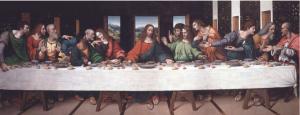
The Last Supper by Leonardo Da Vinci
Picture courtesy of Picryl
In this scene that Ballester creates in Last Supper, it is devoid of Jesus and his apostles, many questions remain. Was this piece developed to represent the aftermath of this dramatic announcement by Jesus? Is it to show how the table looked once the last apostle left the room and the supper was concluded? Is it before they arrived and the food was placed on the table by one of his apostles in preparation for the supper?
Perhaps it is meant to strip away the religious stories and create a new story, a story we have lived and are all living now. The echoes and hallowed out cries of our solitary existence that our own pandemic has grieved upon us.
This is a mystery as the artist does not go on social media and in general has a limited online digital imprint.
In Annunciation, also by Leonardo Da Vinci, the scene is again bare bones and the angel and the Virgin Mary are nowhere in sight. These quite beautiful and picturesque displays evoke shadow and warmth, of a memory that could’ve been or might’ve been, and most of all, an estranged sense of something that is missing.
How early Renaissance art was distributed and displayed to the modern expression of Renaissance digital media
I find the expansion of Renaissance religious expression in a digital format to be a very smart and thoughtful way to keep this timeless period of history alive for the younger generations. As we can tell from art history, much of the early Renaissance art was commissioned by the wealthy families in Florence, mainly the Medici family.
Brunelleschi, Donatello, Fra Angelico, Botticelli, and Michelangelo were among the talent who, by the Medici family(wealthy bankers and three popes), were kept on retainer for their valuable time and mastery of shadow and light.
If a visitor, tourist or commoner of Florence had been interested to see these works of art, I am quite sure it would have been a long process of getting through channels of connections and contacts before you could see such unveilings of magnificent splendor. Even if it were as easy as simply going to the Medici Chapel, the family palace and family tomb wherein they presented many of the pieces of the artist’s works, it certainly is the golden age of technology to be able to click a link or clip and instantly be able to enrich our artistic repertoire with the widely spread digitized prints online.
Overall, I feel the impression that pop culture can relate to the masterful techniques of the early to late Renaissance period is a dutiful one and something incredibly important to art history.
I feel that the youth can be reached with these new expressions and interpretations of the timeless works of art the old masters have created. It also can lead the youth down the rabbit hole of history to get back to the original roots to discover these absolutely gorgeous masterpieces in the first place.
New Visions
General Christian

About Melissa Ingoldsby
Melissa Ingoldsby is a 32 year old author for Resurgence Novels of her debut horror drama I am Bexley. She lives in the STL region and is avid reader of mystery, romance and horror, a cinema fan and part time writer for Vocal and has many self published books on Amazon. You can read more about the author here.
Previous Post

May 23, 2023
Two Diverse Landscapes In A New Exhibit
Next Post

June 5, 2023 Can Pop Culture Revive Religious Renaissance Expression Part Two
Recent Comments
Browse Our Archives
Select a Category 2024 Paris Olympics Angels and demons Anti-heroes in media Artistic spiritualty Bojack Horseman Book of Job (Bibical scripture) Catholic Christian books Christian Films Christian Gaming for Children Christian imagery in art Christian Online Gaming Christian paintings Christianity Christmas movies David Lynch Faith and Mental Health Faith in film family Family Holiday films Fellini Roma French culture French Impressionist art French landscape Gender roles in film gender studies Good Omens Gospel messages in music Gospel music Grief Grief in media Hanukkah healing Healing in music Historical fictional horror film Horror movie soundtracks Impressionist art Jazz Lars Von Trier Life of Pi Live art installation Love Mental Health awareness mental illness modern Christian book adaptations into film Morality Mortality movie Nativity scene Nina Simone Notre-Dame Cathderal of Paris Nymphomaniac Olympics Personal faith Poetry Pop culture religious art religious art in Catholicism Religious entertainment Religious explorations Religious gender roles religious imagery in film Religious music Renaissance art sacrifice Seasonal Holidays self-image in media social commentary South Park Spiritual art Spiritual Poetry Spirituality spirituality in books Spirituality in film Surrealist film trauma Uncategorized Verses in self-image
Select a Month May 2025 February 2025 October 2024 August 2024 June 2024 May 2024 March 2024 February 2024 December 2023 November 2023 October 2023 September 2023 August 2023 July 2023 June 2023 May 2023
Follow Us!
TAKE THE
Religious Wisdom Quiz
What does 1 John say God is, and in Him is no darkness at all?
Select your answer to see how you score.
Truth Light Love Spirit
Related posts from An Exhibition of Art History
Entertainment
Can Pop Culture Revive Religious Renaissance Expression Part...
Entertainment
Pleasure, Pain, and the Edge of Emotion: Lars...

Entertainment
Faith, Mystery, and the Supernatural in Lynch’s world
Entertainment
Plagues and Panic: how art can keep us...
TRENDING AT PATHEOS Religious Art

"Les Diabolique" and Transgression
Alongside something like Arrival, Vertigo, or Charade, Les Diaboliques is a...

"The Plague Dogs" and Mortality
So, flashback to the late 70s, early 80s. Walt Disney Studios is...

With the recent and highly successful release of Christopher Nolan’s epic film,...

"L'avventura" and Human Weakness
Today's piece is going to be a little different for a few...

I first want to apologize for not posting or writing anything. I'm...

I've engaged in the multi-year project of reading through the Church Fathers,...
view all Religious Art blogs
What Are Your Thoughts?leave a comment
Ad-Free & Subscriber Log-In Subscription Support
- About Us
- 2026 Calendar
- Videos
- Podcasts
- Library of World Religions
- Faith In Media Tracker
- Advertise With Us
- Write for Us
- Privacy Policy
- Terms of Service
- Do Not Sell My Data
- Contact Us
- Radiant Digital
- Manage Newsletter Subscriptions
- Unsubscribe From Notifications
- Sitemap
Copyright 2008-2026, Patheos. All rights reserved.
Subscription Support Ad-Free & Subscriber Log-In
Follow Patheos