
BuddhistCatholicContemplativeEvangelicalGeneral ChristianHinduJewishLatter-day SaintMuslimNew VisionsProgressive Christian
Beliefs
- Buddhist
- Catholic
- Contemplative
- Evangelical
- General Christian
- Hindu
- Jewish
- Latter-day Saint
- More Voices
- Muslim
- New Visions
- Pagan
- Progressive Christian
Topics
- Religion News
- Food and Religion
- Sports and Religion
- Religious Art
- Religious Music and Entertainment
- Religious Events
- History and Religion
- Style and Religion
- Politics and Religion
- Women in Religion
- Recreation Outdoors and Religion
- Business Finance and Religion
- Careers Workplace and Religion
- Education and Religion
- Family Parenting and Religion
- Health Fitness and Religion
- Home and Religion
- Relationships and Religion
- Technology and Religion
- Travel and Religion
Columnists
- Buddhist Columnists
- Business Finance and Religion Columnists
- Careers Workplace and Religion Columnists
- Catholic Columnists
- Contemplative Columnists
- Education and Religion Columnists
- Evangelists Columnists
- Family Parenting and Religion Columnists
- General Christian Columnists
- Health Fitness and Religion Columnists
- Hindu Columnists
- History and Religion Columnists
- Home and Religion Columnists
- Jewish Columnists
- More Voices Columnists
- Latter Day Columnists
- Muslim Columnists
- New Visions Columnists
- Nonreligious Columnists
- Pagan Columnists
- Politics and Religion Columnists
- Progressive Columnists
- Recreation Outdoors and Religion Columnists
- Relationships and Religion Columnists
- Religion News Columnists
- Religious Art Columnists
- Religious Events Columnists
- Religious Music and Entertainment Columnists
- Sports and Religion Columnists
- Style and Religion Columnists
- Technology and Religion Columnists
- Travel and Religion Columnists
- Women in Religion Columnists
Resource Library
- 2026 Calendar
- Library of World Religions
- The 100 Most Holy Places on Earth
- Patheos Answers
- Podcasts
- Videos
- Faith Leaders Database
- Anglican Episcopalian
- Bahai
- Baptist
- Buddhism
- Christianity
- Confucianism
- Eastern Orthodoxy
- Hinduism
- Holiness and Pentecostal
- ISKCON
- Islam
- Judaism
- Lutheran
- Methodist
- The Church of Jesus Christ of Latter-day Saints
- New Age
- Paganism
- Presbytarian and Reformed
- Protestantism
- Religion Behind the Scenes
- Roman Catholic
- Scientology
- Shia Islam
- Sikhism
- Sufism
- Sunni Islam
- Taoism
- Zen
- See all religions
Research Tools
 Ad-Free & Subscriber Log-In Subscription Support
Ad-Free & Subscriber Log-In Subscription Support
Follow Patheos 

- Trending:
- Forgiveness
- |
- Marriage
- |
- Consciousness
- |
- Death Penalty
- |
- Election
- |
- Halloween
 Andy Gill
- Home
- Progressive Christian
- Three Ways Jesus Subversively Outsmarted the Religious Elite…
Three Ways Jesus Subversively Outsmarted the Religious Elite…
Last updated on: November 7, 2018 at 5:18 pm by Andy Gill
Three Ways Jesus Subversively Outsmarted the Religious Elite… 2018-11-07T17:18:17-05:00 Andy Gill
Patheos Explore the world's faith through different perspectives on religion and spirituality! Patheos has the views of the prevalent religions and spiritualities of the world.
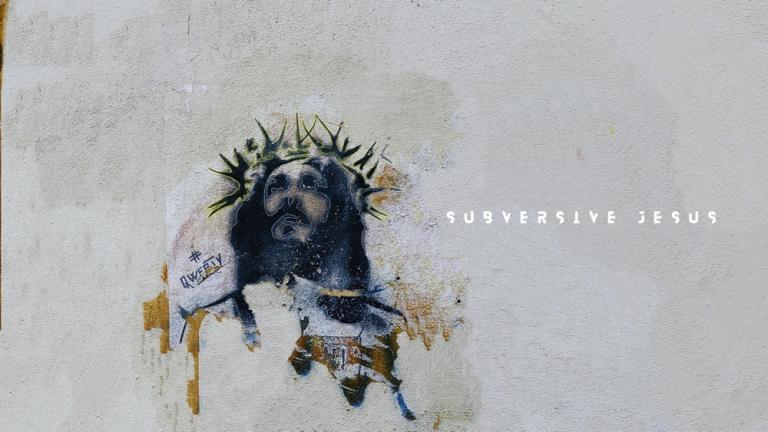 The Subversive Part of Jesus All of us Have Seemed to Miss
You have heard that it was said, An eye for an eye and a tooth for a tooth. But I say to you, Do not resist the one who is evil. But if anyone slaps you on the right cheek, turn to him the other also. And if anyone would sue you and take your tunic, let him have your cloak as well. And if anyone forces you to go one mile, go with him two miles.
– Jesus (Matthew 5:38-41)
Most pastors when preaching about this particular pericope aren’t wrong in their interpretations. Many of us, including myself, have completely missed the genius behind the words of Jesus [here, in Matthew 5:38-41].
As most of us have, at one point or another heard this used to promote the message of nonviolence. I love this. And, I agree in that, there’s a definitive message here from Jesus preaching a form of “non-resistance” – what we many times miss in this is the culture nuance from all of this. When we hear “do not resist” we interpret this to me one should be passively inactive. I wrote more on this here, in my post on “Pseudo-Pacificism“.
In my own opinion, the words “passive” or “inactive” were anything but what I’d describe being within the nature and character of Jesus. The word I’m using here today is “subversive.”
It was Jesus’ subversive genius that allowed Him to change and take hold of His narrative.
Within our modern day American world, we are taught to interpret much of it through a lens of power. Historically, we’re lead to believe their paradigms were also fueled, focussed, and centered on power. But, for Jesus, you see, it wasn’t about power so much as it was about humanity.
Here’s the thing: Jesus was never about power; He was about liberation. But, in order to liberate people [rich or poor] he had to, many times, subvert their structures.
In order for constructs to work, one must buy into them. To put it another way: in order for the rules of a game to matter, one must, typically, participate in whatever game those rules are attributed to.
There’s a lot to learn from this considering not so much has changed over the years [err, millenia] – which is why I wanted to hone in on and highlight three ways Jesus was unknowingly subversive in this particular pericope:
One.
“But if anyone slaps you on the right cheek, turn to him the other also.”
Considering that first century culture was just as hierarchal as our 21st-century culture, it begs us to question human nature and, seemingly, our insatiable thirst for power. But, although expressions of power shift a couple thousand years later a slap to the face is still more insulting than a punch. During the first century, it’s said that there were two primary ways to hit a person: (1) a punch with a closed right fist, and (2) a slap with the back of the right hand. During that time, again, similar to today, punches were reserved for equals while slaps were reserved for those who one deemed as “lower” or “less than”.
All of this begs the question: Why was Jesus so specific about which cheek someone struck you on. Because, if someone hit you on the right cheek then they were backhandedly slapping you with their right hand – i.e. they were deeming you a lesser being. So, was Jesus knowingly saying this so that by turning the other cheek we are forcing our oppressors to treat us as equal?
“Matthew Luz et. al have highlighted that “the slap on the right cheek is not what would ordinarily happen; since one either must be left-handed or hit with the back of the hand…”
Two.
“And if anyone would sue you and take your tunic, let him have your cloak as well.”
As many of us have seen in paintings of Jesus, you generally wore two garments: a tunic and a cloak. So when Jesus says “if anyone would sue you and take your tunic, let him have your cloak as well…” He’s oddly telling one to get naked. He’s saying this because during this time being naked wasn’t as shameful as the one viewing your nakedness. Shame, Jesus knew, similar to today, is a very powerful tool. It’s an emotion that people will avoid at all costs. Forcing someone to be naked and then seeing them nude would allow room for thought; it would subversively force their hand to then hopefully reconsider whether or not the cost of shame is worth this minute temporal feeling of “empowerment”.
Three.
“And if anyone forces you to go one mile, go with him two miles.”
This is a subtle nod to first-century Roman law. At that time, remembering this is well before cars or trains, a soldier could order any given civilian to carry his pack, but there was a limit, one mile. Although, there were donkeys and mules used to carry their equipment – possible conjecture here, but, it’s possible that being ordered to [by law] to carry a soldiers pack was a form of degradation – so when Jesus says, “And if anyone forces you to go one mile, go with him two miles.” You’d then have the playing fields evening out when the soldier is then begging you to give his belongings back in order that he does not break the law of “one mile”… it’s a paradigm shift.
You notice here that Jesus was never encouraging violence. In fact, he exhorts his followers to “not resist.”
He knew people spend their lives chasing after wind instead of just sitting back and enjoying the breeze.
He knew that there are people who didn’t feel joy from winning or, from seeing other people win; they found joy from seeing other people lose.
We fast forward through the red letters, zooming in while not losing sight of the bigger picture, and we see Jesus saying a few chapters later: 18 For John came neither eating nor drinking, and they say, ‘He has a demon.’19 The Son of Man came eating and drinking, and they say, ‘Here is a glutton and a drunkard, a friend of tax collectors and sinners.’ But wisdom is proved right by her deeds.” (Matthew 11:18-19)
Be wise and understand that there is no joy found in vengeance.
There is no life found in violence. Maybe this is why He also said: “that the thief comes to kill, steal, and destroy but, I have come to give you life…”
Maybe He wasn’t being so literal when saying to the zealots that if you “live by the sword then, you’ll die by the sword.”
What we all love so much about Jesus is that he wasn’t trying to “Lord” himself over anyone – He had the power to but, yet, He chose not to. These men may have felt like He was but, Christ was simply not participating in their games.
Do you want power or, do you want to experience the Kingdom?
Is it not wise to simply pay no attention while the men in power eat their cake while chasing after the wind? Or, should we allow ourselves to be consumed with anger because we’ve given them the permission to determine our worth?
[If you enjoyed this read head over and like my Facebook page ]
[1]Luz, Matthew, 1.272; so also Osborne, Matthew, 19. 49 M. Gilbert, ‚La Loi du talion‛, 73-82. 50 M. Dumais, Le Sermon sur la Montagne, 212.
Previous Post

November 5, 2018
Hypothetically Speaking: If Jesus Was a Republican…
Next Post

November 15, 2018 The Future of the Institutionalized Church (In Six Simple Photos)
Browse Our Archives
Select a Category Book Reviews Books Buzzfeed Christian Church Church Culture Dating Dechurched eXvangelical Guest Post Humor Inspirational Justice LGBTQ Life Marriage Media Millennials Mini Post Monday Money Podcast Politics Race Reason Relationships Science Sex Socioeconomic Theology Theology Uncategorized Video Wednesday Youth Ministry
Select a Month June 2020 March 2020 April 2019 March 2019 February 2019 January 2019 December 2018 November 2018 October 2018 September 2018 August 2018 July 2018 June 2018 May 2018 April 2018 March 2018 February 2018 January 2018 December 2017 November 2017 October 2017 September 2017 August 2017 July 2017 June 2017 May 2017 April 2017 March 2017 February 2017 December 2016 November 2016 October 2016 September 2016 August 2016 July 2016 June 2016 May 2016 April 2016 March 2016 February 2016 January 2016 December 2015 August 2015 July 2015 June 2015 May 2015 April 2015 March 2015 February 2015 January 2015 December 2014 November 2014 October 2014 September 2014 August 2014 July 2014 June 2014 May 2014 April 2014 February 2014 January 2014 December 2013 November 2013 October 2013 September 2013 August 2013 July 2013 June 2013 May 2013 January 2013 December 2012 August 2012 July 2012 June 2012 May 2012 April 2012 March 2012 February 2012 January 2012 December 2011 November 2011 October 2011 September 2011 August 2011 July 2011 June 2011 May 2011
Follow Us!
TAKE THE
Religious Wisdom Quiz
Buy a field while the enemy besieges the city? I did this to demonstrate that houses and fields would again be bought in this land. Where was this property?
Select your answer to see how you score.
Anathoth Jerusalem Bethlehem Shiloh
Support this
Column


Related posts from Andy Gill
Trump Pushing for $1.2 Trillion to Give Cash...

A Short Cut to Reconciling One’s Cognitive Dissonance...

The Evangelical Concept of Hell Was Actually Invented...

Jesus Promises Persecution Not Prosperity
TRENDING AT PATHEOS Progressive Christian

What Being a Modern-Day Apostle Means to Me
In my last column, I discussed the ins and outs of modern-day...

Did Ancient China Once Worship the God of...
Across human history, a common thread weaves through the origins of the...

Love Your Neighbor – Including Earth-Kin: Lev. 19,...
God’s command to love your neighbor means acting in an ethical and...

Lead a Church Study of “Jesus and Lao...
Guest writer Jack Thomas (The Irreverent Reverend) reflects on leading his church...

Pastoral Wisdom for Responding to Sermon Pushback
Getting sermon pushback on your social justice sermon? Learn practical, Proverbs-based strategies...

Principles for Understanding the Apostolic Ministry Today
Whenever people discover that my formal ministry title is "apostle," as in...
view all Progressive Christian blogs
Ad-Free & Subscriber Log-In Subscription Support
- About Us
- 2026 Calendar
- Videos
- Podcasts
- Library of World Religions
- Faith In Media Tracker
- Advertise With Us
- Write for Us
- Privacy Policy
- Terms of Service
- Do Not Sell My Data
- Contact Us
- Radiant Digital
- Manage Newsletter Subscriptions
- Unsubscribe From Notifications
- Sitemap
Copyright 2008-2026, Patheos. All rights reserved.
Subscription Support Ad-Free & Subscriber Log-In
Follow Patheos