
BuddhistCatholicContemplativeEvangelicalGeneral ChristianHinduJewishLatter-day SaintMuslimNew VisionsProgressive Christian
Beliefs
- Buddhist
- Catholic
- Contemplative
- Evangelical
- General Christian
- Hindu
- Jewish
- Latter-day Saint
- More Voices
- Muslim
- New Visions
- Pagan
- Progressive Christian
Topics
- Religion News
- Food and Religion
- Sports and Religion
- Religious Art
- Religious Music and Entertainment
- Religious Events
- History and Religion
- Style and Religion
- Politics and Religion
- Women in Religion
- Recreation Outdoors and Religion
- Business Finance and Religion
- Careers Workplace and Religion
- Education and Religion
- Family Parenting and Religion
- Health Fitness and Religion
- Home and Religion
- Relationships and Religion
- Technology and Religion
- Travel and Religion
Columnists
- Buddhist Columnists
- Business Finance and Religion Columnists
- Careers Workplace and Religion Columnists
- Catholic Columnists
- Contemplative Columnists
- Education and Religion Columnists
- Evangelists Columnists
- Family Parenting and Religion Columnists
- General Christian Columnists
- Health Fitness and Religion Columnists
- Hindu Columnists
- History and Religion Columnists
- Home and Religion Columnists
- Jewish Columnists
- More Voices Columnists
- Latter Day Columnists
- Muslim Columnists
- New Visions Columnists
- Nonreligious Columnists
- Pagan Columnists
- Politics and Religion Columnists
- Progressive Columnists
- Recreation Outdoors and Religion Columnists
- Relationships and Religion Columnists
- Religion News Columnists
- Religious Art Columnists
- Religious Events Columnists
- Religious Music and Entertainment Columnists
- Sports and Religion Columnists
- Style and Religion Columnists
- Technology and Religion Columnists
- Travel and Religion Columnists
- Women in Religion Columnists
Resource Library
- 2026 Calendar
- Library of World Religions
- The 100 Most Holy Places on Earth
- Patheos Answers
- Podcasts
- Videos
- Faith Leaders Database
- Anglican Episcopalian
- Bahai
- Baptist
- Buddhism
- Christianity
- Confucianism
- Eastern Orthodoxy
- Hinduism
- Holiness and Pentecostal
- ISKCON
- Islam
- Judaism
- Lutheran
- Methodist
- The Church of Jesus Christ of Latter-day Saints
- New Age
- Paganism
- Presbytarian and Reformed
- Protestantism
- Religion Behind the Scenes
- Roman Catholic
- Scientology
- Shia Islam
- Sikhism
- Sufism
- Sunni Islam
- Taoism
- Zen
- See all religions
Research Tools
 Ad-Free & Subscriber Log-In Subscription Support
Ad-Free & Subscriber Log-In Subscription Support
Follow Patheos 

- Trending:
- Forgiveness
- |
- Marriage
- |
- Consciousness
- |
- Death Penalty
- |
- Election
- |
- Halloween
 Andy Gill
- Home
- Progressive Christian
- Progressive is the New Evangelical
Progressive is the New Evangelical
Last updated on: September 21, 2017 at 8:57 am by Andy Gill
Progressive is the New Evangelical 2017-09-21T08:57:38-05:00 Andy Gill
Patheos Explore the world's faith through different perspectives on religion and spirituality! Patheos has the views of the prevalent religions and spiritualities of the world.
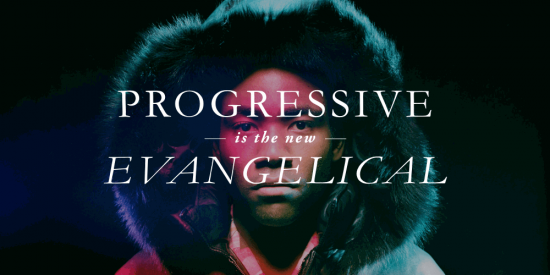
I’ve been calling myself a “progressive” but lately I’ve come to dislike being referred to as a progressive just as much as I dislike being referred to as an evangelical [1]. It’s weird to think that there was a point in time that being an evangelical was once the “progressive” thing to do. They, for their time, revolutionized how we did Church. The evangelical questioned biblical inerrancy, they preached an ecumenical means of salvation, they essentially re-contextualized the gospel in order that it becomes relevant for their audience.
But, as you know the term “Evangelical” is now one of the most infamously ambiguous religious labels. Having been unfortunately robbed by televangelists, such as Jerry Falwell, Pat Robertson, and Focus on the Families James Dobson, leveraging this label to politicize a nation. The label evangelical then became conflated and polluted by the “moral-majority” propagating an agenda, building a westernized socio-political version of “The Promised Land.” The asterisk on evangelical came with a narrow-minded, white-only, dogmatic baggage and it worked at least for that time.
Fast forward a couple decades and well, the 90’s are over, Baby Boomers are retiring, our economy has since been shifting, and the color of our nation is diversifying. As circumstances are changing, culture is dramatically shifting.
Enter progressivism.
It would seem logical to first ask what is progressivism before we locate who those are that make up this progressivism, but in light of being intellectually duplicitous, I see it as more productive by locating and only then, by defining.
I say this because progressivism is more of a group of people than it is a solidified set of beliefs. Mainly because progressivism is amorphous, much like evangelicalism, refusing to be defined or rather confined by any solidified definition. The root of this word “progress” is in and of itself a word dependent on the fluidity of culture.
Where culture is progression goes ahead of.
Which is why I say that not until we recognize who will we then gain the ability to articulate the what.
Who?
Groups and communities, that did not previously, but currently make up large sects of people: LGBT, many [but of course not all] women, the stigmatized “minority” who is the soon to be the majority. These groups of people are the exiled, the nomadic, and the marginalized, but more specifically they are “the progressives,” the future if you will. The church chewed them up and spit them out, and then proceeded to walk all over us. Though there is a sense of forgiveness this is not to be mistaken by an ignorance, we’ve forgiven but we’re not returning.
People have slowly but steadily caught on to the fact that what the Church is teaching, preaching, and living is not just a sham but it’s irrelevant. I concur with John Dickerson in that, “The more that evangelicals attempt to correct course, the more they splinter their movement [2].” Socially, economically, culturally, and therefore politically there is a very different perspective in which enables the progressive to put more emphasis on a God of redemption and liberation as opposed to one of oppression (Galatians 5:1). This doctrine has become more of a means of scapegoating one’s felt guilt, all the while allowing them to feel morally superior to everyone else.
Their words have lost power, their gospel is irrelevant, and their bible is no longer credible. We’re seeing this reflected as their congregations are losing numbers, their bank accounts are dwindling, and yes mega churches are growing, but this US version of christendom is, over all, shrinking.
As a result, we’re witnessing not only a collapse in the US Church but more of a mass exodus from the US church as progressives seem to decontextualize as opposed to, as their evangelical predecessors, re-contextualize. They are ridding themselves of the gospel and Christianity as being primary de facto to their present life.
We see this reflected as “the nones” are the fastest growing religious cohort in the US. While one out of four millennials and one out of five US residents claim “no affiliation.” Simultaneously [the progressive is] rejecting a past religiosity while still acknowledging a sense of their personal spirituality.
In consequence of this, but not solely confined to this, the progressive has developed her own epistemological awareness that is disconnected from their parent’s narrow-minded theological perspective.
To be frank, there is a large sect of the US no longer blindly buying into an inane logic that is claiming an unconditionally loving God while simultaneously propagating a hatefully oppressive law.
This mass exodus is not simply threatening the stability of evangelicalism, but the very life of Christianity. Culturally this cataclysmic shift, aforementioned, is changing not just how we operate ecclesiological-ly but what we believe theologically. The evangelical re-contextualized the gospel but it seems that our nation, unlike evangelicals, are completely ridding of the gospel.
Progressivism is leaving the old behind while embracing, creating, and [re]forming the new which is to come but has yet to fully arrive. But to be clear, progressivism will inevitably replace evangelicalism, they are in no way alike but rather in every way conflicting opposites.
Is progressivism the new evangelicalism? No, rather it’s the final stop for Christianity. The church’s future in the US is already seen in England.
[If you enjoyed this post head over and check out my Facebook Page to follow along with other and future posts]
[2] The Decline of Evangelical America
Progressive is the New Evangelical
Previous Post

September 15, 2017
Gay and Progressive at Liberty University

Browse Our Archives
Select a Category Book Reviews Books Buzzfeed Christian Church Church Culture Dating Dechurched eXvangelical Guest Post Humor Inspirational Justice LGBTQ Life Marriage Media Millennials Mini Post Monday Money Podcast Politics Race Reason Relationships Science Sex Socioeconomic Theology Theology Uncategorized Video Wednesday Youth Ministry
Select a Month June 2020 March 2020 April 2019 March 2019 February 2019 January 2019 December 2018 November 2018 October 2018 September 2018 August 2018 July 2018 June 2018 May 2018 April 2018 March 2018 February 2018 January 2018 December 2017 November 2017 October 2017 September 2017 August 2017 July 2017 June 2017 May 2017 April 2017 March 2017 February 2017 December 2016 November 2016 October 2016 September 2016 August 2016 July 2016 June 2016 May 2016 April 2016 March 2016 February 2016 January 2016 December 2015 August 2015 July 2015 June 2015 May 2015 April 2015 March 2015 February 2015 January 2015 December 2014 November 2014 October 2014 September 2014 August 2014 July 2014 June 2014 May 2014 April 2014 February 2014 January 2014 December 2013 November 2013 October 2013 September 2013 August 2013 July 2013 June 2013 May 2013 January 2013 December 2012 August 2012 July 2012 June 2012 May 2012 April 2012 March 2012 February 2012 January 2012 December 2011 November 2011 October 2011 September 2011 August 2011 July 2011 June 2011 May 2011
Follow Us!
TAKE THE
Religious Wisdom Quiz
Which Christian group is known for not celebrating holidays or birthdays?
Select your answer to see how you score.
Episcopalians Methodists Orthodox Jehovah's Witnesses
Support this
Column


Related posts from Andy Gill
Trump Pushing for $1.2 Trillion to Give Cash...

A Short Cut to Reconciling One’s Cognitive Dissonance...

The Evangelical Concept of Hell Was Actually Invented...
Jesus Promises Persecution Not Prosperity
TRENDING AT PATHEOS Progressive Christian

What Being a Modern-Day Apostle Means to Me
In my last column, I discussed the ins and outs of modern-day...

Did Ancient China Once Worship the God of...
Across human history, a common thread weaves through the origins of the...

Love Your Neighbor – Including Earth-Kin: Lev. 19,...
God’s command to love your neighbor means acting in an ethical and...

Lead a Church Study of “Jesus and Lao...
Guest writer Jack Thomas (The Irreverent Reverend) reflects on leading his church...

Pastoral Wisdom for Responding to Sermon Pushback
Getting sermon pushback on your social justice sermon? Learn practical, Proverbs-based strategies...

Principles for Understanding the Apostolic Ministry Today
Whenever people discover that my formal ministry title is "apostle," as in...
view all Progressive Christian blogs
Ad-Free & Subscriber Log-In Subscription Support
- About Us
- 2026 Calendar
- Videos
- Podcasts
- Library of World Religions
- Faith In Media Tracker
- Advertise With Us
- Write for Us
- Privacy Policy
- Terms of Service
- Do Not Sell My Data
- Contact Us
- Radiant Digital
- Manage Newsletter Subscriptions
- Unsubscribe From Notifications
- Sitemap
Copyright 2008-2026, Patheos. All rights reserved.
Subscription Support Ad-Free & Subscriber Log-In
Follow Patheos