
BuddhistCatholicContemplativeEvangelicalGeneral ChristianHinduJewishLatter-day SaintMuslimNew VisionsProgressive Christian
Beliefs
- Buddhist
- Catholic
- Contemplative
- Evangelical
- General Christian
- Hindu
- Jewish
- Latter-day Saint
- More Voices
- Muslim
- New Visions
- Pagan
- Progressive Christian
Topics
- Religion News
- Food and Religion
- Sports and Religion
- Religious Art
- Religious Music and Entertainment
- Religious Events
- History and Religion
- Style and Religion
- Politics and Religion
- Women in Religion
- Recreation Outdoors and Religion
- Business Finance and Religion
- Careers Workplace and Religion
- Education and Religion
- Family Parenting and Religion
- Health Fitness and Religion
- Home and Religion
- Relationships and Religion
- Technology and Religion
- Travel and Religion
Columnists
- Buddhist Columnists
- Business Finance and Religion Columnists
- Careers Workplace and Religion Columnists
- Catholic Columnists
- Contemplative Columnists
- Education and Religion Columnists
- Evangelists Columnists
- Family Parenting and Religion Columnists
- General Christian Columnists
- Health Fitness and Religion Columnists
- Hindu Columnists
- History and Religion Columnists
- Home and Religion Columnists
- Jewish Columnists
- More Voices Columnists
- Latter Day Columnists
- Muslim Columnists
- New Visions Columnists
- Nonreligious Columnists
- Pagan Columnists
- Politics and Religion Columnists
- Progressive Columnists
- Recreation Outdoors and Religion Columnists
- Relationships and Religion Columnists
- Religion News Columnists
- Religious Art Columnists
- Religious Events Columnists
- Religious Music and Entertainment Columnists
- Sports and Religion Columnists
- Style and Religion Columnists
- Technology and Religion Columnists
- Travel and Religion Columnists
- Women in Religion Columnists
Resource Library
- 2026 Calendar
- Library of World Religions
- The 100 Most Holy Places on Earth
- Patheos Answers
- Podcasts
- Videos
- Faith Leaders Database
- Anglican Episcopalian
- Bahai
- Baptist
- Buddhism
- Christianity
- Confucianism
- Eastern Orthodoxy
- Hinduism
- Holiness and Pentecostal
- ISKCON
- Islam
- Judaism
- Lutheran
- Methodist
- The Church of Jesus Christ of Latter-day Saints
- New Age
- Paganism
- Presbytarian and Reformed
- Protestantism
- Religion Behind the Scenes
- Roman Catholic
- Scientology
- Shia Islam
- Sikhism
- Sufism
- Sunni Islam
- Taoism
- Zen
- See all religions
Research Tools
 Ad-Free & Subscriber Log-In Subscription Support
Follow Patheos 

- Trending:
- Advent
- |
- Forgiveness
- |
- Thanksgiving
- |
- Election
- |
- Seasonal Holidays
- |
- Marriage
 Andy Gill
- Home
- Progressive Christian
- 6 “HERETICS” WHO SHOULD BE BANNED FROM EVANGELICALISM (OR, A LESSON IN CONSISTENCY)
6 “HERETICS” WHO SHOULD BE BANNED FROM EVANGELICALISM (OR, A LESSON IN CONSISTENCY)
Last updated on: April 6, 2017 at 12:58 pm by Guest Contributor
6 “HERETICS” WHO SHOULD BE BANNED FROM EVANGELICALISM (OR, A LESSON IN CONSISTENCY) 2017-04-06T12:58:31-05:00 Guest Contributor
Patheos Explore the world's faith through different perspectives on religion and spirituality! Patheos has the views of the prevalent religions and spiritualities of the world.
What does it mean to be “evangelical”?
What must you believe?
What must you reject?
Can you be an evangelical Christian and believe…
…in evolution?
…that Hell is only temporary?
…that all people, even those in Hell can/will eventually be saved?
…that people from other religions can be saved without even knowing it?
…that the atonement is not about God’s wrath being poured out on Jesus in our place?
…that Scripture is errant?
I think many evangelicals would say “no” to most—maybe even all—of these. That’s why, in an attempt to protect the name of evangelicalism (or, more accurately, to keep certain ideologies in power), some of the most prominent leaders within evangelicalism have made it their responsibility to publicly denounce those with whom they disagree on issues like these.
To be clear, I have no problem with publicly denouncing ideologies (that is, after all, what I’m doing right now). I also believe it is, at times, necessary to publicly call out false teachers. However, one must fully consider whether they promote a different gospel before coming forward with such a bold claim.
But, I’m not talking about denouncing ideas or exposing real false teachers. I’m talking about needless schisms and inconsistent, prideful exclusivism.
Self-appointed gatekeepers of evangelicalism tear apart what could be a noble, diverse movement of the Spirit. In what critics have affectionately named, “excommunitweets,”these gatekeepers take it upon themselves to pronounce who is “in” and who is “out” of orthodox Christianity.
In a previous post I’ve listed a few of the people tossed out of the evangelical community for their slightly-divergent-yet-still-completely-orthodox beliefs. As a moderate evangelical, I’ve found myself on a few occasions, directly or indirectly, accused of not following Christ and even heresy.
By the standards of these gatekeepers, the definition of “evangelical” is becoming so narrow that it really doesn’t describe anyone but themselves. As I’ve said before, evangelicalism is shrinking, and pretty soon even the gatekeepers will have to bid themselves “farewell” due to their inability to meet their own standards.
That, or they will continue to reshape the definition so that it will describe exactly (and only) what they believe.
(Probably the latter.)
So, if we are going to be consistent, then I think it’s time to weed out all of the heretics—especially those who have the most influence—not just Rob Bell, Rachel Held Evans, or World Vision.
For starters, I suggest these 6:
1. C.S. Lewis: Guilty of Inclusivism and rejecting the Penal Substitutionary Atonement theory
 Perhaps the most celebrated Christian writer of the last century, C.S. Lewis is respected by most Christians, no matter what theological corner they occupy. And that’s what confuses me. Lewis was no evangelical by the standards of modern evangelical spokespersons. Lewis’ seven-volume, fictional masterpiece, The Chronicles of Narnia, reveals Lewis’ belief that it is possible for people in other religions to inherit the Kingdom of God without knowing it.1
Lewis also rejects the Penal Substitutionary theory of the atonement, which states that Christ “diverted” God’s wrath toward us and took it upon himself. Instead, in part three of Chronicles, Lewis describes what is called the “Christus Victor” view of the atonement, which holds that the cross is not an image of God’s wrath against us, diverted to his son, but it was the defeat of evil through an act of selfless love. Here is a video of Greg Boyd giving a good description of that view using Lewis’ imagery.
2. Martin Luther: Guilty of rejecting biblical inerrancy
 Where would evangelicalism be without Martin Luther? He is the father of the Reformation and the champion ofSola Scriptura.
According to one evangelical leader, inerrancy, “…is the only position that is fully compatible with the claim that every word of Scripture is fully inspired and thus fully true and trustworthy.” To the dismay of every evangelical Calvinist (including the one who made the above statement), I fear I must be the bearer of bad news that Martin Luther apparently didn’t believe the Bible is fully inspired, true, or trustworthy.
Speaking of inaccuracies in the books of Chronicles, he states,
“When one often reads that great numbers of people were slain—for example, eighty thousand—I believe that hardly one thousand were actually killed.”2
With that in mind, maybe it’s time we vote Mr. Luther off of the evangelical island.
3. St. Augustine: Guilty of rejecting a literal reading of the Creation Story
In his work, The Literal Meaning of Genesis, Augustine (to put it bluntly) thought Christians who took the Creation Story literally were a laughingstock and looked like idiots among non-Christians because they denied science and reason. This is Augustine, people…the one to whom we can give credit for the doctrines of original sin and Hell as eternal conscious torment (which are at the core of reformed theology).
 Here is his statement:
“It not infrequently happens that something about the earth…may be known with the greatest certainty by reasoning or by experience, even by one who is not a Christian. It is too disgraceful and ruinous, though, and greatly to be avoided, that he [the non-Christian] should hear a Christian speaking so idiotically on these matters, and as if in accord with Christian writings, that he might say that he could scarcely keep from laughing when he saw how totally in error they are. In view of this and in keeping it in mind constantly while dealing with the book of Genesis, I have, insofar as I was able, explained in detail and set forth for consideration the meanings of obscure passages, taking care not to affirm rashly some one meaning to the prejudice of another and perhaps better explanation” (emphasis mine).3
Few are the pulpits he would be allowed to fill among conservative churches in our day.
4. William Barclay: Guilty of Universalism
I’ve seen William Barclay’s iconic little blue commentaries on the shelves of many pastors. I find it odd, however, that Rob Bell would be utterly rejected for holding essentially the same belief as this celebrated theologian.
Barclay writes,
“I am a convinced universalist. I believe that in the end all men will be gathered into the love of God…the choice is whether we accept God’s offer and invitation willingly, or take the long and terrible way round through ages of purification.”4
In that work, Barclay also lists early church fathers, Origen and Gregory of Nyssa, as two other Christian Universalists.
5. John Stott: Guilty of Annihilationism
 John Stott is one of the great evangelical Christian thinkers of the last generation. Stott rejected the view that Hell is eternal conscious torment of the wicked and suggested, instead, that the unrepentant cease to exist after enduring the penalty for their sins.
He wrote,
“I believe that the ultimate annihilation of the wicked should at least be accepted as a legitimate, biblically founded alternative to their eternal conscious torment.”5
6. Billy Graham: Guilty of Inclusivism
Billy Graham is, perhaps, the epitome of the evangelical identity.
Or, so we thought…
Like C.S. Lewis, Graham believes that those who do not hear of Christ may, indeed, be saved without explicitly confessing him as Lord.
In a 1997 interview with Robert Schuller, Graham said,
 “I think that everybody that loves or knows Christ, whether they are conscious of it or not, they are members of the body of Christ. . . . [God] is calling people out of the world for his name, whether they come from the Muslim world, or the Buddhist world or the Christian world, or the non-believing world, they are members of the Body of Christ because they have been called by God. They may not even know the name of Jesus but they know in their hearts that they need something that they don’t have, and they turn to the only light they have, and I think that they are saved and they are going to be with us in heaven.” (This statement starts at 1:18 in this video)
#####
After we finish with these most important aspects of what it means to be evangelical, we can focus on weeding out people for less important things, such as their immorality: George Whitefield’s lobbying for slavery, Martin Luther’s hatred of Jews, John Calvin’s approval of burning heretics at the stake, etc. etc.
Now, I’m sure you, as well as I, find it ridiculous to reject these great and godly people. Which is why it’s amazing to me, the things we ignore in order to protect ourselves from the truth. We want our “heroes of the faith” to be perfect in theology and conduct, so we ignore or justify the parts we don’t like.
We all do it.
So, maybe it’s time to extend a bit more loving kindness to the evolutionists, to those who reject inerrancy, to those who take the Bible literally when it says that God will redeem all people to himself, to the Rob Bells and the World Visions.
For those of us on the moderate-progressive side: maybe we can find it in ourselves to turn the other cheek and forgive those who wish us gone. Then, when we find someone who will accept us–”heresy” and all, let’s embrace and learn from them.
For fun: Here is a list of universalistic quotes from our early church fathers.
- See the conversation between Emeth and Aslan in “The Last Battle” in The Chronicles of Narnia (New York: HarperTrophy, 1984), 204-206. ↩
- As quoted in Marcel Sarot, “Christian Fundamentalism as a Reaction to the Enlightenment as Illustrated by the Case of Biblical Inerrancy” (2011), http://www.academia.edu/4006242/Sarot_M.2011._Christian_fundamentalism_as_a_reaction_to_the_Enlightenment (Accessed April 16, 2014), 5. ↩
- http://en.wikipedia.org/wiki/Allegorical_interpretations_of_Genesis#cite_ref-17 ↩
- William Barclay: A Spiritual Autobiography, pg 65–67, William B Eerdmans Publishing Company, Grand Rapids, 1977. (Read excerpt here) ↩
- http://en.wikipedia.org/wiki/Annihilationism#cite_note-40 ↩
Guest Post By Tylor Standley who writes and blogs on issues of faith over at http://tylorstandley.wordpress.com
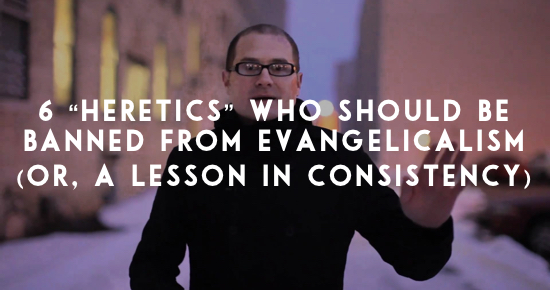
[image is a screenshot from this video]
Heretics Banned From Evangelicalism
Previous Post

May 2, 2014
Tripp and Tyler Present "Christian Tingle: A Dating Site Parody"
Next Post
May 26, 2014 On God & Sex
Browse Our Archives
Select a Category Book Reviews Books Buzzfeed Christian Church Church Culture Dating Dechurched eXvangelical Guest Post Humor Inspirational Justice LGBTQ Life Marriage Media Millennials Mini Post Monday Money Podcast Politics Race Reason Relationships Science Sex Socioeconomic Theology Theology Uncategorized Video Wednesday Youth Ministry
Select a Month June 2020 March 2020 April 2019 March 2019 February 2019 January 2019 December 2018 November 2018 October 2018 September 2018 August 2018 July 2018 June 2018 May 2018 April 2018 March 2018 February 2018 January 2018 December 2017 November 2017 October 2017 September 2017 August 2017 July 2017 June 2017 May 2017 April 2017 March 2017 February 2017 December 2016 November 2016 October 2016 September 2016 August 2016 July 2016 June 2016 May 2016 April 2016 March 2016 February 2016 January 2016 December 2015 August 2015 July 2015 June 2015 May 2015 April 2015 March 2015 February 2015 January 2015 December 2014 November 2014 October 2014 September 2014 August 2014 July 2014 June 2014 May 2014 April 2014 February 2014 January 2014 December 2013 November 2013 October 2013 September 2013 August 2013 July 2013 June 2013 May 2013 January 2013 December 2012 August 2012 July 2012 June 2012 May 2012 April 2012 March 2012 February 2012 January 2012 December 2011 November 2011 October 2011 September 2011 August 2011 July 2011 June 2011 May 2011
Follow Us!
TAKE THE
Religious Wisdom Quiz
How many people did Jesus raise from the dead?
Select your answer to see how you score.
5 3 4 2
Support this
Column


Related posts from Andy Gill

Trump Pushing for $1.2 Trillion to Give Cash...

A Short Cut to Reconciling One’s Cognitive Dissonance...

The Evangelical Concept of Hell Was Actually Invented...
Jesus Promises Persecution Not Prosperity
TRENDING AT PATHEOS Progressive Christian

The Secret behind A Charlie Brown Thanksgiving
Where Franklin Sat at Charlie Brown's Thanksgiving Table Sparky was sticking to...

Bridging the Gap Between God and Man
From Far Off to the Ultimate Embrace “God is a Spirit: and...

Let Matthew 25 Guide You to a Greater...
With the crisp feel of fall in the air, our minds quickly...

Can a Chatbot Touch Your Soul?
Can a chatbot offer genuine spiritual counsel? One conversation brought me to...

Religion and Politics: How Should We Then Live?
Two cultural axioms get repeated in polite company. Don't mix religion and...

7 Things We Get Wrong About Giving Thanks
It's a time of year when many of us turn to the...
view all Progressive Christian blogs
Ad-Free & Subscriber Log-In Subscription Support
- About Us
- 2026 Calendar
- Videos
- Podcasts
- Library of World Religions
- Faith In Media Tracker
- Advertise With Us
- Write for Us
- Privacy Policy
- Terms of Service
- Do Not Sell My Data
- Contact Us
- Radiant Digital
- Manage Newsletter Subscriptions
- Unsubscribe From Notifications
- Sitemap
Copyright 2008-2026, Patheos, part of the Radiant Digital network of media brands. All rights reserved.
Subscription Support Ad-Free & Subscriber Log-In
Follow Patheos