
BuddhistCatholicContemplativeEvangelicalGeneral ChristianHinduJewishLatter-day SaintMuslimNew VisionsProgressive Christian
Beliefs
- Buddhist
- Catholic
- Contemplative
- Evangelical
- General Christian
- Hindu
- Jewish
- Latter-day Saint
- More Voices
- Muslim
- New Visions
- Pagan
- Progressive Christian
Topics
- Religion News
- Food and Religion
- Sports and Religion
- Religious Art
- Religious Music and Entertainment
- Religious Events
- History and Religion
- Style and Religion
- Politics and Religion
- Women in Religion
- Recreation Outdoors and Religion
- Business Finance and Religion
- Careers Workplace and Religion
- Education and Religion
- Family Parenting and Religion
- Health Fitness and Religion
- Home and Religion
- Relationships and Religion
- Technology and Religion
- Travel and Religion
Columnists
- Buddhist Columnists
- Business Finance and Religion Columnists
- Careers Workplace and Religion Columnists
- Catholic Columnists
- Contemplative Columnists
- Education and Religion Columnists
- Evangelists Columnists
- Family Parenting and Religion Columnists
- General Christian Columnists
- Health Fitness and Religion Columnists
- Hindu Columnists
- History and Religion Columnists
- Home and Religion Columnists
- Jewish Columnists
- More Voices Columnists
- Latter Day Columnists
- Muslim Columnists
- New Visions Columnists
- Nonreligious Columnists
- Pagan Columnists
- Politics and Religion Columnists
- Progressive Columnists
- Recreation Outdoors and Religion Columnists
- Relationships and Religion Columnists
- Religion News Columnists
- Religious Art Columnists
- Religious Events Columnists
- Religious Music and Entertainment Columnists
- Sports and Religion Columnists
- Style and Religion Columnists
- Technology and Religion Columnists
- Travel and Religion Columnists
- Women in Religion Columnists
Resource Library
- 2026 Calendar
- Library of World Religions
- The 100 Most Holy Places on Earth
- Patheos Answers
- Podcasts
- Videos
- Faith Leaders Database
- Anglican Episcopalian
- Bahai
- Baptist
- Buddhism
- Christianity
- Confucianism
- Eastern Orthodoxy
- Hinduism
- Holiness and Pentecostal
- ISKCON
- Islam
- Judaism
- Lutheran
- Methodist
- The Church of Jesus Christ of Latter-day Saints
- New Age
- Paganism
- Presbytarian and Reformed
- Protestantism
- Religion Behind the Scenes
- Roman Catholic
- Scientology
- Shia Islam
- Sikhism
- Sufism
- Sunni Islam
- Taoism
- Zen
- See all religions
Research Tools
 Ad-Free & Subscriber Log-In Subscription Support
Ad-Free & Subscriber Log-In Subscription Support
Follow Patheos 

- Trending:
- Forgiveness
- |
- Marriage
- |
- Consciousness
- |
- Death Penalty
- |
- Election
- |
- Halloween
 Andy Gill
- Home
- Progressive Christian
- Does the Reformation Still Matter?
Does the Reformation Still Matter?
Last updated on: October 30, 2018 at 9:14 pm by Andy Gill
Does the Reformation Still Matter? 2018-10-30T21:14:52-05:00 Andy Gill
Patheos Explore the world's faith through different perspectives on religion and spirituality! Patheos has the views of the prevalent religions and spiritualities of the world.
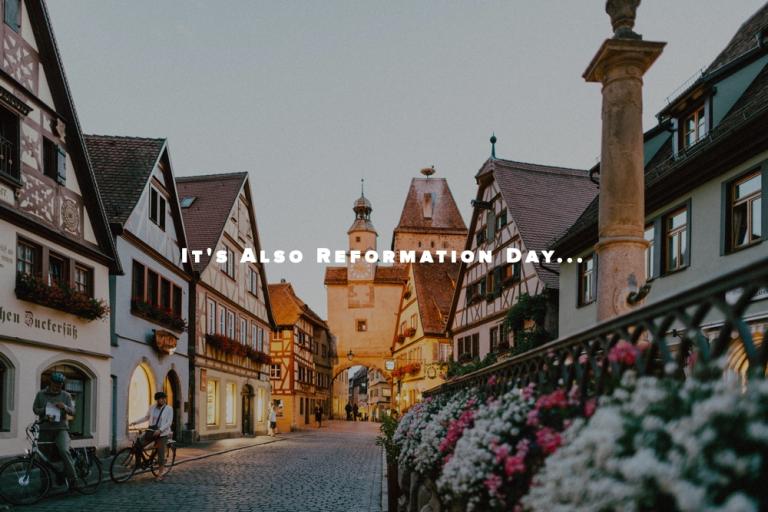
Does the Reformation Still Matter?
501 years ago today Martin Luther nailed a list of grievances to the church door in Wittenberg, a little town in the Holy Roman Empire.
Luther expected a theological debate on the finer points of discipleship and purgatory. What he got was a history rupturing revolution.
We are all today, Protestant or Catholic, beneficiaries of Luther’s legacy. But does that story still matter for us? Does the story of a German monk, a French lawyer, and an English king still have relevance to our world—to the world of globalism, capitalism, and exponentially growing technological advance?
It is interesting, I think, that the Reformation still has a magnetic attraction to many even today, halfway to a millennium after it occurred. Spontaneously, without any historians trying to drum up popular interest in their own area of specialty, Christians around the world look back to the Reformation with a sense of pride, reverence, and nearness. Many, many Christians still look back to the debates of sixteenth-century Europe and find mentors, examples, guides, and friends—and enemies. There are a quickly growing people who proudly call themselves “Calvinists” after the sixteenth-century French refugee to Switzerland. Books like The Reformation Study Bible and The Reformation Commentary on Scripture are best-sellers. There is even an Institutes of the Christian Religion reading plan if you would like to fold the Reformation classic into your daily scripture reading time. For a surprisingly large portion of American Christianity, the Reformation is still vitally important and interesting.
Why, though? Why does the Reformation still matter to so many people?
One of the primary reasons is that the theological debates of the sixteenth century marked out the goal-posts, the boundaries, and the penalty boxes for nearly all Christian debates since. When we talk about communion, we inevitably define ourselves by whether we agree with Calvin, Luther, or Catholicism. When we talk about salvation, we inevitably define ourselves by whether we agree with Arminius or the Dutch Calvinists of the 17th century. When we talk about church structure, we inevitably define ourselves as Presbyterian (following Calvin), Episcopalian (following the English Reformation), congregational (following the Anabaptists), or Catholic (following the Council of Trent). We still inhabit the world of the Reformation, and often theology today is no more than shoring up the defenses of one or another sixteenth-century position while preparing invasions on others. We are children of the Reformation, for good or ill, and we have inherited all of our parents’ property and debts. The Reformation is, for all of us, family history.
The Reformation has a deeper draw than just nostalgia.
There is something about the debates of the sixteenth-century that still captures us, that still inspires us. There is more than just familial pride behind the fact that the names John Calvin and Martin Luther are as familiar to us as George Washington and Malcolm X. Part of that reason, I think, is what the debates of the Reformation reveal about ourselves. The Reformation happened at a critical turning point in Western civilization. The sixteenth-century bridged the ancient and modern worlds; it was a time when most people still believed that fairies lived in the woods, but also when we learned that the earth is not the center of the universe. The sixteenth-century inherited the millennium and a half of Christian theology and two millennia of Western philosophy, synthesized it and organized it for the burgeoning modern world, and offered to all succeeding centuries a legacy of extreme academic rigor and diverse Christian expressions of faithfulness. In the same way that Darwin is still relevant to evolutionary science—as the pivotal figure who taught all succeeding scientists how to think, how to ask the right questions—the leaders of the Protestant and Catholic reformations are still teaching us today how to be both faithfully Christian and honestly intellectual. Sixteenth-century theology is still teaching us today how to be both modern and Christian.
Learning about the Protestant and Catholic reformations teaches us how to think about our own religious traditions and our new, sometimes terrifying, modern world. And learning about ourselves is the only way we can really learn about others. As Calvin wrote in the very beginning of the final edition of his Institutes of the Christian Religion, “Nearly all the wisdom we possess, that is to say, true and sound wisdom, consists of two parts: the knowledge of God and of ourselves. But, while joined by many bonds, which one precedes and brings forth the other is not easy to discern.” What Calvin said about ourselves and God is true also of ourselves and others. We cannot know—cannot really know—others until we know ourselves, nor can we really know ourselves until we know ourselves in relation to others. We don’t really know our spouses until we see in them the same motivations—the same loves and fears and desires—that we already recognize in ourselves, nor do we really know what lies within us until it is brought out through the constant presence of our spouses or friends. I don’t know my wife’s weaknesses and flaws until I see my own weaknesses, and therefore the reasons for those weaknesses, in her. I don’t know my own weaknesses and flaws except as they are drawn out through her love and presence. In the same way, we will never know other religious traditions until we understand ourselves and our modern world. Then, from that base of knowledge, we will begin to understand and cherish the Other.
And that, I think, is the main reason the Reformation still matters today. We learn what it means to be Reformed or Lutheran or Baptist, not just to affirm ourselves in our traditions, but to prepare us to meet other traditions honestly, fully present because we now know ourselves.
This post was written by Gerhard Stübben
Gerhard Stübben is a doctoral student at Baylor University, focusing on Calvin and the Reformation. Gerhard also co-hosts The Reformation Podcast and Podcastica Patristica. You can get some of his books for free at Patristica Press.
Does the Reformation Still Matter?
Previous Post
October 25, 2018
Our Evangelical Misconception of Grace, Mercy, and Forgiveness
Next Post

November 3, 2018 What’s So “Progressive” About Me?
Browse Our Archives
Select a Category Book Reviews Books Buzzfeed Christian Church Church Culture Dating Dechurched eXvangelical Guest Post Humor Inspirational Justice LGBTQ Life Marriage Media Millennials Mini Post Monday Money Podcast Politics Race Reason Relationships Science Sex Socioeconomic Theology Theology Uncategorized Video Wednesday Youth Ministry
Select a Month June 2020 March 2020 April 2019 March 2019 February 2019 January 2019 December 2018 November 2018 October 2018 September 2018 August 2018 July 2018 June 2018 May 2018 April 2018 March 2018 February 2018 January 2018 December 2017 November 2017 October 2017 September 2017 August 2017 July 2017 June 2017 May 2017 April 2017 March 2017 February 2017 December 2016 November 2016 October 2016 September 2016 August 2016 July 2016 June 2016 May 2016 April 2016 March 2016 February 2016 January 2016 December 2015 August 2015 July 2015 June 2015 May 2015 April 2015 March 2015 February 2015 January 2015 December 2014 November 2014 October 2014 September 2014 August 2014 July 2014 June 2014 May 2014 April 2014 February 2014 January 2014 December 2013 November 2013 October 2013 September 2013 August 2013 July 2013 June 2013 May 2013 January 2013 December 2012 August 2012 July 2012 June 2012 May 2012 April 2012 March 2012 February 2012 January 2012 December 2011 November 2011 October 2011 September 2011 August 2011 July 2011 June 2011 May 2011
Follow Us!
TAKE THE
Religious Wisdom Quiz
What is the repeated phrase at the end of Psalm 136?
Select your answer to see how you score.
Let everything praise him His love endures forever Blessed be the Lord Praise the Lord
Support this
Column


Related posts from Andy Gill
Trump Pushing for $1.2 Trillion to Give Cash...

A Short Cut to Reconciling One’s Cognitive Dissonance...
The Evangelical Concept of Hell Was Actually Invented...
Jesus Promises Persecution Not Prosperity
TRENDING AT PATHEOS Progressive Christian

What Being a Modern-Day Apostle Means to Me
In my last column, I discussed the ins and outs of modern-day...

Did Ancient China Once Worship the God of...
Across human history, a common thread weaves through the origins of the...

Love Your Neighbor – Including Earth-Kin: Lev. 19,...
God’s command to love your neighbor means acting in an ethical and...

Lead a Church Study of “Jesus and Lao...
Guest writer Jack Thomas (The Irreverent Reverend) reflects on leading his church...

Pastoral Wisdom for Responding to Sermon Pushback
Getting sermon pushback on your social justice sermon? Learn practical, Proverbs-based strategies...

Principles for Understanding the Apostolic Ministry Today
Whenever people discover that my formal ministry title is "apostle," as in...
view all Progressive Christian blogs
Ad-Free & Subscriber Log-In Subscription Support
- About Us
- 2026 Calendar
- Videos
- Podcasts
- Library of World Religions
- Faith In Media Tracker
- Advertise With Us
- Write for Us
- Privacy Policy
- Terms of Service
- Do Not Sell My Data
- Contact Us
- Radiant Digital
- Manage Newsletter Subscriptions
- Unsubscribe From Notifications
- Sitemap
Copyright 2008-2026, Patheos. All rights reserved.
Subscription Support Ad-Free & Subscriber Log-In
Follow Patheos