
BuddhistCatholicContemplativeEvangelicalGeneral ChristianHinduJewishLatter-day SaintMuslimNew VisionsProgressive Christian
Beliefs
- Buddhist
- Catholic
- Contemplative
- Evangelical
- General Christian
- Hindu
- Jewish
- Latter-day Saint
- More Voices
- Muslim
- New Visions
- Pagan
- Progressive Christian
Topics
- Religion News
- Food and Religion
- Sports and Religion
- Religious Art
- Religious Music and Entertainment
- Religious Events
- History and Religion
- Style and Religion
- Politics and Religion
- Women in Religion
- Recreation Outdoors and Religion
- Business Finance and Religion
- Careers Workplace and Religion
- Education and Religion
- Family Parenting and Religion
- Health Fitness and Religion
- Home and Religion
- Relationships and Religion
- Technology and Religion
- Travel and Religion
Columnists
- Buddhist Columnists
- Business Finance and Religion Columnists
- Careers Workplace and Religion Columnists
- Catholic Columnists
- Contemplative Columnists
- Education and Religion Columnists
- Evangelists Columnists
- Family Parenting and Religion Columnists
- General Christian Columnists
- Health Fitness and Religion Columnists
- Hindu Columnists
- History and Religion Columnists
- Home and Religion Columnists
- Jewish Columnists
- More Voices Columnists
- Latter Day Columnists
- Muslim Columnists
- New Visions Columnists
- Nonreligious Columnists
- Pagan Columnists
- Politics and Religion Columnists
- Progressive Columnists
- Recreation Outdoors and Religion Columnists
- Relationships and Religion Columnists
- Religion News Columnists
- Religious Art Columnists
- Religious Events Columnists
- Religious Music and Entertainment Columnists
- Sports and Religion Columnists
- Style and Religion Columnists
- Technology and Religion Columnists
- Travel and Religion Columnists
- Women in Religion Columnists
Resource Library
- 2026 Calendar
- Library of World Religions
- The 100 Most Holy Places on Earth
- Patheos Answers
- Podcasts
- Videos
- Faith Leaders Database
- Anglican Episcopalian
- Bahai
- Baptist
- Buddhism
- Christianity
- Confucianism
- Eastern Orthodoxy
- Hinduism
- Holiness and Pentecostal
- ISKCON
- Islam
- Judaism
- Lutheran
- Methodist
- The Church of Jesus Christ of Latter-day Saints
- New Age
- Paganism
- Presbytarian and Reformed
- Protestantism
- Religion Behind the Scenes
- Roman Catholic
- Scientology
- Shia Islam
- Sikhism
- Sufism
- Sunni Islam
- Taoism
- Zen
- See all religions
Research Tools
 Ad-Free & Subscriber Log-In Subscription Support
Ad-Free & Subscriber Log-In Subscription Support
Follow Patheos 

- Trending:
- Forgiveness
- |
- Marriage
- |
- Consciousness
- |
- Death Penalty
- |
- Election
- |
- Halloween

- Home
- Hindu
- History and Religion
- What Ancient Sanskrit Wisdom Says About Real Success
What Ancient Sanskrit Wisdom Says About Real Success
Last updated on: August 10, 2026 at 4:25 pm by Shweta Goyal
What Ancient Sanskrit Wisdom Says About Real Success 2026-08-10T16:25:17+00:00 Shweta Goyal
Patheos Explore the world's faith through different perspectives on religion and spirituality! Patheos has the views of the prevalent religions and spiritualities of the world.

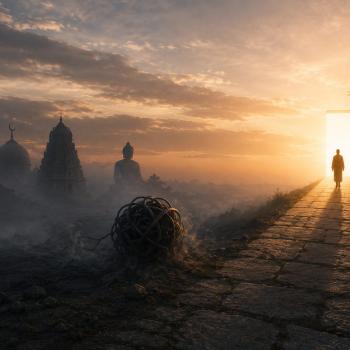
AI image generated by Author
We Have Confused Success With Decoration
Ancient Indian wisdom asks a harder question: not what you possess, but what you are becoming.
We spend an extraordinary amount of life decorating ourselves.
We decorate the body with clothes and jewelry. We decorate our names with qualifications and titles. We decorate our lives with houses, cars, careers, followers and achievements.
None of these things is necessarily wrong. But somewhere along the way, we began confusing what surrounds a person with what constitutes a person.
Ancient Indian wisdom repeatedly challenges this confusion.
One practice that brings the challenge into everyday life is mananam. The word is often translated as “reflection” or “contemplation,” but I think of it more simply: you encounter an idea, and then you refuse to leave it on the page. You turn it over in your mind until it begins questioning the way you live.
Recently, several Sanskrit verses I have been reflecting on seemed, at first, to teach completely different lessons.
One spoke about a drop of water. Another about jewelry. Another about knowledge. Another asked why we need armor, wealth or even a kingdom. And another described the conduct of a good human being.
The more I sat with them, the more I realised they were asking essentially the same question:
What actually makes a human being valuable?
The Same Drop, Three Destinies
One verse offers a beautiful image:
सन्तप्तायसि संस्थितस्य पयसो नामापि न ज्ञायते । मुक्ताऽऽकारतया तदेव नलिनीपत्रस्थितं राजते । स्वात्यां सागरशुक्तिमध्यपतितं तन्मौक्तिकं जायते । प्रायेणाधममध्यमोत्तमगुणः संसर्गतो जायते ॥
A drop of water falls onto burning iron and disappears without a trace. The same drop lands on a lotus leaf and glistens like a pearl. And the same drop, in the traditional poetic image, enters an oyster under the right conditions and becomes an actual pearl.
The water is the same. The environment is different. That is the point.
We like to believe character is entirely individual. I know who I am. Other people don’t influence me.
But look carefully at life. Spend enough time around people who complain, and complaining begins to sound normal. Spend enough time around people obsessed with status, and suddenly your perfectly adequate life starts feeling inadequate. Spend enough time around people who gossip, and eventually gossip begins to feel like conversation.
The opposite is also true.
Live among curious people and you begin asking better questions. Read serious books and your thinking changes. Spend time with people of integrity and certain behaviours that once seemed acceptable begin making you uncomfortable.
Today, our samsarga — our association — extends far beyond physical company. It includes what we watch. What we read. Whom we follow. Which conversations we repeatedly enter. Even what an algorithm places before us every morning.
The ancient verse about a drop of water has acquired a surprisingly modern meaning:
Be careful where you repeatedly place your mind. You may not notice the transformation while it is happening.
Your Real Ornament Is Not Visible
Another verse goes after our obsession with appearance:
केयूराणि न भूषयन्ति पुरुषं हारा न चन्द्रोज्ज्वला न स्नानं न विलेपनं न कुसुमं नालङ्कृता मूर्धजाः । वाण्येका समलङ्करोति पुरुषं या संस्कृता धार्यते क्षीयन्ते खलु भूषणानि सततं वाग्भूषणं भूषणम् ॥
Bracelets do not truly adorn a person. Neither do shining necklaces, perfumes, flowers or beautifully arranged hair.
The lasting ornament, the verse says, is refined speech. That idea deserves attention in an age obsessed with presentation.
We carefully choose which photograph to upload. We edit. We filter. We dress for the occasion. We manage our image. And then, sometimes, one sentence reveals more about us than all of it.
How do you speak to someone who cannot benefit you? How do you speak when you are angry? How do you describe someone who is absent? How do you disagree with someone who has less power than you? How do you speak to service staff, children, elderly people or strangers?
These moments are difficult to photograph for social media. But perhaps they are better portraits of us. Jewelry can make a person look beautiful. Speech tells us whether beauty has traveled inward.
If You Already Have the Greater Thing, Why Chase the Lesser?
Then comes one of my favorite verses:
क्षान्तिश्चेत् कवचेन किं किमरिभिः क्रोधोऽस्ति चेद्देहिनाम् । ज्ञातिश्चेदनलेन किं यदि सुहृद्दिव्यौषधैः किं फलम् । किं सर्पैर्यदि दुर्जनाः किमु धनैर्विद्या अनवद्या यदि । व्रीडा चेत्किमु भूषणैः सुकविता यद्यस्ति राज्येन किम् ॥
It is constructed almost entirely from questions.
If you possess patience, what need is there for armor? If anger already lives within you, what need is there for enemies? If you have a genuine friend, what need is there for divine medicines? If wicked people surround you, why fear serpents? If you possess excellent knowledge, what need is there for wealth? If you have modesty, what need is there for ornaments? And if you possess beautiful poetry — eloquence — what need is there for a kingdom?
The comparisons are deliberately dramatic. But beneath them lies a remarkable reversal. Most of us organize life from the outside inward. First obtain security. Then money. Then recognition. Then status. Then, perhaps, peace.
The verse asks us to reverse the direction.
What if the greater forms of wealth are internal?
Patience becomes armor. Knowledge becomes wealth. Modesty becomes ornament. Friendship becomes medicine. Eloquence becomes a kingdom. And the most unsettling comparison may be the simplest:
If anger lives within you, why do you need an enemy?
We expend enormous energy protecting ourselves from people who may harm us, while harboring impulses that can harm our own lives. Sometimes the enemy has already entered the fortress.
The Wealth That Crosses Borders
Another verse praises vidyā, knowledge:
विद्या नाम नरस्य रूपमधिकं प्रच्छन्नगुप्तं धनम् । विद्या भोगकरी यशःसुखकरी विद्या गुरूणां गुरुः ॥ विद्या बन्धुजनो विदेशगमने विद्या परा देवता । विद्या राजसु पूजिता न तु धनं विद्याविहीनः पशुः ॥
Knowledge, it says, is a hidden treasure. It brings fulfillment, reputation and happiness. It is the teacher of teachers.
But one particular line has always struck me:
विद्या बन्धुजनो विदेशगमने
When one travels to a foreign land, knowledge becomes one’s kin.
Think about how profound that is.
Cross a border, and many markers of identity suddenly lose their power. People may not know your family. They may not recognize your social standing. Your networks disappear. Your possessions may remain behind. Sometimes even qualifications and professional status have to be established all over again. But what you genuinely know travels with you.
Your capacity to think travels. Your ability to learn travels. Your judgment travels. Your skills travel. Your character travels.
Knowledge is therefore an unusual form of wealth. You can carry it without luggage. It can be shared without being depleted. It can be taken across borders without customs. And unlike many external possessions, using it often increases rather than diminishes it.
Perhaps that is why the verse places vidyā above ordinary wealth. Money tells us what a person has. Knowledge expands what a person can become.
Then What Does a Good Life Look Like?
Eventually, philosophy has to leave the page.
Otherwise wisdom itself becomes another decoration. A beautiful verse means very little if it never alters behavior.
That is why the final verse feels almost like a practical code:
प्राणाघातात् निवृत्तिः परधनहरणे संयमः सत्यवाक्यम् । काले शक्त्या प्रदानम् युवतिजनकथायां मूकभावः परेषाम् । तृष्णास्रोतोविभङ्गः गुरुषु च विनयः सर्वभूतानुकम्पा । सामान्यः सर्वशास्त्रेष्वनुपहतविधिः श्रेयसामेष पन्थाः ॥
Refrain from harming living beings. Do not take what belongs to another. Speak truthfully. Give at the proper time, according to your capacity. Do not participate in improper talk about others. Break the current of endless craving. Remain humble toward those from whom you learn. Have compassion for all living beings.
Then comes the conclusion:
श्रेयसामेष पन्थाः
This is the path toward the highest good.
Notice what is missing.
There is no demand here for fame. No requirement to become extraordinarily wealthy. No insistence on power. No instruction to defeat everyone around you.
Instead, the attention turns toward something much harder: governing yourself.
Can you possess without stealing? Speak without deceiving? Give without showing off? Listen without gossiping? Learn without arrogance? Desire without becoming enslaved by desire? Encounter another living being without losing compassion?
These are quiet achievements. Nobody gives trophies for most of them. Yet perhaps civilization depends upon them more than upon the achievements we publicly celebrate.
The Architecture of Character
When I place these verses beside one another, I see a progression.
Association shapes the mind. The water-drop verse tells us to choose our environment carefully.
Speech reveals the mind. The ornament verse asks us to refine what comes out of us.
Inner qualities protect the mind. The armor verse tells us that patience, friendship, knowledge and modesty are forms of wealth.
Knowledge strengthens the mind. The vidyā verse gives us something that circumstances cannot easily take away.
And finally: conduct proves the mind. The last verse asks whether all this wisdom has actually changed how we live.
This is where mananam becomes more than intellectual reflection. It becomes self-examination.
Perhaps We Are Measuring the Wrong Things
Modern life has become remarkably good at measuring external achievement. Salary. Property. Degrees. Job titles. Followers. Awards. Productivity. Status.
None of these measures is meaningless. But they are incomplete. There is no number beside someone’s name telling us:
How trustworthy are you? How gracefully do you handle anger? What happens when nobody is watching? Can another person safely disagree with you? Does knowledge make you humbler or more arrogant? Do people leave your company feeling diminished or strengthened? Can you possess something without needing everyone else to know you possess it?
Perhaps these older verses are not rejecting worldly success at all. They are warning us against mistaking decoration for development.
A beautifully decorated life can still contain an undisciplined mind. A wealthy person can remain impoverished in judgement. An educated person can remain crude in speech. A powerful person can remain enslaved by anger.
And someone with very little outward display can possess extraordinary inner wealth. That distinction feels increasingly important.
Mananam Is a Mirror
Perhaps mananam was never meant to end when we finished reading the verse.
That is where it begins.
A verse becomes useful only when it turns around and looks at the reader.
So instead of merely admiring these words, perhaps we can carry a few questions into the day:
What kind of company am I keeping? What am I repeatedly feeding my mind? How do I speak when there is nothing to gain? Which external ornament am I using to compensate for something undeveloped within? What do I possess that cannot be taken away? What craving is quietly controlling me? And what happens to other people after they spend time with me?
We spend much of our lives asking: Am I successful?
These verses ask something more demanding: What kind of human being is all this success creating? That may be the more important question.
And perhaps that is the purpose of mananam: not simply to understand wisdom, but to allow wisdom to examine us.
Business, Finance and Religion
Previous Post

July 5, 2026
If the War Was Destined, Why Did Krishna Try to Stop It?
Next Post

August 25, 2026 The One Thing You Have Never Seen: Yourself
Recent Comments
"Frequent examination of one's conscience has been a time-tested practice recommended and practiced by sages, ..."
We Have Confused Success With Decoration
"Under the weight of the Cross, Jesus fell down three times. And every time He ..."
The Inner Architecture of a Peaceful ..."
"Yoga is much more than mere physical stretching and flexing of one's muscles. It's a ..."
The Inner Architecture of a Peaceful ..."
"After Judeo-Christian religions, I have deep respect for the Vedic traditions in their cultivation of ..."
Conversations with the Devil: Through the ..."
Browse Our Archives
Select a Category Culture forgiveness Identity Inspirational Relationship Religion Religion News Science and Religion Society and Religion Sufism Travel and Religion Uncategorized
Select a Month October 2026 August 2026 July 2026 June 2026 May 2026 April 2026 March 2026 February 2026 January 2026 November 2025 September 2025 August 2025 July 2025 June 2025 May 2025 April 2025 March 2025 February 2025 January 2025 December 2024 November 2024 October 2024 September 2024 July 2024 June 2024 May 2024 April 2024
TAKE THE
Religious Wisdom Quiz
How long did judges rule over Israel?
Select your answer to see how you score.
250 years 400 years 350 years 300 years
Related posts from Ancient Roots, Modern Fruits


The One Thing You Have Never Seen: Yourself

If the War Was Destined, Why Did Krishna...
TRENDING AT PATHEOS Hindu

I was strolling through the top floor of the brand new Parthenon...

What Does Gêvâh Mean For Kimberley Guifoyle &...
This week, a lot of the news is focused on Kimberly Guilfoyle....

INNER CIRCLE: Profound Mystery (Of Christ In All...
Ephesians 5:31-32 “For this reason, a man will leave his father and...

Do Not Rejoice When Your Enemy Falls: The...
Turning an execution into a public spectacle is a disturbing expression of...

'The Chosen' S6 Trailer: The Passion Gets Very...
Not many watching 'The Chosen' worry about spoilers, but just because they...

The purpose-driven labor priest
A labor activist reads Rick Warren and it gets me wondering about...
view all Hindu blogs
What Are Your Thoughts?leave a comment
Ad-Free & Subscriber Log-In Subscription Support
- About Us
- 2026 Calendar
- Videos
- Podcasts
- Library of World Religions
- Faith In Media Tracker
- Advertise With Us
- Write for Us
- Privacy Policy
- Terms of Service
- Do Not Sell My Data
- Contact Us
- Radiant Digital
- Manage Newsletter Subscriptions
- Unsubscribe From Notifications
- Sitemap
Copyright 2008-2026, Patheos. All rights reserved.
Subscription Support Ad-Free & Subscriber Log-In
Follow Patheos