
BuddhistCatholicContemplativeEvangelicalGeneral ChristianHinduJewishLatter-day SaintMuslimNew VisionsProgressive Christian
Beliefs
- Buddhist
- Catholic
- Contemplative
- Evangelical
- General Christian
- Hindu
- Jewish
- Latter-day Saint
- More Voices
- Muslim
- New Visions
- Pagan
- Progressive Christian
Topics
- Religion News
- Food and Religion
- Sports and Religion
- Religious Art
- Religious Music and Entertainment
- Religious Events
- History and Religion
- Style and Religion
- Politics and Religion
- Women in Religion
- Recreation Outdoors and Religion
- Business Finance and Religion
- Careers Workplace and Religion
- Education and Religion
- Family Parenting and Religion
- Health Fitness and Religion
- Home and Religion
- Relationships and Religion
- Technology and Religion
- Travel and Religion
Columnists
- Buddhist Columnists
- Business Finance and Religion Columnists
- Careers Workplace and Religion Columnists
- Catholic Columnists
- Contemplative Columnists
- Education and Religion Columnists
- Evangelists Columnists
- Family Parenting and Religion Columnists
- General Christian Columnists
- Health Fitness and Religion Columnists
- Hindu Columnists
- History and Religion Columnists
- Home and Religion Columnists
- Jewish Columnists
- More Voices Columnists
- Latter Day Columnists
- Muslim Columnists
- New Visions Columnists
- Nonreligious Columnists
- Pagan Columnists
- Politics and Religion Columnists
- Progressive Columnists
- Recreation Outdoors and Religion Columnists
- Relationships and Religion Columnists
- Religion News Columnists
- Religious Art Columnists
- Religious Events Columnists
- Religious Music and Entertainment Columnists
- Sports and Religion Columnists
- Style and Religion Columnists
- Technology and Religion Columnists
- Travel and Religion Columnists
- Women in Religion Columnists
Resource Library
- 2026 Calendar
- Library of World Religions
- The 100 Most Holy Places on Earth
- Patheos Answers
- Podcasts
- Videos
- Faith Leaders Database
- Anglican Episcopalian
- Bahai
- Baptist
- Buddhism
- Christianity
- Confucianism
- Eastern Orthodoxy
- Hinduism
- Holiness and Pentecostal
- ISKCON
- Islam
- Judaism
- Lutheran
- Methodist
- The Church of Jesus Christ of Latter-day Saints
- New Age
- Paganism
- Presbytarian and Reformed
- Protestantism
- Religion Behind the Scenes
- Roman Catholic
- Scientology
- Shia Islam
- Sikhism
- Sufism
- Sunni Islam
- Taoism
- Zen
- See all religions
Research Tools
 Ad-Free & Subscriber Log-In Subscription Support
Ad-Free & Subscriber Log-In Subscription Support
Follow Patheos 

- Trending:
- Forgiveness
- |
- Marriage
- |
- Consciousness
- |
- Death Penalty
- |
- Election
- |
- Halloween

- Home
- Hindu
- History and Religion
- If the War Was Destined, Why Did Krishna Try to Stop It?
If the War Was Destined, Why Did Krishna Try to Stop It?
Last updated on: July 10, 2026 at 6:41 pm by Shweta Goyal
If the War Was Destined, Why Did Krishna Try to Stop It? 2026-07-10T18:41:06+00:00 Shweta Goyal
Patheos Explore the world's faith through different perspectives on religion and spirituality! Patheos has the views of the prevalent religions and spiritualities of the world.

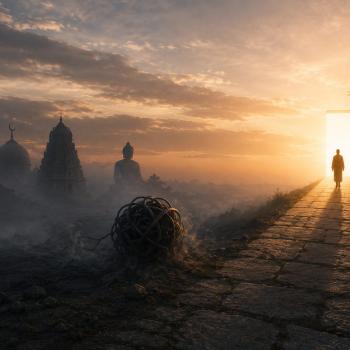
AI Image generated by Author
One of the most common questions people ask after reading the Mahabharata is this:
If everything is already destined, where is free will?
The question seems reasonable. The great war appears inevitable. Krishna knows its outcome. Many events seem foretold long before they happen. If the ending is already written, what difference do our choices make?
It is a question that has puzzled philosophers for centuries. But perhaps we are asking the wrong question.
The Divorce That Never Had to Happen
Imagine a couple whose marriage is struggling. Arguments have become routine. Trust has weakened. Both partners are hurt.
One day someone says, “Perhaps this divorce is destined.”
Not yet.
The husband still has the freedom to apologise instead of defending himself.
The wife still has the freedom to forgive instead of keeping score.
Both can choose counselling. Both can choose honest conversation. Both can choose to change.
At this point, the future is still open. Now imagine something different.
For years, every opportunity for reconciliation is rejected. Pride replaces humility. Every conversation becomes another wound. Eventually, one partner leaves.
Looking back, people often say, “It was meant to happen.”
Was it predetermined from the beginning, or did thousands of small choices gradually make it inevitable?
The Bhagavad Gita leans toward the second answer.
Krishna Never Says, “You Have No Choice”
If everything were fixed in every detail, there would be no reason for Krishna to spend eighteen chapters teaching Arjuna.
He could simply have said: “The war is predetermined. Go fight.”
Instead, Krishna explains, questions, challenges, and persuades.
At the very end, he says something remarkable: “Reflect on this fully, and then act as you wish.”
Those are not the words of someone denying free will.
They are the words of someone who believes our choices matter.
The Battlefield You Did Not Choose
Most of us did not choose many of the major events in our lives.
We did not choose our parents.
We did not choose where we were born.
We did not choose our genes.
We often do not choose illness, loss, betrayal, or tragedy.
These are the battlefields life places before us.
Arjuna did not choose the Kurukshetra war. But he had to choose how he would meet it.
That is where the Gita places responsibility—not in controlling every circumstance, but in choosing our response.
Karma Is Not Fatalism
One of the biggest misunderstandings about karma is that it means everything is already fixed. That is not how the Gita presents it.
A useful way to think about karma is this:
Your past creates your circumstances.
Your present choices create your future.
The past influences you.
It does not imprison you.
Every decision you make today becomes tomorrow’s karma.
If everything were already decided, karma itself would become meaningless because there would be no genuine action, no responsibility, and no moral growth.
Why Krishna Tried to Stop the War
There is another detail people often overlook. Before the war began, Krishna made repeated efforts to prevent it.
He negotiated.
He pleaded for peace.
He even asked for just five villages on behalf of the Pandavas.
If the outcome were completely fixed from the beginning, why bother?
The answer may be that destiny is not a script imposed from outside.
It unfolds through human choices. Only after every opportunity for peace had been rejected did war become unavoidable.
The battlefield was not created by fate alone. It was created by countless decisions.
Destiny Gives the Situation. Free Will Gives the Response.
Perhaps the relationship between destiny and free will is simpler than we imagine.
Life hands us circumstances we cannot always control.
Within those circumstances, we still choose.
We choose whether to forgive or seek revenge.
Whether to speak truth or hide behind lies.
Whether suffering makes us bitter or wiser.
The Gita does not promise that we control every outcome.
It asks something far more demanding.
Who will you become because of what happens to you?
That question remains ours to answer. And perhaps that is where true freedom has always lived.
Previous Post

June 24, 2026
The Doorway You Keep Avoiding
Next Post

August 10, 2026 What Ancient Sanskrit Wisdom Says About Real Success
Recent Comments
"Frequent examination of one's conscience has been a time-tested practice recommended and practiced by sages, ..."
We Have Confused Success With Decoration
"Under the weight of the Cross, Jesus fell down three times. And every time He ..."
The Inner Architecture of a Peaceful ..."
"Yoga is much more than mere physical stretching and flexing of one's muscles. It's a ..."
The Inner Architecture of a Peaceful ..."
"After Judeo-Christian religions, I have deep respect for the Vedic traditions in their cultivation of ..."
Conversations with the Devil: Through the ..."
Browse Our Archives
Select a Category Culture forgiveness Identity Inspirational Relationship Religion Religion News Science and Religion Society and Religion Sufism Travel and Religion Uncategorized
Select a Month October 2026 August 2026 July 2026 June 2026 May 2026 April 2026 March 2026 February 2026 January 2026 November 2025 September 2025 August 2025 July 2025 June 2025 May 2025 April 2025 March 2025 February 2025 January 2025 December 2024 November 2024 October 2024 September 2024 July 2024 June 2024 May 2024 April 2024
TAKE THE
Religious Wisdom Quiz
What is the longest book in the Bible by chapters?
Select your answer to see how you score.
Psalms Matthew Genesis Romans
Related posts from Ancient Roots, Modern Fruits


The One Thing You Have Never Seen: Yourself

What Ancient Sanskrit Wisdom Says About Real Success
TRENDING AT PATHEOS Hindu

In "Irreplaceable," our book on vocation and technology, Trevor Sutton and I...

I was strolling through the top floor of the brand new Parthenon...

What Does Gêvâh Mean For Kimberley Guifoyle &...
This week, a lot of the news is focused on Kimberly Guilfoyle....

INNER CIRCLE: Profound Mystery (Of Christ In All...
Ephesians 5:31-32 “For this reason, a man will leave his father and...

Do Not Rejoice When Your Enemy Falls: The...
Turning an execution into a public spectacle is a disturbing expression of...

'The Chosen' S6 Trailer: The Passion Gets Very...
Not many watching 'The Chosen' worry about spoilers, but just because they...
view all Hindu blogs
What Are Your Thoughts?leave a comment
Ad-Free & Subscriber Log-In Subscription Support
- About Us
- 2026 Calendar
- Videos
- Podcasts
- Library of World Religions
- Faith In Media Tracker
- Advertise With Us
- Write for Us
- Privacy Policy
- Terms of Service
- Do Not Sell My Data
- Contact Us
- Radiant Digital
- Manage Newsletter Subscriptions
- Unsubscribe From Notifications
- Sitemap
Copyright 2008-2026, Patheos. All rights reserved.
Subscription Support Ad-Free & Subscriber Log-In
Follow Patheos