
BuddhistCatholicContemplativeEvangelicalGeneral ChristianHinduJewishLatter-day SaintMuslimNew VisionsProgressive Christian
Beliefs
- Buddhist
- Catholic
- Contemplative
- Evangelical
- General Christian
- Hindu
- Jewish
- Latter-day Saint
- More Voices
- Muslim
- New Visions
- Pagan
- Progressive Christian
Topics
- Religion News
- Food and Religion
- Sports and Religion
- Religious Art
- Religious Music and Entertainment
- Religious Events
- History and Religion
- Style and Religion
- Politics and Religion
- Women in Religion
- Recreation Outdoors and Religion
- Business Finance and Religion
- Careers Workplace and Religion
- Education and Religion
- Family Parenting and Religion
- Health Fitness and Religion
- Home and Religion
- Relationships and Religion
- Technology and Religion
- Travel and Religion
Columnists
- Buddhist Columnists
- Business Finance and Religion Columnists
- Careers Workplace and Religion Columnists
- Catholic Columnists
- Contemplative Columnists
- Education and Religion Columnists
- Evangelists Columnists
- Family Parenting and Religion Columnists
- General Christian Columnists
- Health Fitness and Religion Columnists
- Hindu Columnists
- History and Religion Columnists
- Home and Religion Columnists
- Jewish Columnists
- More Voices Columnists
- Latter Day Columnists
- Muslim Columnists
- New Visions Columnists
- Nonreligious Columnists
- Pagan Columnists
- Politics and Religion Columnists
- Progressive Columnists
- Recreation Outdoors and Religion Columnists
- Relationships and Religion Columnists
- Religion News Columnists
- Religious Art Columnists
- Religious Events Columnists
- Religious Music and Entertainment Columnists
- Sports and Religion Columnists
- Style and Religion Columnists
- Technology and Religion Columnists
- Travel and Religion Columnists
- Women in Religion Columnists
Resource Library
- 2026 Calendar
- Library of World Religions
- The 100 Most Holy Places on Earth
- Patheos Answers
- Podcasts
- Videos
- Faith Leaders Database
- Anglican Episcopalian
- Bahai
- Baptist
- Buddhism
- Christianity
- Confucianism
- Eastern Orthodoxy
- Hinduism
- Holiness and Pentecostal
- ISKCON
- Islam
- Judaism
- Lutheran
- Methodist
- The Church of Jesus Christ of Latter-day Saints
- New Age
- Paganism
- Presbytarian and Reformed
- Protestantism
- Religion Behind the Scenes
- Roman Catholic
- Scientology
- Shia Islam
- Sikhism
- Sufism
- Sunni Islam
- Taoism
- Zen
- See all religions
Research Tools
 Ad-Free & Subscriber Log-In Subscription Support
Ad-Free & Subscriber Log-In Subscription Support
Follow Patheos 

- Trending:
- Forgiveness
- |
- Marriage
- |
- Consciousness
- |
- Death Penalty
- |
- Election
- |
- Halloween

- Home
- Hindu
- History and Religion
- Why Arjuna? The Question Behind the Bhagavad Gita
Why Arjuna? The Question Behind the Bhagavad Gita
Last updated on: June 23, 2026 at 3:06 am by Shweta Goyal
Why Arjuna? The Question Behind the Bhagavad Gita 2026-06-23T03:06:10+00:00 Shweta Goyal
Patheos Explore the world's faith through different perspectives on religion and spirituality! Patheos has the views of the prevalent religions and spiritualities of the world.
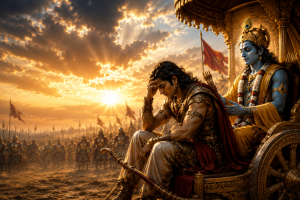
AI image generated by Author
People often ask a simple question about the Bhagavad Gita. The entire teaching begins because one man collapses on a battlefield. Yet there were millions of men gathered there that day—five Pandava brothers, a hundred Kaurava cousins, and the greatest warriors of the age, lined up and ready for battle.
So why Arjuna?
Why did the crisis come to him and to no one else?
The answer is more profound than it first appears. It reveals something fundamental about the human condition.
The Moment He Chose to See
Arjuna’s crisis did not appear out of nowhere. In a way, he invited it. Just before the battle begins, Arjuna asks Krishna to place his chariot between the two armies. He wants to look. He wants to see clearly the men he is about to kill.
Krishna does as he asks. And Arjuna sees. That is the moment everything breaks.
He does not see enemies. He sees Bhishma, the grandfather who raised him. He sees Drona, the teacher who taught him how to hold a bow. He sees uncles, cousins, friends—the faces of his own childhood standing before him, waiting to die by his hand.
His body gives out. His limbs weaken. His mouth dries. His skin burns. The Gandiva, his great bow, slips from his fingers. He cannot stand. He sinks into his chariot.
Anyone who has experienced overwhelming anxiety will recognise this moment. The Gita describes Arjuna’s physical and emotional collapse with remarkable psychological insight, thousands of years before modern psychology had a language for such experiences.
The text even gives this state a name. The first chapter is called Arjuna Vishada Yoga—the Yoga of Arjuna’s Despair.
Vishada means dejection, the collapse of the will to act.
Here is the key: Arjuna asked to see clearly. And it was seeing clearly that broke him.
Insight came first. The collapse came second.
Why the Others Never Broke
Now look at the others. Each of them lacked something that Arjuna possessed.
Take Yudhishthira, the eldest, devoted to dharma—the moral order that guides a person toward what is right. He had his own doubts about the war. But those doubts belonged to the council chamber, not the battlefield.
His mind worked through principles. He reflected. He deliberated. He did not freeze in the middle of action.
His crisis came before the war and again after it, when he wished to abandon the throne and walk away.
A different kind of crisis, arriving at a different moment.
Take Bhima, the strongest of the brothers. Bhima had no room for collapse. He was driven by appetite, anger, and a promise of vengeance. He had vows to fulfil and old wounds to avenge.
He wanted the battle. A mind burning with that much fury does not pause long enough to become paralysed.
Then there were Nakula and Sahadeva—the younger twins, quieter figures who followed the lead of their elder brothers. They were never placed at the centre of this moral conflict.
Among the Pandavas, only Arjuna stood at the exact point of collision.
He had the skill to fight.
He had the love that made fighting unbearable.
And he had the clarity to understand exactly what he was about to destroy.
The Man Who Could Not Question Himself
This is the part worth sitting with.
Duryodhana, the eldest Kaurava, never had an Arjuna moment. In many ways, he could not.
His mind was already decided. He was consumed by two forces the Gita returns to repeatedly: raga—attachment, his desperate grip on a kingdom he refused to share—and dvesha—hatred, his lifelong resentment toward his cousins.
A mind so full of attachment and hatred has no space for self-examination.
Duryodhana never asked the difficult question, and so he never reached the place where a question can break you.
This is the quiet lesson hidden in the comparison.
The people who are most certain are often the furthest from transformation. They act from compulsion and never experience the pause where wisdom enters.
A breakdown is not always a sign that something is wrong with you.
Sometimes, it is the first sign that something inside you is awakening.
The Psychology of Arjuna’s Collapse
What exactly happened inside Arjuna? The Gita allows us to trace the movement of his mind.
It begins with raga—attachment. He loves these people. He is deeply bound to them.
That attachment turns into shoka—grief, as he imagines their deaths.
And grief hardens into moha—confusion and delusion, where he can no longer see what the right action is.
Attachment. Grief. Confusion.
One feeds the next.
By the end of the chain, Arjuna sits in his chariot unable to think and unable to act. A less reflective person might not recognise the moral weight of such a moment. A harder person might be carried past it by anger or desire.
Arjuna collapses precisely because he possesses both sensitivity and awareness. He feels the depth of his attachment, and he sees the contradiction between love and duty.
His breakdown is the price of his depth.
In other words, the Arjuna moment is not the failure of a great person. It is what greatness looks like at the edge of its own understanding.
When Breaking Becomes the Beginning
There is one final reason the crisis belonged to Arjuna. Without it, there is no Bhagavad Gita.
Krishna cannot teach a person who believes they already possess all the answers. Wisdom can only be poured into an empty cup.
Arjuna laying down his bow, sinking into his seat, and admitting that he does not know what to do—this is the empty cup.
Then he speaks the words that transform the entire story: “I am your student. Teach me. I take refuge in you.”
That surrender is the turning point of the Gita.
The Kauravas would never have asked.
Yudhishthira might have continued deliberating alone.
Only the person who breaks open becomes ready to be taught.
Arjuna’s collapse was not his ending.
It was the doorway.
The Arjuna Within All of Us
So the question dissolves when we look more closely.
Why Arjuna and not the others?
Because Arjuna represents the deepest human struggle—the moment when love, duty, and conscience collide. His crisis is the crisis of every thoughtful person who stands before a painful choice, unable to act because every path seems to demand the loss of something precious.
You have stood there.
The decision you keep postponing.
The conversation you cannot bring yourself to begin.
The moment you finally saw your situation clearly—and that clarity did not free you but shattered your certainty.
That is your Arjuna moment. And the Bhagavad Gita is built upon a quiet promise:
The breakdown is not the end of the road. For the person willing to question, surrender, and learn, it is where wisdom begins.
Previous Post
May 11, 2026
When Strength Collapses: Finding the Inner Krishna
Next Post
June 23, 2026 The Question That Opened the Bhagavad Gita
Recent Comments
"Frequent examination of one's conscience has been a time-tested practice recommended and practiced by sages, ..."
We Have Confused Success With Decoration
"Under the weight of the Cross, Jesus fell down three times. And every time He ..."
The Inner Architecture of a Peaceful ..."
"Yoga is much more than mere physical stretching and flexing of one's muscles. It's a ..."
The Inner Architecture of a Peaceful ..."
"After Judeo-Christian religions, I have deep respect for the Vedic traditions in their cultivation of ..."
Conversations with the Devil: Through the ..."
Browse Our Archives
Select a Category Culture forgiveness Identity Inspirational Relationship Religion Religion News Science and Religion Society and Religion Sufism Travel and Religion Uncategorized
Select a Month October 2026 August 2026 July 2026 June 2026 May 2026 April 2026 March 2026 February 2026 January 2026 November 2025 September 2025 August 2025 July 2025 June 2025 May 2025 April 2025 March 2025 February 2025 January 2025 December 2024 November 2024 October 2024 September 2024 July 2024 June 2024 May 2024 April 2024
TAKE THE
Religious Wisdom Quiz
According to 1 John, if we claim to be without sin, what do we do?
Select your answer to see how you score.
Lie to God Blaspheme the Holy Spirit Deceive ourselves and the truth is not in us Mock the sacrifice of Christ
Related posts from Ancient Roots, Modern Fruits


The One Thing You Have Never Seen: Yourself

What Ancient Sanskrit Wisdom Says About Real Success

If the War Was Destined, Why Did Krishna...
TRENDING AT PATHEOS Hindu

How to Make a Decision When You Can't...
Main point: It’s much more valuable to stay close to God so...

Archdiocese Hosts Military Marriage Retreat in Germany
RASTATT, Germany — The transient military lifestyle, with its frequent deployments and...

Nearly every morning, I make the drive to Detroit with my high-school-age...

The Real AI Story Is Adoption Without Trust
Artificial intelligence has crossed a political threshold. It is no longer a...

A new article, written by Jeff Lindsay and Gale L. Pooley,...

Swimfan: Forgotten Aughts Pleasures
This is a recovery effort. In 2002, My Big Fat Greek Wedding...
view all Hindu blogs
What Are Your Thoughts?leave a comment
Ad-Free & Subscriber Log-In Subscription Support
- About Us
- 2026 Calendar
- Videos
- Podcasts
- Library of World Religions
- Faith In Media Tracker
- Advertise With Us
- Write for Us
- Privacy Policy
- Terms of Service
- Do Not Sell My Data
- Contact Us
- Radiant Digital
- Manage Newsletter Subscriptions
- Unsubscribe From Notifications
- Sitemap
Copyright 2008-2026, Patheos. All rights reserved.
Subscription Support Ad-Free & Subscriber Log-In
Follow Patheos