
BuddhistCatholicContemplativeEvangelicalGeneral ChristianHinduJewishLatter-day SaintMuslimNew VisionsProgressive Christian
Beliefs
- Buddhist
- Catholic
- Contemplative
- Evangelical
- General Christian
- Hindu
- Jewish
- Latter-day Saint
- More Voices
- Muslim
- New Visions
- Pagan
- Progressive Christian
Topics
- Religion News
- Food and Religion
- Sports and Religion
- Religious Art
- Religious Music and Entertainment
- Religious Events
- History and Religion
- Style and Religion
- Politics and Religion
- Women in Religion
- Recreation Outdoors and Religion
- Business Finance and Religion
- Careers Workplace and Religion
- Education and Religion
- Family Parenting and Religion
- Health Fitness and Religion
- Home and Religion
- Relationships and Religion
- Technology and Religion
- Travel and Religion
Columnists
- Buddhist Columnists
- Business Finance and Religion Columnists
- Careers Workplace and Religion Columnists
- Catholic Columnists
- Contemplative Columnists
- Education and Religion Columnists
- Evangelists Columnists
- Family Parenting and Religion Columnists
- General Christian Columnists
- Health Fitness and Religion Columnists
- Hindu Columnists
- History and Religion Columnists
- Home and Religion Columnists
- Jewish Columnists
- More Voices Columnists
- Latter Day Columnists
- Muslim Columnists
- New Visions Columnists
- Nonreligious Columnists
- Pagan Columnists
- Politics and Religion Columnists
- Progressive Columnists
- Recreation Outdoors and Religion Columnists
- Relationships and Religion Columnists
- Religion News Columnists
- Religious Art Columnists
- Religious Events Columnists
- Religious Music and Entertainment Columnists
- Sports and Religion Columnists
- Style and Religion Columnists
- Technology and Religion Columnists
- Travel and Religion Columnists
- Women in Religion Columnists
Resource Library
- 2026 Calendar
- Library of World Religions
- The 100 Most Holy Places on Earth
- Patheos Answers
- Podcasts
- Videos
- Faith Leaders Database
- Anglican Episcopalian
- Bahai
- Baptist
- Buddhism
- Christianity
- Confucianism
- Eastern Orthodoxy
- Hinduism
- Holiness and Pentecostal
- ISKCON
- Islam
- Judaism
- Lutheran
- Methodist
- The Church of Jesus Christ of Latter-day Saints
- New Age
- Paganism
- Presbytarian and Reformed
- Protestantism
- Religion Behind the Scenes
- Roman Catholic
- Scientology
- Shia Islam
- Sikhism
- Sufism
- Sunni Islam
- Taoism
- Zen
- See all religions
Research Tools
 Ad-Free & Subscriber Log-In Subscription Support
Ad-Free & Subscriber Log-In Subscription Support
Follow Patheos 

- Trending:
- Forgiveness
- |
- Marriage
- |
- Consciousness
- |
- Death Penalty
- |
- Election
- |
- Halloween

- Home
- Hindu
- History and Religion
- The Question That Opened the Bhagavad Gita
The Question That Opened the Bhagavad Gita
Last updated on: June 23, 2026 at 4:27 am by Shweta Goyal
The Question That Opened the Bhagavad Gita 2026-06-23T04:27:15+00:00 Shweta Goyal
Patheos Explore the world's faith through different perspectives on religion and spirituality! Patheos has the views of the prevalent religions and spiritualities of the world.

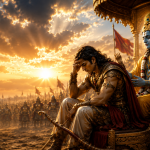
The light of wisdom appearing in the middle of life’s battlefield. AI Image generated by Author
Arjuna asked Lord Krishna:
“You have said that fighting is my duty, but fighting against one’s teacher is unrighteous. We are taught Acharya Devo Bhava—the teacher is to be regarded as divine. Yet my duty is forcing me to raise my weapons against my own guru. By performing dharma, I seem to be committing adharma. I cannot see the highest good, whether I fight or whether I walk away.”
This is one of the deepest dilemmas in the Bhagavad Gita.
Arjuna is not struggling with a choice between right and wrong. If that were the case, the decision would be easy. His problem is that he is caught between two duties. On one side stands his responsibility as a warrior. On the other stands his responsibility to honour his teachers and elders.
Whatever he chooses appears to violate something sacred. Many of us have faced similar moments in our own lives.
Should we remain loyal to family expectations or follow our own path? Should we stay in a secure job or pursue a calling? Should we speak the truth and risk conflict, or remain silent and preserve peace?
Sometimes the hardest decisions are not between good and bad. They are between two competing goods. That is exactly where Arjuna finds himself.
Until this point in the Gita, Arjuna has argued. He has presented reasons. He has explained why he believes fighting is wrong. Yet beneath all his arguments lies a deeper reality. He does not know what to do.
For the first time, he admits it.
kārpaṇya-doṣopahata-svabhāvaḥ
pṛcchāmi tvāṁ dharma-sammūḍha-cetāḥ
yac chreyaḥ syān niścitaṁ brūhi tan me
śiṣyas te ‘haṁ śādhi māṁ tvāṁ prapannam(Bhagavad Gita 2.7)
“My nature is overcome by weakness and confusion regarding my duty. Tell me clearly what is truly best for me. I am your disciple. Teach me, for I have surrendered myself to you.”
This is one of the most important verses in the entire Bhagavad Gita.
Most readers remember Krishna’s teachings. Few stop to consider what made those teachings possible.
The answer is contained in two simple words: Śādhi mām.
Teach me.
Why Krishna Waited
Krishna has been beside Arjuna since the beginning of the dialogue. Yet he does not begin his great teaching until this moment.
Why?
Because Arjuna has finally become a student.
Before this verse, Arjuna is speaking as an equal. He debates. He reasons. He defends his position. He tells Krishna why he believes fighting is wrong.
Then something changes.
He realizes that his intellect can no longer resolve the problem before him.
His emotions are pulling him in different directions. His reasoning has reached its limits. Every path appears clouded.
At that moment, he stops trying to win the argument and starts seeking the truth.
The Bhagavad Gita begins not with knowledge, but with humility.
Arjuna’s greatness lies not in having answers. It lies in his willingness to admit that he does not have them. Modern culture often rewards certainty. We admire confidence. We are encouraged to have opinions on everything. Admitting confusion is often viewed as weakness.
The Gita suggests the opposite.
The beginning of wisdom is not certainty.
The beginning of wisdom is the recognition that we do not know.
The Empty Vessel
Traditional teachers often explain this using a simple analogy.
Imagine pouring water from one vessel into another. For the water to be received, the receiving vessel must be open and ready.
If it is already full, nothing more can enter.
If it is upside down, nothing can be received.
If it is shaking, the water spills.
If it has holes, the water leaks away.
These vessels represent different conditions of the mind.
A vessel raised above the teacher’s vessel represents ego. “I already know.”
Such a person may hear words, but learning never takes place.
A full vessel represents pride. There is no room for new understanding because the mind is already occupied by its own conclusions.
A shaking vessel represents distraction. The attention moves constantly from one thing to another. Today, this condition is almost normal. We try to read, listen, and reflect, but our minds are interrupted every few minutes.
An upside-down vessel represents disinterest. Knowledge cannot enter where there is no desire to receive it.
A leaking vessel represents selective listening. The words are heard, but they never truly penetrate because the mind quietly rejects anything that challenges existing beliefs.
For knowledge to enter, the vessel must be open, steady, and receptive.
That is what Arjuna becomes in this verse.
The Mind Ready for Wisdom
The tradition identifies several qualities necessary for genuine learning.
The first is humility—the willingness to admit, “I do not know.”
The second is surrender—not blind obedience, but a willingness to learn rather than constantly defend one’s current position.
The third is trust. The student must believe that the teacher may see something that he cannot yet see himself.
The fourth is desire. There must be a sincere longing for truth.
The fifth is receptivity—the ability to listen fully and openly.
Arjuna displays all of these qualities in a single moment. He acknowledges his confusion. He asks for guidance. He accepts the role of disciple. He opens himself to transformation.
Only then does Krishna begin the teachings that have inspired seekers for thousands of years.
Most of us will never stand on a battlefield between two armies.
Yet we all encounter moments when our values collide, when our reasoning fails, and when we cannot see the path ahead.
In those moments, the lesson of Arjuna remains as relevant as ever.
Clarity often begins with a simple admission: “I do not know.”
The most important words Arjuna ever spoke were not about war, duty, or philosophy.
They were two words addressed to Krishna:
Teach me.
And that is where wisdom begins.
Previous Post
June 22, 2026
Why Arjuna? The Question Behind the Bhagavad Gita
Next Post

June 24, 2026 The Doorway You Keep Avoiding
Recent Comments
"Frequent examination of one's conscience has been a time-tested practice recommended and practiced by sages, ..."
We Have Confused Success With Decoration
"Under the weight of the Cross, Jesus fell down three times. And every time He ..."
The Inner Architecture of a Peaceful ..."
"Yoga is much more than mere physical stretching and flexing of one's muscles. It's a ..."
The Inner Architecture of a Peaceful ..."
"After Judeo-Christian religions, I have deep respect for the Vedic traditions in their cultivation of ..."
Conversations with the Devil: Through the ..."
Browse Our Archives
Select a Category Culture forgiveness Identity Inspirational Relationship Religion Religion News Science and Religion Society and Religion Sufism Travel and Religion Uncategorized
Select a Month October 2026 August 2026 July 2026 June 2026 May 2026 April 2026 March 2026 February 2026 January 2026 November 2025 September 2025 August 2025 July 2025 June 2025 May 2025 April 2025 March 2025 February 2025 January 2025 December 2024 November 2024 October 2024 September 2024 July 2024 June 2024 May 2024 April 2024
TAKE THE
Religious Wisdom Quiz
Who was the mother of Samuel?
Select your answer to see how you score.
Deborah Hannah Ruth Rebekah
Related posts from Ancient Roots, Modern Fruits


The One Thing You Have Never Seen: Yourself

What Ancient Sanskrit Wisdom Says About Real Success

If the War Was Destined, Why Did Krishna...
TRENDING AT PATHEOS Hindu

Janie Learns the Way of the Cross: A...
Teaching children about Jesus' Passion can be challenging. Many parents and educators...

Looking For Good Catholic Writing - October 2026
He alone extends the heavens, and he walks upon the waves of...

In "Irreplaceable," our book on vocation and technology, Trevor Sutton and I...

I was strolling through the top floor of the brand new Parthenon...

What Does Gêvâh Mean For Kimberley Guifoyle &...
This week, a lot of the news is focused on Kimberly Guilfoyle....

INNER CIRCLE: Profound Mystery (Of Christ In All...
Ephesians 5:31-32 “For this reason, a man will leave his father and...
view all Hindu blogs
What Are Your Thoughts?leave a comment
Ad-Free & Subscriber Log-In Subscription Support
- About Us
- 2026 Calendar
- Videos
- Podcasts
- Library of World Religions
- Faith In Media Tracker
- Advertise With Us
- Write for Us
- Privacy Policy
- Terms of Service
- Do Not Sell My Data
- Contact Us
- Radiant Digital
- Manage Newsletter Subscriptions
- Unsubscribe From Notifications
- Sitemap
Copyright 2008-2026, Patheos. All rights reserved.
Subscription Support Ad-Free & Subscriber Log-In
Follow Patheos