
BuddhistCatholicContemplativeEvangelicalGeneral ChristianHinduJewishLatter-day SaintMuslimNew VisionsProgressive Christian
Beliefs
- Buddhist
- Catholic
- Contemplative
- Evangelical
- General Christian
- Hindu
- Jewish
- Latter-day Saint
- More Voices
- Muslim
- New Visions
- Pagan
- Progressive Christian
Topics
- Religion News
- Food and Religion
- Sports and Religion
- Religious Art
- Religious Music and Entertainment
- Religious Events
- History and Religion
- Style and Religion
- Politics and Religion
- Women in Religion
- Recreation Outdoors and Religion
- Business Finance and Religion
- Careers Workplace and Religion
- Education and Religion
- Family Parenting and Religion
- Health Fitness and Religion
- Home and Religion
- Relationships and Religion
- Technology and Religion
- Travel and Religion
Columnists
- Buddhist Columnists
- Business Finance and Religion Columnists
- Careers Workplace and Religion Columnists
- Catholic Columnists
- Contemplative Columnists
- Education and Religion Columnists
- Evangelists Columnists
- Family Parenting and Religion Columnists
- General Christian Columnists
- Health Fitness and Religion Columnists
- Hindu Columnists
- History and Religion Columnists
- Home and Religion Columnists
- Jewish Columnists
- More Voices Columnists
- Latter Day Columnists
- Muslim Columnists
- New Visions Columnists
- Nonreligious Columnists
- Pagan Columnists
- Politics and Religion Columnists
- Progressive Columnists
- Recreation Outdoors and Religion Columnists
- Relationships and Religion Columnists
- Religion News Columnists
- Religious Art Columnists
- Religious Events Columnists
- Religious Music and Entertainment Columnists
- Sports and Religion Columnists
- Style and Religion Columnists
- Technology and Religion Columnists
- Travel and Religion Columnists
- Women in Religion Columnists
Resource Library
- 2026 Calendar
- Library of World Religions
- The 100 Most Holy Places on Earth
- Patheos Answers
- Podcasts
- Videos
- Faith Leaders Database
- Anglican Episcopalian
- Bahai
- Baptist
- Buddhism
- Christianity
- Confucianism
- Eastern Orthodoxy
- Hinduism
- Holiness and Pentecostal
- ISKCON
- Islam
- Judaism
- Lutheran
- Methodist
- The Church of Jesus Christ of Latter-day Saints
- New Age
- Paganism
- Presbytarian and Reformed
- Protestantism
- Religion Behind the Scenes
- Roman Catholic
- Scientology
- Shia Islam
- Sikhism
- Sufism
- Sunni Islam
- Taoism
- Zen
- See all religions
Research Tools
 Ad-Free & Subscriber Log-In Subscription Support
Ad-Free & Subscriber Log-In Subscription Support
Follow Patheos 

- Trending:
- Forgiveness
- |
- Marriage
- |
- Consciousness
- |
- Death Penalty
- |
- Election
- |
- Halloween

- Home
- Hindu
- History and Religion
- When Strength Collapses: Finding the Inner Krishna
When Strength Collapses: Finding the Inner Krishna
Last updated on: May 11, 2026 at 2:48 am by Shweta Goyal
When Strength Collapses: Finding the Inner Krishna 2026-05-11T02:48:48+00:00 Shweta Goyal
Patheos Explore the world's faith through different perspectives on religion and spirituality! Patheos has the views of the prevalent religions and spiritualities of the world.
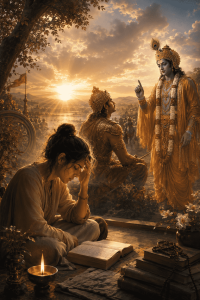
AI image generated by Author
The Collapse Nobody Sees
There comes a moment when even the strongest person quietly collapses.
Yesterday, I reached that moment.
Not the kind of collapse people notice from the outside. The world still moves. Emails still arrive. Responsibilities still wait. You still speak normally. You still smile at people.
But inwardly, something gives way. I was tired of being strong.
For many years, I had taught myself one thing: you cannot break down. No matter what happens, you must stay strong. That is what adulthood often trains us to believe. Keep functioning. Keep moving. Keep handling things. No matter how exhausted you feel internally, you continue carrying responsibilities because that is what you are “supposed” to do.
So I kept going with the flow of strength. I kept trying my best to hold everything together. No matter what happened, I told myself: I cannot collapse.
For a long time, I carried emotions silently, pushing through life the way many people do — fulfilling roles, handling responsibilities, surviving difficulties, convincing myself that strength meant endurance.
But buried emotions do not disappear simply because we ignore them.
Sometimes unresolved pain sits quietly within us for years — hidden beneath work, routines, deadlines, obligations, and distractions. We become skilled at surviving. Skilled at appearing fine. Skilled at helping everyone else while slowly exhausting ourselves internally.
The Coffee That Felt Like Grace
A few months ago, I met a wise man and his wife. From the beginning, I felt an unusual connection with them — the kind that feels deeper than coincidence. Our conversations naturally drifted toward scriptures, philosophy, and quotations from spiritual texts. He would often send me encouraging reflections and wisdom from books.
Yesterday, unexpectedly, he messaged me and asked if I wanted to meet for coffee.
Looking back now, it almost felt intuitive — as though he sensed something was wrong before I fully admitted it to myself. We sat together quietly and talked.
He explained how prolonged stress changes the body itself — how anxiety and depression are not merely emotional weakness, but deeply connected to exhaustion, hormones, unresolved grief, suppressed emotions, and internal conflict.
Sometimes, he said, the things we bury continue living silently within us.
Sometimes we do not speak because we fear judgment.
Sometimes we cannot explain our pain because we ourselves do not fully understand it.
And sometimes we remain strong for so long that vulnerability itself begins to feel unnatural.
When Buried Emotions Finally Emerge
I came home afterward and tried to continue the day normally. Then one of my close friends called me. As we spoke, something inside me finally broke open.
I wanted to express everything I had been carrying, but I did not know where to begin. I did not know how to organize pain into sentences. Emotions that remain buried too long rarely emerge clearly; they erupt chaotically.
And perhaps the hardest part was this: I had never truly shown vulnerability in front of anyone before.
I had become so used to being the strong one, the composed one, the person who manages everything internally, that even speaking honestly about my pain felt unfamiliar.
I wanted to explain what was happening inside me, but the words came out tangled with exhaustion, frustration, fear, and years of suppressed emotion.
And we ended up in a big argument.
That is the strange thing about emotional collapse — sometimes what we most need is understanding, but pain does not always know how to ask for it gently.
“Invoke Your Higher Being”
Later that night, I remembered the words of my Acharya.
Earlier that day, I had attended an Ashtavakra Gita class. The teaching was simple, yet deeply powerful: “Invoke your higher being.”
He told us not to wake up immediately thinking about work, emails, deadlines, and worldly responsibilities. Before becoming a professional, a parent, a teacher, or a person fulfilling endless roles in society, spend a few moments remembering your deeper nature.
Wake up with a smile.
Spend five minutes in silence before entering the world.
Read scriptures.
Remember who you truly are beneath the noise of life.
“You are Gyani,” he reminded us. “Wake up your higher self.”
That teaching stayed with me through the night.
I reopened the verses of the Ashtavakra Gita and found myself returning again to similar teachings from the Bhagavad Gita.
Slowly, the storm inside me began to settle. Not because my external problems disappeared. But because the scriptures reminded me that the real battle was internal.
I Am Arjuna
And suddenly I understood Arjuna differently.
Right now, I am Arjuna.
Emotionally exhausted.
Mentally conflicted.
Standing in the middle of an inner battlefield.
And the scriptures before me are Krishna.
Not merely ancient poetry.
But living wisdom speaking directly into human collapse.
The Bhagavad Gita does not begin with victory. It begins with breakdown.
Arjuna trembles.
His body weakens.
His mind becomes clouded.
His bow slips from his hands.
He no longer knows what to do. Only after the collapse does wisdom begin.
Perhaps this is why these scriptures continue to survive across centuries — because they understand the human condition with extraordinary depth.
The Gita does not shame emotional struggle. It guides us through it.
And the Ashtavakra Gita goes even deeper.
It reminds us:
You are not merely the anxious mind.
You are not merely the passing storm of thoughts.
You are not merely your emotional pain.
At your deepest level, you are consciousness itself.
Brahman.
That teaching does not magically erase suffering overnight. But it creates space within suffering.
A witnessing. A quiet inner stillness beneath the storm.
A reminder that even while the mind trembles, something deeper within remains untouched.
Rise. Awaken.
Yesterday, I collapsed.
But perhaps collapse is not always destruction.
Sometimes it is the moment the soul becomes tired of pretending.
Sometimes it is the breaking point before awakening.
And perhaps this is why Krishna’s call still echoes through every human battle: “Uthishta. Jagrata.”
Rise.
Awaken.
Do not forget who you truly are.
Previous Post

April 26, 2026
The Most Unexpected Gita Teacher in My Life
Next Post

June 22, 2026 Why Arjuna? The Question Behind the Bhagavad Gita
Recent Comments
"Frequent examination of one's conscience has been a time-tested practice recommended and practiced by sages, ..."
We Have Confused Success With Decoration
"Under the weight of the Cross, Jesus fell down three times. And every time He ..."
The Inner Architecture of a Peaceful ..."
"Yoga is much more than mere physical stretching and flexing of one's muscles. It's a ..."
The Inner Architecture of a Peaceful ..."
"After Judeo-Christian religions, I have deep respect for the Vedic traditions in their cultivation of ..."
Conversations with the Devil: Through the ..."
Browse Our Archives
Select a Category Culture forgiveness Identity Inspirational Relationship Religion Religion News Science and Religion Society and Religion Sufism Travel and Religion Uncategorized
Select a Month October 2026 August 2026 July 2026 June 2026 May 2026 April 2026 March 2026 February 2026 January 2026 November 2025 September 2025 August 2025 July 2025 June 2025 May 2025 April 2025 March 2025 February 2025 January 2025 December 2024 November 2024 October 2024 September 2024 July 2024 June 2024 May 2024 April 2024
TAKE THE
Religious Wisdom Quiz
What does the Sword of the Spirit represent?
Select your answer to see how you score.
The Word of God The Holy Spirit Faith The power of prayer
Related posts from Ancient Roots, Modern Fruits


The One Thing You Have Never Seen: Yourself

What Ancient Sanskrit Wisdom Says About Real Success

If the War Was Destined, Why Did Krishna...
TRENDING AT PATHEOS Hindu

Nearly every morning, I make the drive to Detroit with my high-school-age...

The Real AI Story Is Adoption Without Trust
Artificial intelligence has crossed a political threshold. It is no longer a...

A new article, written by Jeff Lindsay and Gale L. Pooley,...

Swimfan: Forgotten Aughts Pleasures
This is a recovery effort. In 2002, My Big Fat Greek Wedding...

Top Three Anti-Catholic Lies About Catholicism
This is my initial transcript for the video, "THE 3 WORST...

Pope Leo Celebrates Mass for Nurses & Docs...
I don't have any idea how he did it, but Pope Leo...
view all Hindu blogs
What Are Your Thoughts?leave a comment
Ad-Free & Subscriber Log-In Subscription Support
- About Us
- 2026 Calendar
- Videos
- Podcasts
- Library of World Religions
- Faith In Media Tracker
- Advertise With Us
- Write for Us
- Privacy Policy
- Terms of Service
- Do Not Sell My Data
- Contact Us
- Radiant Digital
- Manage Newsletter Subscriptions
- Unsubscribe From Notifications
- Sitemap
Copyright 2008-2026, Patheos. All rights reserved.
Subscription Support Ad-Free & Subscriber Log-In
Follow Patheos