
BuddhistCatholicContemplativeEvangelicalGeneral ChristianHinduJewishLatter-day SaintMuslimNew VisionsProgressive Christian
Beliefs
- Buddhist
- Catholic
- Contemplative
- Evangelical
- General Christian
- Hindu
- Jewish
- Latter-day Saint
- More Voices
- Muslim
- New Visions
- Pagan
- Progressive Christian
Topics
- Religion News
- Food and Religion
- Sports and Religion
- Religious Art
- Religious Music and Entertainment
- Religious Events
- History and Religion
- Style and Religion
- Politics and Religion
- Women in Religion
- Recreation Outdoors and Religion
- Business Finance and Religion
- Careers Workplace and Religion
- Education and Religion
- Family Parenting and Religion
- Health Fitness and Religion
- Home and Religion
- Relationships and Religion
- Technology and Religion
- Travel and Religion
Columnists
- Buddhist Columnists
- Business Finance and Religion Columnists
- Careers Workplace and Religion Columnists
- Catholic Columnists
- Contemplative Columnists
- Education and Religion Columnists
- Evangelists Columnists
- Family Parenting and Religion Columnists
- General Christian Columnists
- Health Fitness and Religion Columnists
- Hindu Columnists
- History and Religion Columnists
- Home and Religion Columnists
- Jewish Columnists
- More Voices Columnists
- Latter Day Columnists
- Muslim Columnists
- New Visions Columnists
- Nonreligious Columnists
- Pagan Columnists
- Politics and Religion Columnists
- Progressive Columnists
- Recreation Outdoors and Religion Columnists
- Relationships and Religion Columnists
- Religion News Columnists
- Religious Art Columnists
- Religious Events Columnists
- Religious Music and Entertainment Columnists
- Sports and Religion Columnists
- Style and Religion Columnists
- Technology and Religion Columnists
- Travel and Religion Columnists
- Women in Religion Columnists
Resource Library
- 2026 Calendar
- Library of World Religions
- The 100 Most Holy Places on Earth
- Patheos Answers
- Podcasts
- Videos
- Faith Leaders Database
- Anglican Episcopalian
- Bahai
- Baptist
- Buddhism
- Christianity
- Confucianism
- Eastern Orthodoxy
- Hinduism
- Holiness and Pentecostal
- ISKCON
- Islam
- Judaism
- Lutheran
- Methodist
- The Church of Jesus Christ of Latter-day Saints
- New Age
- Paganism
- Presbytarian and Reformed
- Protestantism
- Religion Behind the Scenes
- Roman Catholic
- Scientology
- Shia Islam
- Sikhism
- Sufism
- Sunni Islam
- Taoism
- Zen
- See all religions
Research Tools
 Ad-Free & Subscriber Log-In Subscription Support
Ad-Free & Subscriber Log-In Subscription Support
Follow Patheos 

- Trending:
- Forgiveness
- |
- Marriage
- |
- Consciousness
- |
- Death Penalty
- |
- Election
- |
- Halloween

- Home
- Hindu
- History and Religion
- Awakening Through Inquiry: The Power of Questioning (Part 1)
Awakening Through Inquiry: The Power of Questioning (Part 1)
Last updated on: February 24, 2026 at 2:40 am by Shweta Goyal
Awakening Through Inquiry: The Power of Questioning (Part 1) 2026-02-24T02:40:56+00:00 Shweta Goyal
Patheos Explore the world's faith through different perspectives on religion and spirituality! Patheos has the views of the prevalent religions and spiritualities of the world.

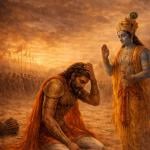
AI image generated by Author
Awakening the Buddhi in an Age of Psychological Overload
Human beings are taught what to think long before they are taught how to think.
From childhood, answers surround us. We are told who we are, what success means, what failure means, what God is, what our purpose should be. These answers come from loving parents, well-meaning teachers, cultural traditions, and social expectations. They provide structure and orientation. They help us function in the world.
But they also create something subtler: a life built on inherited certainty.
Most people never pause to examine the foundations of their own identity. They live inside mental frameworks they did not consciously construct. They think thoughts that feel personal but were quietly absorbed from their environment. They pursue goals they never consciously chose. They fear outcomes they never fully examined.
Outwardly, life appears stable.
Inwardly, a quiet restlessness persists.
The Upanishads begin at precisely this point—not by offering answers, but by legitimising this restlessness.
Their first instruction is simple:
प्रश्न करो. Question.
This instruction is far more radical than it appears. It does not ask the individual to reject tradition or authority. It asks the individual to awaken their own capacity for inquiry.
Because without inquiry, a person may live an entire life without ever truly knowing themselves.
The Psychological Cost of Unquestioned Beliefs
Much of human psychological suffering arises not from external circumstances, but from unquestioned identification.
We assume, without examination, that we are our thoughts. When negative thoughts arise, they feel like personal truths rather than temporary mental events.
We assume we are our emotions. When anxiety arises, it feels like evidence of personal weakness rather than a passing nervous system state.
We assume we are our roles. When a role is threatened—a career setback, a relationship ending, a change in social status—the entire sense of self feels destabilised.
These identifications feel natural because they are rarely examined.
The Upanishadic sages observed that human beings do not suffer simply because the mind changes. They suffer because they mistake the changing for the self.
This insight aligns remarkably with modern psychological research. Cognitive science has demonstrated that thoughts arise automatically, shaped by prior experience, conditioning, and neural patterning. They are events occurring within consciousness, not the source of consciousness itself.
Yet without inquiry, thoughts appear authoritative.
They shape perception without being questioned.
This is why questioning is not merely philosophical—it is psychologically protective.
It creates distance between the observer and the observed.
Inquiry Awakens the Buddhi
In Vedantic psychology, the human mind is not a single undifferentiated entity. It has functional layers.
Manas processes sensory input and generates reactions.
Ahamkara creates identification and personal narrative.
But Buddhi performs a different function entirely.
Buddhi discriminates.
It evaluates.
It questions.
It distinguishes between what is temporary and what is stable.
Without questioning, Buddhi remains dormant.
A dormant Buddhi leaves the individual vulnerable to automatic identification. Thoughts feel like facts. Emotions feel like identity. External circumstances dictate internal stability.
But when questioning begins, Buddhi activates.
The individual begins to observe rather than immediately identify.
Instead of automatically believing a thought like “I am not capable,” the individual begins to ask: Is this absolutely true? Is this thought permanent? Who is observing this thought?
These questions do not create new beliefs. They create space.
And in that space, psychological freedom begins to emerge.
Modern therapeutic approaches increasingly recognise this process. Mindfulness-based therapies, cognitive behavioral therapy, and acceptance and commitment therapy all emphasise the importance of observing thoughts rather than automatically identifying with them.
The Upanishads recognised this principle thousands of years ago—not as a clinical intervention, but as a path to liberation.
Why the Upanishads Encourage Questioning Instead of Providing Answers
The Upanishads do not impose doctrine. They do not demand blind belief.
Instead, they present dialogues.
A student approaches a teacher not to receive commands, but to ask questions.
This structure reflects a profound psychological understanding.
Truth accepted without inquiry remains fragile. It can be easily shaken by doubt, contradiction, or adversity.
But truth discovered through inquiry becomes stable.
It becomes integrated into the individual’s own cognitive and perceptual framework.
This is why the Upanishadic teacher does not seek obedience. The teacher seeks awakening.
The teacher provides guidance, but the student must see directly.
Because lasting psychological stability cannot be imposed externally. It must emerge internally.
The Courage Required to Question
Questioning is often uncomfortable.
It disrupts certainty. It exposes assumptions. It forces the individual to confront the possibility that long-held beliefs may not be absolute.
Certainty provides emotional comfort, even when inaccurate. It creates predictability. It reduces ambiguity.
But psychological growth requires the capacity to tolerate uncertainty.
This is why questioning requires courage.
It requires intellectual humility—the willingness to admit that one’s current understanding may be incomplete.
It requires emotional resilience—the capacity to remain stable while familiar frameworks dissolve.
The Upanishadic path was never meant to provide comfort alone. It was meant to provide clarity.
And clarity often emerges through the dissolution of illusion.
Questioning as the Beginning of Freedom
The purpose of questioning is not to create new beliefs. It is to remove false identification.
When the individual begins to observe thoughts rather than automatically identify with them, the mind loses its unconscious authority.
Thoughts continue to arise, but they no longer dictate identity.
Emotions continue to fluctuate, but they no longer destabilise the core sense of self.
External circumstances continue to change, but they no longer determine internal stability.
This shift creates psychological freedom.
Not freedom from difficulty.
But freedom from unconscious identification with difficulty.
The Upanishads describe this as awakening to the Self—not as a mystical abstraction, but as a direct experiential recognition of the observing awareness that remains stable while all mental and physical processes change.
This recognition cannot be forced.
It begins with a question.
The Timeless Relevance of Inquiry
In today’s world, individuals are surrounded by information. Answers are instantly available. Opinions are constantly presented. Certainty is loudly asserted.
Yet anxiety, burnout, and identity confusion are widespread.
The problem is not lack of answers.
It is lack of inquiry.
Without inquiry, individuals remain vulnerable to unconscious identification with thoughts, roles, and external conditions.
Inquiry restores clarity.
It restores perspective.
It restores stability.
The Upanishads do not ask humanity to believe more.
They ask humanity to see more clearly.
And clarity begins with a simple but transformative instruction:
प्रश्न करो.
Question.
Education and Religion
Previous Post

January 2, 2026
The Vedas Aren’t Science — But They Still Surprise Us
Next Post
March 17, 2026 Awakening Through Inquiry – Power of Questioning (Part 2)
Recent Comments
"Frequent examination of one's conscience has been a time-tested practice recommended and practiced by sages, ..."
We Have Confused Success With Decoration
"Under the weight of the Cross, Jesus fell down three times. And every time He ..."
The Inner Architecture of a Peaceful ..."
"Yoga is much more than mere physical stretching and flexing of one's muscles. It's a ..."
The Inner Architecture of a Peaceful ..."
"After Judeo-Christian religions, I have deep respect for the Vedic traditions in their cultivation of ..."
Conversations with the Devil: Through the ..."
Browse Our Archives
Select a Category Culture forgiveness Identity Inspirational Relationship Religion Religion News Science and Religion Society and Religion Sufism Travel and Religion Uncategorized
Select a Month October 2026 August 2026 July 2026 June 2026 May 2026 April 2026 March 2026 February 2026 January 2026 November 2025 September 2025 August 2025 July 2025 June 2025 May 2025 April 2025 March 2025 February 2025 January 2025 December 2024 November 2024 October 2024 September 2024 July 2024 June 2024 May 2024 April 2024
TAKE THE
Religious Wisdom Quiz
What is the main point of the Parable of the Persistent Widow?
Select your answer to see how you score.
Pray and don't give up Obey the law Avoid judges Give money generously
Related posts from Ancient Roots, Modern Fruits


The One Thing You Have Never Seen: Yourself

What Ancient Sanskrit Wisdom Says About Real Success

If the War Was Destined, Why Did Krishna...
TRENDING AT PATHEOS Hindu

I was strolling through the top floor of the brand new Parthenon...

What Does Gêvâh Mean For Kimberley Guifoyle &...
This week, a lot of the news is focused on Kimberly Guilfoyle....

INNER CIRCLE: Profound Mystery (Of Christ In All...
Ephesians 5:31-32 “For this reason, a man will leave his father and...

Do Not Rejoice When Your Enemy Falls: The...
Turning an execution into a public spectacle is a disturbing expression of...

'The Chosen' S6 Trailer: The Passion Gets Very...
Not many watching 'The Chosen' worry about spoilers, but just because they...

The purpose-driven labor priest
A labor activist reads Rick Warren and it gets me wondering about...
view all Hindu blogs
What Are Your Thoughts?leave a comment
Ad-Free & Subscriber Log-In Subscription Support
- About Us
- 2026 Calendar
- Videos
- Podcasts
- Library of World Religions
- Faith In Media Tracker
- Advertise With Us
- Write for Us
- Privacy Policy
- Terms of Service
- Do Not Sell My Data
- Contact Us
- Radiant Digital
- Manage Newsletter Subscriptions
- Unsubscribe From Notifications
- Sitemap
Copyright 2008-2026, Patheos. All rights reserved.
Subscription Support Ad-Free & Subscriber Log-In
Follow Patheos