
BuddhistCatholicContemplativeEvangelicalGeneral ChristianHinduJewishLatter-day SaintMuslimNew VisionsProgressive Christian
Beliefs
- Buddhist
- Catholic
- Contemplative
- Evangelical
- General Christian
- Hindu
- Jewish
- Latter-day Saint
- More Voices
- Muslim
- New Visions
- Pagan
- Progressive Christian
Topics
- Religion News
- Food and Religion
- Sports and Religion
- Religious Art
- Religious Music and Entertainment
- Religious Events
- History and Religion
- Style and Religion
- Politics and Religion
- Women in Religion
- Recreation Outdoors and Religion
- Business Finance and Religion
- Careers Workplace and Religion
- Education and Religion
- Family Parenting and Religion
- Health Fitness and Religion
- Home and Religion
- Relationships and Religion
- Technology and Religion
- Travel and Religion
Columnists
- Buddhist Columnists
- Business Finance and Religion Columnists
- Careers Workplace and Religion Columnists
- Catholic Columnists
- Contemplative Columnists
- Education and Religion Columnists
- Evangelists Columnists
- Family Parenting and Religion Columnists
- General Christian Columnists
- Health Fitness and Religion Columnists
- Hindu Columnists
- History and Religion Columnists
- Home and Religion Columnists
- Jewish Columnists
- More Voices Columnists
- Latter Day Columnists
- Muslim Columnists
- New Visions Columnists
- Nonreligious Columnists
- Pagan Columnists
- Politics and Religion Columnists
- Progressive Columnists
- Recreation Outdoors and Religion Columnists
- Relationships and Religion Columnists
- Religion News Columnists
- Religious Art Columnists
- Religious Events Columnists
- Religious Music and Entertainment Columnists
- Sports and Religion Columnists
- Style and Religion Columnists
- Technology and Religion Columnists
- Travel and Religion Columnists
- Women in Religion Columnists
Resource Library
- 2026 Calendar
- Library of World Religions
- The 100 Most Holy Places on Earth
- Patheos Answers
- Podcasts
- Videos
- Faith Leaders Database
- Anglican Episcopalian
- Bahai
- Baptist
- Buddhism
- Christianity
- Confucianism
- Eastern Orthodoxy
- Hinduism
- Holiness and Pentecostal
- ISKCON
- Islam
- Judaism
- Lutheran
- Methodist
- The Church of Jesus Christ of Latter-day Saints
- New Age
- Paganism
- Presbytarian and Reformed
- Protestantism
- Religion Behind the Scenes
- Roman Catholic
- Scientology
- Shia Islam
- Sikhism
- Sufism
- Sunni Islam
- Taoism
- Zen
- See all religions
Research Tools
 Ad-Free & Subscriber Log-In Subscription Support
Ad-Free & Subscriber Log-In Subscription Support
Follow Patheos 

- Trending:
- Forgiveness
- |
- Marriage
- |
- Consciousness
- |
- Death Penalty
- |
- Election
- |
- Halloween

- Home
- Hindu
- History and Religion
- The Inner Architecture of a Peaceful Mind (Part 3)
The Inner Architecture of a Peaceful Mind (Part 3)
Last updated on: November 26, 2025 at 2:31 am by Shweta Goyal
The Inner Architecture of a Peaceful Mind (Part 3) 2025-11-26T02:31:13+00:00 Shweta Goyal
Patheos Explore the world's faith through different perspectives on religion and spirituality! Patheos has the views of the prevalent religions and spiritualities of the world.
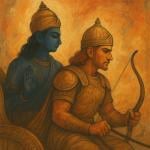
AI image generated by Author
“Endowed with these qualities, the seeker becomes fit for the highest peace.”
— Bhagavad Gita 12:20

Part 3 brings us to the final set of divine qualities — the qualities that refine the ego, purify intention, and anchor the seeker in unwavering peace. These are not outer behaviours but inner transformations. When lived sincerely, they change the very climate of the mind.
21. Tyāga — Renunciation of Doership
Tyāga is not about abandoning responsibilities; it is about releasing the inner whisper of “I did it.”
When we cling to credit, the ego tightens. When we let go of authorship, the heart softens.
This shift transforms work into worship and stress into serenity.
Tyāga teaches: Do fully, release completely.
22–25. Freedom from Rejoicing, Hatred, Grief, and Desire
A desire-driven mind is constantly tossed around:
- rejoicing when fulfilled,
- hating what obstructs it,
- grieving when it fails,
- craving when it succeeds.
Krishna calls this the emotional seesaw.
True peace begins when the pendulum stops swinging.
You still act, you still care, but you are no longer controlled by results.
This freedom is not coldness — it is inner stability.
“He neither rejoices nor hates, neither grieves nor desires.” (12:17)
26. Renouncing Good and Evil (Externally)
This is one of the most misunderstood teachings.
To renounce “good and evil” does not mean becoming immoral — it means dropping judgment.
The real battlefield is within, not outside.
The Gita asks us to stop labelling people and situations as good or bad and instead look inward:
What attachment is this triggering in me?
What desire is colouring my perception?
Spiritual maturity is the ability to see clearly without the veil of moral superiority.
27. Equanimity in Opposites
Honor–dishonor.
Praise–blame.
Success–failure.
Heat–cold.
Joy–sorrow.
Life constantly throws opposites at us. Most minds are dragged instantly by them.
The Gita’s warrior stands steady — not because life is easy, but because their center is strong.
“Be the same to friend and foe, to heat and cold, to praise and blame.” (12:18)
Equanimity is the mark of one who has tasted their own Self.
28. Freedom from Attachment
Attachment is emotional glue.
It turns love into fear, achievement into pressure, and relationships into dependency.
To love without attachment is to hold gently — offering freedom rather than fear.
Attachment suffocates; love liberates.
When we let go of clinging, relationships deepen naturally, because they are no longer weighed down by insecurity.
29. Equal in Censure and Praise
Praise inflates the ego; criticism wounds it.
Both make us dependent on others for our sense of worth.
A spiritual practitioner learns to listen without absorbing.
To accept feedback without emotional collapse.
To stand firm in one’s intention even when the world misunderstands.
When censure and praise become equal, nothing outside can disturb the inside.
30. Mauni — Silence
Silence is not the absence of speaking — it is the absence of inner noise.
One can speak few words yet remain mentally restless; another can remain outwardly active yet inwardly quiet.
Mauna is the stillness in which truth dawns.
In silence, we hear the subtle voice of the Self.
31. Santoshta Sarvathā — Content with Everything
Contentment is not laziness nor apathy.
It is a gentle acceptance of life as it is, combined with sincere effort toward what can be changed.
When we do our best and drop the rest, a soft peace settles.
Contentment is a fragrance that spreads from a heart aligned with its purpose.
32. Aniketha — Non-Attachment to Residence or Possessions
This does not mean homelessness; it means inner non-dependence.
You may own a home, but the home does not own you.
Possessions become burdens only when they become identities.
When the mind is free, everything becomes usable, nothing becomes binding.
You move through the world lightly, like a traveler — grateful, not grasping.
33. Sthira Manah — Steadiness of Mind
A steady mind is not rigid — it is centered.
It is like a lamp in a windless room, shining without flicker.
This steadiness comes from practice — meditation, reflection, disciplined living.
Each time you return the mind to the present, it becomes stronger.
Each time you refuse to be dragged by impulse, it becomes steadier.
34. Shraddhā — Faith, Reflection, and Inner Absorption
Shraddhā is not blind belief; it is lived understanding.
It is the willingness to study deeply, live sincerely, and grow continuously.
Faith gives strength where logic reaches its limit.
It keeps the heart steady when life becomes unpredictable.
Shraddhā is the foundation on which all other qualities stand.
35. Surrender to the Supreme (Mām Paramam)
The final quality is surrender — not of effort, but of ego.
Here “Me” refers to the indwelling Self — the divine consciousness that witnesses every thought.
Surrender is not defeat; it is freedom.
Freedom from fear.
Freedom from doership.
Freedom from the burden of “I must control everything.”
When the small self bows to the Higher Self, life flows with grace.
Every action becomes worship.
Every breath becomes peace.
The Final Architecture: A Mind at Peace
These thirty-five qualities are not to be memorized; they are to be lived.
Each one polishes a different facet of the personality until the mind becomes transparent, steady, and quiet.
A peaceful mind is not born — it is built.
Not through struggle, but through awareness.
Not through suppression, but through surrender.
Not through perfection, but through presence.
This is the mind of the modern Arjuna — strong, still, centered, and awake.
Previous Post
November 18, 2025
The Inner Architecture of a Peaceful Mind (Part 2)
Next Post

January 2, 2026 The Vedas Aren’t Science — But They Still Surprise Us
Recent Comments
"Frequent examination of one's conscience has been a time-tested practice recommended and practiced by sages, ..."
We Have Confused Success With Decoration
"Under the weight of the Cross, Jesus fell down three times. And every time He ..."
The Inner Architecture of a Peaceful ..."
"Yoga is much more than mere physical stretching and flexing of one's muscles. It's a ..."
The Inner Architecture of a Peaceful ..."
"After Judeo-Christian religions, I have deep respect for the Vedic traditions in their cultivation of ..."
Conversations with the Devil: Through the ..."
Browse Our Archives
Select a Category Culture forgiveness Identity Inspirational Relationship Religion Religion News Science and Religion Society and Religion Sufism Travel and Religion Uncategorized
Select a Month October 2026 August 2026 July 2026 June 2026 May 2026 April 2026 March 2026 February 2026 January 2026 November 2025 September 2025 August 2025 July 2025 June 2025 May 2025 April 2025 March 2025 February 2025 January 2025 December 2024 November 2024 October 2024 September 2024 July 2024 June 2024 May 2024 April 2024
TAKE THE
Religious Wisdom Quiz
Which book tells the story of the Israelites' escape from Egypt?
Select your answer to see how you score.
Leviticus Genesis Numbers Exodus
Related posts from Ancient Roots, Modern Fruits


The One Thing You Have Never Seen: Yourself

What Ancient Sanskrit Wisdom Says About Real Success

If the War Was Destined, Why Did Krishna...
TRENDING AT PATHEOS Hindu

Janie Learns the Way of the Cross: A...
Teaching children about Jesus' Passion can be challenging. Many parents and educators...

Looking For Good Catholic Writing - October 2026
He alone extends the heavens, and he walks upon the waves of...

In "Irreplaceable," our book on vocation and technology, Trevor Sutton and I...

I was strolling through the top floor of the brand new Parthenon...

What Does Gêvâh Mean For Kimberley Guifoyle &...
This week, a lot of the news is focused on Kimberly Guilfoyle....

INNER CIRCLE: Profound Mystery (Of Christ In All...
Ephesians 5:31-32 “For this reason, a man will leave his father and...
view all Hindu blogs
What Are Your Thoughts?leave a comment
Ad-Free & Subscriber Log-In Subscription Support
- About Us
- 2026 Calendar
- Videos
- Podcasts
- Library of World Religions
- Faith In Media Tracker
- Advertise With Us
- Write for Us
- Privacy Policy
- Terms of Service
- Do Not Sell My Data
- Contact Us
- Radiant Digital
- Manage Newsletter Subscriptions
- Unsubscribe From Notifications
- Sitemap
Copyright 2008-2026, Patheos. All rights reserved.
Subscription Support Ad-Free & Subscriber Log-In
Follow Patheos