
BuddhistCatholicContemplativeEvangelicalGeneral ChristianHinduJewishLatter-day SaintMuslimNew VisionsProgressive Christian
Beliefs
- Buddhist
- Catholic
- Contemplative
- Evangelical
- General Christian
- Hindu
- Jewish
- Latter-day Saint
- More Voices
- Muslim
- New Visions
- Pagan
- Progressive Christian
Topics
- Religion News
- Food and Religion
- Sports and Religion
- Religious Art
- Religious Music and Entertainment
- Religious Events
- History and Religion
- Style and Religion
- Politics and Religion
- Women in Religion
- Recreation Outdoors and Religion
- Business Finance and Religion
- Careers Workplace and Religion
- Education and Religion
- Family Parenting and Religion
- Health Fitness and Religion
- Home and Religion
- Relationships and Religion
- Technology and Religion
- Travel and Religion
Columnists
- Buddhist Columnists
- Business Finance and Religion Columnists
- Careers Workplace and Religion Columnists
- Catholic Columnists
- Contemplative Columnists
- Education and Religion Columnists
- Evangelists Columnists
- Family Parenting and Religion Columnists
- General Christian Columnists
- Health Fitness and Religion Columnists
- Hindu Columnists
- History and Religion Columnists
- Home and Religion Columnists
- Jewish Columnists
- More Voices Columnists
- Latter Day Columnists
- Muslim Columnists
- New Visions Columnists
- Nonreligious Columnists
- Pagan Columnists
- Politics and Religion Columnists
- Progressive Columnists
- Recreation Outdoors and Religion Columnists
- Relationships and Religion Columnists
- Religion News Columnists
- Religious Art Columnists
- Religious Events Columnists
- Religious Music and Entertainment Columnists
- Sports and Religion Columnists
- Style and Religion Columnists
- Technology and Religion Columnists
- Travel and Religion Columnists
- Women in Religion Columnists
Resource Library
- 2026 Calendar
- Library of World Religions
- The 100 Most Holy Places on Earth
- Patheos Answers
- Podcasts
- Videos
- Faith Leaders Database
- Anglican Episcopalian
- Bahai
- Baptist
- Buddhism
- Christianity
- Confucianism
- Eastern Orthodoxy
- Hinduism
- Holiness and Pentecostal
- ISKCON
- Islam
- Judaism
- Lutheran
- Methodist
- The Church of Jesus Christ of Latter-day Saints
- New Age
- Paganism
- Presbytarian and Reformed
- Protestantism
- Religion Behind the Scenes
- Roman Catholic
- Scientology
- Shia Islam
- Sikhism
- Sufism
- Sunni Islam
- Taoism
- Zen
- See all religions
Research Tools
 Ad-Free & Subscriber Log-In Subscription Support
Ad-Free & Subscriber Log-In Subscription Support
Follow Patheos 

- Trending:
- Forgiveness
- |
- Marriage
- |
- Consciousness
- |
- Death Penalty
- |
- Election
- |
- Halloween

- Home
- Hindu
- History and Religion
- The Inner Architecture of a Peaceful Mind (Part 2)
The Inner Architecture of a Peaceful Mind (Part 2)
Last updated on: November 26, 2025 at 2:32 am by Shweta Goyal
The Inner Architecture of a Peaceful Mind (Part 2) 2025-11-26T02:32:09+00:00 Shweta Goyal
Patheos Explore the world's faith through different perspectives on religion and spirituality! Patheos has the views of the prevalent religions and spiritualities of the world.
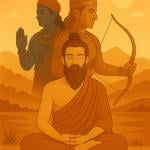
AI image generated by Author
“He whose faith is firm, whose heart and mind are devoted, who has subdued his senses—he attains peace.”
— Bhagavad Gita 4:39

11. Dhrida Nischaya — Steadfast Resolve
Conviction is the bridge between intention and transformation. Dhrida Nischaya means unshakable determination—the quiet strength that keeps us anchored when storms arise.
Spiritual growth is not a sprint; it is a lifelong journey of remembering who we are. There will be moments of doubt, fatigue, and distraction, but resolve keeps the flame burning.
Each time you fall and rise again, the soul celebrates. For resolve is not about never falling—it’s about never staying fallen.
“Those who are ever steadfast in their faith, I carry what they lack and preserve what they have.” (9:22)
12. The Spirit of Learning — Surrender, Question, and Serve
Krishna describes three qualities of a true learner: surrender, questioning, and service.
Surrender is humility—the willingness to say, “There is more for me to understand.”
Questioning keeps wisdom alive; blind acceptance leads to rigidity, but thoughtful inquiry deepens insight.
Service is gratitude in action. Knowledge is never ours alone—it flows through a lineage of teachers, parents, friends, and even life’s challenges.
Learning is not memorizing philosophy; it is the art of emptying ourselves so truth can enter.
13 & 14. Freedom from Agitation and Fear
“He who neither disturbs the world nor is disturbed by it is dear to Me.” (12:15)
When the heart is calm, it radiates stillness to everything around it. A peaceful person becomes like a cool breeze—refreshing, gentle, unobtrusive.
To be free from agitation doesn’t mean to avoid life. It means to participate with awareness, to stay centered amidst turbulence.
Fear disappears when the mind trusts the divine rhythm of life. Agitation vanishes when we stop demanding that reality fit our plans.
15. Understanding Desire — The Cycle of Emotions
Desire is subtle; it enters disguised as hope. Yet when unchecked, it binds the mind.
The Gita outlines six children of desire: Kama (craving), Krodha (anger), Lobha (greed), Mada (pride), Moha (delusion), and Matsarya (jealousy).
When one dominates, the others follow. Desire unfulfilled becomes anger; anger clouds reason; clouded reason leads to loss of peace.
Awareness breaks the chain. Observe desire without judgment and it dissolves in the light of understanding.
16. Anapeksha — Freedom from Expectation
Expectation is the shadow side of hope. It converts joy into anxiety and generosity into transaction.
The Gita’s wisdom is simple: act wholeheartedly, but release the outcome.
When we give without clinging, life responds with ease. When we expect, even love becomes labor.
Freedom from expectation doesn’t shrink ambition—it refines it into purpose.
17. Shuchi — Purity of Body, Mind, and Heart
Shuchi is not just outer cleanliness; it is inner transparency.
When our motives are pure, our presence becomes healing.
A clean environment nurtures calm, but a clean conscience radiates peace. Purity aligns our thoughts, words, and actions so that what we think, say, and do flow in one direction—truth.
18. Dakshah — Skillfulness and Efficiency
A person of Dakshata approaches every task as sacred. Excellence becomes worship when performed with mindfulness.
Lord Krishna himself, though divine, once helped arrange the guests’ footwear during a grand gathering. Even the smallest act, done with devotion, becomes a reflection of the divine.
Perfection is not the goal; presence is.
19. Udasina — Being Unconcerned but Focused on the Higher Goal
To be “unconcerned” is not indifference; it is spiritual prioritization.
When your eyes are fixed on Self-realization, petty matters lose their power.
A river heading toward the ocean doesn’t stop to count pebbles on its banks.
Udasina is that state where your heart is engaged but your peace remains unshaken.
20. Being Untroubled — Living in the Present
The restless mind wanders between two illusions—the past and the future. Regret and worry are the twin thieves of peace.
The Gita gently reminds: peace lives only in the now. When the mind is anchored in awareness, the waves of thought calm naturally.
Each breath becomes sacred, each moment complete.
“Be still in Me; rest your mind in the present.” (12:8)
Pause & Reflect
- Which of these qualities—resolve, humility, purity, or presence—feels most alive in you today?
- What expectations quietly control your happiness? Could you act without them, just once?
- When was the last time you felt truly present—free from past or future? How did that feel?
Coming Next: The Warrior Within
In the next part of this series, we’ll journey deeper into the architecture of the peaceful mind. Krishna now reveals the qualities that shape inner resilience — from dhrida nischaya (unwavering resolve) to anapeksha (freedom from expectation), from shuchi (purity) to udāsina (spiritual unconcern).
These qualities are the spiritual muscles that give strength to the modern seeker — the courage to stay calm in conflict, clear in confusion, and centered in a restless world.
Part 3 will show how these traits transform ordinary living into purposeful living, turning every moment into a step toward inner mastery.
Previous Post

November 11, 2025
The Inner Architecture of a Peaceful Mind (Part 1)
Next Post
November 26, 2025 The Inner Architecture of a Peaceful Mind (Part 3)
Recent Comments
"Frequent examination of one's conscience has been a time-tested practice recommended and practiced by sages, ..."
We Have Confused Success With Decoration
"Under the weight of the Cross, Jesus fell down three times. And every time He ..."
The Inner Architecture of a Peaceful ..."
"Yoga is much more than mere physical stretching and flexing of one's muscles. It's a ..."
The Inner Architecture of a Peaceful ..."
"After Judeo-Christian religions, I have deep respect for the Vedic traditions in their cultivation of ..."
Conversations with the Devil: Through the ..."
Browse Our Archives
Select a Category Culture forgiveness Identity Inspirational Relationship Religion Religion News Science and Religion Society and Religion Sufism Travel and Religion Uncategorized
Select a Month October 2026 August 2026 July 2026 June 2026 May 2026 April 2026 March 2026 February 2026 January 2026 November 2025 September 2025 August 2025 July 2025 June 2025 May 2025 April 2025 March 2025 February 2025 January 2025 December 2024 November 2024 October 2024 September 2024 July 2024 June 2024 May 2024 April 2024
TAKE THE
Religious Wisdom Quiz
What does "Jabez" mean in Hebrew?
Select your answer to see how you score.
Strength The Lord Saves Victory Sorrow
Related posts from Ancient Roots, Modern Fruits


The One Thing You Have Never Seen: Yourself

What Ancient Sanskrit Wisdom Says About Real Success

If the War Was Destined, Why Did Krishna...
TRENDING AT PATHEOS Hindu

In "Irreplaceable," our book on vocation and technology, Trevor Sutton and I...

I was strolling through the top floor of the brand new Parthenon...

What Does Gêvâh Mean For Kimberley Guifoyle &...
This week, a lot of the news is focused on Kimberly Guilfoyle....

INNER CIRCLE: Profound Mystery (Of Christ In All...
Ephesians 5:31-32 “For this reason, a man will leave his father and...

Do Not Rejoice When Your Enemy Falls: The...
Turning an execution into a public spectacle is a disturbing expression of...

'The Chosen' S6 Trailer: The Passion Gets Very...
Not many watching 'The Chosen' worry about spoilers, but just because they...
view all Hindu blogs
What Are Your Thoughts?leave a comment
Ad-Free & Subscriber Log-In Subscription Support
- About Us
- 2026 Calendar
- Videos
- Podcasts
- Library of World Religions
- Faith In Media Tracker
- Advertise With Us
- Write for Us
- Privacy Policy
- Terms of Service
- Do Not Sell My Data
- Contact Us
- Radiant Digital
- Manage Newsletter Subscriptions
- Unsubscribe From Notifications
- Sitemap
Copyright 2008-2026, Patheos. All rights reserved.
Subscription Support Ad-Free & Subscriber Log-In
Follow Patheos