
BuddhistCatholicContemplativeEvangelicalGeneral ChristianHinduJewishLatter-day SaintMuslimNew VisionsProgressive Christian
Beliefs
- Buddhist
- Catholic
- Contemplative
- Evangelical
- General Christian
- Hindu
- Jewish
- Latter-day Saint
- More Voices
- Muslim
- New Visions
- Pagan
- Progressive Christian
Topics
- Religion News
- Food and Religion
- Sports and Religion
- Religious Art
- Religious Music and Entertainment
- Religious Events
- History and Religion
- Style and Religion
- Politics and Religion
- Women in Religion
- Recreation Outdoors and Religion
- Business Finance and Religion
- Careers Workplace and Religion
- Education and Religion
- Family Parenting and Religion
- Health Fitness and Religion
- Home and Religion
- Relationships and Religion
- Technology and Religion
- Travel and Religion
Columnists
- Buddhist Columnists
- Business Finance and Religion Columnists
- Careers Workplace and Religion Columnists
- Catholic Columnists
- Contemplative Columnists
- Education and Religion Columnists
- Evangelists Columnists
- Family Parenting and Religion Columnists
- General Christian Columnists
- Health Fitness and Religion Columnists
- Hindu Columnists
- History and Religion Columnists
- Home and Religion Columnists
- Jewish Columnists
- More Voices Columnists
- Latter Day Columnists
- Muslim Columnists
- New Visions Columnists
- Nonreligious Columnists
- Pagan Columnists
- Politics and Religion Columnists
- Progressive Columnists
- Recreation Outdoors and Religion Columnists
- Relationships and Religion Columnists
- Religion News Columnists
- Religious Art Columnists
- Religious Events Columnists
- Religious Music and Entertainment Columnists
- Sports and Religion Columnists
- Style and Religion Columnists
- Technology and Religion Columnists
- Travel and Religion Columnists
- Women in Religion Columnists
Resource Library
- 2026 Calendar
- Library of World Religions
- The 100 Most Holy Places on Earth
- Patheos Answers
- Podcasts
- Videos
- Faith Leaders Database
- Anglican Episcopalian
- Bahai
- Baptist
- Buddhism
- Christianity
- Confucianism
- Eastern Orthodoxy
- Hinduism
- Holiness and Pentecostal
- ISKCON
- Islam
- Judaism
- Lutheran
- Methodist
- The Church of Jesus Christ of Latter-day Saints
- New Age
- Paganism
- Presbytarian and Reformed
- Protestantism
- Religion Behind the Scenes
- Roman Catholic
- Scientology
- Shia Islam
- Sikhism
- Sufism
- Sunni Islam
- Taoism
- Zen
- See all religions
Research Tools
 Ad-Free & Subscriber Log-In Subscription Support
Ad-Free & Subscriber Log-In Subscription Support
Follow Patheos 

- Trending:
- Forgiveness
- |
- Marriage
- |
- Consciousness
- |
- Death Penalty
- |
- Election
- |
- Halloween

- Home
- Hindu
- History and Religion
- Resilience Wears a Dhoti: The Bihar You Forgot
Resilience Wears a Dhoti: The Bihar You Forgot
Last updated on: September 12, 2025 at 2:54 am by Shweta Goyal
Resilience Wears a Dhoti: The Bihar You Forgot 2025-09-12T02:54:23+00:00 Shweta Goyal
Patheos Explore the world's faith through different perspectives on religion and spirituality! Patheos has the views of the prevalent religions and spiritualities of the world.
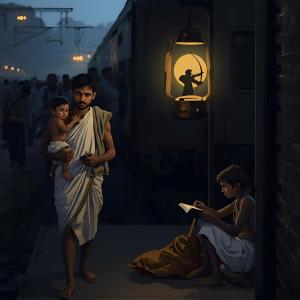
AI image created by Author
Too often, Biharis are met with prejudice.
We have all heard it in casual conversations or careless jokes:
“He is Bihari—he doesn’t know anything.”
“If a theft happens, it must be a Bihari.”
These stereotypes flow easily from our lips, repeated so often that they sound like common sense. But what if we are wrong? What if what we dismiss as backwardness is, in fact, resilience? What if behind every cracked voice, every calloused hand, and every weary face, there lies a story not of disgrace, but of dignity?
Recently, a friend of mine, a doctor in Delhi, shared something that made me stop and think. He has treated thousands of children in his career, and he told me that nearly ninety percent of them were from Bihar. We began talking about the journeys these families make—from places like Begusarai to Delhi—often with nothing but hope in their pockets. And in that conversation, I realised that Bihar is not just a land people leave in search of survival. It is a land that produces some of the most inspiring stories of grit and courage in modern India.
Beyond the caricatures
To many outsiders, the word “Bihari” conjures up images of crime, poverty, or backwardness. The jokes about language and food, the assumptions about criminality or ignorance, are not only unfair but also blind to the larger truth. Bihar is one of the oldest centres of Indian civilisation, a land that has given the world scholars like Chanakya, saints like Mahavira and Buddha, and administrators who shape the nation even today.
And yet, prejudice persists. Perhaps it is easier to laugh than to look deeper. But if we truly looked, we would see a very different Bihar—one where resilience wears a dhoti and determination grows in the most unlikely places.
The three faces of Bihar
Broadly, Bihar’s society can be seen through three layers: the rulers, the ruled, and the creamy layer within the ruled. These categories may look distinct, but in reality they overlap and flow into one another. The son of a labourer can become an officer. The daughter of a wealthy family may still carry the stories of her grandmother’s struggles. Bihar’s narrative is not a straight line—it is a woven fabric, with every fold of the dhoti holding both hardship and hope.
The creamy layer
The creamy layer represents the small section of Biharis born into privilege. Their parents have already secured wealth, power, and opportunities, allowing them to choose careers without worrying about survival. For these families, education is assured, and life is cushioned.
But to equate this privileged layer with the entire state is to misunderstand Bihar. The majority are not shielded by inherited wealth. Most Biharis must fight every day for survival, for education, and for dignity. It is in the lives of the dreamers and the survivors that Bihar’s true spirit is revealed.
The rulers – IAS dreamers
One of the most powerful examples of Bihar’s resilience is its extraordinary record of producing Indian Administrative Service (IAS) officers. The UPSC exam is one of the toughest in the world, demanding years of study, discipline, and clarity of purpose. Children in many other states grow up surrounded by resources: elite schools, expensive coaching classes, air-conditioned hostels, and financial security from family businesses.
Now imagine a boy in Begusarai. His home often loses electricity, so he studies under the flickering flame of a kerosene lamp or the dim light of a railway platform. His family cannot afford five-star coaching classes, so he relies on second-hand books or modest local institutes. He rents a small room in Delhi with three or four other aspirants, sleeping on the floor because a bed is a luxury. To pay for food and fees, he works part-time jobs—tutoring, delivering, sometimes manual labour.
And yet, he does not give up. If he fails once, he tries again. If he fails again, he tries yet another time. What keeps him going? A single-minded determination. Like Arjuna, who in the Mahabharata could see nothing but the eye of the fish, these young men and women lock their gaze on one goal: to clear the IAS exam and change not just their own lives, but the lives of their families and communities.
This is not just ambition—it is resilience, it is the transformation of struggle into strength. It is proof that where resources are scarce, willpower becomes the greatest resource of all.
The ruled – the survivors
Equally powerful, though less visible, are the stories of the ruled—the countless men and women who migrate from Bihar to cities like Delhi, Mumbai, and Kolkata, not in pursuit of elite jobs but in pursuit of survival.
Imagine a father in Begusarai whose child has fallen gravely ill. At home, hospitals offer little hope, and he doesn’t have the money for private treatment. So he gathers his meagre savings, boards a crowded general compartment to Delhi, and clutches his sick child close as the train sways through the night. The compartment is suffocating, but he endures it, whispering silent prayers with every breath.
When he steps onto the platform in Delhi, no relatives wait for him. He has no home, no plan, no safety net. His first thought is not about comfort or status but about survival. By evening, he is already working—pulling a rickshaw, carrying heavy loads, washing dishes in a roadside stall—anything that brings a few rupees. At night, his family spreads a tarpaulin in a crowded corner near the station, surrounded by other migrants with similar stories. The mother stays with their child at the hospital, standing in endless queues, while the father works tirelessly to keep them fed and to pay for treatment.
Days turn into weeks, sometimes months. He never complains about the kind of work he must do. He doesn’t ask how long the struggle will last. He just keeps going, because for him, survival is not optional. Saving his child, protecting his family, and dreaming of a better tomorrow—this is his dharma.
This is not helplessness. This is determination in its rawest form—the will to live, the strength to fight for one more day, and the courage to carry hope in the harshest of circumstances. These ordinary men and women, often invisible to us, are the very people who build our cities, drive us to work, and feed us on the roadside. Outsiders may dismiss them as “migrants,” but in truth, they are survivors. Their stories deserve not ridicule, but respect.
A real story of courage
These stories of struggle and perseverance are not confined to folklore or anonymous anecdotes. They are happening around us every day. Recently, the Times of India reported on Rohit Kumar, a construction worker from Khagaria, Bihar. By day, he carries heavy bricks at construction sites in Delhi, sometimes running with them strapped to his back. By night and dawn, he trains for marathons. Against all odds, he has emerged as a marathon champion, outrunning even professional athletes.
Rohit’s story is the living image of Bihar’s spirit. He is not just running on the track—he is running against every stereotype, every limitation, every assumption people have about his state. His dhoti is not a sign of backwardness but a symbol of strength.
The bridge between them
Whether it is the creamy layer, the IAS dreamers, or the ruled, all three classes are connected by an invisible thread of resilience. From the soil of Bihar grows both the officer who governs the nation and the worker who builds its roads. The child who studies under a streetlight may tomorrow sit in the highest corridors of power. The privileged families may still draw their dignity from the sacrifices of their ancestors.
Bihar’s story is not one of poverty. It is a story of movement, of transformation, of people who refuse to give up. Like the folds of a dhoti, its history is layered with struggle, perseverance, and hope—different threads, but one fabric.
The truth
Behind every stereotype lies a deeper reality. Behind the man pulling a rickshaw is a father who chose survival over despair. Behind the mother waiting outside a hospital ward is a story of love stronger than hardship. Behind the student with a book under a lantern is the future IAS officer who will one day shape the country’s policies. Behind the labourer carrying bricks is the marathon champion breaking records with unshakable will.
These are not stories of disgrace. They are stories of resilience. They remind us that true dignity is not always wrapped in a suit and tie. Often, it wears a simple dhoti—creased, sweat-stained, humble, but unbreakable.
Bihar is not poor. Bihar is resilient. Bihar is determined. Bihar is alive with dreams that refuse to die.
It is not Bihar that is poor. It is our prejudice that is. And it is time we changed the lens through which we see.
Previous Post

August 21, 2025
Pratyaksha: Lighting the Path of Direct Experience
Next Post

September 18, 2025 Conversations with the Devil: Through the Eyes of AI
Recent Comments
"Frequent examination of one's conscience has been a time-tested practice recommended and practiced by sages, ..."
We Have Confused Success With Decoration
"Under the weight of the Cross, Jesus fell down three times. And every time He ..."
The Inner Architecture of a Peaceful ..."
"Yoga is much more than mere physical stretching and flexing of one's muscles. It's a ..."
The Inner Architecture of a Peaceful ..."
"After Judeo-Christian religions, I have deep respect for the Vedic traditions in their cultivation of ..."
Conversations with the Devil: Through the ..."
Browse Our Archives
Select a Category Culture forgiveness Identity Inspirational Relationship Religion Religion News Science and Religion Society and Religion Sufism Travel and Religion Uncategorized
Select a Month October 2026 August 2026 July 2026 June 2026 May 2026 April 2026 March 2026 February 2026 January 2026 November 2025 September 2025 August 2025 July 2025 June 2025 May 2025 April 2025 March 2025 February 2025 January 2025 December 2024 November 2024 October 2024 September 2024 July 2024 June 2024 May 2024 April 2024
TAKE THE
Religious Wisdom Quiz
True or False: 2 Peter warns that false teachers will secretly introduce destructive heresies.
Select your answer to see how you score.
FALSE TRUE
Related posts from Ancient Roots, Modern Fruits

Awakening Through Inquiry: The Power of Questioning (Part...
The Inner Architecture of a Peaceful Mind (Part...

Conversations with the Devil: Through the Eyes of...
TRENDING AT PATHEOS Hindu

'Super Scam Me' Exposes AI Jon Bon Jovi...
Leslie Pickett believed she was in a relationship with Jon Bon Jovi....

The Brazilian Remake of Kendricks' 'Flywheel' Opens in...
“Flywheel,” the story that launched the Kendrick Brothers’ filmmaking career is getting...

The Dangers of Gradual Accommodation (Winking at Sin)
Recently, the “law of gradualness” resurfaced during the opening of a weeklong,...

The Iron Gates and the Lion of the...
Yesterday, I didn't finish my report about, well, yesterday. So I'll...

The Image: On the Horror of Capitalism and...
The Image Then went the Pharisees, and took counsel how they might...

We are approaching the date of our new American national holiday: October...
view all Hindu blogs
What Are Your Thoughts?leave a comment
Ad-Free & Subscriber Log-In Subscription Support
- About Us
- 2026 Calendar
- Videos
- Podcasts
- Library of World Religions
- Faith In Media Tracker
- Advertise With Us
- Write for Us
- Privacy Policy
- Terms of Service
- Do Not Sell My Data
- Contact Us
- Radiant Digital
- Manage Newsletter Subscriptions
- Unsubscribe From Notifications
- Sitemap
Copyright 2008-2026, Patheos. All rights reserved.
Subscription Support Ad-Free & Subscriber Log-In
Follow Patheos