
BuddhistCatholicContemplativeEvangelicalGeneral ChristianHinduJewishLatter-day SaintMuslimNew VisionsProgressive Christian
Beliefs
- Buddhist
- Catholic
- Contemplative
- Evangelical
- General Christian
- Hindu
- Jewish
- Latter-day Saint
- More Voices
- Muslim
- New Visions
- Pagan
- Progressive Christian
Topics
- Religion News
- Food and Religion
- Sports and Religion
- Religious Art
- Religious Music and Entertainment
- Religious Events
- History and Religion
- Style and Religion
- Politics and Religion
- Women in Religion
- Recreation Outdoors and Religion
- Business Finance and Religion
- Careers Workplace and Religion
- Education and Religion
- Family Parenting and Religion
- Health Fitness and Religion
- Home and Religion
- Relationships and Religion
- Technology and Religion
- Travel and Religion
Columnists
- Buddhist Columnists
- Business Finance and Religion Columnists
- Careers Workplace and Religion Columnists
- Catholic Columnists
- Contemplative Columnists
- Education and Religion Columnists
- Evangelists Columnists
- Family Parenting and Religion Columnists
- General Christian Columnists
- Health Fitness and Religion Columnists
- Hindu Columnists
- History and Religion Columnists
- Home and Religion Columnists
- Jewish Columnists
- More Voices Columnists
- Latter Day Columnists
- Muslim Columnists
- New Visions Columnists
- Nonreligious Columnists
- Pagan Columnists
- Politics and Religion Columnists
- Progressive Columnists
- Recreation Outdoors and Religion Columnists
- Relationships and Religion Columnists
- Religion News Columnists
- Religious Art Columnists
- Religious Events Columnists
- Religious Music and Entertainment Columnists
- Sports and Religion Columnists
- Style and Religion Columnists
- Technology and Religion Columnists
- Travel and Religion Columnists
- Women in Religion Columnists
Resource Library
- 2026 Calendar
- Library of World Religions
- The 100 Most Holy Places on Earth
- Patheos Answers
- Podcasts
- Videos
- Faith Leaders Database
- Anglican Episcopalian
- Bahai
- Baptist
- Buddhism
- Christianity
- Confucianism
- Eastern Orthodoxy
- Hinduism
- Holiness and Pentecostal
- ISKCON
- Islam
- Judaism
- Lutheran
- Methodist
- The Church of Jesus Christ of Latter-day Saints
- New Age
- Paganism
- Presbytarian and Reformed
- Protestantism
- Religion Behind the Scenes
- Roman Catholic
- Scientology
- Shia Islam
- Sikhism
- Sufism
- Sunni Islam
- Taoism
- Zen
- See all religions
Research Tools
 Ad-Free & Subscriber Log-In Subscription Support
Ad-Free & Subscriber Log-In Subscription Support
Follow Patheos 

- Trending:
- Forgiveness
- |
- Marriage
- |
- Consciousness
- |
- Death Penalty
- |
- Election
- |
- Halloween

- Home
- Hindu
- History and Religion
- When the Guru Forgives: A Journey from Anger to Awakening
When the Guru Forgives: A Journey from Anger to Awakening
Last updated on: July 21, 2025 at 7:20 am by Shweta Goyal
When the Guru Forgives: A Journey from Anger to Awakening 2025-07-21T07:20:46+00:00 Shweta Goyal
Patheos Explore the world's faith through different perspectives on religion and spirituality! Patheos has the views of the prevalent religions and spiritualities of the world.
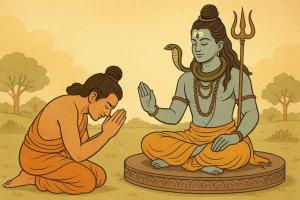
When devotion is true, even mistakes are met with grace. | AI Image generated by the Author.
Guru Purnima is a sacred day dedicated to honouring the Guru, the one who dispels darkness and guides the seeker toward truth, light, and self-realization. In Hinduism, Buddhism, and Jainism, this day holds immense significance. It is not only a day of offering gratitude but also a day of deep inner reflection, letting go, and forgiveness—qualities that are essential for spiritual growth.
At its core, Guru Purnima is not about worshipping a person—it is about awakening the Guru within, by cultivating humility, learning from our mistakes, and releasing the burdens of resentment, guilt, and ego. One of the greatest paths toward this awakening is through forgiveness.
The Guru Forgives: The Story of Upamanyu and Lord Shiva
Let us begin with a lesser-known yet profound story from the Puranas that connects both Guru Purnima and forgiveness.
A young boy named Upamanyu, the son of Sage Vishwanar, longed for spiritual awakening. He was advised to worship Lord Shiva, the Adi Guru (the first Guru). With a heart full of faith, he went into the forest and began intense austerity. Over time, he stopped eating, stopped sleeping, and stood still in meditation, his body growing frail but his soul becoming sharp with concentration.
Pleased by his unwavering devotion, Shiva decided to test him—as all great teachers do. Disguising himself as Indra, the king of the gods, Shiva approached the boy and said,
“Why do you waste your time on a deity like Shiva? He is ash-smeared, lives in cremation grounds, and keeps company with ghosts. Worship me instead—I am the lord of heaven!”
These words struck Upamanyu like fire. His eyes burned with anger. He stood up and said,
“You dare insult my Guru! Shiva is not just a deity—he is my very breath, my path, and my destination. I would rather give up my life than abandon him!”
In that moment, out of sheer loyalty and hurt, Upamanyu invoked a deadly weapon to attack “Indra.” Before it could harm him, Lord Shiva revealed his true form.
Upamanyu fell at his feet, shaken and ashamed.
“Lord! I failed to recognize you and in my anger, I committed a grave mistake. Please forgive me.”
Shiva smiled, lifted him up with compassion, and said,
“You did not fail—you passed. Your unwavering faith and willingness to defend your Guru showed your readiness for true knowledge. I forgive you, and I bless you.”
He then initiated Upamanyu into the sacred truths of the universe, transforming him into a great sage.
What This Story Teaches
This story is not merely mythological—it is psychological and spiritual. It reveals that:
- The Guru tests, not to punish, but to purify.
- The disciple falters, not because of weakness, but because he is still learning.
- Forgiveness, given and received, is the bridge between human imperfection and divine wisdom.
On Guru Purnima, we are called to bow—not just to the teacher outside, but to the inner guide. But how can we access this inner light if our minds are clouded with guilt, resentment, anger, or regret?
That is where forgiveness enters as a sacred practice.
Forgiveness as a Guru
Just as a Guru shows us our weaknesses so we can overcome them, forgiveness reveals to us where we are still holding on to pain. Forgiving others is difficult. But even harder is forgiving ourselves—for the harsh words we said, for the things we failed to do, for the opportunities we let slip away.
Yet the Guru does not look for perfection. The Guru looks for sincerity.
On this Guru Purnima, ask yourself:
- Can I forgive someone who hurt me long ago, and in doing so, free myself?
- Can I forgive myself for the ignorance of my past?
- Can I allow my mistakes to become lessons rather than prisons?
Symbolically Offering Forgiveness to the Guru
In ancient traditions, Guru Dakshina (an offering to the teacher) was given not just in the form of wealth or service, but sometimes in the form of transformation.
What if this Guru Purnima, we offer our teacher:
- A heart free from bitterness.
- A mind ready to learn, without ego.
- A soul softened by forgiveness.
Whether your Guru is a living person, a divine form, or sacred scripture like the Bhagavad Gita, remember: the greatest tribute to a teacher is not just praise—it is change.
A Modern Reflection
We live in a world full of distractions, divisions, and emotional pain. Often, we carry old grudges and unresolved grief like heavy backpacks. Guru Purnima offers a pause. It invites us to sit still and reflect:
“What can I release today to move forward lighter?”
Forgiveness is not a favour to others—it is freedom for ourselves. The Guru shows us the way, but it is we who must walk the path. And every step becomes easier when the burden of unforgiveness is lifted.
On this sacred day of Guru Purnima, let us honour our Gurus not only with flowers, incense, or words, but with a conscious decision to forgive—to forgive those who hurt us, to seek forgiveness where we have erred, and to begin anew with grace.
In the light of the full moon, may your heart also become full—with clarity, compassion, and courage.
Buddhism
Previous Post
June 19, 2025
From Palace to Peace: Bharchu’s Awakening to the Self
Next Post

August 21, 2025 Pratyaksha: Lighting the Path of Direct Experience
Recent Comments
"Frequent examination of one's conscience has been a time-tested practice recommended and practiced by sages, ..."
We Have Confused Success With Decoration
"Under the weight of the Cross, Jesus fell down three times. And every time He ..."
The Inner Architecture of a Peaceful ..."
"Yoga is much more than mere physical stretching and flexing of one's muscles. It's a ..."
The Inner Architecture of a Peaceful ..."
"After Judeo-Christian religions, I have deep respect for the Vedic traditions in their cultivation of ..."
Conversations with the Devil: Through the ..."
Browse Our Archives
Select a Category Culture forgiveness Identity Inspirational Relationship Religion Religion News Science and Religion Society and Religion Sufism Travel and Religion Uncategorized
Select a Month October 2026 August 2026 July 2026 June 2026 May 2026 April 2026 March 2026 February 2026 January 2026 November 2025 September 2025 August 2025 July 2025 June 2025 May 2025 April 2025 March 2025 February 2025 January 2025 December 2024 November 2024 October 2024 September 2024 July 2024 June 2024 May 2024 April 2024
TAKE THE
Religious Wisdom Quiz
What does the name "Abraham" mean?
Select your answer to see how you score.
He laughs God is my judge Father of many My joy
Related posts from Ancient Roots, Modern Fruits

What Ancient Sanskrit Wisdom Says About Real Success

If the War Was Destined, Why Did Krishna...
The Question That Opened the Bhagavad Gita
TRENDING AT PATHEOS Hindu

Archdiocese Hosts Military Marriage Retreat in Germany
RASTATT, Germany — The transient military lifestyle, with its frequent deployments and...

Nearly every morning, I make the drive to Detroit with my high-school-age...

The Real AI Story Is Adoption Without Trust
Artificial intelligence has crossed a political threshold. It is no longer a...

A new article, written by Jeff Lindsay and Gale L. Pooley,...

Swimfan: Forgotten Aughts Pleasures
This is a recovery effort. In 2002, My Big Fat Greek Wedding...

Top Three Anti-Catholic Lies About Catholicism
This is my initial transcript for the video, "THE 3 WORST...
view all Hindu blogs
What Are Your Thoughts?leave a comment
Ad-Free & Subscriber Log-In Subscription Support
- About Us
- 2026 Calendar
- Videos
- Podcasts
- Library of World Religions
- Faith In Media Tracker
- Advertise With Us
- Write for Us
- Privacy Policy
- Terms of Service
- Do Not Sell My Data
- Contact Us
- Radiant Digital
- Manage Newsletter Subscriptions
- Unsubscribe From Notifications
- Sitemap
Copyright 2008-2026, Patheos. All rights reserved.
Subscription Support Ad-Free & Subscriber Log-In
Follow Patheos