
BuddhistCatholicContemplativeEvangelicalGeneral ChristianHinduJewishLatter-day SaintMuslimNew VisionsProgressive Christian
Beliefs
- Buddhist
- Catholic
- Contemplative
- Evangelical
- General Christian
- Hindu
- Jewish
- Latter-day Saint
- More Voices
- Muslim
- New Visions
- Pagan
- Progressive Christian
Topics
- Religion News
- Food and Religion
- Sports and Religion
- Religious Art
- Religious Music and Entertainment
- Religious Events
- History and Religion
- Style and Religion
- Politics and Religion
- Women in Religion
- Recreation Outdoors and Religion
- Business Finance and Religion
- Careers Workplace and Religion
- Education and Religion
- Family Parenting and Religion
- Health Fitness and Religion
- Home and Religion
- Relationships and Religion
- Technology and Religion
- Travel and Religion
Columnists
- Buddhist Columnists
- Business Finance and Religion Columnists
- Careers Workplace and Religion Columnists
- Catholic Columnists
- Contemplative Columnists
- Education and Religion Columnists
- Evangelists Columnists
- Family Parenting and Religion Columnists
- General Christian Columnists
- Health Fitness and Religion Columnists
- Hindu Columnists
- History and Religion Columnists
- Home and Religion Columnists
- Jewish Columnists
- More Voices Columnists
- Latter Day Columnists
- Muslim Columnists
- New Visions Columnists
- Nonreligious Columnists
- Pagan Columnists
- Politics and Religion Columnists
- Progressive Columnists
- Recreation Outdoors and Religion Columnists
- Relationships and Religion Columnists
- Religion News Columnists
- Religious Art Columnists
- Religious Events Columnists
- Religious Music and Entertainment Columnists
- Sports and Religion Columnists
- Style and Religion Columnists
- Technology and Religion Columnists
- Travel and Religion Columnists
- Women in Religion Columnists
Resource Library
- 2026 Calendar
- Library of World Religions
- The 100 Most Holy Places on Earth
- Patheos Answers
- Podcasts
- Videos
- Faith Leaders Database
- Anglican Episcopalian
- Bahai
- Baptist
- Buddhism
- Christianity
- Confucianism
- Eastern Orthodoxy
- Hinduism
- Holiness and Pentecostal
- ISKCON
- Islam
- Judaism
- Lutheran
- Methodist
- The Church of Jesus Christ of Latter-day Saints
- New Age
- Paganism
- Presbytarian and Reformed
- Protestantism
- Religion Behind the Scenes
- Roman Catholic
- Scientology
- Shia Islam
- Sikhism
- Sufism
- Sunni Islam
- Taoism
- Zen
- See all religions
Research Tools
 Ad-Free & Subscriber Log-In Subscription Support
Ad-Free & Subscriber Log-In Subscription Support
Follow Patheos 

- Trending:
- Forgiveness
- |
- Marriage
- |
- Consciousness
- |
- Death Penalty
- |
- Election
- |
- Halloween

- Home
- Hindu
- History and Religion
- From Palace to Peace: Bharchu’s Awakening to the Self
From Palace to Peace: Bharchu’s Awakening to the Self
Last updated on: June 19, 2025 at 12:28 am by Shweta Goyal
From Palace to Peace: Bharchu’s Awakening to the Self 2025-06-19T00:28:40+00:00 Shweta Goyal
Patheos Explore the world's faith through different perspectives on religion and spirituality! Patheos has the views of the prevalent religions and spiritualities of the world.
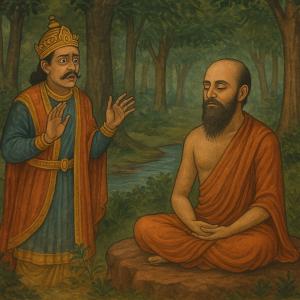
AI Image generated by Author
Vedantic teachings, drawn from the Upanishads and expanded upon in texts like the Bhagavad Gita, often speak in abstract, profound truths about the Self, the illusion of the world, and the path to liberation. But these truths, when told through stories, become accessible, engaging, and unforgettable. The tale of Bharchu, a wise minister betrayed by envy and ultimately transformed by reflection, is one such story that shines with the timeless wisdom of Vedanta.
Bharchu’s Journey: From Devotion to Detachment
Once, in a faraway kingdom, a loyal minister named Bharchu faithfully served his king. Though the king trusted him, other jealous ministers plotted against him. They hired bandits to cause chaos, then cunningly suggested Bharchu handle the crisis. Bharchu went alone, defeated the threat, and restored peace.
But while he was away, the schemers declared him dead and claimed his post. The king believed them. When Bharchu learned of this betrayal, he was not filled with revenge—but sorrow and reflection. He questioned the worth of his efforts, the meaning of praise, family, power, and wealth. Realizing their impermanence and the sorrow they bring, he renounced everything and retreated into the forest.
There, Bharchu lived simply and found profound peace. Years later, the king saw him meditating, but, blinded by fear and rumors, mistook him for a ghost and fled. Bharchu simply smiled, free from all need for recognition.
Vedantic Insights Through Bharchu’s Realization
a. Maya and Avidya (Illusion and Ignorance)
The king, once wise, becomes a victim of maya (illusion) and avidya (ignorance). He believes lies, forgets truth, and becomes terrified of Bharchu’s presence. This reflects how easily truth can be veiled when one clings to false narratives.
b. Raga, Moha, and Dukha (Attachment, Delusion, and Sorrow)
Bharchu’s sorrow arises from raga (attachment) to name, reputation, and comfort, and moha (delusion) about their permanence. His spiritual awakening begins when he questions these attachments.
c. Vairagya (Dispassion) and Viveka (Discrimination)
Through solitude and contemplation, Bharchu develops viveka (discrimination between real and unreal) and vairagya (detachment). He realizes the futility of chasing approval and power.
d. Sannyasa and Inner Freedom
Bharchu’s renunciation isn’t escape—it’s elevation. In Vedanta, sannyasa (renunciation) isn’t about outward change but inner clarity. By walking away, Bharchu walks inward, toward the Self.
The Forest and the Palace: Two Worlds, Two Realities
The palace represents ambition, ego, and social illusion. The forest is the space of inner work, solitude, and nature’s harmony. Vedantic literature often places the seeker in the forest—not because the world is bad, but because silence is needed for Self-realization.
The King’s Arc: Lost in Fear, Bound by Illusion
While Bharchu evolves, the king regresses. His fear shows how avidya causes one to misinterpret reality. The once-wise ruler cannot see the truth before him. His power and pride become his prison.
The king’s journey reminds us that leadership without inner clarity leads to blindness. Trust clouded by insecurity breeds poor judgment. Even with material power, he lacks the spiritual vision to recognize truth and goodness.
Learnings from the King’s Path:
- Trust must be anchored in discernment, not hearsay.
- Fear thrives when ignorance prevails.
- Even a great king can fall when guided by falsehood.
- Without self-reflection, power corrupts more than it protects.
Bharchu in Our World: A Mirror for Modern Minds
In today’s world, many of us are Bharchu—working hard, loyal, chasing success and praise—until life betrays us. Whether through job loss, relationship breakdowns, or health issues, the illusion breaks. Like Bharchu, we can either fall into bitterness or choose wisdom.
Ask yourself:
- What am I attached to that brings more worry than joy?
- Do I seek approval or inner peace?
- What would happen if I let go of my need to be seen, praised, or remembered?
Bharchu’s story invites us to pause, reflect, and perhaps walk into our own metaphorical forest—where true peace awaits.
The Silent Smile of Liberation
Bharchu’s final smile is the smile of one who has seen through illusion. He has no resentment, no desire for restoration, no fear. He is established in the Self. This smile is the fruit of Vedantic wisdom: freedom not from the world, but from dependence on it. He has moved from palace to peace—and shown us the path, if we dare to follow.
“Ayam Ātmā Brahma” – Mandukya Upanishad, 2
(This Self is Brahman.)
Previous Post
June 9, 2025
Salutations to Karma: The Silent Architect of the Universe
Next Post
July 21, 2025 When the Guru Forgives: A Journey from Anger to Awakening
Recent Comments
"Frequent examination of one's conscience has been a time-tested practice recommended and practiced by sages, ..."
We Have Confused Success With Decoration
"Under the weight of the Cross, Jesus fell down three times. And every time He ..."
The Inner Architecture of a Peaceful ..."
"Yoga is much more than mere physical stretching and flexing of one's muscles. It's a ..."
The Inner Architecture of a Peaceful ..."
"After Judeo-Christian religions, I have deep respect for the Vedic traditions in their cultivation of ..."
Conversations with the Devil: Through the ..."
Browse Our Archives
Select a Category Culture forgiveness Identity Inspirational Relationship Religion Religion News Science and Religion Society and Religion Sufism Travel and Religion Uncategorized
Select a Month October 2026 August 2026 July 2026 June 2026 May 2026 April 2026 March 2026 February 2026 January 2026 November 2025 September 2025 August 2025 July 2025 June 2025 May 2025 April 2025 March 2025 February 2025 January 2025 December 2024 November 2024 October 2024 September 2024 July 2024 June 2024 May 2024 April 2024
TAKE THE
Religious Wisdom Quiz
How did Moses' mother save him as a baby?
Select your answer to see how you score.
Placed him in a basket on the river Sent him to another city Hid him in a cave Dressed him as a girl
Related posts from Ancient Roots, Modern Fruits


The One Thing You Have Never Seen: Yourself

What Ancient Sanskrit Wisdom Says About Real Success

If the War Was Destined, Why Did Krishna...
TRENDING AT PATHEOS Hindu

Swimfan: Forgotten Aughts Pleasures
This is a recovery effort. In 2002, My Big Fat Greek Wedding...

Top Three Anti-Catholic Lies About Catholicism
This is my initial transcript for the video, "THE 3 WORST...

Pope Leo Celebrates Mass for Nurses & Docs...
I don't have any idea how he did it, but Pope Leo...

The Sermon on the Mount, Part I: Matthew...
The Sermon on the Mount, Part I (Matthew 4:12-5:12) St. Matthew moves...

What's up from Crossway: Reviewing some of their latest A few weeks...

Janie Learns the Way of the Cross: A...
Teaching children about Jesus' Passion can be challenging. Many parents and educators...
view all Hindu blogs
What Are Your Thoughts?leave a comment
Ad-Free & Subscriber Log-In Subscription Support
- About Us
- 2026 Calendar
- Videos
- Podcasts
- Library of World Religions
- Faith In Media Tracker
- Advertise With Us
- Write for Us
- Privacy Policy
- Terms of Service
- Do Not Sell My Data
- Contact Us
- Radiant Digital
- Manage Newsletter Subscriptions
- Unsubscribe From Notifications
- Sitemap
Copyright 2008-2026, Patheos. All rights reserved.
Subscription Support Ad-Free & Subscriber Log-In
Follow Patheos