
BuddhistCatholicContemplativeEvangelicalGeneral ChristianHinduJewishLatter-day SaintMuslimNew VisionsProgressive Christian
Beliefs
- Buddhist
- Catholic
- Contemplative
- Evangelical
- General Christian
- Hindu
- Jewish
- Latter-day Saint
- More Voices
- Muslim
- New Visions
- Pagan
- Progressive Christian
Topics
- Religion News
- Food and Religion
- Sports and Religion
- Religious Art
- Religious Music and Entertainment
- Religious Events
- History and Religion
- Style and Religion
- Politics and Religion
- Women in Religion
- Recreation Outdoors and Religion
- Business Finance and Religion
- Careers Workplace and Religion
- Education and Religion
- Family Parenting and Religion
- Health Fitness and Religion
- Home and Religion
- Relationships and Religion
- Technology and Religion
- Travel and Religion
Columnists
- Buddhist Columnists
- Business Finance and Religion Columnists
- Careers Workplace and Religion Columnists
- Catholic Columnists
- Contemplative Columnists
- Education and Religion Columnists
- Evangelists Columnists
- Family Parenting and Religion Columnists
- General Christian Columnists
- Health Fitness and Religion Columnists
- Hindu Columnists
- History and Religion Columnists
- Home and Religion Columnists
- Jewish Columnists
- More Voices Columnists
- Latter Day Columnists
- Muslim Columnists
- New Visions Columnists
- Nonreligious Columnists
- Pagan Columnists
- Politics and Religion Columnists
- Progressive Columnists
- Recreation Outdoors and Religion Columnists
- Relationships and Religion Columnists
- Religion News Columnists
- Religious Art Columnists
- Religious Events Columnists
- Religious Music and Entertainment Columnists
- Sports and Religion Columnists
- Style and Religion Columnists
- Technology and Religion Columnists
- Travel and Religion Columnists
- Women in Religion Columnists
Resource Library
- 2026 Calendar
- Library of World Religions
- The 100 Most Holy Places on Earth
- Patheos Answers
- Podcasts
- Videos
- Faith Leaders Database
- Anglican Episcopalian
- Bahai
- Baptist
- Buddhism
- Christianity
- Confucianism
- Eastern Orthodoxy
- Hinduism
- Holiness and Pentecostal
- ISKCON
- Islam
- Judaism
- Lutheran
- Methodist
- The Church of Jesus Christ of Latter-day Saints
- New Age
- Paganism
- Presbytarian and Reformed
- Protestantism
- Religion Behind the Scenes
- Roman Catholic
- Scientology
- Shia Islam
- Sikhism
- Sufism
- Sunni Islam
- Taoism
- Zen
- See all religions
Research Tools
 Ad-Free & Subscriber Log-In Subscription Support
Ad-Free & Subscriber Log-In Subscription Support
Follow Patheos 

- Trending:
- Forgiveness
- |
- Marriage
- |
- Consciousness
- |
- Death Penalty
- |
- Election
- |
- Halloween

- Home
- Hindu
- History and Religion
- The Ocean and the Palm: Rediscovering Our Divine Identity
The Ocean and the Palm: Rediscovering Our Divine Identity
Last updated on: May 15, 2025 at 1:03 am by Shweta Goyal
The Ocean and the Palm: Rediscovering Our Divine Identity 2025-05-15T01:03:30+00:00 Shweta Goyal
Patheos Explore the world's faith through different perspectives on religion and spirituality! Patheos has the views of the prevalent religions and spiritualities of the world.

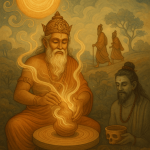
AI image generated by Author
In a world consumed by distractions, endless desires, and the relentless pursuit of material success, it is easy to forget who we truly are. We often measure our worth by what we own, how we look, or the titles we carry. Yet, deep down, there is a quiet longing—a subtle but persistent call to return to something greater than ourselves. That call is the voice of the Divine, gently reminding us of our infinite nature.
Ancient Indian philosophy beautifully illustrates this with a profound metaphor: God is like the ocean, and man is like the water held in one’s palm.
At first glance, the water in the palm and the ocean seem the same. After all, isn’t it the same substance? Yet, the difference is undeniable. The water in the palm is limited, easily evaporated or spilled. But the ocean is vast, deep, and eternal. Similarly, our individual consciousness feels limited by the boundaries of the body and mind. We identify with our roles, our possessions, and our fleeting emotions. But behind this fragile identity lies something vast, eternal, and unchanging—our true Self.
According to tradition, it was Sage Vyasa who, recognizing the difficulty of preserving these vast teachings through oral transmission alone, compiled and organized the Vedas. He entrusted them to his four foremost disciples, ensuring their survival for future generations:
- Rigveda was given to Paila.
- Yajurveda to Vaisampayana.
- Samaveda to Jaimini.
- Atharvaveda to Sumantu.
This division wasn’t merely administrative. It reflected a profound understanding of human nature and the need for structured learning. The Vedas were further classified into four layers of wisdom:
- Samhitas (Mantras for rituals),
- Brahmanas (Prose explanations of rituals),
- Aranyakas (Forest texts for contemplation),
- Upanishads (Philosophical discourses on ultimate reality).
Three Pathways of Human Pursuit
The Vedas also map out the spiritual journey through three distinct paths:
- Karmakanda – The Path of Action:
This is the domain of rituals and religious duties, found in the Mantras and Brahmanas. It speaks to those engaged in the world, performing righteous actions to uphold social and cosmic order. - Upasana Kanda – The Path of Meditation and Devotion:
Found in the Aranyakas, this path emphasizes contemplation and worship, urging seekers to look beyond external rituals and begin the inward journey. - Jnana Kanda – The Path of Knowledge:
The final destination, represented by the Upanishads, is a direct exploration of spiritual truth. It asks the ultimate questions: Who am I? What is the nature of reality? Here, the pursuit is not for worldly gains but for liberation (Moksha).
Why Do We Forget This?
The great sages of India called this forgetting Avidya—ignorance. Not ignorance in the modern sense of lack of information, but a deeper, spiritual ignorance—a veil that blinds us to our own divine nature. This ignorance is sustained by endless desires for pleasure, possessions, and recognition. We chase one desire after another, believing that the next achievement or acquisition will finally bring us happiness. But as the Bhagavad Gita warns, “Desires are like fire; the more you feed them, the more they grow.”
Until desires end—desires about the body, mind, and wealth—we cannot behold Brahman, the Absolute Reality. Like a mist over the eyes, these desires cloud our vision. The truth remains, but we are unable to see it.
Lifting the Veil
The spiritual journey is not about becoming something new but about removing what is false. Just as the sun doesn’t disappear on a cloudy day, our divine essence doesn’t vanish; it simply becomes hidden. The Upanishads declare, “Tat Tvam Asi”—That Thou Art. You are already that eternal, boundless ocean of consciousness. You don’t need to become it—you only need to realize it.
This realization comes not through intellectual debate but through inner stillness and self-inquiry. When we sit quietly and turn our attention inward, we begin to notice that thoughts, emotions, and sensations all come and go. But there is something within us that never changes—the silent witness. That is the drop of the ocean within, a reflection of the Infinite.
The Creator and the Creation
Another beautiful insight from Indian philosophy is the inseparable relationship between the Creator and the Creation. God is not a distant figure sitting in the heavens, separate from His creation. He is immanent, present in every atom of the universe. Sometimes He appears as the ocean, vast and immeasurable. Sometimes as a single drop of rain, nourishing the earth. Sometimes as the air we breathe, sometimes as the silent space between our thoughts.
This understanding bridges the gap between the sacred and the mundane. When we begin to see the Divine in everything—in every person we meet, in every sunrise, in every challenge—we experience life as sacred. Ordinary moments become extraordinary. A simple act of kindness, a shared smile, or even a moment of stillness becomes a form of worship.
Freedom Before Death
A powerful teaching found in these traditions is that salvation, or Moksha, is not something to be attained after death. True liberation is to be experienced here and now, before the body perishes. As one ancient text says, “You will get salvation before death when the veil is lifted from your eyes.”
This is not a call to renounce the world but to live in it with awakened awareness. To engage with life fully, yet remain unattached. To love deeply, work sincerely, but not lose yourself in the impermanent dramas of life.
The Final Truth
In the end, Truth always prevails. Satyam eva jayate—Truth alone triumphs. Darkness may appear powerful, but it cannot withstand the faintest light. In the same way, no matter how dense our ignorance, the light of awareness has the power to dissolve it.
The journey to rediscover our divine identity begins with a simple question: Who am I, really?
Sit with this question. Be still. Watch the mind, the emotions, the thoughts. And slowly, like the mist lifting from a calm morning lake, clarity will dawn. You will realize that you are not merely a drop of water, vulnerable and limited. You are the ocean itself—eternal, infinite, and free.
Previous Post

May 6, 2025
From Abandonment to Awakening: The Gita That Carried Me Home
Next Post
June 9, 2025 Salutations to Karma: The Silent Architect of the Universe
Recent Comments
"Frequent examination of one's conscience has been a time-tested practice recommended and practiced by sages, ..."
We Have Confused Success With Decoration
"Under the weight of the Cross, Jesus fell down three times. And every time He ..."
The Inner Architecture of a Peaceful ..."
"Yoga is much more than mere physical stretching and flexing of one's muscles. It's a ..."
The Inner Architecture of a Peaceful ..."
"After Judeo-Christian religions, I have deep respect for the Vedic traditions in their cultivation of ..."
Conversations with the Devil: Through the ..."
Browse Our Archives
Select a Category Culture forgiveness Identity Inspirational Relationship Religion Religion News Science and Religion Society and Religion Sufism Travel and Religion Uncategorized
Select a Month October 2026 August 2026 July 2026 June 2026 May 2026 April 2026 March 2026 February 2026 January 2026 November 2025 September 2025 August 2025 July 2025 June 2025 May 2025 April 2025 March 2025 February 2025 January 2025 December 2024 November 2024 October 2024 September 2024 July 2024 June 2024 May 2024 April 2024
TAKE THE
Religious Wisdom Quiz
What did King Nebuchadnezzar order everyone to worship?
Select your answer to see how you score.
The sun A golden statue His crown A lion
Related posts from Ancient Roots, Modern Fruits


The One Thing You Have Never Seen: Yourself

What Ancient Sanskrit Wisdom Says About Real Success

If the War Was Destined, Why Did Krishna...
TRENDING AT PATHEOS Hindu

Pope Leo Celebrates Mass for Nurses & Docs...
I don't have any idea how he did it, but Pope Leo...

The Sermon on the Mount, Part I: Matthew...
The Sermon on the Mount, Part I (Matthew 4:12-5:12) St. Matthew moves...

What's up from Crossway: Reviewing some of their latest A few weeks...

Janie Learns the Way of the Cross: A...
Teaching children about Jesus' Passion can be challenging. Many parents and educators...

Looking For Good Catholic Writing - October 2026
He alone extends the heavens, and he walks upon the waves of...

In "Irreplaceable," our book on vocation and technology, Trevor Sutton and I...
view all Hindu blogs
What Are Your Thoughts?leave a comment
Ad-Free & Subscriber Log-In Subscription Support
- About Us
- 2026 Calendar
- Videos
- Podcasts
- Library of World Religions
- Faith In Media Tracker
- Advertise With Us
- Write for Us
- Privacy Policy
- Terms of Service
- Do Not Sell My Data
- Contact Us
- Radiant Digital
- Manage Newsletter Subscriptions
- Unsubscribe From Notifications
- Sitemap
Copyright 2008-2026, Patheos. All rights reserved.
Subscription Support Ad-Free & Subscriber Log-In
Follow Patheos