
BuddhistCatholicContemplativeEvangelicalGeneral ChristianHinduJewishLatter-day SaintMuslimNew VisionsProgressive Christian
Beliefs
- Buddhist
- Catholic
- Contemplative
- Evangelical
- General Christian
- Hindu
- Jewish
- Latter-day Saint
- More Voices
- Muslim
- New Visions
- Pagan
- Progressive Christian
Topics
- Religion News
- Food and Religion
- Sports and Religion
- Religious Art
- Religious Music and Entertainment
- Religious Events
- History and Religion
- Style and Religion
- Politics and Religion
- Women in Religion
- Recreation Outdoors and Religion
- Business Finance and Religion
- Careers Workplace and Religion
- Education and Religion
- Family Parenting and Religion
- Health Fitness and Religion
- Home and Religion
- Relationships and Religion
- Technology and Religion
- Travel and Religion
Columnists
- Buddhist Columnists
- Business Finance and Religion Columnists
- Careers Workplace and Religion Columnists
- Catholic Columnists
- Contemplative Columnists
- Education and Religion Columnists
- Evangelists Columnists
- Family Parenting and Religion Columnists
- General Christian Columnists
- Health Fitness and Religion Columnists
- Hindu Columnists
- History and Religion Columnists
- Home and Religion Columnists
- Jewish Columnists
- More Voices Columnists
- Latter Day Columnists
- Muslim Columnists
- New Visions Columnists
- Nonreligious Columnists
- Pagan Columnists
- Politics and Religion Columnists
- Progressive Columnists
- Recreation Outdoors and Religion Columnists
- Relationships and Religion Columnists
- Religion News Columnists
- Religious Art Columnists
- Religious Events Columnists
- Religious Music and Entertainment Columnists
- Sports and Religion Columnists
- Style and Religion Columnists
- Technology and Religion Columnists
- Travel and Religion Columnists
- Women in Religion Columnists
Resource Library
- 2026 Calendar
- Library of World Religions
- The 100 Most Holy Places on Earth
- Patheos Answers
- Podcasts
- Videos
- Faith Leaders Database
- Anglican Episcopalian
- Bahai
- Baptist
- Buddhism
- Christianity
- Confucianism
- Eastern Orthodoxy
- Hinduism
- Holiness and Pentecostal
- ISKCON
- Islam
- Judaism
- Lutheran
- Methodist
- The Church of Jesus Christ of Latter-day Saints
- New Age
- Paganism
- Presbytarian and Reformed
- Protestantism
- Religion Behind the Scenes
- Roman Catholic
- Scientology
- Shia Islam
- Sikhism
- Sufism
- Sunni Islam
- Taoism
- Zen
- See all religions
Research Tools
 Ad-Free & Subscriber Log-In Subscription Support
Ad-Free & Subscriber Log-In Subscription Support
Follow Patheos 

- Trending:
- Forgiveness
- |
- Marriage
- |
- Consciousness
- |
- Death Penalty
- |
- Election
- |
- Halloween

- Home
- Hindu
- History and Religion
- Celestial Shadows and Sacred Light: Blood Worm Moon Eclipse
Celestial Shadows and Sacred Light: Blood Worm Moon Eclipse
Last updated on: May 7, 2025 at 12:33 pm by Shweta Goyal
Celestial Shadows and Sacred Light: Blood Worm Moon Eclipse 2025-05-07T12:33:04+00:00 Shweta Goyal
Patheos Explore the world's faith through different perspectives on religion and spirituality! Patheos has the views of the prevalent religions and spiritualities of the world.
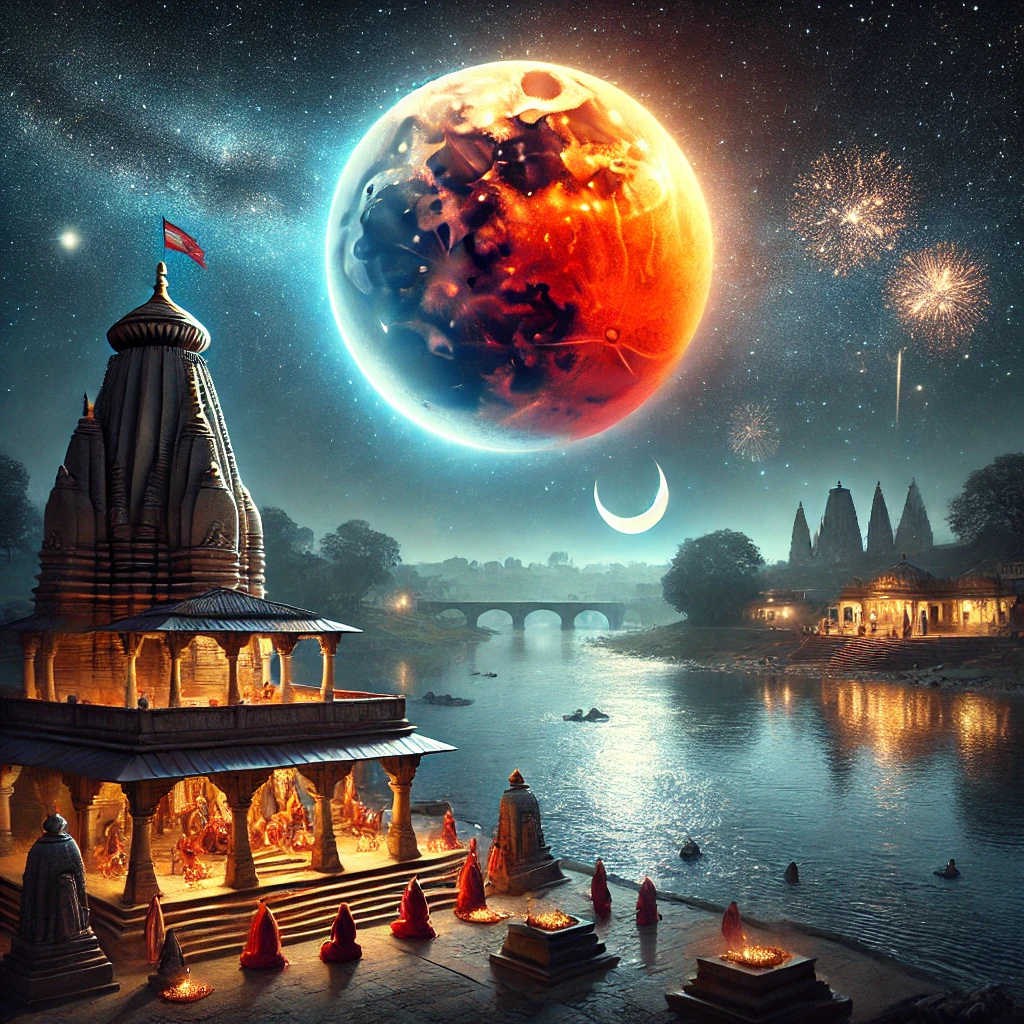
In Hindu astrology (Jyotish Shastra), eclipses are considered powerful yet turbulent periods. | AI Image created by Author.
Lunar Eclipse and the Blood Worm Moon: A Hindu Perspective on Celestial Phenomena
There are nights when emotions seem to ebb and flow with the lunar tide, moments of deep introspection, sudden nostalgia, or unexplainable restlessness. Many of us experience mood swings without realizing that celestial phenomena, such as eclipses, may have an unseen influence on our consciousness. In Hindu tradition, cosmic events like the lunar eclipse are not just astronomical occurrences but moments infused with deep spiritual and mythological significance.
On March 13-14, 2025, the world will witness a lunar eclipse coinciding with the Blood Worm Moon, capturing the fascination of astronomers, astrologers, and spiritual seekers alike. Hinduism views such phenomena through the lens of cosmic cycles, divine interventions, and spiritual discipline, offering a perspective that blends mythology, astrology, and introspective practice.
Hindu Scriptures and Lunar Eclipses
Hindu scriptures narrate an intriguing story behind the phenomenon of eclipses. According to the Samudra Manthan (churning of the ocean), when the gods (devas) and demons (asuras) churned the cosmic ocean for amrita (the nectar of immortality), the asura Rahu disguised himself as a god to consume it. Before the nectar could reach his body, Lord Vishnu, in his Mohini avatar, beheaded Rahu. However, since his head had already tasted the amrita, it became immortal, and both the severed head (Rahu) and the body (Ketu) were placed in the cosmos. Their eternal resentment toward the Sun and the Moon led to the phenomenon of eclipses—when Rahu swallows the Moon, a lunar eclipse occurs, but since the Moon cannot be held permanently, it re-emerges after some time.
Spiritual and Astrological Significance of the Eclipse
In Hindu astrology (Jyotish Shastra), eclipses are considered powerful yet turbulent periods. The Moon governs the mind, emotions, and stability, and when overshadowed by Rahu, it is believed to impact human consciousness, leading to heightened emotions, confusion, or restlessness. Many astrologers caution against making major decisions or starting new ventures during an eclipse due to its unpredictable energies.
The impact of a lunar eclipse on mood swings is often discussed in relation to the Nakshatra (lunar mansion) in which the eclipse occurs. Certain Nakshatras, such as Ardra, Ashlesha, and Rohini, are known to influence emotional intensity, heightened sensitivity, and fluctuations in mental states. Since the Moon represents the mind in Vedic astrology, its temporary shadowing by Rahu can cause people to experience anxiety, irritation, emotional turmoil, or deep introspection.
Hindu Practices During a Lunar Eclipse
Hindu tradition prescribes several spiritual disciplines to counteract any negative influences and harness the eclipse’s energy for inner purification:
Fasting and Cleansing
- Many Hindus observe a fast from the time the eclipse begins until it ends, refraining from eating or drinking to maintain spiritual purity.
- Taking a bath before and after the eclipse is considered essential to wash away any accumulated negative energies.
Chanting Sacred Mantras
- Reciting mantras such as the Maha Mrityunjaya Mantra or Chandra Beej Mantra (Om Shram Shreem Shraum Sah Chandraya Namah) is believed to reduce the malefic effects of the eclipse and protect spiritual well-being.
- Devotees of Lord Shiva, Vishnu, or their personal deities engage in prayers and meditation during this time.
Avoiding Certain Activities
- Cooking, eating, and engaging in worldly tasks during the eclipse period are discouraged as food is believed to absorb negative energy.
- Pregnant women are advised to stay indoors, avoid using sharp objects, and engage in prayers to safeguard themselves and their unborn child. It is believed that an eclipse’s energy may influence fetal development, making it a period of extra caution for expectant mothers.
- Women, in general, have been historically associated with the lunar cycle, and some traditions link an eclipse to fluctuations in emotions and well-being. However, modern interpretations encourage women to use this time for self-reflection and meditation.
Donating and Offering Charity
- Giving donations after an eclipse, especially food, clothes, and grains, is considered highly auspicious and can help neutralize any negative karmic effects.
The Blood Worm Moon in Hindu Context
The Blood Worm Moon is a term originating from Native American traditions, marking the last full moon of winter. However, in Hinduism, the Purnima (Full Moon) holds great significance, especially in spiritual practices. Full moons are associated with heightened energy, clarity, and divine blessings, but when paired with an eclipse, the energy shifts dramatically.
Vedic astrology suggests that a full moon eclipse can amplify internal conflicts, making it an opportune time for self-reflection, surrender, and seeking divine wisdom. Temples, ashrams, and spiritual seekers across India will likely use this time for meditation, scriptural readings, and inner contemplation.
A Time for Reflection and Renewal
Instead of fearing an eclipse, Hinduism encourages viewing it as a cosmic reminder of the impermanence of all things. Just as the Moon temporarily disappears and re-emerges, life, too, goes through cycles of obscurity and illumination. The key is to remain anchored in faith, practice spiritual discipline, and use this celestial event as an opportunity for renewal.
As the March 13-14, 2025 lunar eclipse unfolds, whether you choose to observe traditions, meditate on the grandeur of the cosmos, or simply gaze at the night sky in awe, let this celestial dance remind us of the profound interplay between the universe and the self.
Previous Post

February 26, 2025
The Silent River of Faith: Your Spiritual Identity
Next Post

April 22, 2025 When Love Stands Alone: The Gita on Emotional Intelligence
Recent Comments
"Frequent examination of one's conscience has been a time-tested practice recommended and practiced by sages, ..."
We Have Confused Success With Decoration
"Under the weight of the Cross, Jesus fell down three times. And every time He ..."
The Inner Architecture of a Peaceful ..."
"Yoga is much more than mere physical stretching and flexing of one's muscles. It's a ..."
The Inner Architecture of a Peaceful ..."
"After Judeo-Christian religions, I have deep respect for the Vedic traditions in their cultivation of ..."
Conversations with the Devil: Through the ..."
Browse Our Archives
Select a Category Culture forgiveness Identity Inspirational Relationship Religion Religion News Science and Religion Society and Religion Sufism Travel and Religion Uncategorized
Select a Month October 2026 August 2026 July 2026 June 2026 May 2026 April 2026 March 2026 February 2026 January 2026 November 2025 September 2025 August 2025 July 2025 June 2025 May 2025 April 2025 March 2025 February 2025 January 2025 December 2024 November 2024 October 2024 September 2024 July 2024 June 2024 May 2024 April 2024
TAKE THE
Religious Wisdom Quiz
Which major world religion traces its ancestry back to Abraham, along with Christianity and Judaism?
Select your answer to see how you score.
Hinduism Islam Sikhism Buddhism
Related posts from Ancient Roots, Modern Fruits


The One Thing You Have Never Seen: Yourself

What Ancient Sanskrit Wisdom Says About Real Success
When Strength Collapses: Finding the Inner Krishna
TRENDING AT PATHEOS Hindu

The Sermon on the Mount, Part I: Matthew...
The Sermon on the Mount, Part I (Matthew 4:12-5:12) St. Matthew moves...

What's up from Crossway: Reviewing some of their latest A few weeks...

Janie Learns the Way of the Cross: A...
Teaching children about Jesus' Passion can be challenging. Many parents and educators...

Looking For Good Catholic Writing - October 2026
He alone extends the heavens, and he walks upon the waves of...

In "Irreplaceable," our book on vocation and technology, Trevor Sutton and I...

I was strolling through the top floor of the brand new Parthenon...
view all Hindu blogs
What Are Your Thoughts?leave a comment
Ad-Free & Subscriber Log-In Subscription Support
- About Us
- 2026 Calendar
- Videos
- Podcasts
- Library of World Religions
- Faith In Media Tracker
- Advertise With Us
- Write for Us
- Privacy Policy
- Terms of Service
- Do Not Sell My Data
- Contact Us
- Radiant Digital
- Manage Newsletter Subscriptions
- Unsubscribe From Notifications
- Sitemap
Copyright 2008-2026, Patheos. All rights reserved.
Subscription Support Ad-Free & Subscriber Log-In
Follow Patheos