
BuddhistCatholicContemplativeEvangelicalGeneral ChristianHinduJewishLatter-day SaintMuslimNew VisionsProgressive Christian
Beliefs
- Buddhist
- Catholic
- Contemplative
- Evangelical
- General Christian
- Hindu
- Jewish
- Latter-day Saint
- More Voices
- Muslim
- New Visions
- Pagan
- Progressive Christian
Topics
- Religion News
- Food and Religion
- Sports and Religion
- Religious Art
- Religious Music and Entertainment
- Religious Events
- History and Religion
- Style and Religion
- Politics and Religion
- Women in Religion
- Recreation Outdoors and Religion
- Business Finance and Religion
- Careers Workplace and Religion
- Education and Religion
- Family Parenting and Religion
- Health Fitness and Religion
- Home and Religion
- Relationships and Religion
- Technology and Religion
- Travel and Religion
Columnists
- Buddhist Columnists
- Business Finance and Religion Columnists
- Careers Workplace and Religion Columnists
- Catholic Columnists
- Contemplative Columnists
- Education and Religion Columnists
- Evangelists Columnists
- Family Parenting and Religion Columnists
- General Christian Columnists
- Health Fitness and Religion Columnists
- Hindu Columnists
- History and Religion Columnists
- Home and Religion Columnists
- Jewish Columnists
- More Voices Columnists
- Latter Day Columnists
- Muslim Columnists
- New Visions Columnists
- Nonreligious Columnists
- Pagan Columnists
- Politics and Religion Columnists
- Progressive Columnists
- Recreation Outdoors and Religion Columnists
- Relationships and Religion Columnists
- Religion News Columnists
- Religious Art Columnists
- Religious Events Columnists
- Religious Music and Entertainment Columnists
- Sports and Religion Columnists
- Style and Religion Columnists
- Technology and Religion Columnists
- Travel and Religion Columnists
- Women in Religion Columnists
Resource Library
- 2026 Calendar
- Library of World Religions
- The 100 Most Holy Places on Earth
- Patheos Answers
- Podcasts
- Videos
- Faith Leaders Database
- Anglican Episcopalian
- Bahai
- Baptist
- Buddhism
- Christianity
- Confucianism
- Eastern Orthodoxy
- Hinduism
- Holiness and Pentecostal
- ISKCON
- Islam
- Judaism
- Lutheran
- Methodist
- The Church of Jesus Christ of Latter-day Saints
- New Age
- Paganism
- Presbytarian and Reformed
- Protestantism
- Religion Behind the Scenes
- Roman Catholic
- Scientology
- Shia Islam
- Sikhism
- Sufism
- Sunni Islam
- Taoism
- Zen
- See all religions
Research Tools
 Ad-Free & Subscriber Log-In Subscription Support
Ad-Free & Subscriber Log-In Subscription Support
Follow Patheos 

- Trending:
- Forgiveness
- |
- Marriage
- |
- Consciousness
- |
- Death Penalty
- |
- Election
- |
- Halloween

- Home
- Hindu
- History and Religion
- Forgiveness: The Triumph of Wisdom Over Ego
Forgiveness: The Triumph of Wisdom Over Ego
Last updated on: May 7, 2025 at 12:33 pm by Shweta Goyal
Forgiveness: The Triumph of Wisdom Over Ego 2025-05-07T12:33:08+00:00 Shweta Goyal
Patheos Explore the world's faith through different perspectives on religion and spirituality! Patheos has the views of the prevalent religions and spiritualities of the world.
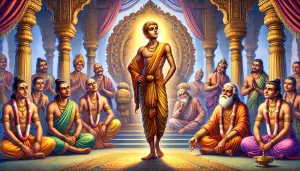
Generated by AI
We welcome all admirers of beauty, but what exactly is beauty? Have you ever seen someone use a mirror only to frown at the reflection staring back at them? Why does the mind become uneasy upon seeing wrinkles or imperfections? Is what we see truly beautiful or ugly, or is it merely a reflection of our perceptions?
The story of Ashtavakra serves as a profound reminder that beauty lies beyond physical appearances, and wisdom lies in transcending superficial judgments. It teaches us that forgiveness, humility, and wisdom ultimately triumph over the ego.
The Birth of Ashtavakra
Ashtavakra was born to the sage Kahoda and his wife, Sujata. Sujata was a devout and intelligent woman who listened to the recitation of the Vedas while pregnant. One day, as Kahoda recited the scriptures, the unborn baby corrected his father’s errors from within the womb. Feeling humiliated by being corrected by an unborn child, Kahoda cursed the baby to be born with a body bent in eight places. Hence, he was named Ashtavakra, meaning “one with eight bends.”
Early Life and Challenges
Despite his physical deformities, Ashtavakra grew up to be a brilliant and wise child, well-versed in the scriptures. However, his life was fraught with challenges. His father, Kahoda, once engaged in a debate with the scholar Vandini at King Janaka’s court and was defeated. As a result, Kahoda was drowned in a river.
Determined to honor his father’s legacy, a young Ashtavakra decided to confront Vandini and win back his father’s dignity.
The Debate at King Janaka’s Court
Ashtavakra entered King Janaka’s court, a place known for its philosophical and spiritual debates. Despite his twisted physical form, Ashtavakra’s wisdom and confidence commanded respect.
When he entered the court, many courtiers laughed at his appearance. Ashtavakra responded calmly, pointing out that their laughter revealed their superficiality and lack of wisdom. He reminded them that true judgment should be based on knowledge, not appearance.
In a profound debate with Vandini, Ashtavakra demonstrated his unmatched understanding of the Vedas and Upanishads. Vandini was defeated, and Ashtavakra restored his father’s honor. Deeply impressed by Ashtavakra’s wisdom, King Janaka became his disciple.
True Identity Lies Beyond Ego
When the courtiers laughed at Ashtavakra’s twisted body, most people in his position might have reacted defensively, driven by their ego. Instead, Ashtavakra remained calm and composed, responding with great wisdom:
“You laugh because you see only my body. The wise see the soul, not the shell.”
This response reveals that ego clings to outward appearances, but true wisdom recognizes the eternal self beyond the physical. The ego-driven focus on superficiality dissolves when faced with genuine understanding.
Ego Fails in the Face of Humility
Ashtavakra’s father, Kahoda, was initially consumed by pride when corrected by his unborn son. His ego could not accept being challenged by someone he deemed inferior—even his own child. This led to his curse on Ashtavakra, showing how ego-driven actions often lead to suffering.
In contrast, Ashtavakra displayed humility and respect when debating Vandini. His motivation was not to defeat Vandini for personal glory but to honor the truth and his father’s legacy. It was Ashtavakra’s humility and absence of ego that allowed his wisdom to shine, ultimately leading to his victory.
Judgment by Appearance Reflects Ego
The laughter of the courtiers reflected their ego-driven tendencies. They judged Ashtavakra based on his physical deformities, assuming his appearance reflected his intellect. Ashtavakra’s calm response exposed their ignorance and made them realize their error. His wisdom showed that ego limits perception, while true understanding embraces the deeper reality of the self.
Ego is the Root of Suffering; Wisdom Liberates
The story of Ashtavakra also illustrates how ego leads to suffering. Vandini, despite being a learned scholar, was ultimately defeated because his knowledge was tainted by ego. In contrast, Ashtavakra’s wisdom came from a place of purity and detachment, enabling him to rise above the need for validation.
Through his teachings to King Janaka, Ashtavakra emphasized that liberation (moksha) comes when one lets go of the ego and identifies with the unchanging self beyond the mind and body.
Wisdom is Universal, Ego is Limited
Ashtavakra’s life demonstrates that wisdom knows no boundaries of age, physical form, or societal status. While his body was bent in eight places, his intellect and spirit remained straight and unwavering. Ego measures worth in limited terms, while wisdom recognizes the universal potential within every individual.
Wisdom Wins When Ego is Lost
The essence of Ashtavakra’s story can be summarized in a single principle:
- Ego seeks validation and superiority, often through comparison and judgment.
- Wisdom seeks truth and liberation, embracing humility and recognizing the oneness of existence.
Ashtavakra’s victory was not merely over Vandini; it was a triumph of wisdom over ego, of substance over appearance, and of humility over arrogance. His story reminds us that by surrendering the ego, we unlock the infinite potential of our inner self.
Forgiveness: The Ultimate Revenge
Ashtavakra once said, “As old as the hills and the rivers are, so too is the Truth, that no one ever conquered through violence.” Forgiveness, in its purest form, becomes the ultimate revenge. By forgiving those who wronged us, we rise above the ego-driven desire for retaliation and move toward true liberation.
Forgiveness is not about weakness; it is the ultimate expression of strength. Just as Ashtavakra rose above the laughter and scorn of others, we too must rise above the petty conflicts that fuel our ego. Forgiving someone allows us to take control of our own emotions, freeing ourselves from the burden of hatred and resentment.
The story of Ashtavakra is a powerful reminder that wisdom lies beyond appearances, ego-driven desires, and superficial judgments. True liberation comes when we let go of our ego and embrace the eternal truth that resides within us all. By practicing humility, forgiveness, and wisdom, we can conquer not only our own limitations but also inspire others to do the same.
Style and Religion
Previous Post

October 21, 2024
From Innocence to Redemption: The Story of Angulimala
Next Post

December 29, 2024 Varanasi: India’s Timeless Spiritual Heart
Recent Comments
"Frequent examination of one's conscience has been a time-tested practice recommended and practiced by sages, ..."
We Have Confused Success With Decoration
"Under the weight of the Cross, Jesus fell down three times. And every time He ..."
The Inner Architecture of a Peaceful ..."
"Yoga is much more than mere physical stretching and flexing of one's muscles. It's a ..."
The Inner Architecture of a Peaceful ..."
"After Judeo-Christian religions, I have deep respect for the Vedic traditions in their cultivation of ..."
Conversations with the Devil: Through the ..."
Browse Our Archives
Select a Category Culture forgiveness Identity Inspirational Relationship Religion Religion News Science and Religion Society and Religion Sufism Travel and Religion Uncategorized
Select a Month October 2026 August 2026 July 2026 June 2026 May 2026 April 2026 March 2026 February 2026 January 2026 November 2025 September 2025 August 2025 July 2025 June 2025 May 2025 April 2025 March 2025 February 2025 January 2025 December 2024 November 2024 October 2024 September 2024 July 2024 June 2024 May 2024 April 2024
TAKE THE
Religious Wisdom Quiz
What mountain did Moses receive the Ten Commandments on?
Select your answer to see how you score.
Mount Sinai Mount Zion Mount Ararat Mount Carmel
Related posts from Ancient Roots, Modern Fruits

The One Thing You Have Never Seen: Yourself

What Ancient Sanskrit Wisdom Says About Real Success

If the War Was Destined, Why Did Krishna...

TRENDING AT PATHEOS Hindu

I was strolling through the top floor of the brand new Parthenon...

What Does Gêvâh Mean For Kimberley Guifoyle &...
This week, a lot of the news is focused on Kimberly Guilfoyle....

INNER CIRCLE: Profound Mystery (Of Christ In All...
Ephesians 5:31-32 “For this reason, a man will leave his father and...

Do Not Rejoice When Your Enemy Falls: The...
Turning an execution into a public spectacle is a disturbing expression of...

'The Chosen' S6 Trailer: The Passion Gets Very...
Not many watching 'The Chosen' worry about spoilers, but just because they...

The purpose-driven labor priest
A labor activist reads Rick Warren and it gets me wondering about...
view all Hindu blogs
What Are Your Thoughts?leave a comment
Ad-Free & Subscriber Log-In Subscription Support
- About Us
- 2026 Calendar
- Videos
- Podcasts
- Library of World Religions
- Faith In Media Tracker
- Advertise With Us
- Write for Us
- Privacy Policy
- Terms of Service
- Do Not Sell My Data
- Contact Us
- Radiant Digital
- Manage Newsletter Subscriptions
- Unsubscribe From Notifications
- Sitemap
Copyright 2008-2026, Patheos. All rights reserved.
Subscription Support Ad-Free & Subscriber Log-In
Follow Patheos