
BuddhistCatholicContemplativeEvangelicalGeneral ChristianHinduJewishLatter-day SaintMuslimNew VisionsProgressive Christian
Beliefs
- Buddhist
- Catholic
- Contemplative
- Evangelical
- General Christian
- Hindu
- Jewish
- Latter-day Saint
- More Voices
- Muslim
- New Visions
- Pagan
- Progressive Christian
Topics
- Religion News
- Food and Religion
- Sports and Religion
- Religious Art
- Religious Music and Entertainment
- Religious Events
- History and Religion
- Style and Religion
- Politics and Religion
- Women in Religion
- Recreation Outdoors and Religion
- Business Finance and Religion
- Careers Workplace and Religion
- Education and Religion
- Family Parenting and Religion
- Health Fitness and Religion
- Home and Religion
- Relationships and Religion
- Technology and Religion
- Travel and Religion
Columnists
- Buddhist Columnists
- Business Finance and Religion Columnists
- Careers Workplace and Religion Columnists
- Catholic Columnists
- Contemplative Columnists
- Education and Religion Columnists
- Evangelists Columnists
- Family Parenting and Religion Columnists
- General Christian Columnists
- Health Fitness and Religion Columnists
- Hindu Columnists
- History and Religion Columnists
- Home and Religion Columnists
- Jewish Columnists
- More Voices Columnists
- Latter Day Columnists
- Muslim Columnists
- New Visions Columnists
- Nonreligious Columnists
- Pagan Columnists
- Politics and Religion Columnists
- Progressive Columnists
- Recreation Outdoors and Religion Columnists
- Relationships and Religion Columnists
- Religion News Columnists
- Religious Art Columnists
- Religious Events Columnists
- Religious Music and Entertainment Columnists
- Sports and Religion Columnists
- Style and Religion Columnists
- Technology and Religion Columnists
- Travel and Religion Columnists
- Women in Religion Columnists
Resource Library
- 2026 Calendar
- Library of World Religions
- The 100 Most Holy Places on Earth
- Patheos Answers
- Podcasts
- Videos
- Faith Leaders Database
- Anglican Episcopalian
- Bahai
- Baptist
- Buddhism
- Christianity
- Confucianism
- Eastern Orthodoxy
- Hinduism
- Holiness and Pentecostal
- ISKCON
- Islam
- Judaism
- Lutheran
- Methodist
- The Church of Jesus Christ of Latter-day Saints
- New Age
- Paganism
- Presbytarian and Reformed
- Protestantism
- Religion Behind the Scenes
- Roman Catholic
- Scientology
- Shia Islam
- Sikhism
- Sufism
- Sunni Islam
- Taoism
- Zen
- See all religions
Research Tools
 Ad-Free & Subscriber Log-In Subscription Support
Ad-Free & Subscriber Log-In Subscription Support
Follow Patheos 

- Trending:
- Forgiveness
- |
- Marriage
- |
- Consciousness
- |
- Death Penalty
- |
- Election
- |
- Halloween

- Home
- Hindu
- History and Religion
- The Journey from the Finite to the Infinite
The Journey from the Finite to the Infinite
Last updated on: May 7, 2025 at 12:33 pm by Shweta Goyal
The Journey from the Finite to the Infinite 2025-05-07T12:33:09+00:00 Shweta Goyal
Patheos Explore the world's faith through different perspectives on religion and spirituality! Patheos has the views of the prevalent religions and spiritualities of the world.

Generated by AI. The essence of self-realization and transformation, as described in the Upanishads.
Knowing Oneself: The Key to Understanding Life
To truly understand the Indian psyche, one must delve into the teachings of the Upanishads. These ancient texts are essential because they address the core of our existence: understanding oneself. The journey of the Upanishads is a journey inward—an exploration of the self—and before we can understand the external world, we must first understand who we truly are.
The Upanishads guide us to know ourselves beyond what can be seen. They speak not of the material world but of the one who perceives it, both outwardly and inwardly. Without understanding our own sorrow, fear, misery, and illusions, we cannot reach fulfilment. The Upanishads are therefore the answer to humanity’s quest for truth and happiness. They address the constant struggle to overcome grief, fear, and bondage. They are the key to resolving the dilemmas and incongruities of life, offering answers to questions that plague our hearts.
The Upanishads teach that there is another being within us—an individual who struggles day and night to express himself, to break free from shackles, to find peace, and to experience true joy. This inner self is the part of us that rebels against restrictions, whether it’s ignoring a traffic signal or defying societal norms. But what drives this rebellion? Why is there a constant sense of dissatisfaction? We all seek happiness, but have we truly found it?
The Journey from the Finite to the Infinite
We are all on a journey—a journey from the finite to the infinite, from mortality to immortality. Yet we remain unaware of this deeper truth. Therefore, the Upanishads exhort us: “Arise! Awake! Realize the Truth!”
Why does a person wish to measure the depth of the ocean, the distance to the sun and moon, or conquer the heights of mountains? Why do we strive to break all barriers and conquer the world? Because, deep within, we know that we are infinite. We want to transcend limits because our true nature is boundless. We yearn for immortality because, at our core, we know that we are immortal.
But what is this truth, this Brahman? We often hear the phrase “Aham Brahmasmi”—I am Brahman. You are Brahman. The essence of the universe is within each of us. Brahman is formless, both subtle and vast, like the ocean and the cosmos. It is the essence that pervades all of existence.
Many of us, like Dhritarashtra, remain blindfolded by ignorance. Who can untie this blindfold? Who creates our world—is it someone else, or is it us? We are the creators of our own struggles, our joys, and our sorrows. When we ask the right questions, the answers lie within the depth of those very questions.
Wise people share the same truth in different ways. Life is like a book, and each of us must turn its pages to learn and grow. I have started turning those pages now, embarking on my own journey to understand myself and the universe.
The Transformative Power of Self-Realization: The Story of Ratnakar
In ancient India, a ruthless dacoit named Ratnakar terrorized travellers in the forest to provide for his family. One day, he encountered the sage Narada, who, instead of showing fear, asked Ratnakar why he committed such sinful acts. Ratnakar replied that he did it for his family, to feed and support them.
Narada then posed a life-changing question: “Have you asked your family if they are willing to share the burden of your sins?” Confused, Ratnakar returned home to ask them. To his shock, his family refused, stating that his actions were his own responsibility. This revelation shattered Ratnakar, and he realized that he alone was accountable for his deeds.
Filled with remorse, Ratnakar returned to Narada, seeking guidance. Narada instructed him to meditate on the name of Lord Rama until he found peace. Ratnakar dedicated himself to this task, chanting for years, until an anthill grew around him. His deep penance transformed him into a sage filled with wisdom and compassion.
Ratnakar became known as Valmiki, the sage who composed the Ramayana. His transformation from a feared dacoit to a revered sage shows the power of repentance and the possibility of change, no matter one’s past.
uddhared ātmanātmānaṁ nātmānam avasādayet
ātmaiva hyātmano bandhur ātmaiva ripur ātmanaḥ (B.G. 6.5)
Elevate yourself through the power of your mind, and not degrade yourself, for the mind can be the friend and also the enemy of the self.
You alone are your friend, and you alone are your enemy. You alone were the creator of your previous world. You alone shall create your new world too. So, get up and write your future with your own enterprise, like Ratnakar the dacoit who left his old ways and created the Ramayana.
The lesson is that man is the master of infinite possibilities—if only he could know himself.
Buddhism
Previous Post
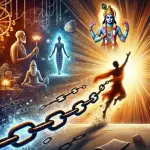
September 11, 2024
Breaking the Chains of Attachment
Next Post

October 21, 2024 From Innocence to Redemption: The Story of Angulimala
Recent Comments
"Frequent examination of one's conscience has been a time-tested practice recommended and practiced by sages, ..."
We Have Confused Success With Decoration
"Under the weight of the Cross, Jesus fell down three times. And every time He ..."
The Inner Architecture of a Peaceful ..."
"Yoga is much more than mere physical stretching and flexing of one's muscles. It's a ..."
The Inner Architecture of a Peaceful ..."
"After Judeo-Christian religions, I have deep respect for the Vedic traditions in their cultivation of ..."
Conversations with the Devil: Through the ..."
Browse Our Archives
Select a Category Culture forgiveness Identity Inspirational Relationship Religion Religion News Science and Religion Society and Religion Sufism Travel and Religion Uncategorized
Select a Month October 2026 August 2026 July 2026 June 2026 May 2026 April 2026 March 2026 February 2026 January 2026 November 2025 September 2025 August 2025 July 2025 June 2025 May 2025 April 2025 March 2025 February 2025 January 2025 December 2024 November 2024 October 2024 September 2024 July 2024 June 2024 May 2024 April 2024
TAKE THE
Religious Wisdom Quiz
What holiday celebrates Jesus rising from the dead?
Select your answer to see how you score.
Easter Pentecost Passover Christmas
Related posts from Ancient Roots, Modern Fruits


The One Thing You Have Never Seen: Yourself

What Ancient Sanskrit Wisdom Says About Real Success

If the War Was Destined, Why Did Krishna...
TRENDING AT PATHEOS Hindu

Janie Learns the Way of the Cross: A...
Teaching children about Jesus' Passion can be challenging. Many parents and educators...

Looking For Good Catholic Writing - October 2026
He alone extends the heavens, and he walks upon the waves of...

In "Irreplaceable," our book on vocation and technology, Trevor Sutton and I...

I was strolling through the top floor of the brand new Parthenon...

What Does Gêvâh Mean For Kimberley Guifoyle &...
This week, a lot of the news is focused on Kimberly Guilfoyle....

INNER CIRCLE: Profound Mystery (Of Christ In All...
Ephesians 5:31-32 “For this reason, a man will leave his father and...
view all Hindu blogs
What Are Your Thoughts?leave a comment
Ad-Free & Subscriber Log-In Subscription Support
- About Us
- 2026 Calendar
- Videos
- Podcasts
- Library of World Religions
- Faith In Media Tracker
- Advertise With Us
- Write for Us
- Privacy Policy
- Terms of Service
- Do Not Sell My Data
- Contact Us
- Radiant Digital
- Manage Newsletter Subscriptions
- Unsubscribe From Notifications
- Sitemap
Copyright 2008-2026, Patheos. All rights reserved.
Subscription Support Ad-Free & Subscriber Log-In
Follow Patheos