
BuddhistCatholicContemplativeEvangelicalGeneral ChristianHinduJewishLatter-day SaintMuslimNew VisionsProgressive Christian
Beliefs
- Buddhist
- Catholic
- Contemplative
- Evangelical
- General Christian
- Hindu
- Jewish
- Latter-day Saint
- More Voices
- Muslim
- New Visions
- Pagan
- Progressive Christian
Topics
- Religion News
- Food and Religion
- Sports and Religion
- Religious Art
- Religious Music and Entertainment
- Religious Events
- History and Religion
- Style and Religion
- Politics and Religion
- Women in Religion
- Recreation Outdoors and Religion
- Business Finance and Religion
- Careers Workplace and Religion
- Education and Religion
- Family Parenting and Religion
- Health Fitness and Religion
- Home and Religion
- Relationships and Religion
- Technology and Religion
- Travel and Religion
Columnists
- Buddhist Columnists
- Business Finance and Religion Columnists
- Careers Workplace and Religion Columnists
- Catholic Columnists
- Contemplative Columnists
- Education and Religion Columnists
- Evangelists Columnists
- Family Parenting and Religion Columnists
- General Christian Columnists
- Health Fitness and Religion Columnists
- Hindu Columnists
- History and Religion Columnists
- Home and Religion Columnists
- Jewish Columnists
- More Voices Columnists
- Latter Day Columnists
- Muslim Columnists
- New Visions Columnists
- Nonreligious Columnists
- Pagan Columnists
- Politics and Religion Columnists
- Progressive Columnists
- Recreation Outdoors and Religion Columnists
- Relationships and Religion Columnists
- Religion News Columnists
- Religious Art Columnists
- Religious Events Columnists
- Religious Music and Entertainment Columnists
- Sports and Religion Columnists
- Style and Religion Columnists
- Technology and Religion Columnists
- Travel and Religion Columnists
- Women in Religion Columnists
Resource Library
- 2026 Calendar
- Library of World Religions
- The 100 Most Holy Places on Earth
- Patheos Answers
- Podcasts
- Videos
- Faith Leaders Database
- Anglican Episcopalian
- Bahai
- Baptist
- Buddhism
- Christianity
- Confucianism
- Eastern Orthodoxy
- Hinduism
- Holiness and Pentecostal
- ISKCON
- Islam
- Judaism
- Lutheran
- Methodist
- The Church of Jesus Christ of Latter-day Saints
- New Age
- Paganism
- Presbytarian and Reformed
- Protestantism
- Religion Behind the Scenes
- Roman Catholic
- Scientology
- Shia Islam
- Sikhism
- Sufism
- Sunni Islam
- Taoism
- Zen
- See all religions
Research Tools
 Ad-Free & Subscriber Log-In Subscription Support
Ad-Free & Subscriber Log-In Subscription Support
Follow Patheos 

- Trending:
- Forgiveness
- |
- Marriage
- |
- Consciousness
- |
- Death Penalty
- |
- Election
- |
- Halloween

- Home
- Hindu
- History and Religion
- Ringing in Renewal: Celebrating Hindu New Year
Ringing in Renewal: Celebrating Hindu New Year
Last updated on: May 7, 2025 at 12:33 pm by Shweta Goyal
Ringing in Renewal: Celebrating Hindu New Year 2025-05-07T12:33:44+00:00 Shweta Goyal
Patheos Explore the world's faith through different perspectives on religion and spirituality! Patheos has the views of the prevalent religions and spiritualities of the world.
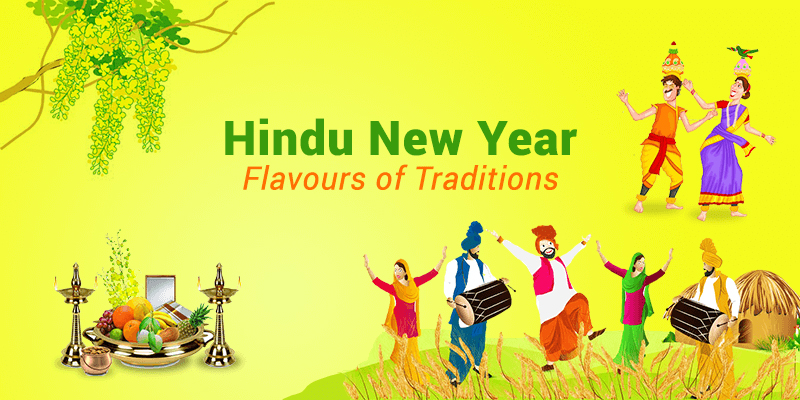

Unlike many cultures with a single, fixed date for New Year’s Day, India explodes in a vibrant kaleidoscope of celebrations throughout the year. This rich tapestry reflects the diversity of Hindu calendars, some based on lunar cycles, others on solar cycles, and still others combining both.
One widely celebrated Hindu New Year, however, falls in the springtime, typically in March or April. This lunisolar New Year, known by various names across regions, signifies the start of the new year according to the Hindu lunisolar calendar.
Forget January 1st! In the Hindu calendar, the new year begins on the first luminous day (Shukla Pratipada) of the Chaitra month. This coincides with the belief that creation, as described in the Brahma Purana, occurred during this same period. The year starts with Navratri, a nine-day festival and comes to a close with the Phalgun month of the Hindu calendar.
Regional Celebrations
Every state and region celebrates the New Year with different names and traditions.
Ugadi / Gudi Padwa:
- Celebrated in the Deccan part of India, particularly in the states of Andhra Pradesh, Telangana, Karnataka, and Maharashtra.
- Known as Ugadi in Andhra Pradesh and Karnataka and Gudi Padwa in Maharashtra.
- Festivities include decorating homes with mango leaves, making colorful rangolis, and preparing a special dish called ‘Ugadi Pachadi’ in the South, which combines various flavors symbolizing different emotions.
Chaitra Navratri / Vasanta Navratri:
- This festival marks the beginning of the new year in the Northern parts of India.
- It coincides with the nine-day festival honoring the goddess Durga.
- Devotees fast and participate in various rituals to invoke blessings.
Baisakhi:
- Predominantly celebrated in Punjab and Haryana, it falls on April 13th or 14th.
- Marks the Sikh New Year as well as the spring harvest festival.
- The day is marked with dancing, singing, wearing of festive garments, and community fairs.
Puthandu:
- The Tamil New Year, celebrated in Tamil Nadu and by Tamilians around the world.
- Homes are decorated with kolam designs, and a ritual tray of three fruits (mango, banana, and jackfruit), betel leaves, arecanut, gold/silver jewelry, money, and flowers is prepared to welcome the New Year.
Poila Boishakh:
- The Bengali New Year, celebrated in West Bengal and by Bengali communities worldwide.
- Cultural events, processions, and fairs dominate the celebrations.
- People wear traditional clothes and enjoy local delicacies.
Vishu:
- Celebrated in Kerala, Vishu signifies the astronomical new year.
- The day starts with the ‘Vishukkani’, where a ceremonial arrangement of vegetables, fruits, flowers, and lamps is viewed early in the morning to ensure a prosperous year ahead.
Unveiling the History of Hindu New Year
Legend tells of Vikramaditya, a revered king of Ujjain, who supposedly liberated his people from Saka rule nearly 2,068 years ago. This event marks the origin of the Vikram Samvat calendar, traditionally used in India and running 57 years ahead of the Gregorian calendar. Today, the year is 2081 according to Vikram Samvat.
The Hindu New Year, also known as Vikram Samvat, falls on the first day of the bright fortnight (Shukla Paksha) in the Chaitra month. Celebrated for its astronomical accuracy, it coincides with the first day of the Baishakh month in some Indian states.
The science behind Hindu New year
Hindu New Year isn’t just a cultural celebration; it’s evidence of India’s rich astronomical heritage. Vedic texts, dating back far beyond 1400 BC (even earlier than Babylonian astronomy), demonstrate India’s long standing fascination with the cosmos. Concepts like Tithis (dates) and Nakshatras (stellar groupings) were cornerstones of this early study. Generations of astronomers, like Aryabhatta, further refined these ideas, culminating in the Panchangs, or Hindu calendars.
The magic of the Hindu New Year lies in its Lunisolar nature, reflecting both the moon’s cycles and the sun’s position. This connection goes beyond culture; it’s a scientific link to the Earth’s movements. Spring arrives with Pratipada, a time of joy and agricultural bounty as crops ripen. The Nakshatras, or lunar mansions, align favorably for new beginnings. With the Earth’s tilt, the Northern Hemisphere basks in the sun’s peak energy for 21 days following the New Year. This astronomical dance dictates the timing: the first day of the waxing moon, following the first new moon after the equinox, marks the year’s official start.
The celebration begins with the first rays of dawn and continues until the next sunrise. Astrologically speaking, Saturn, the planet of karma and justice, reigns supreme this year.
Significance and Customs
A time of fresh beginnings, Hindu Nav Varsh ushers in a new year for Hindus worldwide. It’s a vibrant celebration symbolizing life’s renewal, the triumph of good, and a chance to embark on a new chapter. Devotees use this occasion to delve inwards, set positive goals, and pursue spiritual aspirations.
Nav Varsh fosters a sense of unity. Families, even those scattered across the globe, come together (whether virtually or in person) to celebrate their shared heritage and traditions. It’s a day to rejoice in their faith and the values that bind them together. Beyond its cultural and religious importance, the Hindu New Year coincides with the beginning of the harvest season for many regions across India.
Ringing in the New Year brings fresh hope, renewed plans, and a fresh financial cycle. Devotees pay their respects to goddesses Durga and Lakshmi, and Lord Kubera, seeking blessings for prosperity. Homes are adorned with vibrant rangolis, delicious sweets and dishes are prepared, and temples see a surge of visitors eager to start the year on an auspicious note.
A vibrant tapestry woven from tradition and nature, the Hindu New Year celebrates the rich diversity of Hindu culture. Each region’s unique customs and rituals during this festive season showcase both the unity and variations within the Hindu community. From joy and prosperity to the promise of renewal, core values resonate across the subcontinent. Embracing these traditions is more than a celebration; it’s an acknowledgement of a precious heritage that adds vibrancy to the global cultural landscape.
Previous Post
April 18, 2024
Scientific Brilliance: Surya Tilak's Divine Light
Next Post

April 25, 2024 ‘AUM’: The Universal Vibration of Spiritual Harmony
Recent Comments
"Frequent examination of one's conscience has been a time-tested practice recommended and practiced by sages, ..."
We Have Confused Success With Decoration
"Under the weight of the Cross, Jesus fell down three times. And every time He ..."
The Inner Architecture of a Peaceful ..."
"Yoga is much more than mere physical stretching and flexing of one's muscles. It's a ..."
The Inner Architecture of a Peaceful ..."
"After Judeo-Christian religions, I have deep respect for the Vedic traditions in their cultivation of ..."
Conversations with the Devil: Through the ..."
Browse Our Archives
Select a Category Culture forgiveness Identity Inspirational Relationship Religion Religion News Science and Religion Society and Religion Sufism Travel and Religion Uncategorized
Select a Month October 2026 August 2026 July 2026 June 2026 May 2026 April 2026 March 2026 February 2026 January 2026 November 2025 September 2025 August 2025 July 2025 June 2025 May 2025 April 2025 March 2025 February 2025 January 2025 December 2024 November 2024 October 2024 September 2024 July 2024 June 2024 May 2024 April 2024
TAKE THE
Religious Wisdom Quiz
Who said, "Man shall not live on bread alone, but on every word that comes from the mouth of God"?
Select your answer to see how you score.
Elijah David Moses Jesus
Related posts from Ancient Roots, Modern Fruits
Life's Report Card: Is Karma Real?

‘AUM’: The Universal Vibration of Spiritual Harmony


The One Thing You Have Never Seen: Yourself
TRENDING AT PATHEOS Hindu

Swimfan: Forgotten Aughts Pleasures
This is a recovery effort. In 2002, My Big Fat Greek Wedding...

Top Three Anti-Catholic Lies About Catholicism
This is my initial transcript for the video, "THE 3 WORST...

Pope Leo Celebrates Mass for Nurses & Docs...
I don't have any idea how he did it, but Pope Leo...

The Sermon on the Mount, Part I: Matthew...
The Sermon on the Mount, Part I (Matthew 4:12-5:12) St. Matthew moves...

What's up from Crossway: Reviewing some of their latest A few weeks...

Janie Learns the Way of the Cross: A...
Teaching children about Jesus' Passion can be challenging. Many parents and educators...
view all Hindu blogs
What Are Your Thoughts?leave a comment
Ad-Free & Subscriber Log-In Subscription Support
- About Us
- 2026 Calendar
- Videos
- Podcasts
- Library of World Religions
- Faith In Media Tracker
- Advertise With Us
- Write for Us
- Privacy Policy
- Terms of Service
- Do Not Sell My Data
- Contact Us
- Radiant Digital
- Manage Newsletter Subscriptions
- Unsubscribe From Notifications
- Sitemap
Copyright 2008-2026, Patheos. All rights reserved.
Subscription Support Ad-Free & Subscriber Log-In
Follow Patheos