
BuddhistCatholicContemplativeEvangelicalGeneral ChristianHinduJewishLatter-day SaintMuslimNew VisionsProgressive Christian
Beliefs
- Buddhist
- Catholic
- Contemplative
- Evangelical
- General Christian
- Hindu
- Jewish
- Latter-day Saint
- More Voices
- Muslim
- New Visions
- Pagan
- Progressive Christian
Topics
- Religion News
- Food and Religion
- Sports and Religion
- Religious Art
- Religious Music and Entertainment
- Religious Events
- History and Religion
- Style and Religion
- Politics and Religion
- Women in Religion
- Recreation Outdoors and Religion
- Business Finance and Religion
- Careers Workplace and Religion
- Education and Religion
- Family Parenting and Religion
- Health Fitness and Religion
- Home and Religion
- Relationships and Religion
- Technology and Religion
- Travel and Religion
Columnists
- Buddhist Columnists
- Business Finance and Religion Columnists
- Careers Workplace and Religion Columnists
- Catholic Columnists
- Contemplative Columnists
- Education and Religion Columnists
- Evangelists Columnists
- Family Parenting and Religion Columnists
- General Christian Columnists
- Health Fitness and Religion Columnists
- Hindu Columnists
- History and Religion Columnists
- Home and Religion Columnists
- Jewish Columnists
- More Voices Columnists
- Latter Day Columnists
- Muslim Columnists
- New Visions Columnists
- Nonreligious Columnists
- Pagan Columnists
- Politics and Religion Columnists
- Progressive Columnists
- Recreation Outdoors and Religion Columnists
- Relationships and Religion Columnists
- Religion News Columnists
- Religious Art Columnists
- Religious Events Columnists
- Religious Music and Entertainment Columnists
- Sports and Religion Columnists
- Style and Religion Columnists
- Technology and Religion Columnists
- Travel and Religion Columnists
- Women in Religion Columnists
Resource Library
- 2026 Calendar
- Library of World Religions
- The 100 Most Holy Places on Earth
- Patheos Answers
- Podcasts
- Videos
- Faith Leaders Database
- Anglican Episcopalian
- Bahai
- Baptist
- Buddhism
- Christianity
- Confucianism
- Eastern Orthodoxy
- Hinduism
- Holiness and Pentecostal
- ISKCON
- Islam
- Judaism
- Lutheran
- Methodist
- The Church of Jesus Christ of Latter-day Saints
- New Age
- Paganism
- Presbytarian and Reformed
- Protestantism
- Religion Behind the Scenes
- Roman Catholic
- Scientology
- Shia Islam
- Sikhism
- Sufism
- Sunni Islam
- Taoism
- Zen
- See all religions
Research Tools
 Ad-Free & Subscriber Log-In Subscription Support
Ad-Free & Subscriber Log-In Subscription Support
Follow Patheos 

- Trending:
- Forgiveness
- |
- Marriage
- |
- Consciousness
- |
- Death Penalty
- |
- Election
- |
- Halloween
 Anabaptist Revisions
- Home
- Evangelical
- Politics and Religion
- Introducing A Field Guide to Christian Nonviolence—and Myself
Introducing A Field Guide to Christian Nonviolence—and Myself
Last updated on: August 16, 2022 at 2:40 pm by David C. Cramer
Introducing A Field Guide to Christian Nonviolence—and Myself 2022-08-16T14:40:37-05:00 David C. Cramer
Patheos Explore the world's faith through different perspectives on religion and spirituality! Patheos has the views of the prevalent religions and spiritualities of the world.
This Sunday, June 12, I’m speaking about Christian nonviolence with my friend Ryan Yazel at South Bend City Church, as part of a sermon series on their mantra “Everyone an Icon.” This is probably as good a time as any to mention that the book I coauthored with my friend Myles Werntz, A Field Guide to Christian Nonviolence: Key Thinkers, Activists, and Movements for the Gospel of Peace (Baker Academic, 2022), is now available!
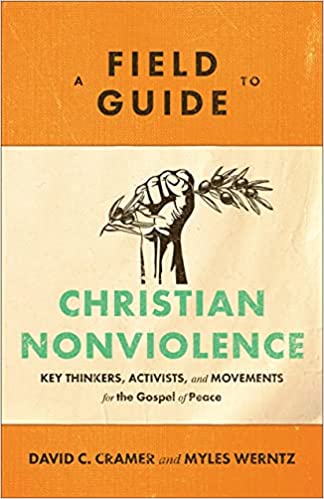
About the book
The book arose out of an article by the same name that I wrote a number of years ago for Sojourners. The premise of the article (and now book) is stated succinctly in the article’s subtitle: “There are different ways to understand the gospel’s call to peace—and that’s a good thing.”
Oftentimes when people hear the words Christian nonviolence, their mind goes quickly to either nonresistant Amish, on the one hand, or the political nonviolence of Martin Luther King Jr. and the Civil Rights Movement, on the other. Those are good starting points, but in the book we argue that Christian nonviolence isn’t so much a settled position as it is a living tradition. And as a tradition, it includes divergent and sometimes competing understandings of what Christian nonviolence is and what it entails.
In the book, we describe eight different streams of Christian nonviolence. Some focus more on nonviolence as a spiritual discipline, while others view it as more of a political practice. Some maintain that there’s no room for physical force in Christian nonviolence, while others would be open to force short of lethal force. We view these discussions over Christian nonviolence as a form of moral reasoning for Christian communities—what the apostle Paul describes as “testing and approving what God’s will is—that which is good, pleasing, and perfect” (Rom. 12:2).
Whether or not you consider yourself an adherent to Christian nonviolence, we think there’s something in the book for you. And, if you’re reading this from South Bend (hi!), you should buy it locally from my friend Kathy at Brain Lair Books.
If you want a taste of the book before buying it, Myles and I have appeared on a few podcasts to talk about it, including the Uncommontary Podcast with Marty Duren, Common Good Podcast with Doug Pagitt, New Creation Conversations with Scott Daniels, Dangerous Dogma with Brian Kaylor, Thinking Out Loud with Dave Hallahan, Bibleology Podcast with Patrick Hamilton, and Theology in the Raw with Preston Sprinkle.
About me
If you’re new to the blog, you might be wondering who this guy is writing about Christian nonviolence. Good question. My name is David Cramer, and I’m the pastor at Keller Park Church, a small, Anabaptist, urban church in South Bend, Indiana. I’ve been pastoring there since 2017. Last year, we joined the Mennonite Church USA after we had some irreconcilable differences with our former evangelical denomination. So that makes me a Mennonite, which might be a little misleading if you aren’t familiar with Mennonites. We don’t all wear plain clothes (or even plaid), and we aren’t all “ethnically” Mennonite. See, here’s a picture of my family and me at the movies:

My family and me
I grew up in an evangelical church and went to an evangelical college and seminary. We were pretty “God and country” (and Republican) growing up. But I nevertheless learned that God loves everyone. And, after 9/11, I started to think about how that “everyone” included my enemies. That thought got me reading some Anabaptist history and theology, which I first thought was pretty out there but eventually came to embrace. So a few years out of seminary, I went back to grad school at Baylor University to study theology more intently, ultimately receiving my PhD in theology and ethics at Baylor.
While in Waco, our family attended a little Mennonite house church called Hope Fellowship. The group of loving and loveable odd balls taught me about the Mennonite faith as an embodied faith in ways that my academic study couldn’t.
While in Waco, I also co-edited (with Jared Burkholder) a book on the relationship between Anabaptism and evangelicalism, The Activist Impulse: Essays on the Intersection of Evangelicalism and Anabaptism (Pickwick, 2012), as I was wrestling with that question for myself. Editing that book also helped to hone my editing skills, which I still use today as the managing editor of the Institute of Mennonite Studies at Anabaptist Mennonite Biblical Seminary (AMBS) in Elkhart, Indiana. (I do that half-time and pastor half-time.) At AMBS, I also teach the course Christian Attitudes toward War, Peace, and Revolution, which gives me regular opportunities to think through questions of violence and nonviolence in a community of scholars and practitioners from around the world. (You can read more about my academic interests on my AMBS page.)
So that’s a bit of background on why I coauthored a book on Christian nonviolence. It’s something I believe in, advocate for, and think about a lot. But since I try to be nonviolent in all areas of life, it isn’t something I would try to force on anyone else. I hope that, if you get a chance to read the book, you’ll encounter a living tradition that invites (but doesn’t coerce) you to join in. And if you find yourself in the South Bend area, look me up, and we can talk! Or, if you live farther away, you can find me on Facebook, Twitter, and Instagram—or right here on the good old-fashioned blog.
Politics and Religion

About David C. Cramer
David C. Cramer is teaching pastor at Keller Park Church in South Bend, Indiana, and managing editor at the Institute of Mennonite Studies at Anabaptist Mennonite Biblical Seminary in Elkhart, Indiana. He is co-author of A Field Guide to Christian Nonviolence (Baker Academic, 2022). You can read more about the author here.
Previous Post

May 23, 2022
Joyful defiance to carceral logic (Philippians 4:10–20)
Next Post

March 3, 2023 Resistance: Confronting Violence, Power, and Abuse within Peace Churches
Browse Our Archives
Select a Category Anabaptist Ecosystem Blogging Books Current Events Dispatches Evangelicalism Guest Post Interview Mennonite History Nonviolence Rad Women of Scripture Sermon Uncategorized
Select a Month March 2024 November 2023 August 2023 July 2023 April 2023 March 2023 June 2022 May 2022 January 2022 September 2021 August 2021 July 2021 June 2021 May 2021 April 2021 January 2021 December 2020 November 2020 October 2020 August 2020 June 2020 May 2020 February 2020 January 2020 November 2019 September 2019 August 2019 July 2019 June 2019 May 2019 April 2019 March 2019 February 2019 January 2019
Follow Us!
TAKE THE
Religious Wisdom Quiz
According to Romans, what is the gift of God?
Select your answer to see how you score.
Grace Salvation Eternal life in Christ Jesus The Holy Spirit
Related posts from Anabaptist Revisions
Mennonites hold die-in, call Rep. to support ceasefire

Revangelical: Proclaiming the Good News after Deconstruction

Little Amal comes to South Bend
Recovering from American Idolatry
TRENDING AT PATHEOS Evangelical

Emotion in Early Christianity by Andrew Crislip
Andrew Crislip’s Emotion in Early Christianity examines an often overlooked dimension of...

16 Spiritual Touchstones for a More Grounded Life
After decades of spiritual study, here are 16 principles I try...

Catholic Evangelization: Sharing Your Faith Every Day
Welcome back to the Graceful Awakening mini-series called, “From Faith to Mission.” ...

The Pillar of the Boatmen: the Ancient Monument...
The Pillar of the Boatmen is a Romano-Gaulish sculpture that dates from...

In one sense walking into Westminster Abbey is like walking down the...

'Super Scam Me' Exposes AI Jon Bon Jovi...
Leslie Pickett believed she was in a relationship with Jon Bon Jovi....
view all Evangelical blogs
Ad-Free & Subscriber Log-In Subscription Support
- About Us
- 2026 Calendar
- Videos
- Podcasts
- Library of World Religions
- Faith In Media Tracker
- Advertise With Us
- Write for Us
- Privacy Policy
- Terms of Service
- Do Not Sell My Data
- Contact Us
- Radiant Digital
- Manage Newsletter Subscriptions
- Unsubscribe From Notifications
- Sitemap
Copyright 2008-2026, Patheos. All rights reserved.
Subscription Support Ad-Free & Subscriber Log-In
Follow Patheos