
BuddhistCatholicContemplativeEvangelicalGeneral ChristianHinduJewishLatter-day SaintMuslimNew VisionsProgressive Christian
Beliefs
- Buddhist
- Catholic
- Contemplative
- Evangelical
- General Christian
- Hindu
- Jewish
- Latter-day Saint
- More Voices
- Muslim
- New Visions
- Pagan
- Progressive Christian
Topics
- Religion News
- Food and Religion
- Sports and Religion
- Religious Art
- Religious Music and Entertainment
- Religious Events
- History and Religion
- Style and Religion
- Politics and Religion
- Women in Religion
- Recreation Outdoors and Religion
- Business Finance and Religion
- Careers Workplace and Religion
- Education and Religion
- Family Parenting and Religion
- Health Fitness and Religion
- Home and Religion
- Relationships and Religion
- Technology and Religion
- Travel and Religion
Columnists
- Buddhist Columnists
- Business Finance and Religion Columnists
- Careers Workplace and Religion Columnists
- Catholic Columnists
- Contemplative Columnists
- Education and Religion Columnists
- Evangelists Columnists
- Family Parenting and Religion Columnists
- General Christian Columnists
- Health Fitness and Religion Columnists
- Hindu Columnists
- History and Religion Columnists
- Home and Religion Columnists
- Jewish Columnists
- More Voices Columnists
- Latter Day Columnists
- Muslim Columnists
- New Visions Columnists
- Nonreligious Columnists
- Pagan Columnists
- Politics and Religion Columnists
- Progressive Columnists
- Recreation Outdoors and Religion Columnists
- Relationships and Religion Columnists
- Religion News Columnists
- Religious Art Columnists
- Religious Events Columnists
- Religious Music and Entertainment Columnists
- Sports and Religion Columnists
- Style and Religion Columnists
- Technology and Religion Columnists
- Travel and Religion Columnists
- Women in Religion Columnists
Resource Library
- 2026 Calendar
- Library of World Religions
- The 100 Most Holy Places on Earth
- Patheos Answers
- Podcasts
- Videos
- Faith Leaders Database
- Anglican Episcopalian
- Bahai
- Baptist
- Buddhism
- Christianity
- Confucianism
- Eastern Orthodoxy
- Hinduism
- Holiness and Pentecostal
- ISKCON
- Islam
- Judaism
- Lutheran
- Methodist
- The Church of Jesus Christ of Latter-day Saints
- New Age
- Paganism
- Presbytarian and Reformed
- Protestantism
- Religion Behind the Scenes
- Roman Catholic
- Scientology
- Shia Islam
- Sikhism
- Sufism
- Sunni Islam
- Taoism
- Zen
- See all religions
Research Tools
 Ad-Free & Subscriber Log-In Subscription Support
Ad-Free & Subscriber Log-In Subscription Support
Follow Patheos 

- Trending:
- Forgiveness
- |
- Marriage
- |
- Consciousness
- |
- Death Penalty
- |
- Election
- |
- Halloween
 Anabaptist Revisions
- Home
- Evangelical
- Priscilla: Coequal Partner and Pastor (Acts 18)
Priscilla: Coequal Partner and Pastor (Acts 18)
Last updated on: August 29, 2021 at 12:38 pm by David C. Cramer
Priscilla: Coequal Partner and Pastor (Acts 18) 2021-08-29T12:38:20-05:00 David C. Cramer
Patheos Explore the world's faith through different perspectives on religion and spirituality! Patheos has the views of the prevalent religions and spiritualities of the world.
Priscilla: Coequal Partner and Pastor
By David C. Cramer
Read Acts 18
This post concludes our summer series, Fiercely Faithful: Rad Women of Scripture. All summer long, we’ve explored how God is fiercely faithful to women throughout Scripture, and how they each respond with their own kinds of fierce faithfulness in return.
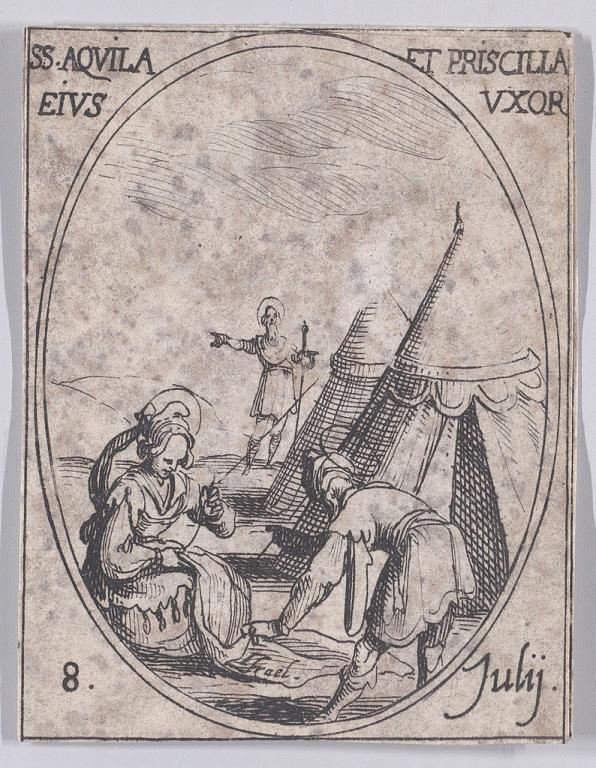
S. Aquilla et Se. Priscille, sa femme (St. Aquila and St. Priscilla, His Wife), Jacques Callot, 1636 / WikiCommons
We saw how Eve shows faith in God, becoming mother to all the living.
Pastor Carrie preached on how Hagar gives God the name “the God who sees.”
On Pentecost Sunday, we learned about the prophet Huldah who speaks truth to a king—and about how the Holy Spirit is poured out on all believers on Pentecost so we all can be Huldahs.
We learned of Shiphrah and Puah, the midwives who resist Pharaoh and reveal God as a Divine Midwife of God’s people.
We were introduced to the sisters Mahlah, Noah, Hoglah, Milcha, and Tirzah, who boldly claim their right to their property inheritance to Moses and are vindicated by God.
Jess Lyons taught us of the fierce faithfulness of Naomi and her daughters-in-law, Orpah and Ruth, who maintain their hope and faith in God and are fiercely faithful to one another.
Pastor Carrie described how Queen Vashti refuses to give in to King Xerxes’s dehumanizing demands, even when it costs her her crown.
Our friend Susannah Larry introduced us to Mother Tekoa, a wise woman who powerfully declares God’s faithful character to King David.
Pastor Carrie preached on how the Samaritan woman becomes the first evangelist of the Gospels, inviting her town to come and see the one who gives living water.
Our friend Janet Abai told the story of the woman with a flow of blood who boldly approaches Jesus for healing and wholeness.
Drew Strait explained how Junia is an outstanding apostle in the early community of faith.
Jess Lyons preached on how Mary and Martha become brave friends of Jesus.
We saw how Jesus’s mother, Mary, becomes our mother in the faith.
How the Syrophoenician woman boldly challenges Jesus and is commended for doing so.
And Brother Tim Erdel described how Phoebe is a sister, deacon, saint, spiritual mentor, and the first commentator on Paul’s letter to Rome.
With this great cloud of witnesses of fiercely faithful women in Scripture—women who faithfully preach, prophesy, teach, evangelize, and serve as deacons and apostles—the Bible seems like a liberating book for women.
Which raises the question: Why has Christianity so often seemed like an oppressive place for women?
Surely some of that has to do with pervasive patriarchal attitudes that creep into nearly all cultures and religions. But I don’t think we can discount the role of Scripture. In particular, there are passages in some of Paul’s letters where Paul seems to insist that wives must be submissive to husbands and women must be silent in church.
These passages are perplexing since, clearly, the great cloud of women witnesses in Scripture are anything but silent and submissive. So how do we make sense of this seeming inconsistency? How do we, in the words of Paul, test and approve what God’s will is—that which is good and pleasing and perfect?
One rule of Bible reading is to understand confusing or complicated passages in light of clear and straightforward ones. And so, for example, because Jesus clearly teaches that the greatest commandments are to love God and our neighbors, including our enemies, we can use that clear teaching to understand confusing or complicated laws in, say, the book of Leviticus.
But sometimes another question arises: Which passages are the clear ones? Throughout Christian history, many have claimed that Paul’s letters are clear and plain, and we should interpret the narratives of bold, rad women in light of Paul’s teaching.
But Paul’s letters are almost always in response to letters or questions from other churches in other cities. And we don’t have these letters or questions. We only have Paul’s responses. So while there is certainly much we can learn from Paul’s letters, sometimes we must admit what the apostle Peter admits in one of his letters.
Peter writes that “our beloved brother Paul also wrote to you with the wisdom God gave him—speaking of these things in all of his letters.” But then Peter adds this: “Some of [Paul’s] comments are hard to understand, and those who are ignorant and unstable have twisted his letters to mean something quite different, just as they do with other parts of Scripture” (2 Peter 3:15–16). Is it possible that, throughout history, Christians have done just that with Paul’s comments on women?
There are many good reasons to think so, including the dozens of rad women of Scripture we met this summer. But this morning I would like us to consider one particularly significant biblical woman, a woman by the name of Priscilla who we meet in the book of Acts.
Priscilla is particularly significant for a number of reasons. But one of those is that she is a close friend and coworker of Paul’s. So whatever Paul writes about women must be understood in light of his partnership with Priscilla.
Paul first meets Priscilla on his missionary journey to Greece, which takes him to the city of Corinth. Priscilla and her husband Aquila are refugees in Corinth, having been deported from Rome by Caesar along with all the other Jews living there.
We quickly learn that Priscilla and Aquila are coequal partners in every way. First, they are coequal business partners. To support themselves, they work together in the tentmaking trade. When Paul arrives in Corinth, not only do they take him into their home, but they also take into their business. All three of them live and work together to support their ministry through tentmaking.
But we soon learn that not only are Priscilla and Aquila coequal business partners. They are also coequal partners in ministry. And so, when Paul continues on his missionary journey, he takes Priscilla and Aquila with him. And he entrusts them to oversee the church in Ephesus, while he continues on to his home church in Antioch.
Soon a new evangelist arrives in town: Apollos, a learned theologian, trained in the scholarly city of Alexandria. Apollos teaches the way of Jesus boldly and accurately, but he has some deficiencies in his theology of baptism. So just as they had taken the evangelist Paul into their home when he arrived in Corinth, now Priscilla and Aquila take the evangelist Apollos into their home when he arrives in Ephesus.
Together, they teach Apollos the way of God more accurately than before. They then send him off, where he proves “to be of great benefit” to all believers, due in no small part to the theological instruction he received from the wife and husband team.
In today’s terminology, we might call Priscilla and Aquila bivocational co-pastors. They work together in their tent-making business, and they work together in ministry. As Mary Evans describes, “There is not the slightest hint of anything other than an equal partnership in every aspect of their relationship.”
Diane and Derek Tidball elaborate:
Priscilla was obviously involved in teaching Apollos alongside her husband. We are given no indication of how the teaching was apportioned, but the wording cannot be construed to mean Aquila did the teaching while Priscilla cooked the meal. No one seems to doubt that Priscilla played an intelligent and explicit role in instructing Apollos in doctrines of the faith.
There is no hint here that Priscilla was out of bounds, that she had entered territory reserved for men. She was a learned woman and a capable teacher, whose spirit reflected the Spirit of God. How shocked she would have been to learn that centuries later, Christians would quote scripture to prohibit the pastoral leadership of women—including a passage addressed to the Christians in the city where she first established her ministry!
And that, my friends, is the kicker.
Paul’s passages about women’s supposed silence and submission occur in letters he wrote to churches in Corinth and Ephesus. And these are the very churches where Paul has ministered right alongside his cominister Priscilla!
Is it possible Paul had begrudgingly ministered alongside Priscilla since she and her husband let him live and work with them? Had he put up with her preaching and teaching, while just waiting for his opportunity to later write those same churches to silence women like Priscilla?
As Paul would say, By no means!
How can we be sure of this?
Because Paul mentions Priscilla by name in these very same letters!
Here is what he writes of Priscilla in his letter to the church in Corinth: “The churches here in the province of Asia send greetings in the Lord, as do Aquila and Priscilla and all the others who gather in their home for church meetings” (1 Cor. 16:19). Paul identifies Priscilla as the co-pastor of a house church, perhaps the very house church where they had instructed Apollos.
Likewise, one of the letters to Timothy states: “Give my greetings to Priscilla and Aquila and those living in the household of Onesiphorus” (2 Tim. 4:19). Here Priscilla is named before Aquila, contrary to the common convention of naming the husband first, indicating once again that Priscilla is a coequal partner with her husband.
And, finally, in Paul’s majestic letter to the church in Rome, he writes: “Give my greetings to Priscilla and Aquila, my co-workers in the ministry of Christ Jesus. In fact, they once risked their lives for me. I am thankful to them, and so are all the Gentile churches” (Rom. 16:3–4).
Not only does Paul name Priscilla and Aquila his “co-workers in the ministry of Jesus Christ.” He also mentions how his own life and ministry are indebted to them. Without Priscilla and Aquila’s boldness, we might not have the apostle Paul or his letters. We also might not have the New Testament letter to the Hebrews, as many believe it was written by Apollos or even Priscilla herself.
And so, as a predominantly gentile church, we can join Paul and the other gentile churches in our gratitude to Priscilla and Aquila. Together they present us with a model of coequal marriage and ministry. And together they testify to the fierce faithfulness of a fiercely faithful God.
Priscilla, in particular, testifies to God’s liberation of women in the home, the church, and society. Women are freed by the Spirit to serve and lead in whatever role and capacity to which they are called by God and gifted by the Spirit. The Spirit has shattered the church’s man-made stained-glass ceiling.
As Hollyday summarizes:
It is clear that throughout Judeo-Christian history, the Spirit has blown where it has wanted to. Despite attempts to imprison it by doctrine or law, it tapped Miriam and Deborah and Huldah, Phoebe and Priscilla, and a host of other women known and unknown to carry on its work. God has not been satisfied to carry on the work of faith with only half of the available servants.
And so, as we conclude this series, let us pray these words of Christian author Linda Gehman Peachey:
Faithful God, thank you for all who have served you over the centuries:
women like Priscilla, men like Aquila.
Thank you for their example.
Help us to also find our place in your family as beloved [daughters, sons, children.] Through Jesus Christ our Lord, Amen.

About David C. Cramer
David C. Cramer is teaching pastor at Keller Park Church in South Bend, Indiana, and managing editor at the Institute of Mennonite Studies at Anabaptist Mennonite Biblical Seminary in Elkhart, Indiana. You can read more about the author here.


Next Post

August 31, 2021 What is good news and how do we communicated it? (Isaiah 40:1–11)
Browse Our Archives
Select a Category Anabaptist Ecosystem Blogging Books Current Events Dispatches Evangelicalism Guest Post Interview Mennonite History Nonviolence Rad Women of Scripture Sermon Uncategorized
Select a Month March 2024 November 2023 August 2023 July 2023 April 2023 March 2023 June 2022 May 2022 January 2022 September 2021 August 2021 July 2021 June 2021 May 2021 April 2021 January 2021 December 2020 November 2020 October 2020 August 2020 June 2020 May 2020 February 2020 January 2020 November 2019 September 2019 August 2019 July 2019 June 2019 May 2019 April 2019 March 2019 February 2019 January 2019
Follow Us!
TAKE THE
Religious Wisdom Quiz
What does "Maranatha" mean?
Select your answer to see how you score.
Come, Lord Praise Him It is finished Be joyful
Related posts from Anabaptist Revisions

Revangelical: Proclaiming the Good News after Deconstruction

Peter, Cornelius, and Evangelical Transphobia
Puzzled and terrified—an Easter homily on Luke 24:1–12

Joyful defiance to carceral logic (Philippians 4:10–20)
TRENDING AT PATHEOS Evangelical

16 Spiritual Touchstones for a More Grounded Life
After decades of spiritual study, here are 16 principles I try...

Catholic Evangelization: Sharing Your Faith Every Day
Welcome back to the Graceful Awakening mini-series called, “From Faith to Mission.” ...

The Pillar of the Boatmen: the Ancient Monument...
The Pillar of the Boatmen is a Romano-Gaulish sculpture that dates from...

In one sense walking into Westminster Abbey is like walking down the...

'Super Scam Me' Exposes AI Jon Bon Jovi...
Leslie Pickett believed she was in a relationship with Jon Bon Jovi....

The Brazilian Remake of Kendricks' 'Flywheel' Opens in...
“Flywheel,” the story that launched the Kendrick Brothers’ filmmaking career is getting...
view all Evangelical blogs
Ad-Free & Subscriber Log-In Subscription Support
- About Us
- 2026 Calendar
- Videos
- Podcasts
- Library of World Religions
- Faith In Media Tracker
- Advertise With Us
- Write for Us
- Privacy Policy
- Terms of Service
- Do Not Sell My Data
- Contact Us
- Radiant Digital
- Manage Newsletter Subscriptions
- Unsubscribe From Notifications
- Sitemap
Copyright 2008-2026, Patheos. All rights reserved.
Subscription Support Ad-Free & Subscriber Log-In
Follow Patheos