
BuddhistCatholicContemplativeEvangelicalGeneral ChristianHinduJewishLatter-day SaintMuslimNew VisionsProgressive Christian
Beliefs
- Buddhist
- Catholic
- Contemplative
- Evangelical
- General Christian
- Hindu
- Jewish
- Latter-day Saint
- More Voices
- Muslim
- New Visions
- Pagan
- Progressive Christian
Topics
- Religion News
- Food and Religion
- Sports and Religion
- Religious Art
- Religious Music and Entertainment
- Religious Events
- History and Religion
- Style and Religion
- Politics and Religion
- Women in Religion
- Recreation Outdoors and Religion
- Business Finance and Religion
- Careers Workplace and Religion
- Education and Religion
- Family Parenting and Religion
- Health Fitness and Religion
- Home and Religion
- Relationships and Religion
- Technology and Religion
- Travel and Religion
Columnists
- Buddhist Columnists
- Business Finance and Religion Columnists
- Careers Workplace and Religion Columnists
- Catholic Columnists
- Contemplative Columnists
- Education and Religion Columnists
- Evangelists Columnists
- Family Parenting and Religion Columnists
- General Christian Columnists
- Health Fitness and Religion Columnists
- Hindu Columnists
- History and Religion Columnists
- Home and Religion Columnists
- Jewish Columnists
- More Voices Columnists
- Latter Day Columnists
- Muslim Columnists
- New Visions Columnists
- Nonreligious Columnists
- Pagan Columnists
- Politics and Religion Columnists
- Progressive Columnists
- Recreation Outdoors and Religion Columnists
- Relationships and Religion Columnists
- Religion News Columnists
- Religious Art Columnists
- Religious Events Columnists
- Religious Music and Entertainment Columnists
- Sports and Religion Columnists
- Style and Religion Columnists
- Technology and Religion Columnists
- Travel and Religion Columnists
- Women in Religion Columnists
Resource Library
- 2026 Calendar
- Library of World Religions
- The 100 Most Holy Places on Earth
- Patheos Answers
- Podcasts
- Videos
- Faith Leaders Database
- Anglican Episcopalian
- Bahai
- Baptist
- Buddhism
- Christianity
- Confucianism
- Eastern Orthodoxy
- Hinduism
- Holiness and Pentecostal
- ISKCON
- Islam
- Judaism
- Lutheran
- Methodist
- The Church of Jesus Christ of Latter-day Saints
- New Age
- Paganism
- Presbytarian and Reformed
- Protestantism
- Religion Behind the Scenes
- Roman Catholic
- Scientology
- Shia Islam
- Sikhism
- Sufism
- Sunni Islam
- Taoism
- Zen
- See all religions
Research Tools
 Ad-Free & Subscriber Log-In Subscription Support
Ad-Free & Subscriber Log-In Subscription Support
Follow Patheos 

- Trending:
- Forgiveness
- |
- Marriage
- |
- Consciousness
- |
- Death Penalty
- |
- Election
- |
- Halloween
 Anabaptist Revisions
- Home
- Evangelical
- Mother Mary: Undaunted Faith (Luke 1:26–56)
Mother Mary: Undaunted Faith (Luke 1:26–56)
Last updated on: August 5, 2021 at 8:52 am by David C. Cramer
Mother Mary: Undaunted Faith (Luke 1:26–56) 2021-08-05T08:52:23-05:00 David C. Cramer
Patheos Explore the world's faith through different perspectives on religion and spirituality! Patheos has the views of the prevalent religions and spiritualities of the world.
Mother Mary: Undaunted Faith
By David C. Cramer
Read Luke 1:26–56
Growing up as an evangelical in the South Bend area was an interesting experiment in compartmentalization. On the one hand, as evangelicals, we were deeply suspicious of Catholicism. We thought Catholics were works based, superstitious, ritualistic, and hypocritical. On the other hand, as South Benders, we loved Notre Dame football. We loved their work ethic, superstitions, and rituals! So I guess you could say that we were the hypocritical ones. Except that we didn’t know any better.
I knew Notre Dame was Catholic, but it didn’t really occur to me that “touchdown Jesus” and the Golden Dome were anything more than interesting landmarks surrounding Notre Dame stadium. In fact, I didn’t realize until I was much older that Notre Dame is just the Hoosier way of saying Notre Dame, which is just the French way of saying Our Lady, which is just the Catholic way of referring to Mother Mary.
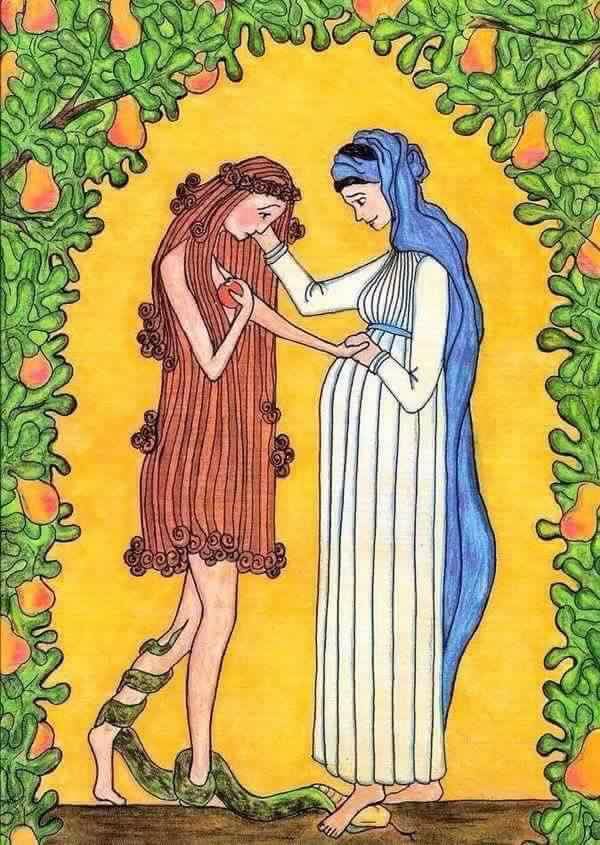
Mary consoles Eve, painting by Sister Grace Remington, OCSO, Sisters of the Mississippi Abbey in Dubuque, Iowa / flickr
Indeed, at the peak of the Golden Dome is a 19-foot-tall, 4,000-pound statue of “Mary our Lady.” And so our church is, at times, quite literally in the shadow of Mother Mary. If you look due east down Bryan Street from the front entrance of the church, you can see Mother Mary on top of the Golden Dome, towering over Brown School. Or if you look just across the river from Camp Cramer, you can see the steeple of the Church of Our Lady of Loretto, which refers to who else but Mother Mary!
For all the reasons we evangelicals were suspicious of Catholics, I would wager that the biggest one is their devotion to Mary. And, although we never would have said this, I think the reason was because this combined our anti-Catholic bias with our anti-woman bias.
We worship Father, Son, and Holy Spirit—the latter of whom we conceived as male, contrary to much of church tradition. And we found it off-putting that Catholics worship Mother Mary.
The reality is that Catholics don’t worship Mother Mary. But they do hold her in very high esteem. In the words of our sermon series, we might say that they view Mary as the raddest of all the rad women of the Bible.
And the reason they do so isn’t just that she was the vessel through which the Son of God entered the world, as significant as that is. Catholics also hold her in high esteem for her undaunted faith, which serves as a model for all Christians, regardless of gender.
And as evangelicals, or Anabaptists, or Protestants, or Mennonites, or whatever we might consider ourselves today, we would do well to learn from our Catholic siblings and their devotion to this rad woman of the faith. So, this morning, I would like us to hear directly from the Catholic Pope on Catholicism’s view of Mary, as I think there’s a lot we can learn from their Mary devotion.
In his book The Church of Mercy, Pope Francis concludes with a section on Mary, Mother of Evangelization, which includes reflections on Her Example, Her Faith, and Her Intercession.
Citing the narrative from Luke 1, Francis describes Mary as our example of listening to God’s voice, deciding to respond to God in faith, and acting on that decision “with haste.”
Francis then describes various aspects of Mary’s faith. Quoting the Second Vatican Council, who themselves quote church father Irenaeus, Francis describes how Mary’s act of faith “unties the knot of sin.”
In the words of Ireneaus, “the knot of Eve’s disobedience was untied by the obedience of Mary; what the Virgin Eve bound by her unbelief, the Virgin Mary loosened by her faith.”
In our first sermon of this series, we saw how Eve herself began to untie this knot when, through faith, she became “the mother of all the living.” In Genesis 3, God prophesies to the serpent that his power will ultimately be destroyed by the offspring of the woman, who will strike the serpent’s head. We call this the proto-gospel, the Bible’s first hint of the gospel message.
Through her act of faith, Eve becomes the mother of all the living. And her offspring, Mary, through her act of faith, likewise becomes the Mother of all the Living, as her Offspring crushes the head of the serpent of Death, bringing Life to all.
As Francis writes, “This was the point on which the Fathers of the Church greatly insisted: Mary first conceived Jesus in faith and then in the flesh, when she said yes to the message God gave her through the angel.”
“What does this mean?” Francis continues. “It means that God did not want to become human by bypassing our freedom; [God] wanted to pass through Mary’s free assent, through her ‘yes.’ [God] asked her, ‘Are you prepared to do this?’ And she replied, ‘Yes.’” In so doing, Mary becomes the Mother of all and the model of faith.
Francis writes,
Do we think that Jesus’ incarnation is simply a past event that has nothing to do with us personally? Believing in Jesus means giving him our flesh with the humility and courage of Mary, so that he can continue to dwell in our midst. It means giving him our hands, to caress the little ones and the poor; our feet, to go forth and meet our brothers and sisters; our arms, to hold up the weak and to work in the Lord’s vineyard; our minds, to think and act in light of the Gospel; and especially to offer our hearts to love and to make choices in accordance with God’s will. And this happens thanks to the working of the Holy Spirit. And in this way we become instruments in God’s hands, so that Jesus can act in the world through us.
Finally, Francis describes Mary’s faith not as a solitary, one-time act but as a lifelong journey. “How was Mary’s faith a journey?” he asks. “In the sense that her entire life was to follow her Son: he—Jesus—is the way, he is the path! To press forward in faith, to advance in the spiritual pilgrimage that is faith, is nothing other than to follow Jesus: to listen to him and be guided by his words; to see how he acts and to follow in his footsteps; to have his same sentiments.”
“And what are these sentiments of Jesus?” he asks. “Humility, mercy, closeness to others, but also a firm rejection of hypocrisy, duplicity, and idolatry. The way of Jesus is the way of a love that is faithful to the end, even to sacrificing one’s life; it is the way of the cross.”
Francis observes that
Mary understood this from the beginning, when Herod sought to kill the newborn Jesus. But this experience of the cross became deeper when Jesus was rejected. Mary was always with Jesus; she followed Jesus in the midst of the crowds, and she heard all the gossip and nastiness of those who opposed the Lord. And she carried this cross! Mary’s faith encountered misunderstanding and contempt—when Jesus’s ‘hour’ came, the hour of his Passion, when Mary’s faith was a little flame burning in the night, a little light flickering in the darkness. Through the night of Holy Saturday, Mary kept watch. Her flame, small but bright, remained burning until the dawn of the resurrection. And when she received word that the tomb was empty, her heart was filled with the joy of faith: Christian faith in the death and resurrection of Jesus Christ.
Francis concludes,
Faith always brings us to joy, and Mary is the Mother of joy! May she teach us to take the path of joy, to experience this joy! That was the high point—this joy, this meeting of Jesus and Mary, and we can imagine what it was like. Their meeting was the high point of Mary’s journey of faith, and that of the whole Church. What is our faith like? Like Mary, do we keep it burning even at times of difficulty, in moments of darkness? Do I feel the joy of faith?
So Mother Mary is our example, and she is our forerunner in the faith.
Third and finally, Francis describes Mary as an intercessor, or missionary, who demonstrates in her life what true evangelization looks like in practice.
As Francis describes,
There is a Marian “style” to the Church’s work of evangelization. Whenever we look to Mary, we come to believe once again in the revolutionary nature of love and tenderness. In her we see that humility and tenderness are not virtues of the weak but of the strong, who need not treat others poorly in order to feel important themselves. Contemplating Mary, we realize that she who praised God for “bringing down the mighty from their thrones” and “sending the rich away empty” (Luke 1:52—53) is also the one who brings a homely warmth to our pursuit of justice. She is also the one who carefully keeps “all these things, pondering them in her heart” (Luke 2:19).
And so, Francis concludes,
Mary is able to recognize traces of God’s Spirit in events great and small. She constantly contemplates the mystery of God in our world, in human history, and in our daily lives. She is the woman of prayer and work in Nazareth, and she is also Our Lady of Help, who sets out from her town “with haste” (Luke 1:39) to be of service to others. This interplay of justice and tenderness, of contemplation and concern for others, is what makes the ecclesial community look to Mary as a model of evangelization. We implore her maternal intercession that the Church may become a home for many peoples, a mother for all peoples, and that the way may be opened to the birth of a new world. It is the risen Christ who tells us, with a power that fills us with confidence and unshakable hope: “Behold, I make all things new” (Rev. 21:5). With Mary we advance confidently toward the fulfillment of this promise.
To which this evangelical Protestant, Anabaptist Mennonite says, “Amen and amen.”
About David C. Cramer
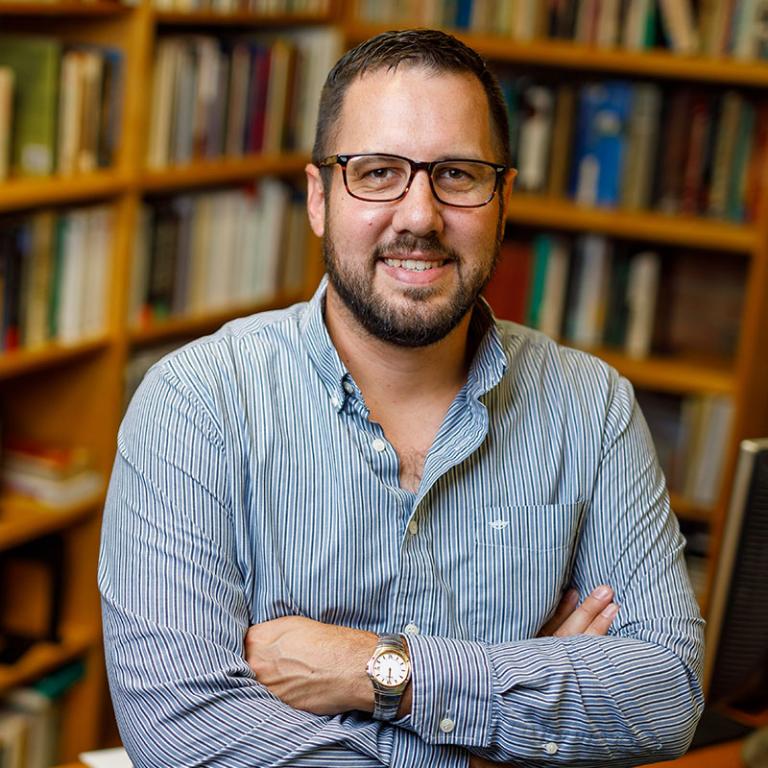
David C. Cramer is teaching pastor at Keller Park Church in South Bend, Indiana, and managing editor at the Institute of Mennonite Studies at Anabaptist Mennonite Biblical Seminary in Elkhart, Indiana. You can read more about the author here.
Previous Post

July 24, 2021
13 anti-oppression summer reads
Next Post
August 5, 2021 The Syrophoenician Woman: Speaking Boldly (Mark 7:24–30)
Browse Our Archives
Select a Category Anabaptist Ecosystem Blogging Books Current Events Dispatches Evangelicalism Guest Post Interview Mennonite History Nonviolence Rad Women of Scripture Sermon Uncategorized
Select a Month March 2024 November 2023 August 2023 July 2023 April 2023 March 2023 June 2022 May 2022 January 2022 September 2021 August 2021 July 2021 June 2021 May 2021 April 2021 January 2021 December 2020 November 2020 October 2020 August 2020 June 2020 May 2020 February 2020 January 2020 November 2019 September 2019 August 2019 July 2019 June 2019 May 2019 April 2019 March 2019 February 2019 January 2019
Follow Us!
TAKE THE
Religious Wisdom Quiz
Pride deceived those who dwell in the clefts of the rocks and make their home on the heights. Which nation was being addressed?
Select your answer to see how you score.
Philistia Ammon Moab Edom
Related posts from Anabaptist Revisions
Revangelical: Proclaiming the Good News after Deconstruction

Peter, Cornelius, and Evangelical Transphobia
Puzzled and terrified—an Easter homily on Luke 24:1–12

Joyful defiance to carceral logic (Philippians 4:10–20)
TRENDING AT PATHEOS Evangelical

Emotion in Early Christianity by Andrew Crislip
Andrew Crislip’s Emotion in Early Christianity examines an often overlooked dimension of...

16 Spiritual Touchstones for a More Grounded Life
After decades of spiritual study, here are 16 principles I try...

Catholic Evangelization: Sharing Your Faith Every Day
Welcome back to the Graceful Awakening mini-series called, “From Faith to Mission.” ...

The Pillar of the Boatmen: the Ancient Monument...
The Pillar of the Boatmen is a Romano-Gaulish sculpture that dates from...

In one sense walking into Westminster Abbey is like walking down the...

'Super Scam Me' Exposes AI Jon Bon Jovi...
Leslie Pickett believed she was in a relationship with Jon Bon Jovi....
view all Evangelical blogs
Ad-Free & Subscriber Log-In Subscription Support
- About Us
- 2026 Calendar
- Videos
- Podcasts
- Library of World Religions
- Faith In Media Tracker
- Advertise With Us
- Write for Us
- Privacy Policy
- Terms of Service
- Do Not Sell My Data
- Contact Us
- Radiant Digital
- Manage Newsletter Subscriptions
- Unsubscribe From Notifications
- Sitemap
Copyright 2008-2026, Patheos. All rights reserved.
Subscription Support Ad-Free & Subscriber Log-In
Follow Patheos