
BuddhistCatholicContemplativeEvangelicalGeneral ChristianHinduJewishLatter-day SaintMuslimNew VisionsProgressive Christian
Beliefs
- Buddhist
- Catholic
- Contemplative
- Evangelical
- General Christian
- Hindu
- Jewish
- Latter-day Saint
- More Voices
- Muslim
- New Visions
- Pagan
- Progressive Christian
Topics
- Religion News
- Food and Religion
- Sports and Religion
- Religious Art
- Religious Music and Entertainment
- Religious Events
- History and Religion
- Style and Religion
- Politics and Religion
- Women in Religion
- Recreation Outdoors and Religion
- Business Finance and Religion
- Careers Workplace and Religion
- Education and Religion
- Family Parenting and Religion
- Health Fitness and Religion
- Home and Religion
- Relationships and Religion
- Technology and Religion
- Travel and Religion
Columnists
- Buddhist Columnists
- Business Finance and Religion Columnists
- Careers Workplace and Religion Columnists
- Catholic Columnists
- Contemplative Columnists
- Education and Religion Columnists
- Evangelists Columnists
- Family Parenting and Religion Columnists
- General Christian Columnists
- Health Fitness and Religion Columnists
- Hindu Columnists
- History and Religion Columnists
- Home and Religion Columnists
- Jewish Columnists
- More Voices Columnists
- Latter Day Columnists
- Muslim Columnists
- New Visions Columnists
- Nonreligious Columnists
- Pagan Columnists
- Politics and Religion Columnists
- Progressive Columnists
- Recreation Outdoors and Religion Columnists
- Relationships and Religion Columnists
- Religion News Columnists
- Religious Art Columnists
- Religious Events Columnists
- Religious Music and Entertainment Columnists
- Sports and Religion Columnists
- Style and Religion Columnists
- Technology and Religion Columnists
- Travel and Religion Columnists
- Women in Religion Columnists
Resource Library
- 2026 Calendar
- Library of World Religions
- The 100 Most Holy Places on Earth
- Patheos Answers
- Podcasts
- Videos
- Faith Leaders Database
- Anglican Episcopalian
- Bahai
- Baptist
- Buddhism
- Christianity
- Confucianism
- Eastern Orthodoxy
- Hinduism
- Holiness and Pentecostal
- ISKCON
- Islam
- Judaism
- Lutheran
- Methodist
- The Church of Jesus Christ of Latter-day Saints
- New Age
- Paganism
- Presbytarian and Reformed
- Protestantism
- Religion Behind the Scenes
- Roman Catholic
- Scientology
- Shia Islam
- Sikhism
- Sufism
- Sunni Islam
- Taoism
- Zen
- See all religions
Research Tools
 Ad-Free & Subscriber Log-In Subscription Support
Ad-Free & Subscriber Log-In Subscription Support
Follow Patheos 

- Trending:
- Forgiveness
- |
- Marriage
- |
- Consciousness
- |
- Death Penalty
- |
- Election
- |
- Halloween
 Anabaptist Revisions
- Home
- Evangelical
- Mary and Martha: Brave Friends (Luke 10:38–42; John 11:1–44)
Mary and Martha: Brave Friends (Luke 10:38–42; John 11:1–44)
Last updated on: July 21, 2021 at 1:17 pm by David C. Cramer
Mary and Martha: Brave Friends (Luke 10:38–42; John 11:1–44) 2021-07-21T13:17:39-05:00 David C. Cramer
Patheos Explore the world's faith through different perspectives on religion and spirituality! Patheos has the views of the prevalent religions and spiritualities of the world.
Mary and Martha: Brave Friends
By Jess Lyons
Read Luke 10:38–42; John 11:1–44
At first glance, the story of Mary and Martha is simple and straightforward. Many of us are familiar with Luke’s account of these women. Don’t be a busy Martha, always fussing and “doing” for Jesus. Instead, be like Mary. Sit with Jesus, listen, recognize that only “one thing is needed.”
Do a quick Google search using the words “Mary and Martha,” and you’ll find sermons focused solely on devotion over performance. You’ll come across ideas for Mary and Martha parties where hosts can buy serving trays and decorative pillows to create a welcoming environment for guests. But don’t neglect the companion Bible Study plans that really make your party pop!
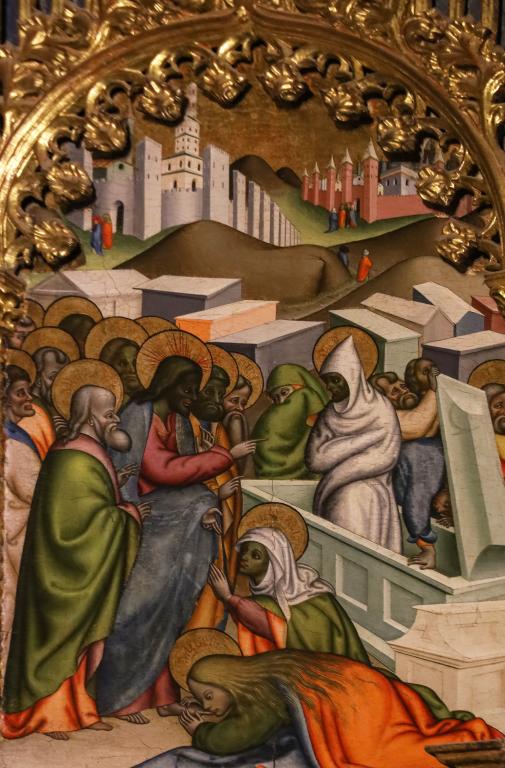
The Raising of Lazarus, painting from the reredos in the Catedral Vieja de Salamanca, c.1430-50 / flickr
This familiar Mary and Martha narrative is good but not complete. We’re inspired to prioritize time with Jesus over service for him. But unfortunately, on their own, these six familiar verses from Luke’s Gospel create difficult choices for followers of Christ, especially for women.
One writer notes this well: “For centuries, Luke’s story has been used to polarize women into no-win situations. ‘Marthas’ have been criticized for their mundane busy-ness, while studious or professional ‘Marys’ have been condemned for unnatural disregard of family or usurpation of male roles.”
Thankfully, we are given a fuller, more dimensional picture of these women and their faithfulness. We read about their deep friendship with Jesus more in John 11 and 12, and this is where we get some good stuff to complement Luke’s picture.
Scripture tells us that Jesus loves these sisters and their brother, Lazarus, dearly. He frequently visits their home, almost as if it is a haven of sorts. We see his level of comfort with them in their conversations, allowing the sisters to talk candidly and even complain a bit. When Lazarus suddenly dies, Mary and Martha call on Jesus.
At this point, they know Jesus as a teacher and healer, but they do not know of his divine identity. They do not yet know he is the Messiah. So they call on him as their friend, one they love and who loves them deeply.
Jesus’s return prompts two individual conversations. First, we see Martha run to meet him. She doesn’t wait for him to come to her. There’s trust in this action. Martha, the one who seemed overly concerned about the work and appearance of her home previously, was rushing to be with Jesus. As they speak, we see this beautiful exchange. She is frustrated and grieved by the loss of Lazarus and by Jesus’s absence. The conversation centers on resurrection, and Jesus reveals his mysterious, full identity to Martha—the hospitable homemaker. Her response is full of trust and belief, and we see her demonstrate great faithfulness here. She acknowledges his power and authority—before Jesus raises Lazarus!
Then, Jesus calls Mary to himself. Their conversation moves him deeply, and we see him weep with his friends. Many neighbors have come to console the sisters, and they witness this great love between Jesus and this family of siblings.
As John 11 and 12 describe, these friends share intimate moments together. From declarations of Jesus’s divinity to later anointing and preparing him for burial, these sisters are with Jesus in moments of pain and great risk.
Jesus does eventually speak words that raise Lazarus from the dead. Later, he celebrates around the family table with these beloved friends. But the target on Jesus’s back continues to grow, especially after the miracle of Lazarus’s renewed life.
When we understand the great risk Mary, Martha, and their brother Lazarus take when they bond themselves with Jesus, we see why it makes sense to call them “brave friends.” Martha bravely acknowledges and trusts Jesus when he speaks of being the Messiah, even before she sees Lazarus come to life. Mary puts herself in a vulnerable position, learning from Jesus, pouring expensive perfume over Jesus, and sitting with the criticism of the disciples.
After John 12, we don’t hear much about these siblings. We do read that Lazarus’s life is threatened for his connection to Jesus, but we’re unsure how that plays out. We can imagine, though, that Mary and Martha, especially, risk a great deal by investing deeply in their friendships with Jesus.
They are women.
They are unmarried, as far as we can tell.
And to top it all off, they have the audacity to sit under his teaching and learn from him.
Our understanding of Mary and Martha includes the “one-thing needed” conversation, but it can’t end there.
If it does, we will lose the picture of friends faithfully loving and trusting Jesus, even when it makes them vulnerable.
We will miss the image of a deeply relational Christ who finds rest and comfort in these sisters and their hospitality and friendship.
We can’t skip over these brave friends and their ability to help us see Jesus more fully and authentically.
Without Mary and Martha, I think we’d be tempted to bypass an aspect of the beautiful character of Jesus. In his interactions with these sisters, we see his tender power.
He is the resurrection and the life.
He is the Savior.
He is God.
And he is also our friend, our brother.
Fully God, fully human.
Though some depictions of Mary and Martha might leave us wanting, we know the stories of their faithfulness affirm our own opportunities to know Jesus as friend.
And so I conclude with the words of a commentator on these stories:
Today the stories challenge churches, especially, but also society as a whole to recall both Martha’s and Mary’s evident fitness for friendship with Jesus. Instead of affirming dichotomies, the stories present differences in personality as complementary. The friendship that both sisters found with Jesus also offers an image for prayer—an image not freighted with the issues of dominance that cloud metaphors of God as ‘master,’ ‘Lord,’ ‘father,’ or even ‘mother.’ The image of friendship is, in fact, Jesus’ own choice for describing his relationship with his followers: ‘No longer do I call you servants. . . . I have called you friends’ (Jn. 15:15).

About Jess Lyons
Jess Lyons is a mentor, teacher, and "back-up" pastor. She works as the Career Development program manager and adjunct professor at Bethel University, Indiana, where she also received her BA in communication and Master of Ministry. In her free time, she listens to lots of podcasts and explores the city's good food. Jess lives in South Bend with her husband, Reed, and two boys. You can read more about the author here.
Previous Post

July 16, 2021
Junia: Outstanding Apostle (Romans 16:7)
Next Post

July 24, 2021 13 anti-oppression summer reads
Browse Our Archives
Select a Category Anabaptist Ecosystem Blogging Books Current Events Dispatches Evangelicalism Guest Post Interview Mennonite History Nonviolence Rad Women of Scripture Sermon Uncategorized
Select a Month March 2024 November 2023 August 2023 July 2023 April 2023 March 2023 June 2022 May 2022 January 2022 September 2021 August 2021 July 2021 June 2021 May 2021 April 2021 January 2021 December 2020 November 2020 October 2020 August 2020 June 2020 May 2020 February 2020 January 2020 November 2019 September 2019 August 2019 July 2019 June 2019 May 2019 April 2019 March 2019 February 2019 January 2019
Follow Us!
TAKE THE
Religious Wisdom Quiz
Who saw a vision of wheels within wheels by the Kebar River?
Select your answer to see how you score.
Micah Ezekiel Daniel Jonah
Related posts from Anabaptist Revisions

Revangelical: Proclaiming the Good News after Deconstruction

Peter, Cornelius, and Evangelical Transphobia
Puzzled and terrified—an Easter homily on Luke 24:1–12

Joyful defiance to carceral logic (Philippians 4:10–20)
TRENDING AT PATHEOS Evangelical

Emotion in Early Christianity by Andrew Crislip
Andrew Crislip’s Emotion in Early Christianity examines an often overlooked dimension of...

16 Spiritual Touchstones for a More Grounded Life
After decades of spiritual study, here are 16 principles I try...

Catholic Evangelization: Sharing Your Faith Every Day
Welcome back to the Graceful Awakening mini-series called, “From Faith to Mission.” ...

The Pillar of the Boatmen: the Ancient Monument...
The Pillar of the Boatmen is a Romano-Gaulish sculpture that dates from...

In one sense walking into Westminster Abbey is like walking down the...

'Super Scam Me' Exposes AI Jon Bon Jovi...
Leslie Pickett believed she was in a relationship with Jon Bon Jovi....
view all Evangelical blogs
Ad-Free & Subscriber Log-In Subscription Support
- About Us
- 2026 Calendar
- Videos
- Podcasts
- Library of World Religions
- Faith In Media Tracker
- Advertise With Us
- Write for Us
- Privacy Policy
- Terms of Service
- Do Not Sell My Data
- Contact Us
- Radiant Digital
- Manage Newsletter Subscriptions
- Unsubscribe From Notifications
- Sitemap
Copyright 2008-2026, Patheos. All rights reserved.
Subscription Support Ad-Free & Subscriber Log-In
Follow Patheos