
BuddhistCatholicContemplativeEvangelicalGeneral ChristianHinduJewishLatter-day SaintMuslimNew VisionsProgressive Christian
Beliefs
- Buddhist
- Catholic
- Contemplative
- Evangelical
- General Christian
- Hindu
- Jewish
- Latter-day Saint
- More Voices
- Muslim
- New Visions
- Pagan
- Progressive Christian
Topics
- Religion News
- Food and Religion
- Sports and Religion
- Religious Art
- Religious Music and Entertainment
- Religious Events
- History and Religion
- Style and Religion
- Politics and Religion
- Women in Religion
- Recreation Outdoors and Religion
- Business Finance and Religion
- Careers Workplace and Religion
- Education and Religion
- Family Parenting and Religion
- Health Fitness and Religion
- Home and Religion
- Relationships and Religion
- Technology and Religion
- Travel and Religion
Columnists
- Buddhist Columnists
- Business Finance and Religion Columnists
- Careers Workplace and Religion Columnists
- Catholic Columnists
- Contemplative Columnists
- Education and Religion Columnists
- Evangelists Columnists
- Family Parenting and Religion Columnists
- General Christian Columnists
- Health Fitness and Religion Columnists
- Hindu Columnists
- History and Religion Columnists
- Home and Religion Columnists
- Jewish Columnists
- More Voices Columnists
- Latter Day Columnists
- Muslim Columnists
- New Visions Columnists
- Nonreligious Columnists
- Pagan Columnists
- Politics and Religion Columnists
- Progressive Columnists
- Recreation Outdoors and Religion Columnists
- Relationships and Religion Columnists
- Religion News Columnists
- Religious Art Columnists
- Religious Events Columnists
- Religious Music and Entertainment Columnists
- Sports and Religion Columnists
- Style and Religion Columnists
- Technology and Religion Columnists
- Travel and Religion Columnists
- Women in Religion Columnists
Resource Library
- 2026 Calendar
- Library of World Religions
- The 100 Most Holy Places on Earth
- Patheos Answers
- Podcasts
- Videos
- Faith Leaders Database
- Anglican Episcopalian
- Bahai
- Baptist
- Buddhism
- Christianity
- Confucianism
- Eastern Orthodoxy
- Hinduism
- Holiness and Pentecostal
- ISKCON
- Islam
- Judaism
- Lutheran
- Methodist
- The Church of Jesus Christ of Latter-day Saints
- New Age
- Paganism
- Presbytarian and Reformed
- Protestantism
- Religion Behind the Scenes
- Roman Catholic
- Scientology
- Shia Islam
- Sikhism
- Sufism
- Sunni Islam
- Taoism
- Zen
- See all religions
Research Tools
 Ad-Free & Subscriber Log-In Subscription Support
Ad-Free & Subscriber Log-In Subscription Support
Follow Patheos 

- Trending:
- Forgiveness
- |
- Marriage
- |
- Consciousness
- |
- Death Penalty
- |
- Election
- |
- Halloween
 Anabaptist Revisions
- Home
- Evangelical
- Junia: Outstanding Apostle (Romans 16:7)
Junia: Outstanding Apostle (Romans 16:7)
Last updated on: July 16, 2021 at 2:33 pm by David C. Cramer
Junia: Outstanding Apostle (Romans 16:7) 2021-07-16T14:33:25-05:00 David C. Cramer
Patheos Explore the world's faith through different perspectives on religion and spirituality! Patheos has the views of the prevalent religions and spiritualities of the world.
Junia: Outstanding Apostle
By Drew Strait
Read Romans 16:1–7; Acts 2:14–21
In her TED talk, titled, “The Danger of a Single Story,” the Nigerian novelist Chimamanda Ngozi Adichie talks about the power of story and literature to shape how we think about our lives. She recalls growing up in Nigeria reading British novels with blonde haired, blue eyed children who drank ginger beer. When Adichie started writing her first stories as a child, she found herself writing exclusively about blond haired, blue eyed children and ginger beer despite the fact that she had never tasted ginger beer and her family and friends were all black.
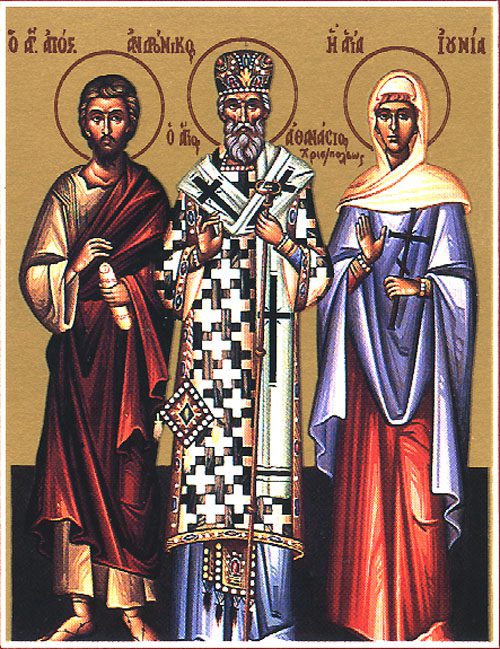
Icon with Andronicus of Pannonia, Saint Athanasius Bishop of Christianoupolis, and Saint Junia depicted / WikiCommons
It wasn’t until Adichie was introduced to African literature that she realized that girls that look like her can also exist in literature. Adichie reminds us just how impressionable and vulnerable we are in the face of a single story, and how humans throughout history have created a single story to stigmatize and oppress people and thereby lord their power over them. Here, at the intersection of story and power, Adichie is worth quoting in full. She says,
Show a people as one thing, as only one thing, over and over again, and that is what they become. It is impossible to talk about the single story without talking about power. There is a word, an Igbo word, that I think about whenever I think about the power structures of the world, and it is “nkali.” It’s a noun that loosely translates to “to be greater than another.” Like our economic and political worlds, stories too are defined by the principle of nkali: How they are told, who tells them, when they’re told, how many stories are told, are really dependent on power. Power is the ability not just to tell the story of another person, but to make it the definitive story of that person. . . . Start the story with the arrows of the Native Americans, and not with the arrival of the British, and you have an entirely different story. Start the story with the failure of the African state, and not with the colonial creation of the African state, and you have an entirely different story. . . . The single story creates stereotypes, and the problem with stereotypes is not that they are untrue, but that they are incomplete. They make one story become the only story.
Friends, I’d like to propose this morning that many of us—perhaps even most of us—have been told a single story about women in the early church that is incomplete.
Growing up in the church, I was taught to think that Jesus had twelve male apostles. I remember learning about Peter, James, and John. I remember learning about Andrew, Philip, Bartholomew, Matthew, and Thomas. I remember hearing about James, son of Alphaeus; Simon, the so-called Zealot; Judas, son of James; and, of course, Judas Iscariot, who betrayed Jesus. I remember learning about Matthias, who replaced Judas Iscariot, and I especially remember learning about Paul, who converted to the way of Jesus after persecuting Christians and became an apostle to the gentiles.
But I have no memory of any pastor, teacher, mentor, or youth group leader teaching me that there was also a female apostle in the early church. In the circles that I grew up in, manhood was a prerequisite for apostleship, and women were largely relegated to the periphery of church leadership.
In teaching us a single story about women, the church created a hierarchy of power.
In teaching us a single story about apostleship, Bible teachers created a gendered caste system.
In teaching us a single story about who can proclaim the gospel with authority, church leaders undermined the church’s full witness to a justice-making, liberating, forgiving, and fiercely faithful God.
Friends, I’m so happy to let you know this morning that this single story we were taught is not the full story—in fact, it is not the whole gospel.
Here I want my own voice to get out of the way and allow Paul to speak.
In Romans 16:7, Paul writes:
“Greet Andronicus and Junia, my Jewish relatives who were incarcerated together with me; they are outstanding among the apostles, and they were in Christ before I was” (translation mine).
In the male-dominated world of biblical interpretation, the presence of a female apostle caused many men to squirm in their seats. In fact, the presence of Junia made some male biblical interpreters like Martin Luther so uncomfortable that they literally man-washed her out of the story and changed her name from Junia to Junias—a him instead of a her.
What’s striking about the man-washing of Junia is that we have no literary or material evidence of anyone in the Roman world with the male name Junias. However, we have over 250 examples of women named Junia.
Even so, some major English translations of the Bible popularized the masculine reading. Hear, for example, the Revised Standard Version—a translation that some of you may have grown up reading:
“Greet Androni′cus and Ju′nias, my kinsmen and my fellow prisoners; they are men of note among the apostles, and they were in Christ before me.”
Here not only is Junia man-washed with the masculine Junias—but the translators also add that “they are men of note among the apostles,” despite the fact that the word men does not occur in the original Greek! Indeed, as one commentator writes, “Junias is a figment of a chauvinistic imagination.”
In more recent years, conservative male biblical interpreters have mostly conceded that Junia was a woman since we have no evidence of someone named Junias existing in the ancient world. Yet the thought of a woman being an apostle remains so uncomfortable for these men that they’ve sought other ways to man-wash Junia’s apostleship.
For example, in 2001, two conservative male biblical scholars argued that the phrase “outstanding among the apostles” (syntactically speaking) should be translated as “esteemed by the apostles.”
Do you see what they did there? To maintain patriarchal views of apostleship, these authors suggest that Andronicus and Junia are simply “esteemed by the apostles” rather than outstanding apostles themselves!
The lengths men have gone to man-wash Junia are especially striking given the fact that no less than eight early interpreters understood Junia as a woman and an apostle. For example, in the fourth century, church father Chrysostom wrote this:
It was the greatest of honors to be counted a fellow prisoner of Paul’s. . . . Think what great praise it was to be considered of note among the apostles. These two were of note because of their works and achievements. Think how great the devotion of this woman Junia must have been, that she should be worthy to be called an apostle! But even here Paul does not stop his praise, for they were Christians before he was. (Homilies on Romans 31, Trans. ACCS, 372)
And in the fifth century, Theodoret of Cyrrhus wrote this about Andronicus and Junia:
Yet more praises. These people were companions of Paul in his sufferings and even shared imprisonment with him. Hence he says that they are men and women of note, not among the pupils but among the teachers, and not among the ordinary teachers but among the apostles. He even praises them for having been Christians before him. (Interpretation of the Letter to the Romans, Trans. ACCS, 372).
In naming Junia outstanding among the apostles, Paul reminds the church at Rome that women are liberated from patriarchal or male-dominated structures.
In naming Junia outstanding among the apostles, Paul reminds the church at Rome that women are emissaries sent out into the world to bear witness to the kingdom of God in word and deed.
In naming Junia as a fellow prisoner, Paul reminds us that the early church was led by fiercely faithful women who agitated the values of the empire.
In naming Junia as being “in Christ before me,” Paul animates Junia’s apostleship and his own mantra that he was the last and least of all the apostles (1 Cor. 15:8–9; Gal. 1:17).
Friends, there has been a gravitational pull throughout church history to man-wash women out of leadership in ministry—to tell a single story. But a man-washed church is not a whole church, nor is it the whole story.
At Keller Park Church we strive to be a protest movement that defies and resists such patriarchal gravity. We protest patriarchy not because we are all liberal or Democrat or feminist but, rather, because we believe that, in Jesus, God has liberated women to lead, flourish, and become sent ones into our communities on behalf of God’s kingdom.
This is what we see in the fiercely faithful Junia, a Jewish-Christian woman who preceded Paul himself in the faith, who, like Paul, was imprisoned for her faith, and who, like Paul, was considered an outstanding apostle by the early church.
It is no accident that when the church’s mission was birthed at Pentecost and empowered by the Holy Spirit, that the apostle Peter reads from the prophet Joel. Hear these ancient words:
“In the last days it will be, God declares, that I will pour out my Spirit upon all flesh, and your sons and your daughters shall prophesy.”
Go and do likewise. Amen.

About Drew Strait
Drew Strait is assistant professor of New Testament and Christian origins at Anabaptist Mennonite Biblical Seminary in Elkhart, Indiana. Drew received his PhD in New Testament from the University of Pretoria, South Africa. Prior to becoming a member at Keller Park Church, he served as an interim pastor at Living Water Community Church in Chicago (Mennonite Church USA) and as an elder at Peace Fellowship Church in Washington, DC. Drew lives in South Bend with his wife, Dana, and two children. You can read more about the author here.
Previous Post
July 8, 2021
Woman with a Flow of Blood: Seeking Wholeness (Mark 5:25–34)
Next Post
July 21, 2021 Mary and Martha: Brave Friends (Luke 10:38–42; John 11:1–44)
Browse Our Archives
Select a Category Anabaptist Ecosystem Blogging Books Current Events Dispatches Evangelicalism Guest Post Interview Mennonite History Nonviolence Rad Women of Scripture Sermon Uncategorized
Select a Month March 2024 November 2023 August 2023 July 2023 April 2023 March 2023 June 2022 May 2022 January 2022 September 2021 August 2021 July 2021 June 2021 May 2021 April 2021 January 2021 December 2020 November 2020 October 2020 August 2020 June 2020 May 2020 February 2020 January 2020 November 2019 September 2019 August 2019 July 2019 June 2019 May 2019 April 2019 March 2019 February 2019 January 2019
Follow Us!
TAKE THE
Religious Wisdom Quiz
Who gave Jesus gifts of gold, frankincense, and myrrh?
Select your answer to see how you score.
Shepherds Fishermen Disciples Wise men
Related posts from Anabaptist Revisions

Revangelical: Proclaiming the Good News after Deconstruction

Peter, Cornelius, and Evangelical Transphobia
Puzzled and terrified—an Easter homily on Luke 24:1–12

Joyful defiance to carceral logic (Philippians 4:10–20)
TRENDING AT PATHEOS Evangelical

Catholic Evangelization: Sharing Your Faith Every Day
Welcome back to the Graceful Awakening mini-series called, “From Faith to Mission.” ...

The Pillar of the Boatmen: the Ancient Monument...
The Pillar of the Boatmen is a Romano-Gaulish sculpture that dates from...

In one sense walking into Westminster Abbey is like walking down the...

'Super Scam Me' Exposes AI Jon Bon Jovi...
Leslie Pickett believed she was in a relationship with Jon Bon Jovi....

The Brazilian Remake of Kendricks' 'Flywheel' Opens in...
“Flywheel,” the story that launched the Kendrick Brothers’ filmmaking career is getting...

The Dangers of Gradual Accommodation (Winking at Sin)
Recently, the “law of gradualness” resurfaced during the opening of a weeklong,...
view all Evangelical blogs
Ad-Free & Subscriber Log-In Subscription Support
- About Us
- 2026 Calendar
- Videos
- Podcasts
- Library of World Religions
- Faith In Media Tracker
- Advertise With Us
- Write for Us
- Privacy Policy
- Terms of Service
- Do Not Sell My Data
- Contact Us
- Radiant Digital
- Manage Newsletter Subscriptions
- Unsubscribe From Notifications
- Sitemap
Copyright 2008-2026, Patheos. All rights reserved.
Subscription Support Ad-Free & Subscriber Log-In
Follow Patheos