
BuddhistCatholicContemplativeEvangelicalGeneral ChristianHinduJewishLatter-day SaintMuslimNew VisionsProgressive Christian
Beliefs
- Buddhist
- Catholic
- Contemplative
- Evangelical
- General Christian
- Hindu
- Jewish
- Latter-day Saint
- More Voices
- Muslim
- New Visions
- Pagan
- Progressive Christian
Topics
- Religion News
- Food and Religion
- Sports and Religion
- Religious Art
- Religious Music and Entertainment
- Religious Events
- History and Religion
- Style and Religion
- Politics and Religion
- Women in Religion
- Recreation Outdoors and Religion
- Business Finance and Religion
- Careers Workplace and Religion
- Education and Religion
- Family Parenting and Religion
- Health Fitness and Religion
- Home and Religion
- Relationships and Religion
- Technology and Religion
- Travel and Religion
Columnists
- Buddhist Columnists
- Business Finance and Religion Columnists
- Careers Workplace and Religion Columnists
- Catholic Columnists
- Contemplative Columnists
- Education and Religion Columnists
- Evangelists Columnists
- Family Parenting and Religion Columnists
- General Christian Columnists
- Health Fitness and Religion Columnists
- Hindu Columnists
- History and Religion Columnists
- Home and Religion Columnists
- Jewish Columnists
- More Voices Columnists
- Latter Day Columnists
- Muslim Columnists
- New Visions Columnists
- Nonreligious Columnists
- Pagan Columnists
- Politics and Religion Columnists
- Progressive Columnists
- Recreation Outdoors and Religion Columnists
- Relationships and Religion Columnists
- Religion News Columnists
- Religious Art Columnists
- Religious Events Columnists
- Religious Music and Entertainment Columnists
- Sports and Religion Columnists
- Style and Religion Columnists
- Technology and Religion Columnists
- Travel and Religion Columnists
- Women in Religion Columnists
Resource Library
- 2026 Calendar
- Library of World Religions
- The 100 Most Holy Places on Earth
- Patheos Answers
- Podcasts
- Videos
- Faith Leaders Database
- Anglican Episcopalian
- Bahai
- Baptist
- Buddhism
- Christianity
- Confucianism
- Eastern Orthodoxy
- Hinduism
- Holiness and Pentecostal
- ISKCON
- Islam
- Judaism
- Lutheran
- Methodist
- The Church of Jesus Christ of Latter-day Saints
- New Age
- Paganism
- Presbytarian and Reformed
- Protestantism
- Religion Behind the Scenes
- Roman Catholic
- Scientology
- Shia Islam
- Sikhism
- Sufism
- Sunni Islam
- Taoism
- Zen
- See all religions
Research Tools
 Ad-Free & Subscriber Log-In Subscription Support
Ad-Free & Subscriber Log-In Subscription Support
Follow Patheos 

- Trending:
- Forgiveness
- |
- Marriage
- |
- Consciousness
- |
- Death Penalty
- |
- Election
- |
- Halloween
 Anabaptist Revisions
- Home
- Evangelical
- Huldah: Speaking Truth (2 Kings 22; 2 Chronicles 34; Acts 2)
Huldah: Speaking Truth (2 Kings 22; 2 Chronicles 34; Acts 2)
Last updated on: June 17, 2021 at 2:49 pm by David C. Cramer
Huldah: Speaking Truth (2 Kings 22; 2 Chronicles 34; Acts 2) 2021-06-17T14:49:38-05:00 David C. Cramer
Patheos Explore the world's faith through different perspectives on religion and spirituality! Patheos has the views of the prevalent religions and spiritualities of the world.
Huldah: Speaking Truth
By David C. Cramer
Read 2 Kings 22:8–20; 2 Chronicles 34:14–28; Acts 2
This Sunday we celebrate Pentecost. Pentecost, meaning “50,” is a Jewish holiday that celebrates the fiftieth day after Passover. For Christians, it celebrates the day the Holy Spirit was poured out on the first believers, fifty days after Easter.
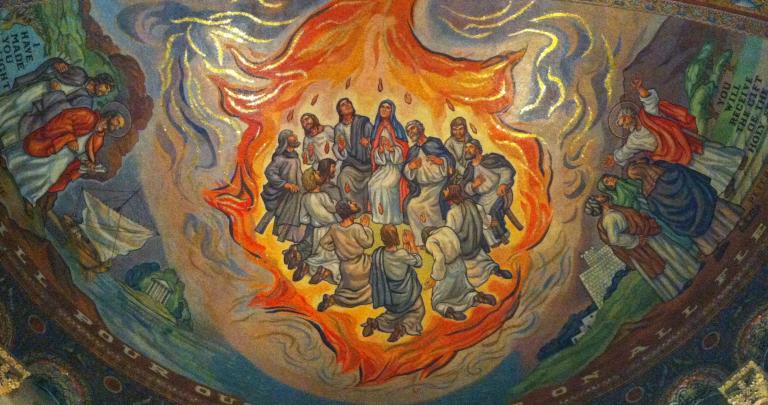
A mosaic representing Pentecost on the cathedral ceiling / WikiCommons
On that day, the apostle Peter quotes the prophet Joel to explain why everyone gathered is able to hear about “the wonderful things God has done” in their own languages:
‘In the last days,’ God says,
‘I will pour out my Spirit upon all people.
Your sons and daughters will prophesy.
Your young men will see visions,
and your old men will dream dreams.
In those days I will pour out my Spirit
even on my servants—men and women alike—
and they will prophesy.
And I will cause wonders in the heavens above
and signs on the earth below—
blood and fire and clouds of smoke.
The sun will become dark,
and the moon will turn blood red
before that great and glorious day of the Lord arrives.
But everyone who calls on the name of the Lord
will be saved.’ (Acts 2:17–21; cf. Joel 2:28–32)
For Peter, this prophecy is being fulfilled in their midst. That early group of believers, women and men, old and young, slave and free, are filled with the Spirit and empowered to prophesy.
Sometimes we can miss the significance of this moment because we have a skewed understanding of what it means to prophesy. We tend to equate prophecy with soothsaying or fortune-telling. Prophecy is all about predicting the future, we tend to assume.
But, while predicting the future can be one aspect of prophecy, it is a fairly minor aspect. Prophecy is about so much more than that. You can predict the future without prophesying, and you can prophesy without predicting the future.
So what, then, does it mean to prophesy? And why is it significant that the Holy Spirit empowers believers with this gift irrespective of their gender, age, or social status?
To answer these questions, I want to turn to the Old Testament story of the prophet Huldah.
Huldah is a prophet during the reign of King Josiah in Judah, about 600 years before Jesus’s birth. Her story is told in both 2 Kings 22 and 2 Chronicles 34.
In this story, Josiah becomes king when he is only 8 years old, and he reigns for 31 years. At about the age of 16, Josiah begins to seek after God, after generations of kings before him have forsaken God to follow after idols and false gods. Josiah institutes many reforms to remove idols and restore the Temple for worship of the Lord.
While work is being done to restore the Temple, the high priest Hilkiah discovers a copy of the scroll of the Book of the Law written by Moses. (Today we would refer to this as the Book of Deuteronomy.) The kingdom has been in such disarray for so long that this scroll has been completely lost, and no one has been following it. So when Hilkiah discovers it, he gives it to the court secretary, Shaphan, to read to King Josiah.
When Josiah hears the words of the Law being read and realizes how far the kingdom has strayed from it, he tears his clothes in despair and orders Hilkiah, Shaphan, and a few of his other court officials:
Go to the Temple and speak to the Lord for me and for all the remnant of Israel and Judah. Inquire about the words written in the scroll that has been found. For the Lord’s great anger has been poured out on us because our ancestors have not obeyed the word of the Lord. We have not been doing everything this scroll says we must do. (2 Chron. 34:21)
With this order to speak to the Lord on the king’s behalf, what do these men do? They seek out the prophet Huldah, wife of Shallum, the keeper of the Temple wardrobe.
There were other major prophets during the reign of Josiah that they could have consulted instead: Jeremiah, Zephaniah, Nahum. But they go to Huldah, who is one of seven female prophets mentioned by name in the Old Testament.
Sure enough, Huldah has a message from the Lord to the king.
“The Lord, the God of Israel, has spoken! Go back and tell the man who sent you, ‘This is what the Lord says’,” she begins (2 Chron. 34:23–24). She then offers a word of judgment on the kingdom. Deuteronomy lists blessings on those who follow the law and curses on those who don’t. And because the people have strayed so far from the Law, Huldah states that the curses will indeed come to pass.
But along with this word of judgment, Huldah also offers a word of mercy. “This is what the Lord, the God of Israel, says concerning the message you have just heard,” she states (2 Chron. 34:26). And she then describes how King Josiah will be spared of this fate because of his humble acts of repentance.
When the king’s officials take this message back to King Josiah, he immediately summons all the priests and elders of the kingdom to the Temple. There King Josiah and all the people gathered pledged themselves to be faithful once again to their covenant with the God of their ancestors.
And so, the story concludes, throughout the rest of King Josiah’s lifetime, the people of Judah do not turn away from the Lord, the God of their ancestors (2 Chron. 34:33).
So what does this story of Huldah tell us about prophecy and the significance of Pentecost? I think it teaches us this:
A prophet is a person that someone seeks out when they need a word from the Lord. Prophesying isn’t so much about future-telling as it is about truth-telling.
When King Josiah needed to hear the word of God to help him understand his situation and what he should do, his officials sought out Huldah to provide that message from the Lord. Huldah is able, with confidence, to speak a word from the Lord because she knows the Word of the Lord. Inspired by the Holy Spirit, she is able to interpret the words of Deuteronomy and rightly apply them to the present crisis.
And, according to the apostle Peter, quoting the prophet Joel, this is the significance of Pentecost:
The Holy Spirit is poured out on all the believers so that we can all be Huldahs in our day.
You don’t have to have a Bible degree.
You don’t have to have a title.
And you certainly don’t have to be a man—or even an adult!
When you are filled with God’s Spirit, you too can proclaim “the wonderful things God has done” (Acts 2:11).
Like Huldah, like the early believers, you too can be God’s spokesperson, God’s prophet. And in so doing, you can call God’s people back to fierce faithfulness to God: to destroying our idols and become a people who worship in Spirit and in truth.
A people who devote ourselves to the apostles’ teaching, and to fellowship, and to sharing in meals, and to prayer.
A people who share a deep sense of awe at the many miraculous signs and wonders God does in our midst,
A people who meet together and share everything we have.
Who share with those in need.
Who worship together each day.
Who share meals with great joy and generosity.
And who praise God and enjoy the goodwill of all the people. (Acts 2:42–47)
About David C. Cramer
David C. Cramer is teaching pastor at Keller Park Church in South Bend, Indiana, and managing editor at the Institute of Mennonite Studies at Anabaptist Mennonite Biblical Seminary in Elkhart, Indiana. You can read more about the author here.
Previous Post

May 12, 2021
Hagar: Seen by God (Genesis 16, 21:8–21)
Next Post
May 29, 2021 Shiphrah and Puah: Disobeying Pharaoh (Exodus 1:8–22)
Browse Our Archives
Select a Category Anabaptist Ecosystem Blogging Books Current Events Dispatches Evangelicalism Guest Post Interview Mennonite History Nonviolence Rad Women of Scripture Sermon Uncategorized
Select a Month March 2024 November 2023 August 2023 July 2023 April 2023 March 2023 June 2022 May 2022 January 2022 September 2021 August 2021 July 2021 June 2021 May 2021 April 2021 January 2021 December 2020 November 2020 October 2020 August 2020 June 2020 May 2020 February 2020 January 2020 November 2019 September 2019 August 2019 July 2019 June 2019 May 2019 April 2019 March 2019 February 2019 January 2019
Follow Us!
TAKE THE
Religious Wisdom Quiz
What happened to the first stone tablets of the Ten Commandments?
Select your answer to see how you score.
They were placed in the Ark Moses broke them They were lost in battle Pharaoh destroyed them
Related posts from Anabaptist Revisions

Revangelical: Proclaiming the Good News after Deconstruction

Peter, Cornelius, and Evangelical Transphobia
Puzzled and terrified—an Easter homily on Luke 24:1–12

Joyful defiance to carceral logic (Philippians 4:10–20)
TRENDING AT PATHEOS Evangelical

Emotion in Early Christianity by Andrew Crislip
Andrew Crislip’s Emotion in Early Christianity examines an often overlooked dimension of...

16 Spiritual Touchstones for a More Grounded Life
After decades of spiritual study, here are 16 principles I try...

Catholic Evangelization: Sharing Your Faith Every Day
Welcome back to the Graceful Awakening mini-series called, “From Faith to Mission.” ...

The Pillar of the Boatmen: the Ancient Monument...
The Pillar of the Boatmen is a Romano-Gaulish sculpture that dates from...

In one sense walking into Westminster Abbey is like walking down the...

'Super Scam Me' Exposes AI Jon Bon Jovi...
Leslie Pickett believed she was in a relationship with Jon Bon Jovi....
view all Evangelical blogs
Ad-Free & Subscriber Log-In Subscription Support
- About Us
- 2026 Calendar
- Videos
- Podcasts
- Library of World Religions
- Faith In Media Tracker
- Advertise With Us
- Write for Us
- Privacy Policy
- Terms of Service
- Do Not Sell My Data
- Contact Us
- Radiant Digital
- Manage Newsletter Subscriptions
- Unsubscribe From Notifications
- Sitemap
Copyright 2008-2026, Patheos. All rights reserved.
Subscription Support Ad-Free & Subscriber Log-In
Follow Patheos