
BuddhistCatholicContemplativeEvangelicalGeneral ChristianHinduJewishLatter-day SaintMuslimNew VisionsProgressive Christian
Beliefs
- Buddhist
- Catholic
- Contemplative
- Evangelical
- General Christian
- Hindu
- Jewish
- Latter-day Saint
- More Voices
- Muslim
- New Visions
- Pagan
- Progressive Christian
Topics
- Religion News
- Food and Religion
- Sports and Religion
- Religious Art
- Religious Music and Entertainment
- Religious Events
- History and Religion
- Style and Religion
- Politics and Religion
- Women in Religion
- Recreation Outdoors and Religion
- Business Finance and Religion
- Careers Workplace and Religion
- Education and Religion
- Family Parenting and Religion
- Health Fitness and Religion
- Home and Religion
- Relationships and Religion
- Technology and Religion
- Travel and Religion
Columnists
- Buddhist Columnists
- Business Finance and Religion Columnists
- Careers Workplace and Religion Columnists
- Catholic Columnists
- Contemplative Columnists
- Education and Religion Columnists
- Evangelists Columnists
- Family Parenting and Religion Columnists
- General Christian Columnists
- Health Fitness and Religion Columnists
- Hindu Columnists
- History and Religion Columnists
- Home and Religion Columnists
- Jewish Columnists
- More Voices Columnists
- Latter Day Columnists
- Muslim Columnists
- New Visions Columnists
- Nonreligious Columnists
- Pagan Columnists
- Politics and Religion Columnists
- Progressive Columnists
- Recreation Outdoors and Religion Columnists
- Relationships and Religion Columnists
- Religion News Columnists
- Religious Art Columnists
- Religious Events Columnists
- Religious Music and Entertainment Columnists
- Sports and Religion Columnists
- Style and Religion Columnists
- Technology and Religion Columnists
- Travel and Religion Columnists
- Women in Religion Columnists
Resource Library
- 2026 Calendar
- Library of World Religions
- The 100 Most Holy Places on Earth
- Patheos Answers
- Podcasts
- Videos
- Faith Leaders Database
- Anglican Episcopalian
- Bahai
- Baptist
- Buddhism
- Christianity
- Confucianism
- Eastern Orthodoxy
- Hinduism
- Holiness and Pentecostal
- ISKCON
- Islam
- Judaism
- Lutheran
- Methodist
- The Church of Jesus Christ of Latter-day Saints
- New Age
- Paganism
- Presbytarian and Reformed
- Protestantism
- Religion Behind the Scenes
- Roman Catholic
- Scientology
- Shia Islam
- Sikhism
- Sufism
- Sunni Islam
- Taoism
- Zen
- See all religions
Research Tools
 Ad-Free & Subscriber Log-In Subscription Support
Ad-Free & Subscriber Log-In Subscription Support
Follow Patheos 

- Trending:
- Forgiveness
- |
- Marriage
- |
- Consciousness
- |
- Death Penalty
- |
- Election
- |
- Halloween
 Anabaptist Revisions
- Home
- Evangelical
- Hagar: Seen by God (Genesis 16, 21:8–21)
Hagar: Seen by God (Genesis 16, 21:8–21)
Last updated on: May 12, 2021 at 11:20 pm by David C. Cramer
Hagar: Seen by God (Genesis 16, 21:8–21) 2021-05-12T23:20:03-05:00 David C. Cramer
Patheos Explore the world's faith through different perspectives on religion and spirituality! Patheos has the views of the prevalent religions and spiritualities of the world.
Hagar: Seen by God
By Carrie Badertscher
Read Genesis 16; 21:8–21
She is a gift from Pharaoh to wealthy nomads. A goat, some sheep, and an immigrant slave girl—all given to Abram and Sarai who are first thought to be brother and sister by Pharaoh, but in reality are husband and wife.
The immigrant slave girl is Hagar. She is an Egyptian whose name in Hebrew means “foreign thing.” Her position and power are restricted by ethnic, class, and gender boundaries. Having no power in her own right, she is given as a maidservant to Sarai, whom she would now serve all the days of her life. This role would leave little room for her to be human, but it would provide the guarantee of protection from hunger and violence under Hebrew custom and law.
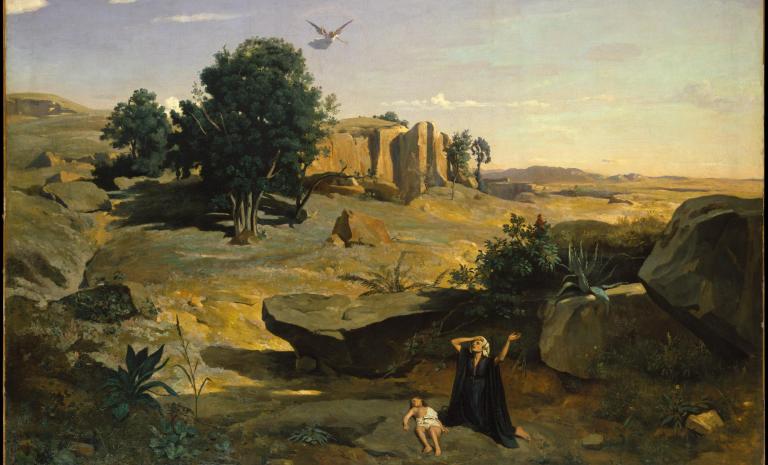
Hagar in the Wilderness by Jean-Baptiste Camille Corot (1835) / WikiCommons
After ten years of infertility, Sarai devises a plan to give her maidservant, Hagar, to her husband, Abram, in hopes of bearing a son. Offering a concubine to a husband to produce offspring is not uncommon at this time, nor is this act of sexual exploitation considered violence. Again, it is just part of the guaranteed protection under Hebrew law. Hagar’s body and life are not her own; both can be used as resources by her owners. Her womb will be utilized to grow an heir for her owners, a child that she will have no rights to after the child’s birth.
Hagar lays with Abram and conceives with him a son.
As Hagar’s son grows in her womb, so grows the bitterness in her heart toward Sarai. In return, Sarai’s contempt for Hagar’s defiant behavior grows as well. Contempt meets with contempt, Sarai’s oppression and maltreatment of Hagar abound, and Hagar is left with few options but to flee to the wilderness in search of relief.
So flee, she does. Hagar, now a pregnant runaway, escapes her oppressor and takes refuge by a spring of water in the wilderness along the road to Shur. She knows the perilous journey she will need to take back to Egypt and the danger that will meet her there as a slave with no protection provided by her masters. Still, the thought of continuing in her current reality is too much to bear.
Then she meets God, in the form of a messenger who finds her by the spring in the wilderness.
“Hagar, Sarai’s servant, where have you come from, and where are you going?” a voice asks her (Gen. 16:8, NLT).
The messenger identifies Hagar first by her personhood, then by her position. Up to this point in the story, Hagar is only referred to as “slave girl.” The moment she meets God, locking eyes from a place of deep despair, uncertainty, pain, and rejection, God calls Hagar by name, offers dignity to her as a whole person created in the image of God.
And then God declares a plan and a promise:
“Return to your mistress, and submit to her authority.”
“I will give you more descendants than you can count.”
“You are now pregnant and will give birth to a son. You are to name him Ismael (which means, ‘God hears’), for the Lord has heard your cry of distress” (Gen. 16:9–11).
Hagar, the cries of your heart have interfused with the very heart of God. God hears your cry and has come to your aid.
In response, Hagar gives God a name: “You are the God who sees me” (Gen. 16:13).
For the first time in biblical history, a person has both the courage and certitude to give God a name. Hagar is seen by God and sees God in return. She declares that God is El Roi—The God Who Sees.
Hagar responds to God’s plan and promise with fierce faith. She returns to Abram and Sarai, bears a son, Ishmael, and serves Sarai for the next seventeen years. During this time, Abram and Sarai are given new names by God—Abraham and Sarah—and Sarah gives birth to a son, Isaac.
When Hagar’s son, Ishmael, is seventeen years old and Sarah’s son, Isaac, is just three, Abraham plans a feast to celebrate the weaning of Isaac from Sarah’s breast. During the celebration, Ishmael is caught mocking Isaac, which infuriates Sarah.
Sarah demands of Abraham, “Get rid of that slave woman and her son. He is not going to share the inheritance with my son, Isaac. I won’t have it!” (Gen. 21:10)
Although Sarah’s demand troubles Abraham because he loves his son Ishmael, Abraham gets up early the next morning, straps a bag of provisions to Hagar’s back, and sends Hagar and their son, Ishmael, into the wilderness.
When the provisions run out, Hagar in her distress places Ishmael beside a bush and then positions herself nearly a hundred yards away. She knows what is to come and can’t bear the thought of watching her son suffer and die under the unforgiving desert sun.
Just as all hope seems lost, The God Who Sees engages Hagar once again.
“Hagar, what’s wrong? Do not be afraid! God has heard the boy crying as he lies there. Go to him and comfort him, for I will make a great nation from his descendants” (Gen. 21:17–18)
God opens Hagar’s eyes, and she sees a well full of water. She quickly fills her water container and gives Ishmael a drink. And, the narrator tells us, God is with Ishmael as he grows up in the wilderness.
God does not ask Hagar to return to Sarah and Abraham. Instead, God promises to provide for Hagar and Ishmael right there in the wilderness. Hagar and Ishmael no longer need protection provided by the headship of masters, for God ensures that God will be near. Not only will God provide for their physical needs; God promises to establish Hagar as the matriarch and Ishmael the father of a great nation of descendants, and that is exactly what God does.
In the Kingdom of God, the cries of the oppressed are heard. Those who are treated as a resource instead of a human being are seen. The immigrant, alone and displaced, is sought after. The exploited worker is offered a well of living water. An abused concubine can be the matriarch of a great nation. A slave woman is just as important as the Father of Israel. This is the story of Hagar.
Though this world has constructed systems used to oppress individuals with ethnic, class, and gender boundaries, the Kingdom of God does not. A fiercely faithful God, seen through the story of Hagar, presents a different reality—one of inclusion, acceptance, and provision, regardless of any status or classification. Hagar, fully seen and cared for, responds to God’s fierce faithfulness with her own fierce faithfulness, living the rest of her days as the one who has seen The God Who Sees.
This post is part of the series Fiercely Faithful: Rad Women of Scripture. See also Eve: Mother to All.

About Carrie Badertscher
Carrie Badertscher is community pastor at Keller Park Church in South Bend, Indiana. You can read more about the author here.
Previous Post

May 8, 2021
Eve: Mother to All (Genesis 1:1–5:2)
Next Post
May 21, 2021 Huldah: Speaking Truth (2 Kings 22; 2 Chronicles 34; Acts 2)
Browse Our Archives
Select a Category Anabaptist Ecosystem Blogging Books Current Events Dispatches Evangelicalism Guest Post Interview Mennonite History Nonviolence Rad Women of Scripture Sermon Uncategorized
Select a Month March 2024 November 2023 August 2023 July 2023 April 2023 March 2023 June 2022 May 2022 January 2022 September 2021 August 2021 July 2021 June 2021 May 2021 April 2021 January 2021 December 2020 November 2020 October 2020 August 2020 June 2020 May 2020 February 2020 January 2020 November 2019 September 2019 August 2019 July 2019 June 2019 May 2019 April 2019 March 2019 February 2019 January 2019
Follow Us!
TAKE THE
Religious Wisdom Quiz
What does God question Job about, showing His wisdom in creation?
Select your answer to see how you score.
Kingdoms Religious rituals Battles Animals and nature
Related posts from Anabaptist Revisions

Revangelical: Proclaiming the Good News after Deconstruction

Peter, Cornelius, and Evangelical Transphobia
Puzzled and terrified—an Easter homily on Luke 24:1–12

Joyful defiance to carceral logic (Philippians 4:10–20)
TRENDING AT PATHEOS Evangelical

16 Spiritual Touchstones for a More Grounded Life
After decades of spiritual study, here are 16 principles I try...

Catholic Evangelization: Sharing Your Faith Every Day
Welcome back to the Graceful Awakening mini-series called, “From Faith to Mission.” ...

The Pillar of the Boatmen: the Ancient Monument...
The Pillar of the Boatmen is a Romano-Gaulish sculpture that dates from...

In one sense walking into Westminster Abbey is like walking down the...

'Super Scam Me' Exposes AI Jon Bon Jovi...
Leslie Pickett believed she was in a relationship with Jon Bon Jovi....

The Brazilian Remake of Kendricks' 'Flywheel' Opens in...
“Flywheel,” the story that launched the Kendrick Brothers’ filmmaking career is getting...
view all Evangelical blogs
Ad-Free & Subscriber Log-In Subscription Support
- About Us
- 2026 Calendar
- Videos
- Podcasts
- Library of World Religions
- Faith In Media Tracker
- Advertise With Us
- Write for Us
- Privacy Policy
- Terms of Service
- Do Not Sell My Data
- Contact Us
- Radiant Digital
- Manage Newsletter Subscriptions
- Unsubscribe From Notifications
- Sitemap
Copyright 2008-2026, Patheos. All rights reserved.
Subscription Support Ad-Free & Subscriber Log-In
Follow Patheos