
BuddhistCatholicContemplativeEvangelicalGeneral ChristianHinduJewishLatter-day SaintMuslimNew VisionsProgressive Christian
Beliefs
- Buddhist
- Catholic
- Contemplative
- Evangelical
- General Christian
- Hindu
- Jewish
- Latter-day Saint
- More Voices
- Muslim
- New Visions
- Pagan
- Progressive Christian
Topics
- Religion News
- Food and Religion
- Sports and Religion
- Religious Art
- Religious Music and Entertainment
- Religious Events
- History and Religion
- Style and Religion
- Politics and Religion
- Women in Religion
- Recreation Outdoors and Religion
- Business Finance and Religion
- Careers Workplace and Religion
- Education and Religion
- Family Parenting and Religion
- Health Fitness and Religion
- Home and Religion
- Relationships and Religion
- Technology and Religion
- Travel and Religion
Columnists
- Buddhist Columnists
- Business Finance and Religion Columnists
- Careers Workplace and Religion Columnists
- Catholic Columnists
- Contemplative Columnists
- Education and Religion Columnists
- Evangelists Columnists
- Family Parenting and Religion Columnists
- General Christian Columnists
- Health Fitness and Religion Columnists
- Hindu Columnists
- History and Religion Columnists
- Home and Religion Columnists
- Jewish Columnists
- More Voices Columnists
- Latter Day Columnists
- Muslim Columnists
- New Visions Columnists
- Nonreligious Columnists
- Pagan Columnists
- Politics and Religion Columnists
- Progressive Columnists
- Recreation Outdoors and Religion Columnists
- Relationships and Religion Columnists
- Religion News Columnists
- Religious Art Columnists
- Religious Events Columnists
- Religious Music and Entertainment Columnists
- Sports and Religion Columnists
- Style and Religion Columnists
- Technology and Religion Columnists
- Travel and Religion Columnists
- Women in Religion Columnists
Resource Library
- 2026 Calendar
- Library of World Religions
- The 100 Most Holy Places on Earth
- Patheos Answers
- Podcasts
- Videos
- Faith Leaders Database
- Anglican Episcopalian
- Bahai
- Baptist
- Buddhism
- Christianity
- Confucianism
- Eastern Orthodoxy
- Hinduism
- Holiness and Pentecostal
- ISKCON
- Islam
- Judaism
- Lutheran
- Methodist
- The Church of Jesus Christ of Latter-day Saints
- New Age
- Paganism
- Presbytarian and Reformed
- Protestantism
- Religion Behind the Scenes
- Roman Catholic
- Scientology
- Shia Islam
- Sikhism
- Sufism
- Sunni Islam
- Taoism
- Zen
- See all religions
Research Tools
 Ad-Free & Subscriber Log-In Subscription Support
Follow Patheos 

- Trending:
- Advent
- |
- Forgiveness
- |
- Thanksgiving
- |
- Election
- |
- Seasonal Holidays
- |
- Marriage
 Anabaptist Revisions
- Home
- Evangelical
- An Open Apology to Kaitlin Curtice from a Baylor Alumnus
An Open Apology to Kaitlin Curtice from a Baylor Alumnus
Last updated on: February 17, 2020 at 9:07 am by David C. Cramer
An Open Apology to Kaitlin Curtice from a Baylor Alumnus 2020-02-17T09:07:09-05:00 David C. Cramer
Patheos Explore the world's faith through different perspectives on religion and spirituality! Patheos has the views of the prevalent religions and spiritualities of the world.
On Wednesday, February 12, Potawatomi author, poet, and storyteller Kaitlin Curtice spoke in chapel at my alma mater Baylor University about her journey of decolonizing her Christian faith, inviting students into their own journey of decolonization. During the first of three chapels, a student interrupted Curtice mid-address by shouting, “No one even thinks like that!” in response to Curtice’s statement that “in the church today, women are not seen as equal to men.” A Baylor-sanctioned student group that describes itself as “dedicated to the founding principles of American exceptionalism, Christian ethics, & Baylor heritage” then publicly disavowed the chapel service and called on the university to publicly apologize to constituents for inviting Curtice to speak in chapel. They then went to the local media who reported on the “controversy” of Curtice reportedly using feminine language for the divine in her prayer. This is not the first time a BIWOC (Black/Indigenous/Woman of Color) chapel speaker has been interrupted and harassed at Baylor. And yet the institution is yet to issue a public apology to Curtice for how she was treated during her visit. As a graduate of Baylor, I offer my own public apology below.

Kaitlin Curtice (Patheos)
Dear Kaitlin,
In my office hangs a diploma from Baylor University with my name on it. The degree I received there gives me all the power, privileges, and benefits that come with holding a doctorate from Baylor. With it, I have access to positions and spaces within academia and the church that I wouldn’t otherwise have.
In exchange, I carry with me the name of Baylor wherever I go and in whatever I do. By Baylor conferring on me a degree and I accepting it, Baylor and I are forever inseparable. I am now forever a member of what Baylor athletics refers to as “Baylor Nation.”
Being a member of Baylor Nation means that I am partly responsible for what happens at Baylor. And as a member of Baylor Nation, I am deeply sorry for what happened to you last week at your invited address at Baylor chapel.
You came to Baylor with a message of peace. You would have been well within your rights to denounce Baylor for our history—including our quite recent history—of racism, white supremacy, sexual violence, and homophobia. Instead, you shared about your own journey of discovery and healing—of, in your terminology, “decolonizing.” Even as a Potawatomi woman, you confessed, “I wouldn’t dare call myself decolonized when there’s still so much decolonizing to do.” You acknowledged your own “white privilege” as a “mixed European and Potawatomi woman.” And you admitted that you participate in the very systems of oppression that you are learning to question. Throughout your talk, you spoke not of “me versus you” but of “we,” inviting students into their own journey of discovery, healing, and liberation alongside you. You refused to vilify individuals but spoke instead against dehumanizing and oppressive systems. Quoting your friend Rachel Held Evans, you spoke out of “deep love” for your community.
In response, a student chose to heckle you during your talk. Instead of apologizing to you publicly before your subsequent chapel addresses, the chapel director (no doubt well intentioned) introduced you with a trigger warning to students, comparing your talk to a previous chapel talk by an Air Force chaplain and lieutenant colonel and inviting students to walk out of your talk and speak to chapel staff if they were uncomfortable with your message. (Did he give a similar trigger warning before the white male lieutenant colonel’s address?)
When a student group immediately vilified you as “a speaker with pagan sympathies,” the Baylor president issued a statement not defending you or apologizing to you for the treatment you were receiving during and following your visit. No, her statement distanced Baylor from you, stating, “Every Chapel speaker works with us ahead of time on what message they will be sharing, but on occasion, a speaker may veer away from our understanding of the message they planned to convey.” (What part of your message veered away from their prior understanding of what you planned to convey? What was their understanding of what you planned to convey?)
In a sense, the president’s message to concerned students and their parents was more authentic than a quick apology to you would have been. While there are many good people at Baylor—many of whom you likely met during your visit—as an institution Baylor is still deeply invested in the colonizing systems and logics that you came to help us dismantle. Despite the traditional Baptist emphasis on separation of church and state, the “Christian heritage” at Baylor is still enmeshed with whiteness, nationalism, patriarchy, and colonialism.
While all speech is inherently political, it is disheartening to see your gentle invitation to join you in wrestling with our shared cultural heritage dismissively characterized as part of a “liberal agenda” instead of as what it is: proclamation of the gospel. As my friend and colleague Malinda Elizabeth Berry writes, the Doctrine of Discovery that allowed colonial powers to seize Indigenous land with impunity is the “originating sin” of the United States of America. It has so infected the consciousness of white Western Christians that many of us reflexively consider the idea of Indigenous Christianity to be inherently syncretistic. But by inviting us to decolonize our faith, you help us to see how our own colonialist conception of Christianity is what’s syncretistic, as our faith has blended with American exceptionalism, nationalism, capitalism, militarism, and patriarchy until questioning any of the latter is taken as an affront to the former. Decolonizing is thus another name for what Jesus calls repentance—turning away from systems of violence and empire in order to embrace the nonviolent kingdom of heaven as those with pure hearts who seek after the righteousness and justice of God.
I am writing this from my home in South Bend, Indiana, along the St. Joseph River. As you described in your chapel address, the land on which my home now stands is land of the Potawatomi Nation who, in 1838, were forcibly removed from it by the US government. As historian Rich Meyer describes, around 800 Potawatomi were marched at gunpoint by US soldiers to Kansas on what became known as the Trail of Death. It is called the Trail of Death because, during this forced emigration in the chilly months of September and November, an estimated 60 of the 800 Potawatomi—most of them elderly or children—died. Those who survived were left homeless and landless, and many of them moved south to Oklahoma where you were later born.
To my Baylor family, I ask: Is there something particularly “controversial” or “partisan” or “divisive” about remembering this history, these deaths? If so, then what does that say about our allegiances? Might the Spirit be calling us, through the voice of our sister Kaitlin, to repent of our complicity in systems of death so that we may instead choose life that we and our neighbors and our children and all God’s creation might live?
Kaitlin, I cannot take back what my ancestors did to yours. Nor can I take back what my university did to you. But, humbled by your invitation to join you in decolonizing our shared faith, I repent. I repent of my own silent complicity in the harms done to you and your people and of the ways that, even today, I benefit from the displacement of your ancestors from the land on which I now call home. And I repent further of my own silent complicity in an educational system that values “civil discourse” over truth and justice.
I pray the day will come soon when my alma mater‘s administration will join me not just in apology but also in repentance so that justice might roll down like a mighty flood and righteousness like an ever-flowing stream.
Shalom,

David Cramer, PhD 2016 (religion), Baylor University
Watch Curtice’s February 12 Baylor chapel address below.
About David C. Cramer
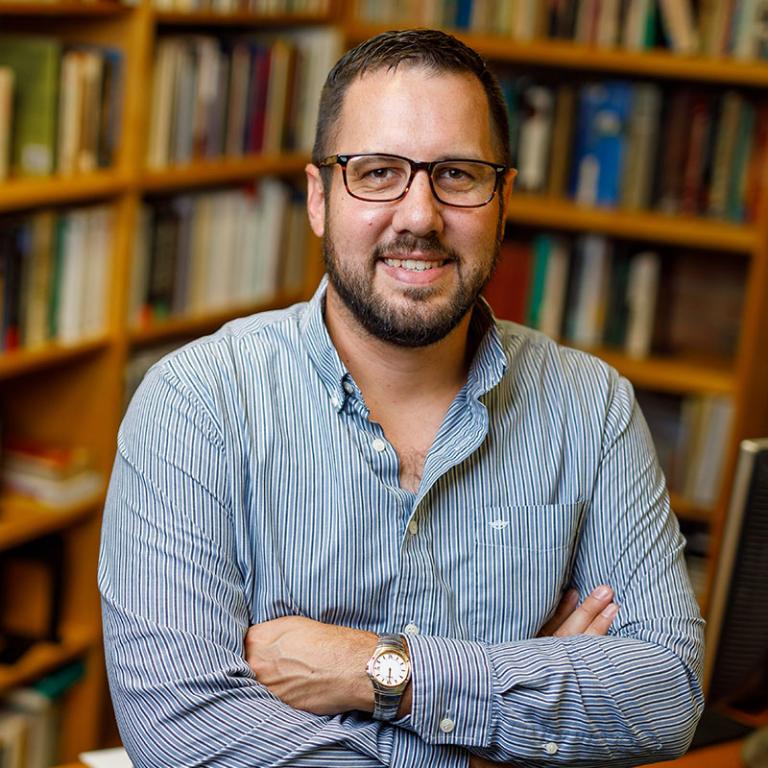
David C. Cramer is teaching pastor at Keller Park Church in South Bend, Indiana, and managing editor at the Institute of Mennonite Studies at Anabaptist Mennonite Biblical Seminary in Elkhart, Indiana. You can read more about the author here.
Previous Post

January 6, 2020
Private Profit and the Nation's Honor—A Protest and a Plea
Next Post
February 29, 2020 Prophetic Songwriting: Jon Guerra's "Citizens"
Browse Our Archives
Select a Category Anabaptist Ecosystem Blogging Books Current Events Dispatches Evangelicalism Guest Post Interview Mennonite History Nonviolence Rad Women of Scripture Sermon Uncategorized
Select a Month March 2024 November 2023 August 2023 July 2023 April 2023 March 2023 June 2022 May 2022 January 2022 September 2021 August 2021 July 2021 June 2021 May 2021 April 2021 January 2021 December 2020 November 2020 October 2020 August 2020 June 2020 May 2020 February 2020 January 2020 November 2019 September 2019 August 2019 July 2019 June 2019 May 2019 April 2019 March 2019 February 2019 January 2019
Follow Us!
TAKE THE
Religious Wisdom Quiz
What does James say is the implanted word able to do?
Select your answer to see how you score.
Judge the nations Defeat your enemies Heal your body Save your souls
Related posts from Anabaptist Revisions

Mennonites hold die-in, call Rep. to support ceasefire

Little Amal comes to South Bend
Accountability before unity—a reflection on King's "Where Do...

Catholic Social Teaching and the US Election—A Response...
TRENDING AT PATHEOS Evangelical

Thomas Paine, the Smiths, the apostles in England,...
I'm pleased to announce that the Becoming Brigham Black Friday Sale,...

CatholicTV Series: Six Black Catholics on Path to...
WATERTOWN, Mass., November 9, 2026 – In recognition of Black Catholic History...

New Advent Journal Invites Catholics to Be Pilgrims
Florissant, MO, November 16, 2026— What if Advent were more than a...

INNER CIRCLE: John's Quantum Gospel
INTRODUCTION In this next Inner Circle series, which I anticipate will...

"Three B's" of My Apologetics Ministry (+ VIDEO)
In early December 2026 (less than a week from the time...

James Ishmael Ford's books on Zen
James Ishmael Ford's Official Website provides the most complete annotated list of...
view all Evangelical blogs
Ad-Free & Subscriber Log-In Subscription Support
- About Us
- 2026 Calendar
- Videos
- Podcasts
- Library of World Religions
- Faith In Media Tracker
- Advertise With Us
- Write for Us
- Privacy Policy
- Terms of Service
- Do Not Sell My Data
- Contact Us
- Radiant Digital
- Manage Newsletter Subscriptions
- Unsubscribe From Notifications
- Sitemap
Copyright 2008-2026, Patheos, part of the Radiant Digital network of media brands. All rights reserved.
Subscription Support Ad-Free & Subscriber Log-In
Follow Patheos