
BuddhistCatholicContemplativeEvangelicalGeneral ChristianHinduJewishLatter-day SaintMuslimNew VisionsProgressive Christian
Beliefs
- Buddhist
- Catholic
- Contemplative
- Evangelical
- General Christian
- Hindu
- Jewish
- Latter-day Saint
- More Voices
- Muslim
- New Visions
- Pagan
- Progressive Christian
Topics
- Religion News
- Food and Religion
- Sports and Religion
- Religious Art
- Religious Music and Entertainment
- Religious Events
- History and Religion
- Style and Religion
- Politics and Religion
- Women in Religion
- Recreation Outdoors and Religion
- Business Finance and Religion
- Careers Workplace and Religion
- Education and Religion
- Family Parenting and Religion
- Health Fitness and Religion
- Home and Religion
- Relationships and Religion
- Technology and Religion
- Travel and Religion
Columnists
- Buddhist Columnists
- Business Finance and Religion Columnists
- Careers Workplace and Religion Columnists
- Catholic Columnists
- Contemplative Columnists
- Education and Religion Columnists
- Evangelists Columnists
- Family Parenting and Religion Columnists
- General Christian Columnists
- Health Fitness and Religion Columnists
- Hindu Columnists
- History and Religion Columnists
- Home and Religion Columnists
- Jewish Columnists
- More Voices Columnists
- Latter Day Columnists
- Muslim Columnists
- New Visions Columnists
- Nonreligious Columnists
- Pagan Columnists
- Politics and Religion Columnists
- Progressive Columnists
- Recreation Outdoors and Religion Columnists
- Relationships and Religion Columnists
- Religion News Columnists
- Religious Art Columnists
- Religious Events Columnists
- Religious Music and Entertainment Columnists
- Sports and Religion Columnists
- Style and Religion Columnists
- Technology and Religion Columnists
- Travel and Religion Columnists
- Women in Religion Columnists
Resource Library
- 2026 Calendar
- Library of World Religions
- The 100 Most Holy Places on Earth
- Patheos Answers
- Podcasts
- Videos
- Faith Leaders Database
- Anglican Episcopalian
- Bahai
- Baptist
- Buddhism
- Christianity
- Confucianism
- Eastern Orthodoxy
- Hinduism
- Holiness and Pentecostal
- ISKCON
- Islam
- Judaism
- Lutheran
- Methodist
- The Church of Jesus Christ of Latter-day Saints
- New Age
- Paganism
- Presbytarian and Reformed
- Protestantism
- Religion Behind the Scenes
- Roman Catholic
- Scientology
- Shia Islam
- Sikhism
- Sufism
- Sunni Islam
- Taoism
- Zen
- See all religions
Research Tools
 Ad-Free & Subscriber Log-In Subscription Support
Ad-Free & Subscriber Log-In Subscription Support
Follow Patheos 

- Trending:
- Forgiveness
- |
- Marriage
- |
- Consciousness
- |
- Death Penalty
- |
- Election
- |
- Halloween
 Anabaptist Revisions
- Home
- Evangelical
- “I Was Hungry”—author interview with Jeremy Everett (2)
“I Was Hungry”—author interview with Jeremy Everett (2)
Last updated on: August 14, 2019 at 7:00 am by David C. Cramer
“I Was Hungry”—author interview with Jeremy Everett (2) 2019-08-13T15:23:29-05:00 David C. Cramer
Patheos Explore the world's faith through different perspectives on religion and spirituality! Patheos has the views of the prevalent religions and spiritualities of the world.
While studying at Baylor University, I had the pleasure of meeting and befriending fellow Baylor Bear and Wacoan, Jeremy Everett. Jeremy is the founder and director of the Texas Hunger Initiative, a project devoted to ending hunger through policy, education, research, community organizing, and community development. He’s a National Commission on Hunger congressional appointee who has testified before congress on how to provide evidence-based solutions for the Supplemental Nutrition Assistance Program. He has worked for international community organizations as a teacher, religious leader, community organizer, fundraiser, and organic farmer. And, most recently, he is author of the brand new book I Was Hungry: Cultivating Common Ground to End an American Crisis (Brazos, 2019). While in Waco, I sat down with Jeremy at his THI office for an interview about his work and the genesis of his book. Below is part 2 of 3 of our interview (edited for length and clarity). (Click here for part 1.)
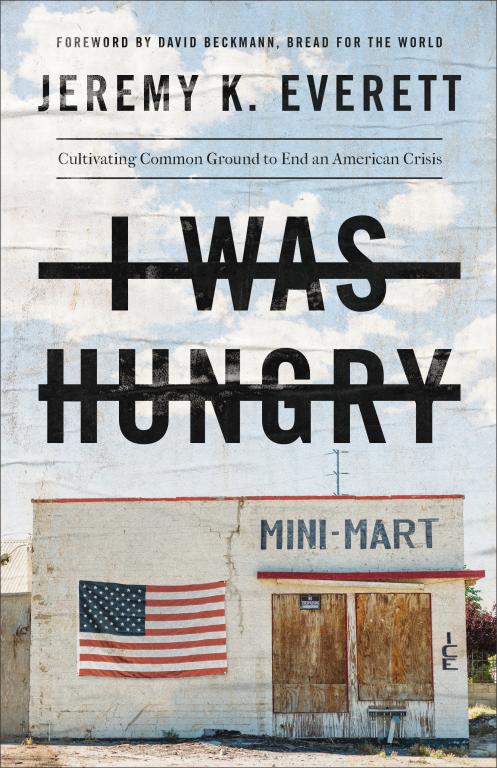
Jeremy Everett, I Was Hungry (Brazos Press, 2019)
DC: As you’ve learned to develop solidarity with the poor, you’ve also had to learn how to navigate partnerships with the US Department of Agriculture, Conagra Foods, and even the Walmart Foundation. How do you navigate these partnerships, especially when you might have ideological differences?
JE: THI now has thousands of partners. We’ve been able to increase summer meals sites at about 5,500 new organizations across the state of Texas, only 750 of which are congregations. We work closely with local organizations, but we also work with big corporate partners and federal agencies. If we believe that we’re all created in the image of God, that’s where we have to start.
Walmart Corporation, for example, is the biggest retail company in the world. As Walmart goes, so goes the retail industry. Walmart had pledged 2 billion dollars over a five year period to address the issue of hunger, and so I ended up getting to know them through a number of connections. One of the things that we knew about Walmart was that they are the best at logistics of any company in the world, and much of summer hunger is related to logistics—how to get meals to kids through congregate meal sites around the country. And we were failing as a nation to be able to do that. In Texas, of all the kids who were eligible for summer meals, less than ten percent were getting access to them. We were hearing horrific stories of child hunger during the summer. So we initially partnered with Walmart for them to teach us logistics. They’re the best at it, and we wanted to learn from them. And through that relationship, we learned that we have more in common than we have differences. And though it’s easy for the social justice community to vilify Walmart as a company—and they do a lot of things we don’t agree with—we also identify that there are a lot of good people in that organization that want to make a difference. And so at some point, Kasey Ashenfelter—now our director of communications—and I were trying to decide if Walmart was an organization we wanted to partner with. We knew if we didn’t partner with them, it would reduce access to summer meals in the state of Texas; if we did, we would expand access. So we decided to try it out and see if our culture affects them or if their culture affects us or both.
It’s turned out to be a great partnership. We certainly don’t take credit for this, but they recently raised their minimum wage, which is two and a half dollars higher in Texas than any other state, and they’re beginning to explore issues of health insurance. We encouraged such steps, arguing that, if they offer these benefits and pay better wages, they would retain more employees and that more people in the social justice movement might even start shopping in their stores. As people like Bono have taught us, simple moral persuasion can have profound effects. Because we know that we’re all made in the image of God, whether a CEO or the greeter at the local grocery store, we can begin to identify the space where we have things in common and cultivate trust with each other and then expand on that trust. That’s our hope for all of our partners, and that’s been key to getting industry and justice organizations at the table together—Democrats and Republicans alike.
DC: I think a cynical reader might agree that individuals are made in the image of God but respond that there’s also original sin—including structural sin—to deal with, as Reinhold Niebuhr famously argued in Moral Man and Immoral Society*. How would you respond to those who argue that some of your partner organizations are perpetuating the very problem you’re trying to address? Is there a little bit of pragmatism to your approach in terms of doing whatever it takes to put food on the table?*
JE: You absolutely have to be pragmatic. If I choose out of self-righteous indignation not to work with anyone who doesn’t agree with my social justice principles, then I’m not going to see the end of hunger and poverty in my time. I probably would do nothing to further the cause of people experiencing hunger and poverty, but I would preserve my self-righteous indignation. If I’m preserving my self-righteous indignation, I’m probably not working for justice.
And so, yes, sin is a reality that we all live with. I think where we experience it even more so than working with industry is in the sectors that have found themselves as bestowers of charity for the poor. They’ve done very well within the current system, and so we’ve experienced more push-back from that sector because they want to be the face of charity in their particular community.
From the corporate and government sectors we’ve seen more willingness to address the issue. It’s still important that we don’t skirt the issues. Wage rates are critical. We can do a lot to do summer meals for kids, but if we’re not raising wage rates, then we’re locking people into perpetual food insecurity. Texas has the most minimum wage paying jobs in the country and the highest amount of uninsured people in the country. Those numbers directly impact our ability to put food on the table for families around the state. Those are things that we have to deal with if we are going to work collectively for justice. We can’t turn a blind eye to those issues in an effort to find common ground. And so we do find the areas where we can work with the corporate and government sectors, but that doesn’t preclude us from identifying other areas where we can apply moral pressure.
DC: THI isn’t an advocacy group, but your work has gotten attention at the federal level. You personally were appointed to the National Commission on Hunger by former Speaker John Boehner, and you testified before the Agricultural Committee on SNAP. What do you think it is about THI that has garnered such attention? Does it provide a model for something that can be done on a national scale?
JE: Periodically you’ll hear politicians talk about public and private partnerships. And our philosophical vantage point is that hunger is too big for one organization or one sector to be able to solve by itself. We believe that the problem is so big that it’s going to take us all working together in an integrated, efficient capacity, if we’re going to whip this issue and move on to other issues to address as a nation.
Typically, our friends in Washington who are Democrats feel that it’s the federal government’s job to address the issue of hunger, while our friends in Washington who are Republicans feel that it’s the faith community’s job or the nonprofit sector’s job. And I think the reason that we’ve done well with both side of the aisle is because we say that, in order to address the issue comprehensively, it’s going to take the nonprofit, corporate, and government sectors—along with faith communities—all doing their part. So we’ve built the infrastructure to be able to support those kind of partnerships. One-off partnerships are not going to reduce hunger. It’s going to take an infrastructure that supports these partnerships indefinitely.
*Brazos Press provided me a promotional copy of I Was Hungry for this post.

About David C. Cramer
David C. Cramer is teaching pastor at Keller Park Church in South Bend, Indiana, and managing editor at the Institute of Mennonite Studies at Anabaptist Mennonite Biblical Seminary in Elkhart, Indiana. You can read more about the author here.
Previous Post

August 12, 2019
"I Was Hungry"—author interview with Jeremy Everett (1)
Next Post
August 16, 2019 "I Was Hungry"—author interview with Jeremy Everett (3)
Browse Our Archives
Select a Category Anabaptist Ecosystem Blogging Books Current Events Dispatches Evangelicalism Guest Post Interview Mennonite History Nonviolence Rad Women of Scripture Sermon Uncategorized
Select a Month March 2024 November 2023 August 2023 July 2023 April 2023 March 2023 June 2022 May 2022 January 2022 September 2021 August 2021 July 2021 June 2021 May 2021 April 2021 January 2021 December 2020 November 2020 October 2020 August 2020 June 2020 May 2020 February 2020 January 2020 November 2019 September 2019 August 2019 July 2019 June 2019 May 2019 April 2019 March 2019 February 2019 January 2019
Follow Us!
TAKE THE
Religious Wisdom Quiz
What was a "phylactery" used by Jews during prayer?
Select your answer to see how you score.
A lamp A musical instrument A small leather box with scripture A festival garment
Related posts from Anabaptist Revisions
"I Was Hungry"—author interview with Jeremy Everett (3)
"I Was Hungry"—author interview with Jeremy Everett (1)

Mennonites hold die-in, call Rep. to support ceasefire

Revangelical: Proclaiming the Good News after Deconstruction
TRENDING AT PATHEOS Evangelical

The Problem with False Prophets
Miller’s Station UMC| 10/18/26| Anchor Verse: Jeremiah 23: 1, 9-23 I...

Emotion in Early Christianity by Andrew Crislip
Andrew Crislip’s Emotion in Early Christianity examines an often overlooked dimension of...

16 Spiritual Touchstones for a More Grounded Life
After decades of spiritual study, here are 16 principles I try...

Catholic Evangelization: Sharing Your Faith Every Day
Welcome back to the Graceful Awakening mini-series called, “From Faith to Mission.” ...

The Pillar of the Boatmen: the Ancient Monument...
The Pillar of the Boatmen is a Romano-Gaulish sculpture that dates from...

In one sense walking into Westminster Abbey is like walking down the...
view all Evangelical blogs
Ad-Free & Subscriber Log-In Subscription Support
- About Us
- 2026 Calendar
- Videos
- Podcasts
- Library of World Religions
- Faith In Media Tracker
- Advertise With Us
- Write for Us
- Privacy Policy
- Terms of Service
- Do Not Sell My Data
- Contact Us
- Radiant Digital
- Manage Newsletter Subscriptions
- Unsubscribe From Notifications
- Sitemap
Copyright 2008-2026, Patheos. All rights reserved.
Subscription Support Ad-Free & Subscriber Log-In
Follow Patheos