
BuddhistCatholicContemplativeEvangelicalGeneral ChristianHinduJewishLatter-day SaintMuslimNew VisionsProgressive Christian
Beliefs
- Buddhist
- Catholic
- Contemplative
- Evangelical
- General Christian
- Hindu
- Jewish
- Latter-day Saint
- More Voices
- Muslim
- New Visions
- Pagan
- Progressive Christian
Topics
- Religion News
- Food and Religion
- Sports and Religion
- Religious Art
- Religious Music and Entertainment
- Religious Events
- History and Religion
- Style and Religion
- Politics and Religion
- Women in Religion
- Recreation Outdoors and Religion
- Business Finance and Religion
- Careers Workplace and Religion
- Education and Religion
- Family Parenting and Religion
- Health Fitness and Religion
- Home and Religion
- Relationships and Religion
- Technology and Religion
- Travel and Religion
Columnists
- Buddhist Columnists
- Business Finance and Religion Columnists
- Careers Workplace and Religion Columnists
- Catholic Columnists
- Contemplative Columnists
- Education and Religion Columnists
- Evangelists Columnists
- Family Parenting and Religion Columnists
- General Christian Columnists
- Health Fitness and Religion Columnists
- Hindu Columnists
- History and Religion Columnists
- Home and Religion Columnists
- Jewish Columnists
- More Voices Columnists
- Latter Day Columnists
- Muslim Columnists
- New Visions Columnists
- Nonreligious Columnists
- Pagan Columnists
- Politics and Religion Columnists
- Progressive Columnists
- Recreation Outdoors and Religion Columnists
- Relationships and Religion Columnists
- Religion News Columnists
- Religious Art Columnists
- Religious Events Columnists
- Religious Music and Entertainment Columnists
- Sports and Religion Columnists
- Style and Religion Columnists
- Technology and Religion Columnists
- Travel and Religion Columnists
- Women in Religion Columnists
Resource Library
- 2026 Calendar
- Library of World Religions
- The 100 Most Holy Places on Earth
- Patheos Answers
- Podcasts
- Videos
- Faith Leaders Database
- Anglican Episcopalian
- Bahai
- Baptist
- Buddhism
- Christianity
- Confucianism
- Eastern Orthodoxy
- Hinduism
- Holiness and Pentecostal
- ISKCON
- Islam
- Judaism
- Lutheran
- Methodist
- The Church of Jesus Christ of Latter-day Saints
- New Age
- Paganism
- Presbytarian and Reformed
- Protestantism
- Religion Behind the Scenes
- Roman Catholic
- Scientology
- Shia Islam
- Sikhism
- Sufism
- Sunni Islam
- Taoism
- Zen
- See all religions
Research Tools
 Ad-Free & Subscriber Log-In Subscription Support
Ad-Free & Subscriber Log-In Subscription Support
Follow Patheos 

- Trending:
- Forgiveness
- |
- Marriage
- |
- Consciousness
- |
- Death Penalty
- |
- Election
- |
- Halloween
 Anabaptist Revisions
- Home
- Evangelical
- “We must celebrate with a feast”: A Lenten Sermon (Luke 15:11–32)
“We must celebrate with a feast”: A Lenten Sermon (Luke 15:11–32)
Last updated on: April 2, 2019 at 9:42 am by David C. Cramer
“We must celebrate with a feast”: A Lenten Sermon (Luke 15:11–32) 2019-04-02T09:42:59-05:00 David C. Cramer
Patheos Explore the world's faith through different perspectives on religion and spirituality! Patheos has the views of the prevalent religions and spiritualities of the world.
In the case of the Prodigal Son parable, I’m on Team Big Brother.
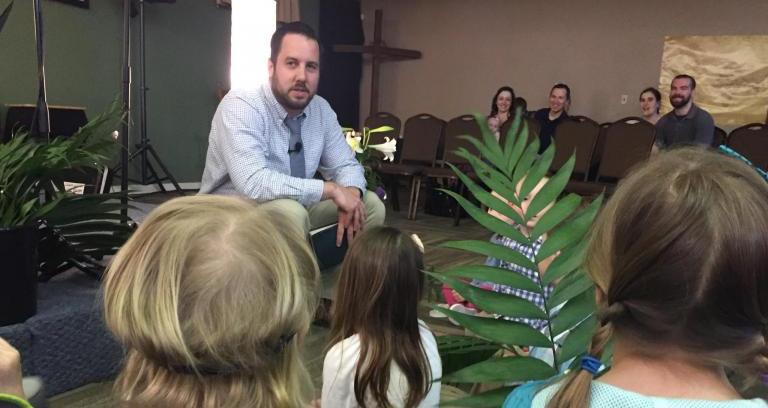
Preaching at Keller Park Church, Palm Sunday, 2017
Across the two millennia that the parable has been preached, Team Big Brother consistently gets a raw deal. For one thing, even though the parable literally begins with the phrase, “A man had two sons,” many tellings forget about the older son entirely. Even one of my all-time favorite songwriters, Keith Green, wrote a song about this parable from the perspective of the younger son—without ever mentioning that there’s another son in the parable.
When the elder son is mentioned, it is usually to contrast him negatively with the younger. Sure, the younger son went off to sow his wild oats, but eventually he came to his senses, repented of his ways, and returned home to ask forgiveness. Just like all good Christians do. Meanwhile, the elder son is trying to earn his Father’s love through his good works. Just like those bad old Pharisees and teachers of the law.
The only problem with this reading is that it doesn’t match what the parable actually says. After the younger son asks for his share of his father’s estate early, the father, we’re told, “divides his wealth between his sons” (v. 12). In other words, from the very outset of the story, both sons receive their inheritance. The elder son didn’t ask for it, but because the younger son did, they both received it.
While the younger son takes his inheritance and squanders it, the elder son continues to work in his father’s fields. He isn’t working to earn his inheritance since he already received it. He’s just working because he’s a loyal elder son, and that’s just what loyal elder sons do. He never asks for anything. He just quietly works for his father, while the younger son is off burning through his inheritance.
Then when the younger son runs out of cash and realizes that he’d be better off returning to the old man that eating with pigs, the father is so quick to celebrate his return that he forgets all about his loyal elder son. The party begins before anyone thinks to notify the elder son. It’s only after the elder son comes in from the field, hears the music, and asks a servant what’s going on that he learns that there’s a party celebrating the return of his younger brother.
I have to admit. As an older brother myself, I can sympathize with how this brother feels. It’s one thing if you’re going to spoil the baby of the family. But can you at least give me a heads up when you throw him a party? So, the elder brother quite understandably refuses to go in to the party that no one remembered to invite him to.
Now the father fears that he’s gained one son back only to lose another. So he goes out and pleads with the elder son. Actually the word used here to describe the father’s action is parekalei, which can mean “plead” or “comfort”— as when Jesus tells the disciples in John 14 that when he left them he would send a Paraclete, or Comforter, the Holy Spirit.
But the elder son is not ready to be comforted. He cries out to his father with some of the most heart-wrenching words in Scripture:
All these years I’ve slaved for you and never once refused to do a single thing you told me to. And in all that time you never gave me even one young goat for a feast with my friends. Yet when this son of yours comes back after squandering your money on prostitutes, you celebrate by killing the fattened calf! (vv. 29–30)
The father doesn’t challenge his son on the facts. He doesn’t chastise him for trying to earn his love or anything of the sort. Instead, he shows deep empathy and love for his son: “Look, dear son, you have always stayed by me, and everything I have is yours” (v. 31).
The son had been loyal. He had always stayed by his father’s side, even when his brother had ditched out.
There’s just one point that the father tries to convey to his eldest son: “We had to celebrate this happy day.”
Why?
“Your brother was dead and has come back to life! He was lost, but now he is found!” (v. 31)
The father is essentially telling his elder son: Look, we both know you’re my loyal son. You’ve stuck with me through thick and thin. We’re not celebrating your brother right now because he possesses any virtues you lack. We’re not celebrating him for any particular virtues he possesses at all. In fact, you know as well as I that he’s kind of a spoiled brat. But none of that matters right now. What matters is that he’s family. He’s my son and your brother. We’re celebrating simply because we thought we’d lost him, but we got him back. And when you think you’ve lost a family member only to get him back, there’s only one proper response: Celebrating with a feast.
This Lenten season, Jesus asks us to count the cost, take up our cross, and follow him. But then, in the middle of this journey, he tells this parable of a couple of brothers, one of whom veers off course for quite some time.
He’s not telling us not to keep following him. He’s not telling us not to count the costs and carry our cross. He’s simply reminding us that not everyone in the family is going to stay as committed. Some are going to stray away. Some are going to try to take advantage of the system for their own benefit.
But at the end of the day, that’s not what matters most. What matters most is that we’re family.
Sure, sometimes family members can drive you crazy like no one else could. Birth order dynamics are a real thing. But when it comes to family, we’re in it together.
As Paul writes to his sisters and brothers in Rome, we rejoice with those who rejoice and mourn with those who mourn. For, as he writes to his sisters and brothers in Corinth: “If one part suffers, all the parts suffer with it, and if one part is honored, all the parts are glad.”

About David C. Cramer
David C. Cramer is teaching pastor at Keller Park Church in South Bend, Indiana, and managing editor at the Institute of Mennonite Studies at Anabaptist Mennonite Biblical Seminary in Elkhart, Indiana. You can read more about the author here.
Previous Post

March 29, 2019
Melissa Florer-Bixler's Fire by Night
Next Post
April 8, 2019 “You will always have the poor among you” (John 12:1–8)
Browse Our Archives
Select a Category Anabaptist Ecosystem Blogging Books Current Events Dispatches Evangelicalism Guest Post Interview Mennonite History Nonviolence Rad Women of Scripture Sermon Uncategorized
Select a Month March 2024 November 2023 August 2023 July 2023 April 2023 March 2023 June 2022 May 2022 January 2022 September 2021 August 2021 July 2021 June 2021 May 2021 April 2021 January 2021 December 2020 November 2020 October 2020 August 2020 June 2020 May 2020 February 2020 January 2020 November 2019 September 2019 August 2019 July 2019 June 2019 May 2019 April 2019 March 2019 February 2019 January 2019
Follow Us!
TAKE THE
Religious Wisdom Quiz
True or False: James says that whoever keeps the whole law but stumbles at just one point is guilty of breaking all of it.
Select your answer to see how you score.
FALSE TRUE
Related posts from Anabaptist Revisions

Revangelical: Proclaiming the Good News after Deconstruction

Peter, Cornelius, and Evangelical Transphobia
Puzzled and terrified—an Easter homily on Luke 24:1–12

Joyful defiance to carceral logic (Philippians 4:10–20)
TRENDING AT PATHEOS Evangelical

The Problem with False Prophets
Miller’s Station UMC| 10/18/26| Anchor Verse: Jeremiah 23: 1, 9-23 I...

Emotion in Early Christianity by Andrew Crislip
Andrew Crislip’s Emotion in Early Christianity examines an often overlooked dimension of...

16 Spiritual Touchstones for a More Grounded Life
After decades of spiritual study, here are 16 principles I try...

Catholic Evangelization: Sharing Your Faith Every Day
Welcome back to the Graceful Awakening mini-series called, “From Faith to Mission.” ...

The Pillar of the Boatmen: the Ancient Monument...
The Pillar of the Boatmen is a Romano-Gaulish sculpture that dates from...

In one sense walking into Westminster Abbey is like walking down the...
view all Evangelical blogs
Ad-Free & Subscriber Log-In Subscription Support
- About Us
- 2026 Calendar
- Videos
- Podcasts
- Library of World Religions
- Faith In Media Tracker
- Advertise With Us
- Write for Us
- Privacy Policy
- Terms of Service
- Do Not Sell My Data
- Contact Us
- Radiant Digital
- Manage Newsletter Subscriptions
- Unsubscribe From Notifications
- Sitemap
Copyright 2008-2026, Patheos. All rights reserved.
Subscription Support Ad-Free & Subscriber Log-In
Follow Patheos