
BuddhistCatholicContemplativeEvangelicalGeneral ChristianHinduJewishLatter-day SaintMuslimNew VisionsProgressive Christian
Beliefs
- Buddhist
- Catholic
- Contemplative
- Evangelical
- General Christian
- Hindu
- Jewish
- Latter-day Saint
- More Voices
- Muslim
- New Visions
- Pagan
- Progressive Christian
Topics
- Religion News
- Food and Religion
- Sports and Religion
- Religious Art
- Religious Music and Entertainment
- Religious Events
- History and Religion
- Style and Religion
- Politics and Religion
- Women in Religion
- Recreation Outdoors and Religion
- Business Finance and Religion
- Careers Workplace and Religion
- Education and Religion
- Family Parenting and Religion
- Health Fitness and Religion
- Home and Religion
- Relationships and Religion
- Technology and Religion
- Travel and Religion
Columnists
- Buddhist Columnists
- Business Finance and Religion Columnists
- Careers Workplace and Religion Columnists
- Catholic Columnists
- Contemplative Columnists
- Education and Religion Columnists
- Evangelists Columnists
- Family Parenting and Religion Columnists
- General Christian Columnists
- Health Fitness and Religion Columnists
- Hindu Columnists
- History and Religion Columnists
- Home and Religion Columnists
- Jewish Columnists
- More Voices Columnists
- Latter Day Columnists
- Muslim Columnists
- New Visions Columnists
- Nonreligious Columnists
- Pagan Columnists
- Politics and Religion Columnists
- Progressive Columnists
- Recreation Outdoors and Religion Columnists
- Relationships and Religion Columnists
- Religion News Columnists
- Religious Art Columnists
- Religious Events Columnists
- Religious Music and Entertainment Columnists
- Sports and Religion Columnists
- Style and Religion Columnists
- Technology and Religion Columnists
- Travel and Religion Columnists
- Women in Religion Columnists
Resource Library
- 2026 Calendar
- Library of World Religions
- The 100 Most Holy Places on Earth
- Patheos Answers
- Podcasts
- Videos
- Faith Leaders Database
- Anglican Episcopalian
- Bahai
- Baptist
- Buddhism
- Christianity
- Confucianism
- Eastern Orthodoxy
- Hinduism
- Holiness and Pentecostal
- ISKCON
- Islam
- Judaism
- Lutheran
- Methodist
- The Church of Jesus Christ of Latter-day Saints
- New Age
- Paganism
- Presbytarian and Reformed
- Protestantism
- Religion Behind the Scenes
- Roman Catholic
- Scientology
- Shia Islam
- Sikhism
- Sufism
- Sunni Islam
- Taoism
- Zen
- See all religions
Research Tools
 Ad-Free & Subscriber Log-In Subscription Support
Ad-Free & Subscriber Log-In Subscription Support
Follow Patheos 

- Trending:
- Forgiveness
- |
- Marriage
- |
- Consciousness
- |
- Death Penalty
- |
- Election
- |
- Halloween
 Re-Generacion
- Home
- Progressive Christian
- The Curious Life and Death (?) of William Branham
The Curious Life and Death (?) of William Branham
Last updated on: June 20, 2013 at 12:41 pm by Arlene Sánchez-Walsh
The Curious Life and Death (?) of William Branham 2013-06-20T12:41:48-07:00 Arlene Sánchez-Walsh
Patheos Explore the world's faith through different perspectives on religion and spirituality! Patheos has the views of the prevalent religions and spiritualities of the world.
One of the reasons Pentecostalism is both academically fascinating and personally invigorating is because of its ability for religious innovation. Its pneumatic drive make it a daring mix of high tension piety and effervescence (thank you Emile Durkheim). Independent evangelists have had more of a hand in crafting their own brand of Pentecostalism since they tend to be free of the denominational structures imposed by hierarchies whose survival depends on securing the borders of orthodox belief and practice. William Branham was one of the most intriguing Pentecostals of the mid 20th century, and as always, depending on whose history and theology you buy–was either a charlatan, prophet, heretic, modern-day Elijah, trickster, or Messenger of the Seventh Age.
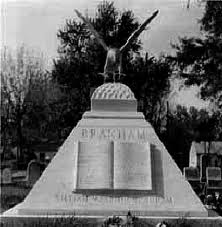
pilgrimage site for Branham’s followers
Every Easter, a group of Branham’s followers visit his grave in Jeffersonville, Indiana and await his resurrection, which will be the sign that Jesus’ Second Coming is at hand. Branham’s grave attracts hundreds of domestic and international visitors who believe, as Branham prophesied, that he was the messenger of the Last Days. This was not the only unusual view that Branham held. Branham believed that women were forbidden from holding any ministry position, and called women who wore make-up, “dog-meat.” With his prophecies of the Seven Ages, Branham contributed to a long-standing belief that the Roman Catholic church would have a negative role to play in the end-time schema, though depending on which Branhamite website you go to, the anti-Catholicism is more virulent on some–but it is there nevertheless. We will look at Branham’s Seven Age prophecies in a minute, first, a little background.
Branham was born in a log cabin in Kentucky in 1909. The hagiographic re-telling of his life story begins with his infancy, where as Branham tells it, he had a glowing angelic presence aside him sincebirth. This presence later will be a constant in Branham’s ministry, he describes it as a guardian angel, his followers later change it to “Pillar of Fire,” perhaps because the use and role of angels in Pentecostalism has a mixed history, especially when claiming some kind of agency, these angels start to look–well–too Catholic. Branham’s angels walk around his various places of ministry, they tell him about people, their illnesses, their problems–in effect, they are the catalysts for what Pentecostals call “words of knowledge,” information gleaned from a divine source about people that one would not know otherwise. Branham was also a Oneness Pentecostal, attributing belief in the Trinity to unbiblical interpretation of particular texts. Branham’s followers seem to have continued that line of theological thinking, and in some cases, invoke the presence of ministering angels as Branham did, but more so outside the U.S.
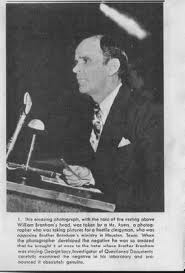
angelic presence or Pillar of Fire
Belief in Branham is global. There are at least 6500 ministers worldwide who align themselves at least in part with Branham’s prophetic ministry, in total about 2 million followers, many in the 2/3 world. A quick look at where Branham’s ministry, the Voice of God, is located, Angola, Philippines, Argentina, Benin, Bolivia, India, Togo, and South Africa among dozens of other countries says much about what researchers have told us about global Pentecostalism. First, its more supernaturally inclined than U.S. variety–healing and prophecy being staples of Pentecostal practice. Second, its theological fluidity allows for the Oneness variety to be accepted more readily, mostly because Pentecostalism is popular because it is viewed as working for everyday needs.
Out of the 1100 sermons and messages that Branham left his followers (all searchable online), the few that have garnered most attention are his prophecies concerning the Seven Ages. Many of these prophecies have been prominent since the beginning of the bible prophecy movement of the late 19th/early 20th century. These prophecies reinforce the political and cultural roots out of which they are shaped and re-trained to appeal to like-minded theological allies. The first three prophecies: the invasion of Ethiopia by Mussolini, U.S. entanglement in a war with Germany, and the rise of Fascism, Nazism, and Communism–which eventually all become part of a global communism movement, are all fairly typical politically motivated prophecies, setting up what is most important for Branham’s followers, and indeed many contemporary Pentecostals who follow prophetic musings–that Communism is a part of the eternal struggle–so anything that smacks of it has to be resisted.

Branham prophesied that driverless egg-shaped cars were portents of the End
The next prophecies, technological advances such as an “egg-shaped” driverless car also marks the beginning of the end (truth be told, I don’t find Smart Cars theologically problematic as much as I find them annoying). This prophecy plays into the penchant that some Pentecostals have to eschew scientific and technological innovations as dangerous because they are created outside of God’s controlling power. ( In a few weeks, I will tell you about the co-worker who cautioned me not to use my ATM card fearing it would lead to the mark of the Beast–to which I replied I would not be using my card–because I was broke, she seemed relieved nevertheless).
Prophecy number five we will bracket till next time when we re-visit Pentecostal dress codes, in particular, all the things women do that drive Pentecostal men crazy—yes, we are going to talk about hairstyles and make-up, something my daughter will be thrilled about. Suffice to say, one of the marks of the end-times is the “fast moral decay of women, [where] she soon began to wear clothes that were too revealing, she bobbed her hair and and adopted the clothing of men.” More next time.
Prophecy Six and Seven have the U.S. at the center, which, if you are curious, is always a good sign that the prophecy is made in the USA–since we are always the center of our own universe, even in bible prophecy. Prophecy Six relates the loss of U.S. power to the whore of Babylon, (Roman Catholic Church), and presumably the loss of Protestant America means that the U.S. has given up any legitimate right to theological supremacy. With that prophecy seven ends with the destruction of the U.S. in a nuclear attack (Russia always figures prominently here somehow).

from one of the dozens of websites that track Branham’s prophecies
Branham had another divergent view, called the “serpent’s seed” view of Genesis, where Eve has sexual relations with the serpent, thus giving rise to a race of inferior and cursed human beings–that historically this view has been used to promote white supremacy and African American inferiority, (through British Israelism for example), is a theology that is refuted with regularity by Branham’s detractors. Even his followers do not like to make the nexus between the theology and its racial implications, but others have already done so–for centuries. That this view, or the prophecies, or the views about women, and yes, even the (non)resurrection of Branham do not affect his popularity perhaps says much about how people structure their belief.
People’s plausibility structures are stretched out to the max–people are willing to suspend their own disappointment, entertain divergent views, accept the anti Trinitarian, anti-Catholic, anti-women views–simply because they want to believe. According to sociologists who study prophetic movements, people predisposed to prophecy have created ingenious ways of moving the yardsticks of what constitutes prophecy, proof, and belief because it is necessary for the effervescence of the movement to continue to motivate them to promoting Branham’s life as nearly divine and their spiritual lives as meaningful.
Next time–Hair and Make-Up Tips from the Pentecostal Subcutlure
Previous Post

June 10, 2013
A.A. Allen: "God's Man of Faith and Power"
Next Post

June 26, 2013 (Culture War) is Over-If You Want it...Please
Browse Our Archives
Select a Category Academia African American Books church life Conspiracy Theories culture Culture wars DOMA Dress Codes Evangelicalism Healing Immigration Latino/a Catholicism Latino/a History Latino/a Religion Mennonites millennials Missions Music Pentecostalism Politics popular culture progressives prophecy Religious Right Religious Violence Uncategorized women
Select a Month February 2015 January 2015 December 2014 October 2014 September 2014 August 2014 July 2014 June 2014 May 2014 April 2014 March 2014 February 2014 January 2014 December 2013 November 2013 October 2013 September 2013 August 2013 July 2013 June 2013 May 2013 April 2013 March 2013 February 2013 January 2013 December 2012 November 2012
Follow Us!
TAKE THE
Religious Wisdom Quiz
Which Christian denomination is known for wearing plain clothing and avoiding modern technology?
Select your answer to see how you score.
Amish Lutherans Presbyterians Baptists
Related posts from Re-Generacion

The Tragic Sense of Historical Illiteracy

Latino/a Rehab Ministry embroiled in controversy

The Obsession with What Latinos Will Do This...

TRENDING AT PATHEOS Progressive Christian

Why Christians Have a Sacred Duty to Vote:...
The Bible offers strong support for the sacred duty to vote. Here...

What Being a Modern-Day Apostle Means to Me
In my last column, I discussed the ins and outs of modern-day...

Did Ancient China Once Worship the God of...
Across human history, a common thread weaves through the origins of the...

Love Your Neighbor – Including Earth-Kin: Lev. 19,...
God’s command to love your neighbor means acting in an ethical and...

Lead a Church Study of “Jesus and Lao...
Guest writer Jack Thomas (The Irreverent Reverend) reflects on leading his church...

Principles for Understanding the Apostolic Ministry Today
Whenever people discover that my formal ministry title is "apostle," as in...
view all Progressive Christian blogs
Ad-Free & Subscriber Log-In Subscription Support
- About Us
- 2026 Calendar
- Videos
- Podcasts
- Library of World Religions
- Faith In Media Tracker
- Advertise With Us
- Write for Us
- Privacy Policy
- Terms of Service
- Do Not Sell My Data
- Contact Us
- Radiant Digital
- Manage Newsletter Subscriptions
- Unsubscribe From Notifications
- Sitemap
Copyright 2008-2026, Patheos. All rights reserved.
Subscription Support Ad-Free & Subscriber Log-In
Follow Patheos