
BuddhistCatholicContemplativeEvangelicalGeneral ChristianHinduJewishLatter-day SaintMuslimNew VisionsProgressive Christian
Beliefs
- Buddhist
- Catholic
- Contemplative
- Evangelical
- General Christian
- Hindu
- Jewish
- Latter-day Saint
- More Voices
- Muslim
- New Visions
- Pagan
- Progressive Christian
Topics
- Religion News
- Food and Religion
- Sports and Religion
- Religious Art
- Religious Music and Entertainment
- Religious Events
- History and Religion
- Style and Religion
- Politics and Religion
- Women in Religion
- Recreation Outdoors and Religion
- Business Finance and Religion
- Careers Workplace and Religion
- Education and Religion
- Family Parenting and Religion
- Health Fitness and Religion
- Home and Religion
- Relationships and Religion
- Technology and Religion
- Travel and Religion
Columnists
- Buddhist Columnists
- Business Finance and Religion Columnists
- Careers Workplace and Religion Columnists
- Catholic Columnists
- Contemplative Columnists
- Education and Religion Columnists
- Evangelists Columnists
- Family Parenting and Religion Columnists
- General Christian Columnists
- Health Fitness and Religion Columnists
- Hindu Columnists
- History and Religion Columnists
- Home and Religion Columnists
- Jewish Columnists
- More Voices Columnists
- Latter Day Columnists
- Muslim Columnists
- New Visions Columnists
- Nonreligious Columnists
- Pagan Columnists
- Politics and Religion Columnists
- Progressive Columnists
- Recreation Outdoors and Religion Columnists
- Relationships and Religion Columnists
- Religion News Columnists
- Religious Art Columnists
- Religious Events Columnists
- Religious Music and Entertainment Columnists
- Sports and Religion Columnists
- Style and Religion Columnists
- Technology and Religion Columnists
- Travel and Religion Columnists
- Women in Religion Columnists
Resource Library
- 2026 Calendar
- Library of World Religions
- The 100 Most Holy Places on Earth
- Patheos Answers
- Podcasts
- Videos
- Faith Leaders Database
- Anglican Episcopalian
- Bahai
- Baptist
- Buddhism
- Christianity
- Confucianism
- Eastern Orthodoxy
- Hinduism
- Holiness and Pentecostal
- ISKCON
- Islam
- Judaism
- Lutheran
- Methodist
- The Church of Jesus Christ of Latter-day Saints
- New Age
- Paganism
- Presbytarian and Reformed
- Protestantism
- Religion Behind the Scenes
- Roman Catholic
- Scientology
- Shia Islam
- Sikhism
- Sufism
- Sunni Islam
- Taoism
- Zen
- See all religions
Research Tools
 Ad-Free & Subscriber Log-In Subscription Support
Ad-Free & Subscriber Log-In Subscription Support
Follow Patheos 

- Trending:
- Forgiveness
- |
- Marriage
- |
- Consciousness
- |
- Death Penalty
- |
- Election
- |
- Halloween

- Home
- Pagan
- DSD – Shahrzad: Patron Saint of Cleverness, Wisdom, and Creativity + Prayer
DSD – Shahrzad: Patron Saint of Cleverness, Wisdom, and Creativity + Prayer
Last updated on: January 26, 2023 at 2:47 pm by Bader Saab
DSD – Shahrzad: Patron Saint of Cleverness, Wisdom, and Creativity + Prayer 2023-01-26T14:47:43-04:00 Bader Saab
Patheos Explore the world's faith through different perspectives on religion and spirituality! Patheos has the views of the prevalent religions and spiritualities of the world.
I’ve been thinking about this article for a while, not really sure about how to begin with it because the character of Shahrzad, better known as Scheherazade, is perhaps the most known about regarding Arabic literature. One cannot speak about the Arabian Nights or The 1001 Nights without mentioning her name, maybe not even when speaking about the Middle East. Her fame creates an expectation, and that is intimidating for a writer. However, the more I thought about her, the more interested and eager to start working with her I was.
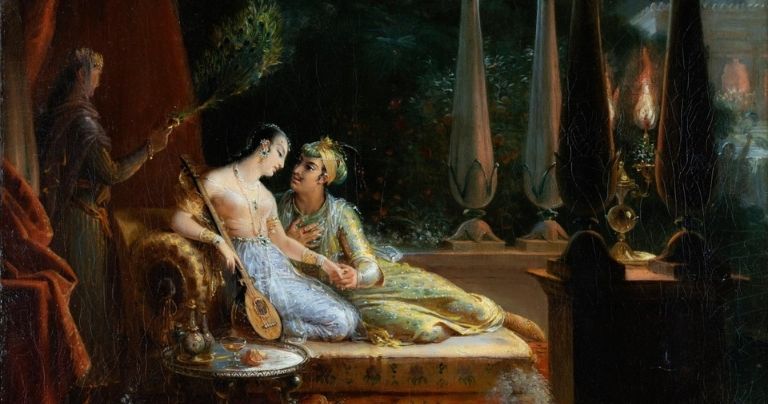
“As she weaves her tales of awe and wonder each night, the sultan is mentioned no more, whereas we always have the witty Shahrzad promising something better and more entertaining the next time”. Scheherazade and Shahryar, by Marie-Éléonore Godefroid (circa 1842). Cropped. Source.

About the Name
Although her name is most commonly known in English as Scheherazade, there are many variations that have been used through time. This one, for starters, first appeared in English-language texts in 1801, borrowed from German usage, from Persian Shīrazād (Merriam-Webster, n.d.), which is also one of the earliest forms of the name along with Shahrzad (Irwin, 2004: 944; Ismail, 2009: 170).
Some scholars have argued that her name derives from the Middle Persian name Čehrāzād, which is composed of the words čehr (‘lineage’) and āzād (‘noble, exalted’). (Marzolph, 2017; Pellat, 2011; Hamori, 2012). The name can also be found as Šahrazād and Šahrāzād. However, for this article, I will be using the variant which is closest to the original Arabic, Shahrzad (شهرزاد), which is also the one used in The Arabian Nights (Mahdi and Haddawy edition).
Due to its origins, Shahrazad’s name would mean “Noble, exalted lineage”, or indicate she comes from such lineage. The later is also a possibility since she is the oldest daughter of the vizier and ends up becoming the queen of the sultan, who learns to love her and trust her, and mother of his three children. (Mahdi and Haddawy, 2008: 518).
A Patron Saint
According to Britannica (2021), a patron saint is:
saint to whose protection and intercession a person, a society, a church, or a place is dedicated. The choice is often made on the basis of some real or presumed relationship with the persons or places involved. (…) In some cultures national or local gods are the equivalent of patron saints.
I was reluctant to consider Shahrzad a Goddess since she is a mortal during the whole story. Some may argue that she can be considered one depending on how we look at her figure, maybe even a local god, but for me she is closer to the definition of a patron saint and that, since I wasn’t able to find evidence of any cult or belief related to her, think it is more respectable not to deify her figure. In the end, the matter depends on whoever decides to include her in their practice.
As I started working on this article, I thought about her as the perfect embodiment of cleverness, wisdom, and creativity. It was said about her that Shahrzad (Mahdi and Haddawy, 2008: 20-21):
“had read the books of literature , philosophy, and medicine. She knew poetry by heart, had studied historical reports, and was acquainted with the sayings of men and the maxims of sages and kings. She was intelligent, knowledgeable, wise, and refined. She was read and learned.”
When meditating with her, there was another word that resonated: Sovereignty. Shahrzad knew what was coming up on her by marrying the sultan, knew the fate of those who came before her, and still walked straight up to it because she also knew she was the master of her destiny. The sultan would use her body for his own satisfaction night after night, and her life could end at any moment, however, her body was just a means for an end to stay alive one more day.
As she weaves her tales of awe and wonder each night, the sultan is mentioned no more, whereas we always have the witty Shahrzad promising something better and more entertaining the next time. She becomes the central figure after starting as an intrepid heroine with a deathwish. She only had her sister to call upon for help after imposing her will on her father. Brave and fearless, this girl decided to use all the wisdom she had accumulated in her (possibly short) life to tame a beast that terrified the whole kingdom, and was willing to die trying.
For me, living in such unstable conditions, Shahrzad is the heroine I need, the one many would when in a dire time. She was able to walk right up to the storm, deal with it one night at the time, and figure out how to destroy it, and what’s more remarkable, she did it with zero violence. Always peaceful and patient, this sultana took control of the enraged man who killed many women after just one was cheated on him.
Shahrazad’s Prayer/Incantation
You who played with the sands of time,
Who saved another soul with every night,
Charming tongue of a cunning mind,
Guide my journey, Shahrzad.
You who charmed to stay alive,
Sharp tongue that slayed all pride,
Your body offered for all to survive,
Guide my journey, Shahrzad.
Noble Sultana with the kindest of hearts,
Wise empress, tamer of minds,
Voice of the wind, the desert, and the nights,
Guide my journey, Shahrzad.
References
Britannica, T. Editors of Encyclopaedia (2021, March 25). patron saint. Encyclopedia Britannica. https://www.britannica.com/topic/patron-saint
Ch. Pellat. 2011. “ALF LAYLA WA LAYLA,” Encyclopædia Iranica, I/8, pp. 831-835; an updated version is available online at http://www.iranicaonline.org/articles/alf-layla-wa-layla (accessed on 18 May 2014).
Hamdan Muhammad Ali Hussein Ismail (حمدان محمد علي حسين إسماعيل) (2009). Ishkaliyat al-Tarjamah fi al-Adab al-Muqaranإشكالية الترجمة في الآدب المقارن. Al Manhal.
Hamori, A. (2012). “S̲h̲ahrazād”. In P. Bearman; Th. Bianquis; C.E. Bosworth; E. van Donzel; W.P. Heinrichs (eds.). Encyclopaedia of Islam (2nd ed.). Brill.
Irwin, R. 2004. The Arabian Nights: A Companion. Tauris Parke Paperbacks.
Mahdi, M, translated by Haddawy. 2008. The Arabian Nights. H. W. W. Norton & Company.
Marzolph, U. 2017. “Arabian Nights“. In Kate Fleet; Gudrun Krämer; Denis Matringe; John Nawas; Everett Rowson (eds.). Encyclopaedia of Islam (3rd ed.). Brill.
Merriam-Webster. (n.d.). Scheherazade. In Merriam-Webster.com dictionary. Retrieved May 10, 2022, from https://www.merriam-webster.com/dictionary/Scheherazade

About Bader Saab
I’m an Arabic witch and journalist, also with a master’s degree in digital research. I have worked as a book reviewer and written about pre-Islamic folklore. You can connect with me by Private Message on Instagram: @saab.bader. You can read more about the author here.
Previous Post
April 11, 2022
What's in a name? What Does Bader Saab Mean?
Next Post

May 16, 2022 Featured in That Witch Life Podcast
Browse Our Archives
Select a Category Ancestors Book review Books Deities Divination Folklore History news Practice Spirits Uncategorized Wellbeing witchcraft Writing
Select a Month September 2026 July 2026 March 2026 December 2025 November 2025 August 2025 July 2025 June 2025 February 2025 January 2025 September 2024 July 2024 March 2024 February 2024 November 2023 September 2023 July 2023 May 2023 April 2023 February 2023 January 2023 December 2022 November 2022 October 2022 September 2022 July 2022 June 2022 May 2022 April 2022 March 2022 February 2022 January 2022 December 2021 October 2021 September 2021 August 2021 July 2021 June 2021 May 2021 April 2021 March 2021 February 2021 January 2021 December 2020 November 2020 October 2020 September 2020 August 2020
Follow Us!
TAKE THE
Religious Wisdom Quiz
What does Jesus say about judging others?
Select your answer to see how you score.
Do not judge Judge by appearance Judge harshly Seek revenge
Related posts from A Modern Day Sha'ir


No More Booklists. Enter the Fake Degree!

TRENDING AT PATHEOS Pagan

When we talk about Greek religion, we often begin with the dodekatheion—the...

I was recently chatting with someone on Instagram. She asked me what...

While there are many people who share their results, the end of...

On July 23, I saw Christopher Nolan's The Odyssey which is Homer’s...

As I write this two big events have just finished up. One...

Restoring the Watershed of Divine Love
Perhaps cooperation is not something we manufacture through legislation, ideology, or moral...
view all Pagan blogs
Ad-Free & Subscriber Log-In Subscription Support
- About Us
- 2026 Calendar
- Videos
- Podcasts
- Library of World Religions
- Faith In Media Tracker
- Advertise With Us
- Write for Us
- Privacy Policy
- Terms of Service
- Do Not Sell My Data
- Contact Us
- Radiant Digital
- Manage Newsletter Subscriptions
- Unsubscribe From Notifications
- Sitemap
Copyright 2008-2026, Patheos. All rights reserved.
Subscription Support Ad-Free & Subscriber Log-In
Follow Patheos