
BuddhistCatholicContemplativeEvangelicalGeneral ChristianHinduJewishLatter-day SaintMuslimNew VisionsProgressive Christian
Beliefs
- Buddhist
- Catholic
- Contemplative
- Evangelical
- General Christian
- Hindu
- Jewish
- Latter-day Saint
- More Voices
- Muslim
- New Visions
- Pagan
- Progressive Christian
Topics
- Religion News
- Food and Religion
- Sports and Religion
- Religious Art
- Religious Music and Entertainment
- Religious Events
- History and Religion
- Style and Religion
- Politics and Religion
- Women in Religion
- Recreation Outdoors and Religion
- Business Finance and Religion
- Careers Workplace and Religion
- Education and Religion
- Family Parenting and Religion
- Health Fitness and Religion
- Home and Religion
- Relationships and Religion
- Technology and Religion
- Travel and Religion
Columnists
- Buddhist Columnists
- Business Finance and Religion Columnists
- Careers Workplace and Religion Columnists
- Catholic Columnists
- Contemplative Columnists
- Education and Religion Columnists
- Evangelists Columnists
- Family Parenting and Religion Columnists
- General Christian Columnists
- Health Fitness and Religion Columnists
- Hindu Columnists
- History and Religion Columnists
- Home and Religion Columnists
- Jewish Columnists
- More Voices Columnists
- Latter Day Columnists
- Muslim Columnists
- New Visions Columnists
- Nonreligious Columnists
- Pagan Columnists
- Politics and Religion Columnists
- Progressive Columnists
- Recreation Outdoors and Religion Columnists
- Relationships and Religion Columnists
- Religion News Columnists
- Religious Art Columnists
- Religious Events Columnists
- Religious Music and Entertainment Columnists
- Sports and Religion Columnists
- Style and Religion Columnists
- Technology and Religion Columnists
- Travel and Religion Columnists
- Women in Religion Columnists
Resource Library
- 2026 Calendar
- Library of World Religions
- The 100 Most Holy Places on Earth
- Patheos Answers
- Podcasts
- Videos
- Faith Leaders Database
- Anglican Episcopalian
- Bahai
- Baptist
- Buddhism
- Christianity
- Confucianism
- Eastern Orthodoxy
- Hinduism
- Holiness and Pentecostal
- ISKCON
- Islam
- Judaism
- Lutheran
- Methodist
- The Church of Jesus Christ of Latter-day Saints
- New Age
- Paganism
- Presbytarian and Reformed
- Protestantism
- Religion Behind the Scenes
- Roman Catholic
- Scientology
- Shia Islam
- Sikhism
- Sufism
- Sunni Islam
- Taoism
- Zen
- See all religions
Research Tools
 Ad-Free & Subscriber Log-In Subscription Support
Ad-Free & Subscriber Log-In Subscription Support
Follow Patheos 

- Trending:
- Forgiveness
- |
- Marriage
- |
- Consciousness
- |
- Death Penalty
- |
- Election
- |
- Halloween

- Home
- Pagan
- Book Review: The Arabian Nights (Mahdi and Haddawy edition)
Book Review: The Arabian Nights (Mahdi and Haddawy edition)
Last updated on: January 28, 2022 at 12:01 am by Bader Saab
Book Review: The Arabian Nights (Mahdi and Haddawy edition) 2022-01-24T23:10:41-04:00 Bader Saab
Patheos Explore the world's faith through different perspectives on religion and spirituality! Patheos has the views of the prevalent religions and spiritualities of the world.
It’s been a long time since I wrote about this book for the first time, The Arabian Nights, better known as The 1001 Nights, and one of my readings for 2021. Although it took me some time to be done with this book, which I began in April, to be more specific, I’m in love with it from beginning to end. Like all loves, it is far from perfect, but it gets close enough, so I can be glad I finally gave this timeless classic a chance.
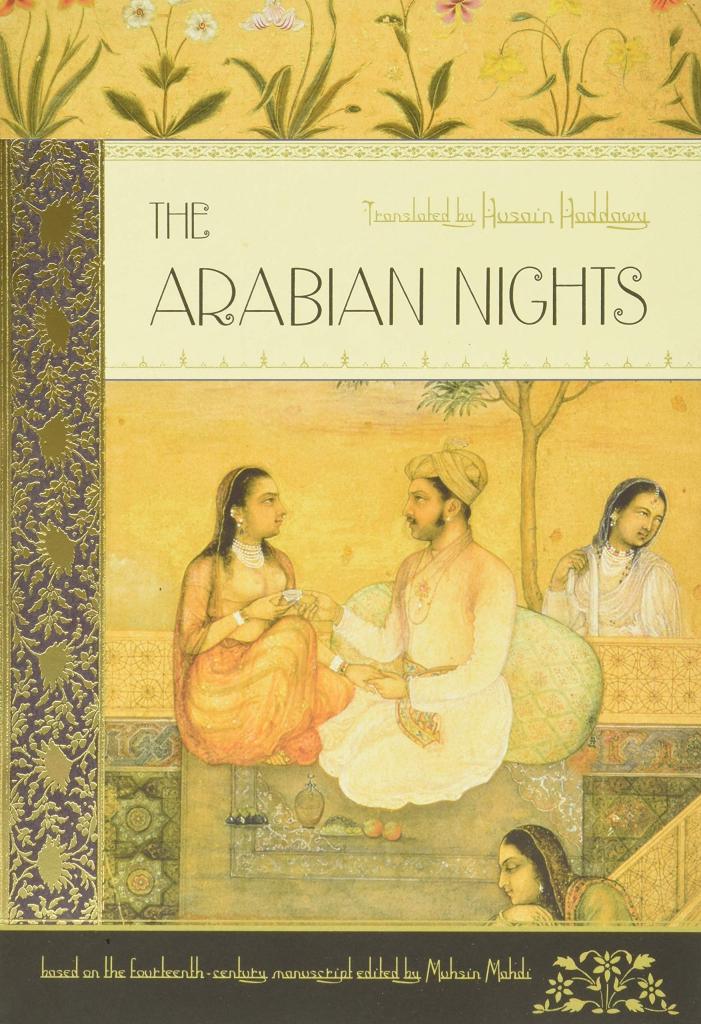
Cover image. Taken From Amazon.
Now as sumptuously packaged as they are critically acclaimed―a new deluxe trade paperback edition of the beloved stories.
The stories of The Arabian Nights (and stories within stories, and stories within stories within stories) are famously told by the Princess Shahrazad, under the threat of death should the king lose interest in her tale. Collected over the centuries from India, Persia, and Arabia, and ranging from adventure fantasies, vivacious erotica, and animal fables, to pointed Sufi tales, these stories provided the daily entertainment of the medieval Islamic world at the height of its glory. No one knows exactly when a given story originated, and many circulated orally for centuries before being written down; but in the process of telling and retelling, they were modified to reflect the general life and customs of the Arab society that adapted them―a distinctive synthesis that marks the cultural and artistic history of Islam.
This translation is of the complete text of the Mahdi edition, the definitive Arabic edition of a fourteenth-century Syrian manuscript, which is the oldest surviving version of the tales and considered to be the most authentic.
All the stories are filled with beautiful characters, entertaining plots, uncountable twists, and magic on every page. I felt teleported to the very sands of Arabia while reading this book, discovering endless morals and teachings, but also more light-hearted messages in all the tales.
One of the things I liked the most was the initial notes before the beginning of the tales, explaining the history behind this manuscript and how this edition came to happen, along with some regarding the edition and translation process. My academic side was really happy to have some background and research to accompany all this fantasy, although not as much as I would like.
You can also expect a good dose of morals and teachings, some of them that could seem contradictory, some stories suggesting one thing and others telling the opposite, but I find this is a part of the charm. It’s better if you never expect anything with The Arabian Nights, for it is full of many twists and surprises in every story.
However, nothing is perfect, and in this case, there are two things I need to mention. First, this is not a deluxe edition as the synopsis claims; some readers have complained about the pages being too thin and the deckle edges, and these are not too bothersome for me, but the quality of the cover and back cover is terrible, losing color with time, especially the back cover, which looks awful at this point.
The second thing I don’t like is in the text as well, and it’s a matter of style and preferences. The antepenultimate tale, “The Story of Nur al-Din Ali ibn-Bakkar and the Slave-Girl Shams al-Nahar”, felt eternal and even tedious. I hated the style, how illogical everything seemed to be even for a fairy tale, even for fantasy literature, and the fact that it was so long made it worse. There are longer, more fantastical, and stranger stories in this book, all of them filled with magic and wonder, but this one, in particular, was the only one I didn’t like at all.
With incomparable charm, a magic of its own, and stories that will surprise all readers, The Arabian Nights will win every heart that dares to venture through its pages. Shahrazad is my favorite character of all times now, with all her knowledge and wit, her creativity and wisdom, she can beat any other protagonist I can think about. I’m sure you will agree with me once you read her story and discover the ones she has learned or created.
For now, I will keep on with my original reading list, the ones I added after, the Orphan tales, and the Satanic Verses. There is an annotated version of The Arabian Nights I want to read as well, but I need a rest after such a heavy book, so I may favor a webcomic adaptation meanwhile; I need to think about reading the original novels at the same time, though.
Print Length: 560 pages
Publisher: W. W. Norton & Company; New Deluxe edition (May 17, 2008)
Publication Date: May 17, 2008
ISBN-10: 0393331660
ISBN-13: 978-0393331660
About the Editor:
Muḥsin Sayyid Mahdī al-Mashhadani was an Iraqi-American Islamologist and Arabist. He was a leading authority on Arabian history, philology, and philosophy. His best-known work was the first critical edition of the One Thousand and One Nights.
About the Translator:
Husain Haddawy was born and grew up in Baghdad, taught English and comparative literature at various American universities, wrote art criticism, and is now living in retirement in Thailand.

About Bader Saab
I’m an Arabic witch and journalist, also with a master’s degree in digital research. I have worked as a book reviewer and written about pre-Islamic folklore. You can connect with me by Private Message on Instagram: @saab.bader. You can read more about the author here.
Previous Post

January 24, 2022
Experiencing Al-‘Uzza Healing Love
Next Post

February 24, 2022 When Witchcraft Doesn't Work
Browse Our Archives
Select a Category Ancestors Book review Books Deities Divination Folklore History news Practice Spirits Uncategorized Wellbeing witchcraft Writing
Select a Month September 2026 July 2026 March 2026 December 2025 November 2025 August 2025 July 2025 June 2025 February 2025 January 2025 September 2024 July 2024 March 2024 February 2024 November 2023 September 2023 July 2023 May 2023 April 2023 February 2023 January 2023 December 2022 November 2022 October 2022 September 2022 July 2022 June 2022 May 2022 April 2022 March 2022 February 2022 January 2022 December 2021 October 2021 September 2021 August 2021 July 2021 June 2021 May 2021 April 2021 March 2021 February 2021 January 2021 December 2020 November 2020 October 2020 September 2020 August 2020
Follow Us!
TAKE THE
Religious Wisdom Quiz
Who was the first man created by God?
Select your answer to see how you score.
Noah Adam Moses Abraham
Related posts from A Modern Day Sha'ir



No More Booklists. Enter the Fake Degree!

TRENDING AT PATHEOS Pagan

When we talk about Greek religion, we often begin with the dodekatheion—the...

I was recently chatting with someone on Instagram. She asked me what...

While there are many people who share their results, the end of...

On July 23, I saw Christopher Nolan's The Odyssey which is Homer’s...

As I write this two big events have just finished up. One...

Restoring the Watershed of Divine Love
Perhaps cooperation is not something we manufacture through legislation, ideology, or moral...
view all Pagan blogs
Ad-Free & Subscriber Log-In Subscription Support
- About Us
- 2026 Calendar
- Videos
- Podcasts
- Library of World Religions
- Faith In Media Tracker
- Advertise With Us
- Write for Us
- Privacy Policy
- Terms of Service
- Do Not Sell My Data
- Contact Us
- Radiant Digital
- Manage Newsletter Subscriptions
- Unsubscribe From Notifications
- Sitemap
Copyright 2008-2026, Patheos. All rights reserved.
Subscription Support Ad-Free & Subscriber Log-In
Follow Patheos