
BuddhistCatholicContemplativeEvangelicalGeneral ChristianHinduJewishLatter-day SaintMuslimNew VisionsProgressive Christian
Beliefs
- Buddhist
- Catholic
- Contemplative
- Evangelical
- General Christian
- Hindu
- Jewish
- Latter-day Saint
- More Voices
- Muslim
- New Visions
- Pagan
- Progressive Christian
Topics
- Religion News
- Food and Religion
- Sports and Religion
- Religious Art
- Religious Music and Entertainment
- Religious Events
- History and Religion
- Style and Religion
- Politics and Religion
- Women in Religion
- Recreation Outdoors and Religion
- Business Finance and Religion
- Careers Workplace and Religion
- Education and Religion
- Family Parenting and Religion
- Health Fitness and Religion
- Home and Religion
- Relationships and Religion
- Technology and Religion
- Travel and Religion
Columnists
- Buddhist Columnists
- Business Finance and Religion Columnists
- Careers Workplace and Religion Columnists
- Catholic Columnists
- Contemplative Columnists
- Education and Religion Columnists
- Evangelists Columnists
- Family Parenting and Religion Columnists
- General Christian Columnists
- Health Fitness and Religion Columnists
- Hindu Columnists
- History and Religion Columnists
- Home and Religion Columnists
- Jewish Columnists
- More Voices Columnists
- Latter Day Columnists
- Muslim Columnists
- New Visions Columnists
- Nonreligious Columnists
- Pagan Columnists
- Politics and Religion Columnists
- Progressive Columnists
- Recreation Outdoors and Religion Columnists
- Relationships and Religion Columnists
- Religion News Columnists
- Religious Art Columnists
- Religious Events Columnists
- Religious Music and Entertainment Columnists
- Sports and Religion Columnists
- Style and Religion Columnists
- Technology and Religion Columnists
- Travel and Religion Columnists
- Women in Religion Columnists
Resource Library
- 2026 Calendar
- Library of World Religions
- The 100 Most Holy Places on Earth
- Patheos Answers
- Podcasts
- Videos
- Faith Leaders Database
- Anglican Episcopalian
- Bahai
- Baptist
- Buddhism
- Christianity
- Confucianism
- Eastern Orthodoxy
- Hinduism
- Holiness and Pentecostal
- ISKCON
- Islam
- Judaism
- Lutheran
- Methodist
- The Church of Jesus Christ of Latter-day Saints
- New Age
- Paganism
- Presbytarian and Reformed
- Protestantism
- Religion Behind the Scenes
- Roman Catholic
- Scientology
- Shia Islam
- Sikhism
- Sufism
- Sunni Islam
- Taoism
- Zen
- See all religions
Research Tools
 Ad-Free & Subscriber Log-In Subscription Support
Ad-Free & Subscriber Log-In Subscription Support
Follow Patheos 

- Trending:
- Forgiveness
- |
- Marriage
- |
- Consciousness
- |
- Death Penalty
- |
- Election
- |
- Halloween

- Home
- Pagan
- Pride Month in the Arabic World
Pride Month in the Arabic World
Last updated on: June 2, 2021 at 9:26 am by Bader Saab
Pride Month in the Arabic World 2021-06-02T09:26:14-04:00 Bader Saab
Patheos Explore the world's faith through different perspectives on religion and spirituality! Patheos has the views of the prevalent religions and spiritualities of the world.
Today marks the beginning of the pride season all over the world, and many are celebrating a month during which diversity and freedom are the most important things. However, many LGBT+ people in the Arabic world are afraid of being outed for the harsh laws regarding homosexuality, some of them even punishing it by death. Interestingly, this wasn’t always the case, and there are even historical and mythological examples that could empower the practice of any queer Arabic witch. I had my doubts about finding much material before I started working on this article, but I found out it was not the case.
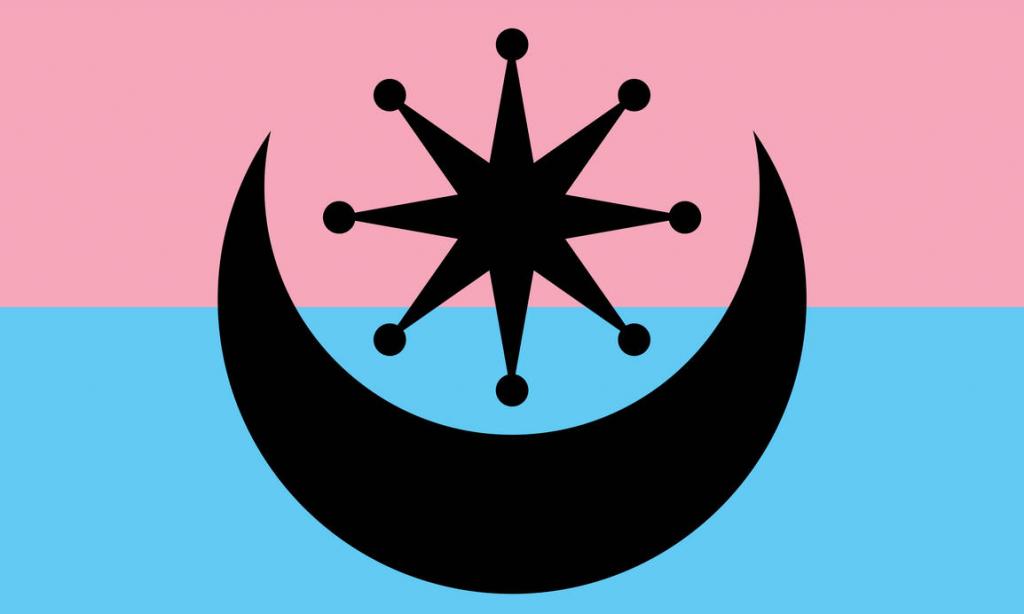
Khanith Flag by unknown. Source.
In his second book, Queer Magic: LGBT+ Spirituality and Culture from Around the World, Tomás Prower speaks about the Goddesses I started this blog with: Manat, Al-Lat, and Al-‘Uzza, the Three Daughters of Allah, who he mentions had a female and transgender following. The Peacock Angel, Tawusê Melek is another deity connected to queer people, as mentioned by Storm Faerywolf in his interview with Mat Auryn.
Prower also mentions Mehmed the Conqueror, who married women thrice but also seemed to have an interest in young men, particularly Radu III of Wallachia, his favourite and hostage, and brother of the infamous Vlad the Impaler. When the Ottomans captured the Wallachian capital Târgoviște in and Mehmed II withdrew, he left Radu as ruler of Wallachia. Marios Philippides also said in The Siege and the Fall of Constantinople in 1453 that if there were young men condemned to death that Mehmed found attractive, he would spare their lives and they would be added to his seraglio, a sequestered living quarters used by wives and concubines in Ottoman times.
There is also the Khanith, a third gender in Oman, with a flag designed by an unknown person, consisting on a person assigned male at birth but with characteristics and behavior often described as feminine. For those of you interested in this figure, Brian Whitaker speaks extensively about the role of the Khanith in his article Transgender issues in the Middle East: A history of ambiguity.

Image by 3D Animation Production Company from Pixabay. Cropped..
It also seems possible that there were three genders in Egypt. Mark Brustman, also known as Faris Malik, writes about The Third Gender in Ancient Egypt in his website Born Eunuchs:
Inscribed pottery shards discovered near ancient Thebes (now Luxor, Egypt), and dating from the Middle Kingdom (2000-1800 BCE), contain a listing of three genders of humanity: males, eunuchs, and females, in that order. (See Sethe, Kurt, “Die Aechtung feindlicher Fürsten, Völker und Dinge auf altägyptischen Tongefäßscherben des mittleren Reiches,” in: Abhandlungen der Preussischen Akademie der Wissenschaften, Philosophisch-Historische Klasse, 1926, p. 61.) The word for male includes a picture of a penis and a picture of a man kneeling. The word for eunuch includes a picture of a man kneeling, but not a picture of a penis. The word for female includes a picture of a woman kneeling, but no picture of body parts (unless the shield-like shape which designates “woman” is a picture of the female pubic region).
The pronunciation of the words on the shards is given as tai (tie), sht (sekhet) and hmt (hemet), respectively. The word for eunuch here, sht, also appears in a pyramid text where it is contrasted with the word for male, tai. There is not much evidence, if any, for castration of living human beings in ancient Egypt. [See my translation of Frans Jonckheere’s 1954 article attempting to find such evidence, I think unsuccessfully.] One can assume in the absence of contrary evidence that eunuchs in ancient Egypt were anatomically whole, natural eunuchs such as are found elsewhere throughout the ancient world.

Postcard depicting a khawal (pre–1907). Source.

We also have the Egyptian khawal, also known as gawwal in other Arabic countries, who was a male dressed in masculine and feminine clothes in the 19th century who entertained the public in the streets and also performed during parties, weddings, ceremonies, and others. Some men even found their ambiguity seductive, and they were considered as sexually available. Nowadays, however, the term is derogatory slang for passive gay men, similarly to how the term mukhannathun, the effeminate ones, is used today.
The connection with arts and entertainment doesn’t end here. Abu Nuwas was one of the most respected poets, and he wrote extensively about gay love under the protection of Caliph Harun al-Rashid. Some of his poems were translated and edited by Jaafar Abu Tarab in Carousing with Gazelles: Homoerotic Songs of Old Baghdad. We can also speak about Harun al-Rashid’s son, Caliph Al-Amin, who wasn’t interested in women generally speaking, but preferred eunuchs, according to Samar Habib in her Islam and Homosexuality. Khaled El-Rouayheb also wrote about homosexuality in the Muslim world in Before Homosexuality in the Arab-Islamic World, 1500-1800.
Afsaneh Najmabadi explains in Women with Mustaches and Men without Beards: Gender and Sexual Anxieties of Iranian Modernity that young men without facial hair were considered beautiful and older men would pursue them. Sexual relationships between both were common in Iran until the nineteenth century after Europeans visited the country and claimed such relationships were immoral, an opinion endorsed by the following totalitarian governments in the Arabic world by fundamentalist Muslims, as claimed by Shereen El Feki in The Arab Bed Spring? Sexual rights in troubled times across the Middle East and North Africa.
Finally, I cannot not mention Jalāl ad-Dīn Mohammad Rūmī, better known as Rumi, who has been the subject of long speculation since there is no clear proof that he and Shams Tabrizi were lovers. Kittredge Cherry, by QSpirit, wrote an incredible article with lots of resources to go deeper in the matter and included quotes Rumi’s poetry to illustrate some points. I enjoyed reading Rumi: Poet and Sufi mystic inspired by same-sex love and got a few new books to my to-read list. I encourage you to do the same.
There are a few projects and organizations that could be of your interest: I Am Not Haraam, a Tumblr blog with several resources listed, and Rainbow Street, a non-governmental organization that helps LGBT people in the Middle East and North Africa. If there are more resources that you would like me to include, let me know, and I will do it right away.
The Arabic world is certainly an interesting place to examine, but LGBT+ issues are a big concern for many of us. There is much work to be done, it went backwards after the 19th century, but there’s still hope. Iraq, Israel, Jordan, and Lebanon are the most queer-friendly countries in the Arabic world, with slow but continual progress, and I am sure it is a matter of time before we can mention more.

About Bader Saab
I’m an Arabic witch and journalist, also with a master’s degree in digital research. I have worked as a book reviewer and written about pre-Islamic folklore. You can connect with me by Private Message on Instagram: @saab.bader. You can read more about the author here.
Previous Post

May 24, 2021
My not-so-conventional Selection of Arabic Witchcraft Music
Next Post

June 9, 2021 Pray for and Save Sheikh Jarrah
Browse Our Archives
Select a Category Ancestors Book review Books Deities Divination Folklore History news Practice Spirits Uncategorized Wellbeing witchcraft Writing
Select a Month September 2026 July 2026 March 2026 December 2025 November 2025 August 2025 July 2025 June 2025 February 2025 January 2025 September 2024 July 2024 March 2024 February 2024 November 2023 September 2023 July 2023 May 2023 April 2023 February 2023 January 2023 December 2022 November 2022 October 2022 September 2022 July 2022 June 2022 May 2022 April 2022 March 2022 February 2022 January 2022 December 2021 October 2021 September 2021 August 2021 July 2021 June 2021 May 2021 April 2021 March 2021 February 2021 January 2021 December 2020 November 2020 October 2020 September 2020 August 2020
Follow Us!
TAKE THE
Religious Wisdom Quiz
What empire was in power when Jesus was born?
Select your answer to see how you score.
Roman Greek Babylonian Persian
Related posts from A Modern Day Sha'ir

No More Booklists. Enter the Fake Degree!



Something, anything, this way comes
TRENDING AT PATHEOS Pagan

I was recently chatting with someone on Instagram. She asked me what...

While there are many people who share their results, the end of...

On July 23, I saw Christopher Nolan's The Odyssey which is Homer’s...

As I write this two big events have just finished up. One...

Restoring the Watershed of Divine Love
Perhaps cooperation is not something we manufacture through legislation, ideology, or moral...

Many UUs don’t pray because of bad experiences in a previous religion,...
view all Pagan blogs
Ad-Free & Subscriber Log-In Subscription Support
- About Us
- 2026 Calendar
- Videos
- Podcasts
- Library of World Religions
- Faith In Media Tracker
- Advertise With Us
- Write for Us
- Privacy Policy
- Terms of Service
- Do Not Sell My Data
- Contact Us
- Radiant Digital
- Manage Newsletter Subscriptions
- Unsubscribe From Notifications
- Sitemap
Copyright 2008-2026, Patheos. All rights reserved.
Subscription Support Ad-Free & Subscriber Log-In
Follow Patheos