
BuddhistCatholicContemplativeEvangelicalGeneral ChristianHinduJewishLatter-day SaintMuslimNew VisionsProgressive Christian
Beliefs
- Buddhist
- Catholic
- Contemplative
- Evangelical
- General Christian
- Hindu
- Jewish
- Latter-day Saint
- More Voices
- Muslim
- New Visions
- Pagan
- Progressive Christian
Topics
- Religion News
- Food and Religion
- Sports and Religion
- Religious Art
- Religious Music and Entertainment
- Religious Events
- History and Religion
- Style and Religion
- Politics and Religion
- Women in Religion
- Recreation Outdoors and Religion
- Business Finance and Religion
- Careers Workplace and Religion
- Education and Religion
- Family Parenting and Religion
- Health Fitness and Religion
- Home and Religion
- Relationships and Religion
- Technology and Religion
- Travel and Religion
Columnists
- Buddhist Columnists
- Business Finance and Religion Columnists
- Careers Workplace and Religion Columnists
- Catholic Columnists
- Contemplative Columnists
- Education and Religion Columnists
- Evangelists Columnists
- Family Parenting and Religion Columnists
- General Christian Columnists
- Health Fitness and Religion Columnists
- Hindu Columnists
- History and Religion Columnists
- Home and Religion Columnists
- Jewish Columnists
- More Voices Columnists
- Latter Day Columnists
- Muslim Columnists
- New Visions Columnists
- Nonreligious Columnists
- Pagan Columnists
- Politics and Religion Columnists
- Progressive Columnists
- Recreation Outdoors and Religion Columnists
- Relationships and Religion Columnists
- Religion News Columnists
- Religious Art Columnists
- Religious Events Columnists
- Religious Music and Entertainment Columnists
- Sports and Religion Columnists
- Style and Religion Columnists
- Technology and Religion Columnists
- Travel and Religion Columnists
- Women in Religion Columnists
Resource Library
- 2026 Calendar
- Library of World Religions
- The 100 Most Holy Places on Earth
- Patheos Answers
- Podcasts
- Videos
- Faith Leaders Database
- Anglican Episcopalian
- Bahai
- Baptist
- Buddhism
- Christianity
- Confucianism
- Eastern Orthodoxy
- Hinduism
- Holiness and Pentecostal
- ISKCON
- Islam
- Judaism
- Lutheran
- Methodist
- The Church of Jesus Christ of Latter-day Saints
- New Age
- Paganism
- Presbytarian and Reformed
- Protestantism
- Religion Behind the Scenes
- Roman Catholic
- Scientology
- Shia Islam
- Sikhism
- Sufism
- Sunni Islam
- Taoism
- Zen
- See all religions
Research Tools
 Ad-Free & Subscriber Log-In Subscription Support
Ad-Free & Subscriber Log-In Subscription Support
Follow Patheos 

- Trending:
- Forgiveness
- |
- Marriage
- |
- Consciousness
- |
- Death Penalty
- |
- Election
- |
- Halloween

- Home
- Pagan
- The Protective Hamsa
The Protective Hamsa
Last updated on: March 13, 2021 at 3:03 pm by Bader Saab
The Protective Hamsa 2021-03-13T15:03:22-04:00 Bader Saab
Patheos Explore the world's faith through different perspectives on religion and spirituality! Patheos has the views of the prevalent religions and spiritualities of the world.
I mentioned the hamsa a long time ago in this blog, I’ve wanted to have one for longer, and it wasn’t until recently that I got it in the form of a bracelet. I’ve been using it every day when I am out, only taking it off when I could get my hands dirty or I am home again. I’ve felt calmer and more comfortable, but I also wanted to know more about it and how to use it.
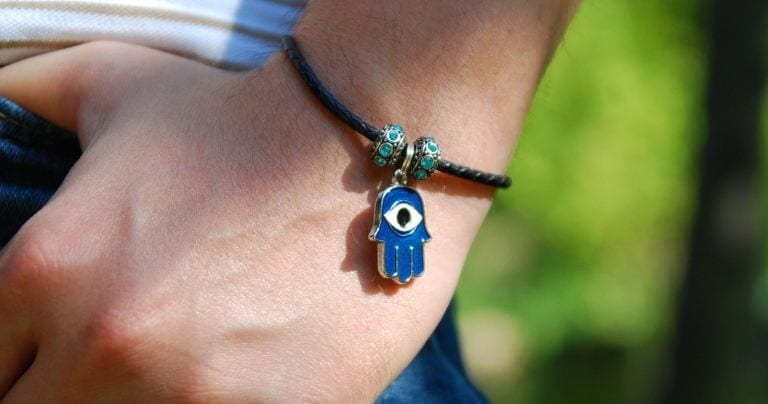
“Irrespective of the culture that it was adopted, the symbol of hamsa was believed to offer defense against the evil eye”. Image by Irina Ilina from Pixabay. Cropped.
Where does it come from?
For a short answer, we can consider that Christensen (2021) explains:
A hamsa is a type of charm, symbol or talisman that is commonly used by people of the Islamic and Jewish faiths, although members of other faiths might use it as well. Also called a hamesh hand, it looks like a hand that has three fingers pointing upward and the thumb and pinkie finger pointing outward. The palm of the hand is commonly covered with an eye. This symbol is thought to ward off “the evil eye” and offer protection from the hand of God.
Sayed (2016, pp: 23), on the other side, gets more specific:
The Hamsa is basically a palm-shaped amulet popular all over the Middle East as well as North Africa. The shape depicts the open right hand that has been documented and used as a symbol of protection throughout history in different cultures. Irrespective of the culture that it was adopted, the symbol of hamsa was believed to offer defense against the evil eye. In accordance to the historical facts, its origins are found in Carthage (modern-day Tunisia) closely associated with the Goddess Tanit. The Phoenicians represented Tanit, the patron goddess of their capital Carthage and controller of the lunar cycle through depicting a hand. Over the course of history, her hand became a defensive amulet or talisman to ward off the evil eye. Later on, the symbol was embraced as the Hand of Maryam by the ancient Sephardic Jewish community spreads across the Iberian Peninsula.
I also find it interesting that “It stands for the Five Pillars of Islam for Sunnis and the Five People of the veil (Prophet’s Family for Shiites). Despite the fact that the Hamsa symbol is associated with Islamic cultures, the Qur’an law prohibits the wearing of charms and amulets.” (Sayed, 2016, pp: 24). We can also add that, after a quick reading, Tanit was a Goddess related to war, virginity, motherhood, nursing, and fertility. I could also find that it called “Hand of Fatima” after the daughter of the Muslim prophet Muhammad, Fatimah bint Muhammad, commonly known as Fāṭimah al-Zahrāʾ, who worked hard, remained humble, and devoted herself to her family in many ways.
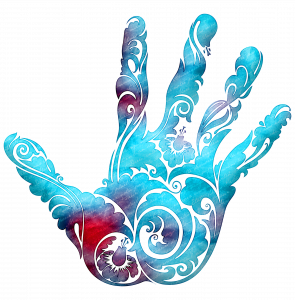
“While it could be seen as a symbol present in different cultures, maybe of flexible meaning, I suggest staying with the Eastern meaning”. Image by Please Don’t sell My Artwork AS IS from Pixabay. Cropped.
Only an Arabic symbol?
I’ve seen some people drawing comparisons with the Egyptian Mano Pantea (El-Azhary Sonbol, 2005), and citing its appearance in Kabbalistic manuscripts and amulets (Rubin, 2010). One could also argue a similarity between the hamsa and the Hindu mudras. While it could be seen as a symbol present in different cultures, maybe of flexible meaning, I suggest staying with the Eastern meaning.
In addition to this, it is interesting that its fingers can be shown apart from one another to protect, together to bring good luck, pointing up to defend, and pointing down to bless and heal. (Gomez, 1996). Although it seems to be a modern interpretation to me, I can see the logic behind it and I don’t see any reason for it not to work.
Finally, as a personal appreciation, I would suggest always using a hamsa that also includes the Nazar, an Arabic amulet against the evil eye, which is how I see it more often than not. I also have my reservations regarding artistic representations of this symbol, some of them being very abstract. I don’t have a problem with this symbol being altered a little if it retains its meaning, but taking it out of its context shouldn’t be a practice.
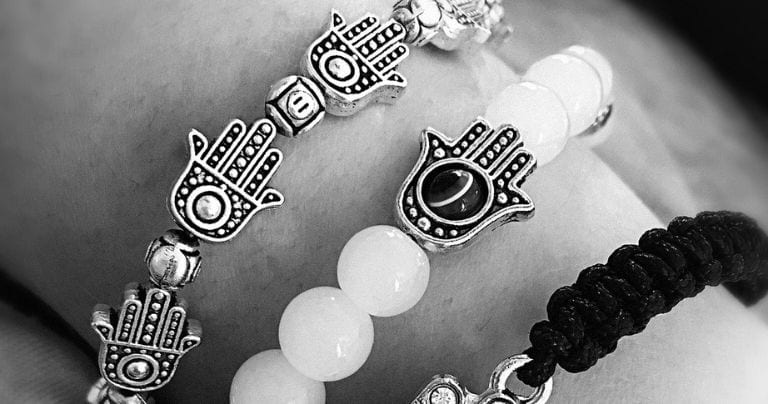
“I’m the only man so far in my family, maybe also between the countrymen I know, but nobody told me anything about it but how pretty it i”. Image by sunburntaloe from Pixabay. Cropped.
How to use it?
After some reading and remembering, the easiest way to use the hamsa is to wear it. Be it in clothes, in jewelry, tattoos, or any other option, having it with you is enough for it to work. As with the Nazar, I suggest staying with the traditional blue and white coloring, although it has also been used in gold and silver. (Badawi, 2004).
My bracelet has a black cord, and while there are nothing and no one saying it should always be like that, I think it would be the best option along with red due to its meaning in the Arabic world (Hasan, Al-Sammerai and Kadir, 2011, p: 209):
a. Colour basic meaning = red (+)
The primary symbolisms of red are blood and red rose (Houghton, 2007).
b. Extended meaning = love, passion (+)
In the Arabic culture, it is clear from the extended meaning of this colour that the colour red implies positive
meanings, as explained earlier.
c. Abstract meaning (+ -)
i.Arab flag logo = as revolutionary army, brave army.
ii.Red cheeks = shy.
iii.Red eye = anger
As a wall hanging, I’ve seen it used in the main entrance of many Arab homes, in the living room, sometimes even in bedrooms. As jewelry, it is particularly popular among women, almost always using it as a necklace, but when I asked my grandmother about it she told me anyone can use it. While she was referring to both men and women, I don’t see why anyone out of the binary gender system could not.
However, we’re speaking about a hand. In any case, if the need arises, we have two, and we can also visualize it or create a chant based on it as I did when I just listened to my Ancestors. For me, the hamsa is a special symbol and carries a meaning of strength, passion, love, and courage. My grandmother never wore it, but many women in my family have, particularly my cousins. I’m the only man so far in my family, maybe also between the countrymen I know, but nobody told me anything about it but how pretty it is, and I agree with them, only that for me is more than just a protective bracelet.
References:
- Badawi, C. (2004). Egypt. Bath: Footprint.
- Christensen, T. (2021). What is a Hamsa?. [online] wiseGEEK. Available at: <https://www.wisegeek.com/what-is-a-hamsa.htm> [Accessed 11 March 2021].
- El-Azhary Sonbol, A. (ed). (2005). Beyond the Exotic: Women’s Histories in Islamic Societies. United Kingdom: Syracuse University Press.
- Gomez, Aurelia (1996). Crafts of Many Cultures: 30 Authentic Craft Projects from Around the World. Scholastic Inc.
- Hasan, A., Al-Sammerai, N. and Kadir, F. (2011). How Colours are Semantically Construed in the Arabic and English Culture: A Comparative study. English Language Teaching, 4(3), pp: 206-2013.
- Rubin, N. A. (2010). Magical and Mystical Mysterious World of Jewish incantations, spells, magic and curses. [online] Jewishmag.com. Available at: <http://jewishmag.com/144mag/superstition_magic/superstition_magic.htm> [Accessed 11 March 2021].
- Sayed, N. A. (2016). The Hand of Hamsa: Interpretation across the Globe. Hand, 6(20).

About Bader Saab
I’m an Arabic witch and journalist, also with a master’s degree in digital research. I have worked as a book reviewer and written about pre-Islamic folklore. You can connect with me by Private Message on Instagram: @saab.bader. You can read more about the author here.
Previous Post

February 28, 2021
Witchcraft Books for Newcomers
Next Post

March 14, 2021 Is the 1001 Nights Misogynist?
Browse Our Archives
Select a Category Ancestors Book review Books Deities Divination Folklore History news Practice Spirits Uncategorized Wellbeing witchcraft Writing
Select a Month September 2026 July 2026 March 2026 December 2025 November 2025 August 2025 July 2025 June 2025 February 2025 January 2025 September 2024 July 2024 March 2024 February 2024 November 2023 September 2023 July 2023 May 2023 April 2023 February 2023 January 2023 December 2022 November 2022 October 2022 September 2022 July 2022 June 2022 May 2022 April 2022 March 2022 February 2022 January 2022 December 2021 October 2021 September 2021 August 2021 July 2021 June 2021 May 2021 April 2021 March 2021 February 2021 January 2021 December 2020 November 2020 October 2020 September 2020 August 2020
Follow Us!
TAKE THE
Religious Wisdom Quiz
In Romans 8, what does Paul say can separate us from the love of Christ?
Select your answer to see how you score.
Nothing Sin Death The Law
Related posts from A Modern Day Sha'ir

No More Booklists. Enter the Fake Degree!

TRENDING AT PATHEOS Pagan

I was recently chatting with someone on Instagram. She asked me what...

While there are many people who share their results, the end of...

On July 23, I saw Christopher Nolan's The Odyssey which is Homer’s...

As I write this two big events have just finished up. One...

Restoring the Watershed of Divine Love
Perhaps cooperation is not something we manufacture through legislation, ideology, or moral...

Many UUs don’t pray because of bad experiences in a previous religion,...
view all Pagan blogs
Ad-Free & Subscriber Log-In Subscription Support
- About Us
- 2026 Calendar
- Videos
- Podcasts
- Library of World Religions
- Faith In Media Tracker
- Advertise With Us
- Write for Us
- Privacy Policy
- Terms of Service
- Do Not Sell My Data
- Contact Us
- Radiant Digital
- Manage Newsletter Subscriptions
- Unsubscribe From Notifications
- Sitemap
Copyright 2008-2026, Patheos. All rights reserved.
Subscription Support Ad-Free & Subscriber Log-In
Follow Patheos