
BuddhistCatholicContemplativeEvangelicalGeneral ChristianHinduJewishLatter-day SaintMuslimNew VisionsProgressive Christian
Beliefs
- Buddhist
- Catholic
- Contemplative
- Evangelical
- General Christian
- Hindu
- Jewish
- Latter-day Saint
- More Voices
- Muslim
- New Visions
- Pagan
- Progressive Christian
Topics
- Religion News
- Food and Religion
- Sports and Religion
- Religious Art
- Religious Music and Entertainment
- Religious Events
- History and Religion
- Style and Religion
- Politics and Religion
- Women in Religion
- Recreation Outdoors and Religion
- Business Finance and Religion
- Careers Workplace and Religion
- Education and Religion
- Family Parenting and Religion
- Health Fitness and Religion
- Home and Religion
- Relationships and Religion
- Technology and Religion
- Travel and Religion
Columnists
- Buddhist Columnists
- Business Finance and Religion Columnists
- Careers Workplace and Religion Columnists
- Catholic Columnists
- Contemplative Columnists
- Education and Religion Columnists
- Evangelists Columnists
- Family Parenting and Religion Columnists
- General Christian Columnists
- Health Fitness and Religion Columnists
- Hindu Columnists
- History and Religion Columnists
- Home and Religion Columnists
- Jewish Columnists
- More Voices Columnists
- Latter Day Columnists
- Muslim Columnists
- New Visions Columnists
- Nonreligious Columnists
- Pagan Columnists
- Politics and Religion Columnists
- Progressive Columnists
- Recreation Outdoors and Religion Columnists
- Relationships and Religion Columnists
- Religion News Columnists
- Religious Art Columnists
- Religious Events Columnists
- Religious Music and Entertainment Columnists
- Sports and Religion Columnists
- Style and Religion Columnists
- Technology and Religion Columnists
- Travel and Religion Columnists
- Women in Religion Columnists
Resource Library
- 2026 Calendar
- Library of World Religions
- The 100 Most Holy Places on Earth
- Patheos Answers
- Podcasts
- Videos
- Faith Leaders Database
- Anglican Episcopalian
- Bahai
- Baptist
- Buddhism
- Christianity
- Confucianism
- Eastern Orthodoxy
- Hinduism
- Holiness and Pentecostal
- ISKCON
- Islam
- Judaism
- Lutheran
- Methodist
- The Church of Jesus Christ of Latter-day Saints
- New Age
- Paganism
- Presbytarian and Reformed
- Protestantism
- Religion Behind the Scenes
- Roman Catholic
- Scientology
- Shia Islam
- Sikhism
- Sufism
- Sunni Islam
- Taoism
- Zen
- See all religions
Research Tools
 Ad-Free & Subscriber Log-In Subscription Support
Ad-Free & Subscriber Log-In Subscription Support
Follow Patheos 

- Trending:
- Forgiveness
- |
- Marriage
- |
- Consciousness
- |
- Death Penalty
- |
- Election
- |
- Halloween

- Home
- Pagan
- Is the 1001 Nights Misogynist?
Is the 1001 Nights Misogynist?
Last updated on: March 14, 2021 at 7:00 am by Bader Saab
Is the 1001 Nights Misogynist? 2021-03-13T23:52:57-04:00 Bader Saab
Patheos Explore the world's faith through different perspectives on religion and spirituality! Patheos has the views of the prevalent religions and spiritualities of the world.
I recently started reading The 1001 Nights, one of my pre-Islamic readings for this year, and one of the questions that often arise when I search for this book is whether it is a misogynist narrative or not. The short answer, if you want to know, is not for me, but that it reflects the fears of insecure men.
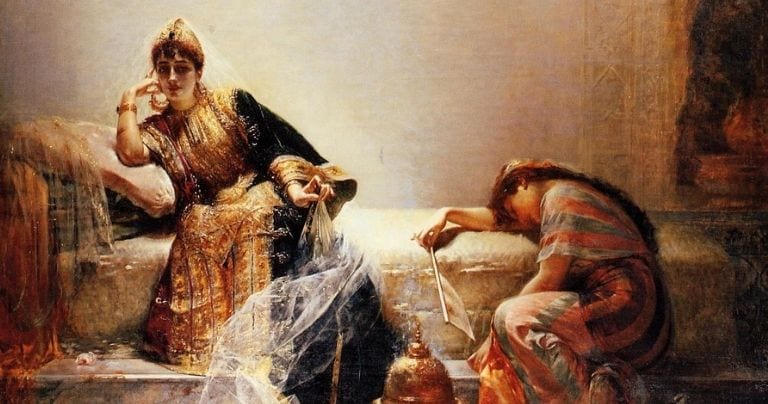
“Scheherazade”, by Edouard Frederic Wilhelm Richter, taken from Wikimedia Commons. Cropped.

Before anyone asks which version I refer to, because there are many and there may be a few differences here and there between them, I have the Mahdi edition, edited Muhsin Mahdi, PhD., and translated by Husain Haddawy. This edition has been named the best one to date and its editor was an expert Islamologist and Arabist, so it’s the only version I’m interested in reading for now. I would also be using the spelling of this book.
I also need to be clear about something: I barely started with the 1001 Nights, but what I’ve read so far gives me a really good answer. The women that have appeared at this point set the stage for the rest of the book, they determined what would happen in the next chapters (or should I say nights?) Far from being a misogynist book, I have found it to be actually empowering towards women but told from the perspective of fearful, insecure, and mentally-archaic men.
Getting into Context
Right from the beginning, we learn about the wives of King Shahrayar and King Shahzaman, who are unfaithful to his husband the minute they are away from them, cheating on them with their slaves. Both Kings leave in search of someone with a fate worse than theirs, which is a woman trapped by a demon since her wedding night. She has let the demon believe she is chaste and pure, while she has had sex with 98 men, now 100 with the brothers, as a form of rebellion. Back to Shahrayar’s kingdom, this kills his wife like Shahzaman did at the beginning of the 1001 Nights but, while the younger brother will not marry another woman, Shahrayar decides to marry a different maiden each night only to be with her and kill her the next morning.
When there were no more girls between the commoners, the vizier’s oldest daughter, Shahrazad, the protagonist of the 1001 Nights, decides to take the matter on her hands and protect the kingdom by offering herself as the King’s next wife, but allied with her younger sister Dinarzad and with a plan to prevent more deaths by the hand of Shahrayar.
I wouldn’t blame you if it sounds misogynist to you but, for me, it was reading about four women that found a way to rebel against their current lives. When I think about each case, I see rebel spirits that can’t be tamed, no matter the men that surround them. Therefore, these men need to eliminate them because they prove to be a menace to their comfortable lives.
A Closer Look
The two Queens at the beginning of the 1001 Nights are the easiest case. Both women seek the slaves only for sex, which is an obvious indication that matters in the royal bedrooms haven’t been really good with their husbands. Both Kings are so focused on their responsibilities with their respective kingdoms that their marriage is falling apart, and their wives are clever enough to hide it until Shahzaman discovers it by accident and makes his brother do the same. The fact that Shahzaman’s wife was careless enough for her husband to notice it tells me she has been doing this for a long time. Her only mistake was taking her success for granted. The same happens with Shahrayar’s wife, who believed in the word of her husband and didn’t make sure both brothers were out before calling for her lover.
The prisoner woman we meet after has been lying and letting the demon who trapped her believe she is chaste, but she is anything but pure sexually speaking. Every time this demon sleeps, she takes her chance to force any man to be with her, taking a ring from them as proof of her rebellion. She is clever and careful enough to fool the demon around a hundred times, basically saying that if sexual chastity would keep her caged, she will embrace her sexual desire as often as she wants to.
Finally, we have Shahrazad, the heroine in the 1001 Nights, the cleverest of them all, who decided to walk right into the wolf’s mouth to protect those in need. She offers herself as an object but her tales charm Shahrayar so much he keeps letting her live for another night. Pretending to be a mere sexual thing, which is what gives Shahrayar his power, Shahrazad strips him from the protagonism and assumes the role of a fighter as a storyteller, transforming the 1001 Nights in her own story.
More examples?
Those of you who have read at least one of the versions of this book could tell me that I ignored The Tale of the Merchant and His Wife, where a whimsical and spoiled woman cares enough about gossiping than her own husband. If taken literally, it is very misogynist, but oak has been called a tree of wisdom in many cultures, leading the reader to interpret this scene as the husband educating his wife even if she refuses, assuming the role of the father instead of that of a partner. Also, I see this as a lesson of behaving as what you want to be treated as. It wouldn’t surprise anyone to know that in previous years spanking children was a common practice, so having a grown woman treated as such tells that she stops being an adult the moment she stops behaving like one. We could also add that this is also connected to the oak as a symbol of wisdom and learning.
I’m sure there will be much more examples, more lessons, and morals, but so far I’m amazed at the symbolism, the questions, and thoughts that arise as I read the 1001 Nights. Far from analyzing each tale, which would prevent me from writing any other thing (and could probably bore you to death), I’d rather focus on sharing my thoughts on it when something calls for my attention. I’m aware that many people call Arab women victims of repression and violence, and these tales could reinforce the idea without any problem, but one of the aspects I love about folklore the most is how flexible it is in terms of meaning.

About Bader Saab
I’m an Arabic witch and journalist, also with a master’s degree in digital research. I have worked as a book reviewer and written about pre-Islamic folklore. You can connect with me by Private Message on Instagram: @saab.bader. You can read more about the author here.
Previous Post

March 11, 2021
The Protective Hamsa
Next Post

March 21, 2021 More pre-Islamic readings
Browse Our Archives
Select a Category Ancestors Book review Books Deities Divination Folklore History news Practice Spirits Uncategorized Wellbeing witchcraft Writing
Select a Month September 2026 July 2026 March 2026 December 2025 November 2025 August 2025 July 2025 June 2025 February 2025 January 2025 September 2024 July 2024 March 2024 February 2024 November 2023 September 2023 July 2023 May 2023 April 2023 February 2023 January 2023 December 2022 November 2022 October 2022 September 2022 July 2022 June 2022 May 2022 April 2022 March 2022 February 2022 January 2022 December 2021 October 2021 September 2021 August 2021 July 2021 June 2021 May 2021 April 2021 March 2021 February 2021 January 2021 December 2020 November 2020 October 2020 September 2020 August 2020
Follow Us!
TAKE THE
Religious Wisdom Quiz
True or False: The apostles drew lots to choose Matthias to replace Judas.
Select your answer to see how you score.
FALSE TRUE
Related posts from A Modern Day Sha'ir

No More Booklists. Enter the Fake Degree!


TRENDING AT PATHEOS Pagan

I was recently chatting with someone on Instagram. She asked me what...

While there are many people who share their results, the end of...

On July 23, I saw Christopher Nolan's The Odyssey which is Homer’s...

As I write this two big events have just finished up. One...

Restoring the Watershed of Divine Love
Perhaps cooperation is not something we manufacture through legislation, ideology, or moral...

Many UUs don’t pray because of bad experiences in a previous religion,...
view all Pagan blogs
Ad-Free & Subscriber Log-In Subscription Support
- About Us
- 2026 Calendar
- Videos
- Podcasts
- Library of World Religions
- Faith In Media Tracker
- Advertise With Us
- Write for Us
- Privacy Policy
- Terms of Service
- Do Not Sell My Data
- Contact Us
- Radiant Digital
- Manage Newsletter Subscriptions
- Unsubscribe From Notifications
- Sitemap
Copyright 2008-2026, Patheos. All rights reserved.
Subscription Support Ad-Free & Subscriber Log-In
Follow Patheos