
BuddhistCatholicContemplativeEvangelicalGeneral ChristianHinduJewishLatter-day SaintMuslimNew VisionsProgressive Christian
Beliefs
- Buddhist
- Catholic
- Contemplative
- Evangelical
- General Christian
- Hindu
- Jewish
- Latter-day Saint
- More Voices
- Muslim
- New Visions
- Pagan
- Progressive Christian
Topics
- Religion News
- Food and Religion
- Sports and Religion
- Religious Art
- Religious Music and Entertainment
- Religious Events
- History and Religion
- Style and Religion
- Politics and Religion
- Women in Religion
- Recreation Outdoors and Religion
- Business Finance and Religion
- Careers Workplace and Religion
- Education and Religion
- Family Parenting and Religion
- Health Fitness and Religion
- Home and Religion
- Relationships and Religion
- Technology and Religion
- Travel and Religion
Columnists
- Buddhist Columnists
- Business Finance and Religion Columnists
- Careers Workplace and Religion Columnists
- Catholic Columnists
- Contemplative Columnists
- Education and Religion Columnists
- Evangelists Columnists
- Family Parenting and Religion Columnists
- General Christian Columnists
- Health Fitness and Religion Columnists
- Hindu Columnists
- History and Religion Columnists
- Home and Religion Columnists
- Jewish Columnists
- More Voices Columnists
- Latter Day Columnists
- Muslim Columnists
- New Visions Columnists
- Nonreligious Columnists
- Pagan Columnists
- Politics and Religion Columnists
- Progressive Columnists
- Recreation Outdoors and Religion Columnists
- Relationships and Religion Columnists
- Religion News Columnists
- Religious Art Columnists
- Religious Events Columnists
- Religious Music and Entertainment Columnists
- Sports and Religion Columnists
- Style and Religion Columnists
- Technology and Religion Columnists
- Travel and Religion Columnists
- Women in Religion Columnists
Resource Library
- 2026 Calendar
- Library of World Religions
- The 100 Most Holy Places on Earth
- Patheos Answers
- Podcasts
- Videos
- Faith Leaders Database
- Anglican Episcopalian
- Bahai
- Baptist
- Buddhism
- Christianity
- Confucianism
- Eastern Orthodoxy
- Hinduism
- Holiness and Pentecostal
- ISKCON
- Islam
- Judaism
- Lutheran
- Methodist
- The Church of Jesus Christ of Latter-day Saints
- New Age
- Paganism
- Presbytarian and Reformed
- Protestantism
- Religion Behind the Scenes
- Roman Catholic
- Scientology
- Shia Islam
- Sikhism
- Sufism
- Sunni Islam
- Taoism
- Zen
- See all religions
Research Tools
 Ad-Free & Subscriber Log-In Subscription Support
Ad-Free & Subscriber Log-In Subscription Support
Follow Patheos 

- Trending:
- Forgiveness
- |
- Marriage
- |
- Consciousness
- |
- Death Penalty
- |
- Election
- |
- Halloween

- Home
- Pagan
- The Nazar: an Arabic Amulet Against the Evil Eye
The Nazar: an Arabic Amulet Against the Evil Eye
Last updated on: January 10, 2021 at 7:00 am by Bader Saab
The Nazar: an Arabic Amulet Against the Evil Eye 2021-01-09T21:35:22-04:00 Bader Saab
Patheos Explore the world's faith through different perspectives on religion and spirituality! Patheos has the views of the prevalent religions and spiritualities of the world.
Since I was a kid, there was a blue eye used as an amulet for babies to be protected. Only when they were one year old or so, or when my grandparents considered enough time had passed by, they removed the pendant from the child’s clothes. Later in life, I discovered this amulet is called nazar, is against the evil eye, and can be used by actually anyone, not only babies.
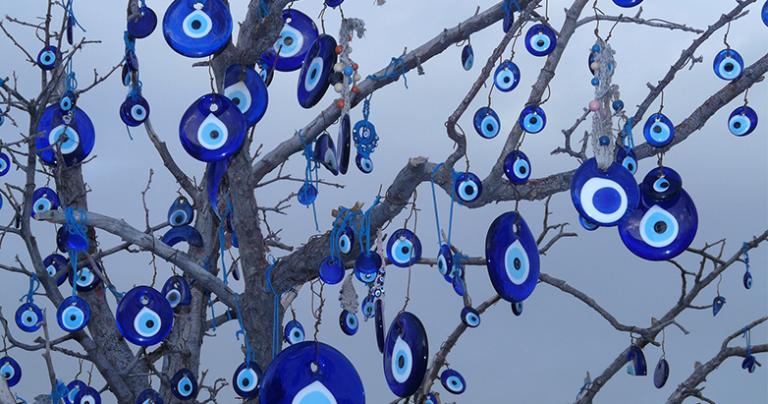
“it is a curse someone may be conscious of or not based on envy, greed, and/or admiration”. Image by Hans Braxmeier from Pixabay. Cropped.
What’s the Evil Eye?
Annwyn Avalon, from The Water Wich, wrote an excellent article about the matter and its cultural significance, offering a brief but interesting look at it through different cultures. Instead of saying the same as her, maybe with a few differences, I prefer to share my experiences and my family’s teachings in the matter. For those who would like an audiovisual explanation, I also got you covered.
In short, it is a curse someone may be conscious of or not based on envy, greed, and/or admiration. Its effects always vary a bit, but most of the time the affected person feels week, afraid, has nightmares and gets sick very easily. Due to a familiar experience, I think it is also connected to the context of when and where the evil eye was sent.
When sent by an envious person, their hate and desire are directed at a person who has something or someone they don’t. Either verbally or mentally, a person can send those negative vibes toward the one who has their desired object, or sometimes it can also be because of a project or a job.
Once, my mother was given the chance to sell Arabic food in a bazaar. We knew there was already a meals’ food, but they were more oriented toward breakfasts, and ours was more for lunch. When midday came and the customers started buying more at our table than at the other one, my mother felt the owner’s eyes on her all the time.
This woman was so annoyed and her face was so upset that even the organizer had to come to our tables and see what was happening because even the customers felt the tension between both tables. In the end, my mom and I sold everything we had, but she had a very bad night, feeling bad in the stomach and feeling strong indigestion.

“I was told from a young age that even high admiration could cause harm in the form of the evil eye”. Image by Hans Braxmeier from Pixabay. Cropped.
The “Unintended” Evil Eye
However, you can also send the evil eye when admiring someone’s belongings, success, or even a child, especially when they’re newborn. I was told from a young age that even high admiration could cause harm in the form of the evil eye, a belief I’m sure is influenced by my family’s Druze belief, which states that everything in excess becomes dangerous.
My little brother, for example, always needed to have a nazar with him because people always said he was cute, beautiful, and funny, even more during his first year of life. Everyone wanted to hug him, tickle him, kiss him, and his skin was always irritated, he always hit a part of his body, mostly his head, or got sick when he didn’t have the amulet.
This happened to some of my cousins as well, mostly when people came to visit my uncles and aunts to congratulate them on the new child. After so many visits, some of my cousins would go sick like my brother, experiencing some of the same effects as him. I also saw this happen when we visited someone and the baby started to cry for no apparent reason. My grandmother would then give them a nazar after blessing it with many prayers.

“The color blue in the Nazar amulet is of particular importance. History reveals many ancient cultures considered blue color to be of divine origin”. Image by Arek Socha from Pixabay. Cropped.
How do You Use the Nazar? What if I Don’t Have One?
There are a lot of designs now in the market, with the nazar coming in several colors, but I’ve never seen any of those in my family or any Arabic family. I even look at them with suspicion, and my grandmother always gives a blue nazar. About the color blue, Ellen Lloyd, owner of AncientPages.com, explains that:
The color blue in the Nazar amulet is of particular importance. History reveals many ancient cultures considered blue color to be of divine origin. Ancient Egyptians saw the deep blue color of water as life and blue sky was divine.
Sumerians made many statues of beings who had very big and blue eyes. Like many other ancient civilizations, the Sumerians considered blue eyes to be a sign of gods.
Also, blue eyes were an unusual color in western Asia. Blue eyes were perceived as having powerful magic, powerful enough even for deflecting the Evil Eye.
My grandmother always tells us to put a small golden pendant with a blue nazar in it for babies to be protected. For adults, any piece of jewelry is okay. This amulet can also be hung on the home’s main entry, on the rooms’ doors, and in cars and vehicles to stay out of harm. Grandmother always prays in Arabic before giving one, or when a baby needs when extra protection.
However, she’s not always carrying one in her purse or in her car, and some in my family don’t even speak Arabic. When she doesn’t have an amulet or she needs to heal or protect someone, she always takes a glass of water, prays and blesses the water, and uses a bit of it to wash the person’s face. The rest is for this person to drink. A piece of jewelry of the same light blue color can be used as a substitute for the eye
“Bismillah al rahman al rahim”, meaning “In the name of God, most Gracious, most Compassionate“, or simply “In the name of God”, is a simple and effective phrase she uses, as well as my mother and I, when we suspect something evil is around or when we get out of the house. I’ve also heard grandmother say this phrase when blessing the water, among others you can barely hear. She gets very emotional and sometimes even cries when doing this, so you need to really feel love and compassion for the affected person.
This is not the first time I hear about the healing powers of water and its use as a channel for good energies. Masaru Emoto has written several books on the topic, The Hidden Messages in Water being one of the most known, if not the first one people think about when reading or hearing his name.
Obviously, you don’t need to pray in Arabic. The Gods and Ancestors don’t speak only Arabic, but try to do it if you’re aiming to have the help of Arabic-speaking spirits. All you really need is to feel it and act with love. Divine energy is intelligent, so it will do its job after you do yours.

About Bader Saab
I’m an Arabic witch and journalist, also with a master’s degree in digital research. I have worked as a book reviewer and written about pre-Islamic folklore. You can read more about the author here.
Previous Post

January 3, 2021
7 pre-Islamic Readings for this 2021
Next Post

January 17, 2021 DSD: Hilal, the pre-Islamic God of Cycles, Trickery and the Crescent Moon
Browse Our Archives
Select a Category Ancestors Book review Books Deities Divination Folklore History news Practice Spirits Uncategorized Wellbeing witchcraft Writing
Select a Month September 2026 July 2026 March 2026 December 2025 November 2025 August 2025 July 2025 June 2025 February 2025 January 2025 September 2024 July 2024 March 2024 February 2024 November 2023 September 2023 July 2023 May 2023 April 2023 February 2023 January 2023 December 2022 November 2022 October 2022 September 2022 July 2022 June 2022 May 2022 April 2022 March 2022 February 2022 January 2022 December 2021 October 2021 September 2021 August 2021 July 2021 June 2021 May 2021 April 2021 March 2021 February 2021 January 2021 December 2020 November 2020 October 2020 September 2020 August 2020
Follow Us!
TAKE THE
Religious Wisdom Quiz
What was the primary trade route in Biblical times?
Select your answer to see how you score.
Silk Road Spice Route Mediterranean Route Royal Road
Related posts from A Modern Day Sha'ir



Something, anything, this way comes

Pray for the Druze and Christians in Syria
TRENDING AT PATHEOS Pagan

I was recently chatting with someone on Instagram. She asked me what...

While there are many people who share their results, the end of...

On July 23, I saw Christopher Nolan's The Odyssey which is Homer’s...

As I write this two big events have just finished up. One...

Restoring the Watershed of Divine Love
Perhaps cooperation is not something we manufacture through legislation, ideology, or moral...

Many UUs don’t pray because of bad experiences in a previous religion,...
view all Pagan blogs
Ad-Free & Subscriber Log-In Subscription Support
- About Us
- 2026 Calendar
- Videos
- Podcasts
- Library of World Religions
- Faith In Media Tracker
- Advertise With Us
- Write for Us
- Privacy Policy
- Terms of Service
- Do Not Sell My Data
- Contact Us
- Radiant Digital
- Manage Newsletter Subscriptions
- Unsubscribe From Notifications
- Sitemap
Copyright 2008-2026, Patheos. All rights reserved.
Subscription Support Ad-Free & Subscriber Log-In
Follow Patheos