
BuddhistCatholicContemplativeEvangelicalGeneral ChristianHinduJewishLatter-day SaintMuslimNew VisionsProgressive Christian
Beliefs
- Buddhist
- Catholic
- Contemplative
- Evangelical
- General Christian
- Hindu
- Jewish
- Latter-day Saint
- More Voices
- Muslim
- New Visions
- Pagan
- Progressive Christian
Topics
- Religion News
- Food and Religion
- Sports and Religion
- Religious Art
- Religious Music and Entertainment
- Religious Events
- History and Religion
- Style and Religion
- Politics and Religion
- Women in Religion
- Recreation Outdoors and Religion
- Business Finance and Religion
- Careers Workplace and Religion
- Education and Religion
- Family Parenting and Religion
- Health Fitness and Religion
- Home and Religion
- Relationships and Religion
- Technology and Religion
- Travel and Religion
Columnists
- Buddhist Columnists
- Business Finance and Religion Columnists
- Careers Workplace and Religion Columnists
- Catholic Columnists
- Contemplative Columnists
- Education and Religion Columnists
- Evangelists Columnists
- Family Parenting and Religion Columnists
- General Christian Columnists
- Health Fitness and Religion Columnists
- Hindu Columnists
- History and Religion Columnists
- Home and Religion Columnists
- Jewish Columnists
- More Voices Columnists
- Latter Day Columnists
- Muslim Columnists
- New Visions Columnists
- Nonreligious Columnists
- Pagan Columnists
- Politics and Religion Columnists
- Progressive Columnists
- Recreation Outdoors and Religion Columnists
- Relationships and Religion Columnists
- Religion News Columnists
- Religious Art Columnists
- Religious Events Columnists
- Religious Music and Entertainment Columnists
- Sports and Religion Columnists
- Style and Religion Columnists
- Technology and Religion Columnists
- Travel and Religion Columnists
- Women in Religion Columnists
Resource Library
- 2026 Calendar
- Library of World Religions
- The 100 Most Holy Places on Earth
- Patheos Answers
- Podcasts
- Videos
- Faith Leaders Database
- Anglican Episcopalian
- Bahai
- Baptist
- Buddhism
- Christianity
- Confucianism
- Eastern Orthodoxy
- Hinduism
- Holiness and Pentecostal
- ISKCON
- Islam
- Judaism
- Lutheran
- Methodist
- The Church of Jesus Christ of Latter-day Saints
- New Age
- Paganism
- Presbytarian and Reformed
- Protestantism
- Religion Behind the Scenes
- Roman Catholic
- Scientology
- Shia Islam
- Sikhism
- Sufism
- Sunni Islam
- Taoism
- Zen
- See all religions
Research Tools
 Ad-Free & Subscriber Log-In Subscription Support
Ad-Free & Subscriber Log-In Subscription Support
Follow Patheos 

- Trending:
- Forgiveness
- |
- Marriage
- |
- Consciousness
- |
- Death Penalty
- |
- Election
- |
- Halloween

- Home
- Pagan
- On The 1001 Nights
On The 1001 Nights
Last updated on: November 16, 2020 at 12:03 am by Bader Saab
On The 1001 Nights 2020-11-16T00:03:21-04:00 Bader Saab
Patheos Explore the world's faith through different perspectives on religion and spirituality! Patheos has the views of the prevalent religions and spiritualities of the world.
Described as “the epitome of world literature” (Horta, 2020, p. 1), everyone knows a little bit about the 1001 Nights. We all grew up knowing the stories of Aladdin, Ali Baba, and Sinbad, we know there is a certain Scheherazade who told a different tale every single night to an Arabic king, but how many of us have actually read these folk tales?
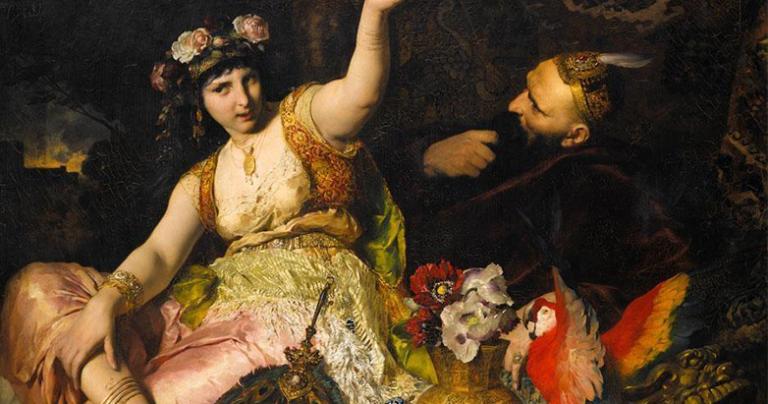
“Čehrāzād, therefore, means “of noble or exalted lineage””. Scheherazade und Sultan Schariar (1880), by Ferdinand Keller. Taken from Wikimedia Commons. Cropped.

The Basics
While it is known that the One Thousand Nights and One Night (Arabic: أَلْفُ لَيْلَةٍ وَلَيْلَةٌ, ʾAlf Laylah wa-Laylah) is a collection of stories, all of them are tied together by the first one, the tale between the blood-thirsty King Shahryār and the clever Scheherazade. When Shahryār discovers his wife is being unfaithful, he is changed into a different man (Burton, 1885, p. 4):
The Queen, his wife, asleep on his own carpet-bed, embracing with both arms a black cook of loathsome aspect and foul with kitchen grease and grime. When he saw this the world waxed black before his sight and he said, “If such case happen while I am yet within sight of the city what will be the doings of this damned whore during my long absence at my brother’s court?”
This caused the King to be sure all women are the same, making him marry a different maiden every day only to kill them after consummating their marriage so they wouldn’t have time to betray him. Woman after woman died because of his obsession and misogyny until he decided to put his eyes on the vizier’s daughter, Scheherazade, a well-read woman who thinks about a definite solution to end the massacre.
Before the King has a chance to execute her, she asks for a final goodbye to her sister, Dunyazad, who knows about her plan asks Scheherazade to tell them a story. As the morning comes, the new Queen leaves the tale unfinished, buying a new day of life for her. For 1001 nights, Scheherazade weaves different stories in order to stay alive, after which Shahryār is deeply in love with her and admires his wife because of her wisdom, knowledge, and cunning character.
Names also play an important role in the story and describe the role of these characters, making this a fight of powers and social classes that want to prevail above the others (Pellat, 2011):
Šahrīār is a Middle Persian name (šahr + dār) which literally means “holder of a kingdom, possessor of ruling power,” and therefore, “prince, king.” Among the class-conscious Iranians of Sasanian times, the word carried a sharply defined social significance and referred to a provincial/local ruler, ranking with the most prestigious families.
Čehrāzād, another Middle Persian name, is composed of čehr, “lineage,” and āzād (going back to Av. āzāta-, which originally meant “agnate, born [into a family with full rights]” and eventually came to mean “noble, exalted”). In Sasanian Persia, āzād referred to the nobility as a whole, as against the slaves and the non-citizen freeborn, and it also designated the lower echelon of the nobility, mostly landed gentry (see Camb. Hist. Iran III, pp. 644ff.). Čehrāzād, therefore, means “of noble or exalted lineage.”
Dīnāzād, which also appears in the manuscripts as Dīnārzād and Donyāzād, is almost certainly the Middle Persian *Dēnāzād, composed of dēn (Av. daēnā-), “religious consciousness or sensibilities,” which was hypostatized as a goddess, and āzād, the name therefore meaning “[the goddess] Dēn[is] exalted.”
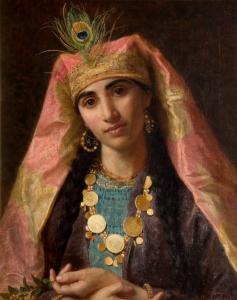
“Finally, there is one that I’m eager to read: although considerably shorter in comparison, the only critical edition to date”. Scheherazade, (between 1850 and 1900) by Sophie Gengembre Anderson. Taken from Wikimedia Commons. Cropped.
The 1001 Translations
The earliest version of the 1001 Nights, known as the Galland Manuscript, is agreed to come from 14th or 15th century Syria. Is a three-part manuscript, although some scholars have proposed the idea of it being originally a four-part book. French orientalist and archaeologist Antoine Galland based his translation, the first to be done, on this book and on tales told by Hanna Diyab (Zipes, 2007, p. 53), a writer and storyteller from Ottoman Syria (c. 1688).
Several writers have translated and edited this collection, some adding their own style to the book, and being criticized for doing so. It is beyond my reach to speak about all of them, but there are a few that have been quite notorious. First, we have Richard Francis Burton’s 1885-8 translation in 10 volumes, considered the best one since its publication, although it was censored for the highly erotic and explicit elements on it, followed by a 6 volume supplemental edition, both collections available for free.
Le livre des mille nuits et une nuit, a 12-volume French translation of One Thousand and One Nights by J. C. Mardrus, also gained some attention on its time, being also criticized because he “took elements which were there in the original Arabic and worked them up, exaggerating and inventing, reshaping the Nights in such a manner that the stories appear at times to have been written by Oscar Wilde or Stéphane Mallarmé” (Irwin 2004, p. 37). Although the full collection in French is available for free on Google Books, I couldn’t find a full English translation of this edition.
Compared to others, the 3 volume edition of the 1001 Nights translated by Malcolm Lyons and Ursula Lyons uses a simpler, more straightforward language that could be a better option for modern readers (Kirk, 2018):
Burton has a tendency towards rambling and flowery language, using “thee”s and “thou”s to evoke an archaic tone. He deliberately chooses obscure words, using Latin whenever the chance arises. (…) The Lyons, on the other hand, take a more grounded approach. They aim for clarity and a smooth effortless reading experience. You’ll never lose the train of thought or get exhausted after reading one tale. Some might argue that the Lyons version lacks pizzazz, but others would say that they allow the words to speak for themselves.
Finally, there is one that I’m eager to read. Although considerably shorter in comparison, The Leiden Edition, prepared by Muhsin Mahdi, is the only critical edition to date (Marzolph, 2007) and is believed by Irwin to be the most stylistically faithful representation of medieval Arabic versions currently available. (Irwin, 2004) This version also includes both the original material from Syria and tales originating from Egypt.
Which edition of the 1001 Nights is the best one is open to debate depending on what the reader wants. I am only interested in reading Mahdi’s, but both Burton and the Lyons have received good opinions as far as I have seen on the internet, and I cannot deny it worries me that this translation is so brief compared to the others.
References:
- Burton, R., 1885. The Book Of The Thousand Nights And A Night. Volume 1. 1st ed. United Kingdom: Kama Shastra Society.
- Ch. Pellat, 2011, “ALF LAYLA WA LAYLA,” Encyclopædia Iranica, I/8, pp. 831-835; an updated version is available online at http://www.iranicaonline.org/articles/alf-layla-wa-layla.
- Horta, P. L., 2020. The 1001 Nights as World Literature: Cultural Appropriation and Collaboration. A Companion to World Literature, pp: 1-12.
- Irwin, R., 2004. The Arabian Nights: A Companion. 1st ed. New York: Tauris Parke Paperbacks.
- Kirk, T., 2018. Arabian Nights Series Part 2: Burton Vs Lyons Translation Throwdown. Fairytalenewsblog.blogspot.com. Accessed 15 November 2020.
- Marzolph, U., 2007. “Arabian Nights”, in Encyclopaedia of Islam, THREE, by Fleet, K., Krämer, G., Matringe, D., Nawas, J., and Rowson, E. (eds). Leiden: Brill Publishers. Consulted online on 15 November 2020.
- Zipes, J., 2007. When Dreams Came True: Classical Fairy Tales and Their Tradition. New York: Routledge.

About Bader Saab
I’m an Arabic witch and journalist, also with a master’s degree about to be finished on digital research. I have worked as a book reviewer and written about pre-Islamic folklore. You can read more about the author here.
Previous Post

November 8, 2020
What's a Modern Day Sha’ir?
Next Post

November 18, 2020 Witchcraft, Hobbies and Fox News
Browse Our Archives
Select a Category Ancestors Book review Books Deities Divination Folklore History news Practice Spirits Uncategorized Wellbeing witchcraft Writing
Select a Month September 2026 July 2026 March 2026 December 2025 November 2025 August 2025 July 2025 June 2025 February 2025 January 2025 September 2024 July 2024 March 2024 February 2024 November 2023 September 2023 July 2023 May 2023 April 2023 February 2023 January 2023 December 2022 November 2022 October 2022 September 2022 July 2022 June 2022 May 2022 April 2022 March 2022 February 2022 January 2022 December 2021 October 2021 September 2021 August 2021 July 2021 June 2021 May 2021 April 2021 March 2021 February 2021 January 2021 December 2020 November 2020 October 2020 September 2020 August 2020
Follow Us!
TAKE THE
Religious Wisdom Quiz
Who had a vision of a great sheet filled with unclean animals?
Select your answer to see how you score.
Peter Stephen John Paul
Related posts from A Modern Day Sha'ir
No More Booklists. Enter the Fake Degree!



Something, anything, this way comes
TRENDING AT PATHEOS Pagan

I was recently chatting with someone on Instagram. She asked me what...

While there are many people who share their results, the end of...

On July 23, I saw Christopher Nolan's The Odyssey which is Homer’s...

As I write this two big events have just finished up. One...

Restoring the Watershed of Divine Love
Perhaps cooperation is not something we manufacture through legislation, ideology, or moral...

Many UUs don’t pray because of bad experiences in a previous religion,...
view all Pagan blogs
Ad-Free & Subscriber Log-In Subscription Support
- About Us
- 2026 Calendar
- Videos
- Podcasts
- Library of World Religions
- Faith In Media Tracker
- Advertise With Us
- Write for Us
- Privacy Policy
- Terms of Service
- Do Not Sell My Data
- Contact Us
- Radiant Digital
- Manage Newsletter Subscriptions
- Unsubscribe From Notifications
- Sitemap
Copyright 2008-2026, Patheos. All rights reserved.
Subscription Support Ad-Free & Subscriber Log-In
Follow Patheos