
BuddhistCatholicContemplativeEvangelicalGeneral ChristianHinduJewishLatter-day SaintMuslimNew VisionsProgressive Christian
Beliefs
- Buddhist
- Catholic
- Contemplative
- Evangelical
- General Christian
- Hindu
- Jewish
- Latter-day Saint
- More Voices
- Muslim
- New Visions
- Pagan
- Progressive Christian
Topics
- Religion News
- Food and Religion
- Sports and Religion
- Religious Art
- Religious Music and Entertainment
- Religious Events
- History and Religion
- Style and Religion
- Politics and Religion
- Women in Religion
- Recreation Outdoors and Religion
- Business Finance and Religion
- Careers Workplace and Religion
- Education and Religion
- Family Parenting and Religion
- Health Fitness and Religion
- Home and Religion
- Relationships and Religion
- Technology and Religion
- Travel and Religion
Columnists
- Buddhist Columnists
- Business Finance and Religion Columnists
- Careers Workplace and Religion Columnists
- Catholic Columnists
- Contemplative Columnists
- Education and Religion Columnists
- Evangelists Columnists
- Family Parenting and Religion Columnists
- General Christian Columnists
- Health Fitness and Religion Columnists
- Hindu Columnists
- History and Religion Columnists
- Home and Religion Columnists
- Jewish Columnists
- More Voices Columnists
- Latter Day Columnists
- Muslim Columnists
- New Visions Columnists
- Nonreligious Columnists
- Pagan Columnists
- Politics and Religion Columnists
- Progressive Columnists
- Recreation Outdoors and Religion Columnists
- Relationships and Religion Columnists
- Religion News Columnists
- Religious Art Columnists
- Religious Events Columnists
- Religious Music and Entertainment Columnists
- Sports and Religion Columnists
- Style and Religion Columnists
- Technology and Religion Columnists
- Travel and Religion Columnists
- Women in Religion Columnists
Resource Library
- 2026 Calendar
- Library of World Religions
- The 100 Most Holy Places on Earth
- Patheos Answers
- Podcasts
- Videos
- Faith Leaders Database
- Anglican Episcopalian
- Bahai
- Baptist
- Buddhism
- Christianity
- Confucianism
- Eastern Orthodoxy
- Hinduism
- Holiness and Pentecostal
- ISKCON
- Islam
- Judaism
- Lutheran
- Methodist
- The Church of Jesus Christ of Latter-day Saints
- New Age
- Paganism
- Presbytarian and Reformed
- Protestantism
- Religion Behind the Scenes
- Roman Catholic
- Scientology
- Shia Islam
- Sikhism
- Sufism
- Sunni Islam
- Taoism
- Zen
- See all religions
Research Tools
 Ad-Free & Subscriber Log-In Subscription Support
Ad-Free & Subscriber Log-In Subscription Support
Follow Patheos 

- Trending:
- Forgiveness
- |
- Marriage
- |
- Consciousness
- |
- Death Penalty
- |
- Election
- |
- Halloween

- Home
- Pagan
- Hubal, the pre-Islamic God of Poetry, Divination and Revenge
Hubal, the pre-Islamic God of Poetry, Divination and Revenge
Last updated on: October 28, 2020 at 4:02 pm by Bader Saab
Hubal, the pre-Islamic God of Poetry, Divination and Revenge 2020-10-28T16:02:46-04:00 Bader Saab
Patheos Explore the world's faith through different perspectives on religion and spirituality! Patheos has the views of the prevalent religions and spiritualities of the world.
A couple of nights ago, when I was doing my regular meditations and devotions, I felt the need to call Hubal, connect with His energy and get to know Him better. Similarly to what I did with Tawusê Melek, we had a short conversation of sorts, and He explained a few things I had to consider if I wanted to work closer with Him and His energy. Near to the end of it, He said the Tawny owl is his bird, and I got an image very close to what this bird looks like.
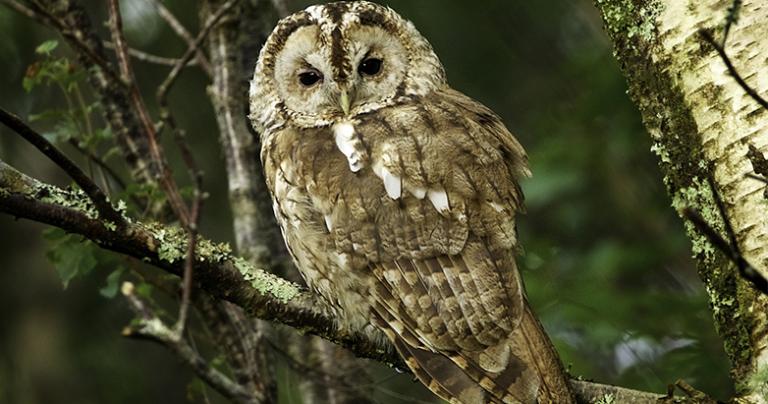
“I think about Hubal as a God of poetry, divination and revenge, a guardian of the death and inspiration. He had a gentle character during our interaction, so I’m surprised by all those associations with death, war and revenge”. Image by Vanessaanne from Pixabay. Cropped.
Who is Hubal?
I obviously wasn’t daring to forget any of this, and decided to do some research because, although I had read about Him, I knew I was missing some details, and as far as I could remember there wasn’t any bird connected to Hubal. The Book of Idols, by Hisham Ibn Al-Kalbi, gives a short explanation about Him:
The Quraysh had also several idols in and around the Ka’bah. The greatest of these was Hubal. It was, as I was told, of red agate, in the form of a man with the right hand broken off. It came into the possession of the Quraysh in this condition, and they, therefore, made for it a hand of gold. The first to set it up [for worship] was Khuzaymah ibn-Mudrikah ibn-al-Ya’s’ ibn-Muda. Consequently it used to be called Khuzaymah’s Hubal.
This caught my attention because, when I was learning about gemstones and their healing properties, my mates and I were told that red agate is linked to the second chakra, Svadhishthana, linked with creativity, manifested desire and confidence, and the first one, Muladhara, linked with earthy, physical matters, physical body, blood, bones, and safety. Both ca be blocked by fear, especially the fear of death, an important subject as we dwell deeper in Hubal. It is important to note that the Book of Idols also says Hubal was a divination God, specifically divination using arrows.
During my meditation, Hubal explained that He only wanted me to trust my intuition, the He would help me to gain a better sight and listening, which makes sense if He’s connected to the tawny owl, since these birds need both sense to hunt on the night. While He is commonly associated with divination by arrows, I got the impression now is not the time to include that practice, but to develop my own senses or clairs, as Mat Auryn calls the five clair-senses in his book Psychic Witch: Clairvoyance, clairtangency, clairaudience, clairgustance and clairalience.
Hubal’s phantom bird
Tawny owls can be found in Azerbaijan, Lebanon, Syria, Israel, Jordan, Iraq, Iran, among other Asian countries. Owls in general “associated with specific views of life, death, and the afterlife, thus becoming an important religious symbol to the ancient Arabs”. (Homerin, 1985).
Coincidentally, the scientific name, Strix aluco, is based on the Greek myth of the Strix, a bloodthirsty monstrous bird (Oliphant, 1913), and, according to the British Trust for Ornithology, uses the Italian allocco, meaning Tawny Owl, but that also comes from the Latin ulucus, meaning screech-owl. If you go to minute 1:28 of the next video, you will get a good demonstration of this, and better ones after that, although I admit I found the whole video relaxing in a way.
Why is this important? Because “the standard poetic imagery of blood vengeance is that of thirsting and drinking: both the seeker of vengeance and the souls of the unavenged dead in the form of the owl that cries isquni (Give me drink!) are described as thirsting.” (Stetkevych, 1993, pp. 279). Pinault (2018, pp. 27) explains that:
As in Gilgamesh, pagan Arabs likened the spirits of the dead to spectral birds. Jahiliyah* poets sometimes described the human soul after death as an owl that haunts the grave. In this society, preoccupied as it was with vendettas and tribal honor, it was believed that the most restless of spirits were the owl ghosts of those who had been killed and remained unavenged. These phantom birds haunted the site where their corpses lay, hooting Isquni, isquni: “Give me a drink, give me a drink!” The drink such owls wanted, of course, was a long deep slurp of blood.
Final thoughts
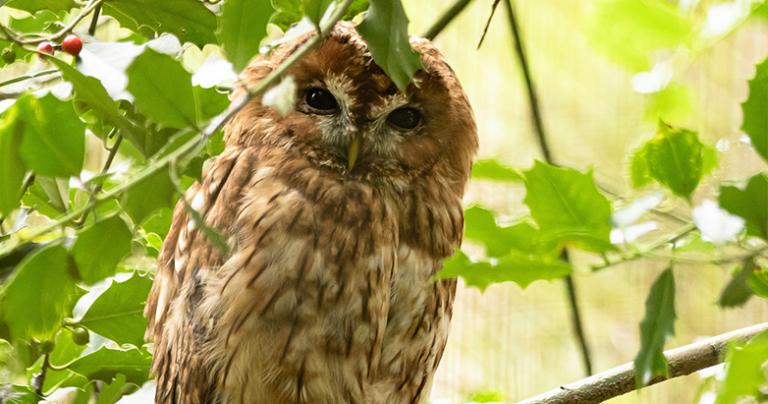
“If I liked Him before, now I’m fascinated and like Him even more”. Image by minka2507 from Pixabay. Cropped.
Although it has been proposed the idea of Hubal being a lunar deity (Winckler, 1901), I get the impression He is more related to the night in a general way, since I haven’t found a direct link with the Moon. It has also been prosoposed that Hubal is the husband of Manat, and that He and Wadd are the sons of Al-Lat (Wellhausen, 1926).
He was also seen as a “a god of rain and a warrior god. Towards the end of the pre-Islamic era he emerged as an intertribal warrior god worshipped by the Quraysh and the allied tribes of the Kinana and Tihama” (Eliade, M. and Adams, 1987, p.365), which makes a lot of sense considering the previous associations. Finally, Healey (2001, pp. 127-132) says that He was possible linked to Dushara and mentions a surviving inscription which concerns a religious injunction to placate Hubal and others for violating a tomb.
In my opinion, it is also possible that other divination methods connected to Hubal could be bibliomancy and rhapsodomancy (Mavroudi, 2009):
The texts and books chosen for this purpose generally are held to contain truth and include the epics of Homer, Hesiod, and Virgil as well as the Psalter, New Testament, Koran, the ahih of ai-Bukhari, and the poetry of Jalal al-Oin ai-Rumi and Hafiz. (…) One may claim that rhapsodomancy involves oral procurement of such an excerpt, while in bibliomancy identifying the excerpt requires the physical presence of a book.
So far, I think about Hubal as a God of poetry, divination and revenge, a guardian of the death and inspiration. He had a gentle character during our interaction, so I’m surprised by all those associations with death, war and revenge, which could be due to His nature as a rain God. Either way, if I liked Him before, now I’m fascinated and like Him even more.
* Jahiliyyah is an Islamic concept that describes a time before the advent of Islam in 610 CE.
References:
- Eliade, M. and Adams, C. J. 1987. The Encyclopedia of religion, Volume 1, Macmillan.
- Healey, J. F. 2001. The Religion Of The Nabataeans: A Conspectus. Leiden: BRILL.
- Homerin, T. 1985. Echoes of a Thirsty Owl: Death and Afterlife in Pre-Islamic Arabic Poetry. Journal of Near Eastern Studies, 44(3), 165-184. Retrieved on 27 October 2020.
- Mavroudi, M. 2009. The Islamic Divination in the Context of Its” Eastern” and” Western” Counterparts. Retrieved on 27 October 2020.
- Oliphant, S. 1913. The Story of the Strix: Ancient. Transactions and Proceedings of the American Philological Association, 44, 133-149. Retrieved on 27 October 2020.
- Pinault, D. 2018. The Crucifix On Mecca’s Front Porch: A Christian’s Companion For The Study Of Islam. 1st ed. San Francisco: Ignatius Press.
- Robinson, R.A. 2005. BirdFacts: profiles of birds occurring in Britain & Ireland. BTO, Thetford. Retrieved on 27 October 2020.
- Stetkevych, S., 1993. The Mute Immortals Speak: Pre-Islamic Poetry And The Poetics Of Ritual. 1st ed. Ithaca: Cornell University Press.
- Wellhausen, 1926, p. 717, quoted in a translation by Hans Krause. Archived on 2005-02-16 at the Wayback Machine.
- Winckler, H. 1901. Arabisch, Semitisch, Orientalisch: Kulturgeschichtlich-Mythologische Untersuchung. W. Peiser: Berlin.

About Bader Saab
I’m an Arabic witch and journalist, also with a master’s degree about to be finished on digital research. I have worked as a book reviewer and written about pre-Islamic folklore. You can read more about the author here.
Previous Post

October 18, 2020
Book Review: The Friendship Poems of Rumi
Next Post
October 29, 2020 Book review: The Spiritual Poems of Rumi
Browse Our Archives
Select a Category Ancestors Book review Books Deities Divination Folklore History news Practice Spirits Uncategorized Wellbeing witchcraft Writing
Select a Month September 2026 July 2026 March 2026 December 2025 November 2025 August 2025 July 2025 June 2025 February 2025 January 2025 September 2024 July 2024 March 2024 February 2024 November 2023 September 2023 July 2023 May 2023 April 2023 February 2023 January 2023 December 2022 November 2022 October 2022 September 2022 July 2022 June 2022 May 2022 April 2022 March 2022 February 2022 January 2022 December 2021 October 2021 September 2021 August 2021 July 2021 June 2021 May 2021 April 2021 March 2021 February 2021 January 2021 December 2020 November 2020 October 2020 September 2020 August 2020
Follow Us!
TAKE THE
Religious Wisdom Quiz
Who prayed in the lions' den every day?
Select your answer to see how you score.
David Paul Daniel Solomon
Related posts from A Modern Day Sha'ir

No More Booklists. Enter the Fake Degree!


Daily Spiritual Practices of a Modern Day Sha'ir
TRENDING AT PATHEOS Pagan

When we talk about Greek religion, we often begin with the dodekatheion—the...

I was recently chatting with someone on Instagram. She asked me what...

While there are many people who share their results, the end of...

On July 23, I saw Christopher Nolan's The Odyssey which is Homer’s...

As I write this two big events have just finished up. One...

Restoring the Watershed of Divine Love
Perhaps cooperation is not something we manufacture through legislation, ideology, or moral...
view all Pagan blogs
Ad-Free & Subscriber Log-In Subscription Support
- About Us
- 2026 Calendar
- Videos
- Podcasts
- Library of World Religions
- Faith In Media Tracker
- Advertise With Us
- Write for Us
- Privacy Policy
- Terms of Service
- Do Not Sell My Data
- Contact Us
- Radiant Digital
- Manage Newsletter Subscriptions
- Unsubscribe From Notifications
- Sitemap
Copyright 2008-2026, Patheos. All rights reserved.
Subscription Support Ad-Free & Subscriber Log-In
Follow Patheos