
BuddhistCatholicContemplativeEvangelicalGeneral ChristianHinduJewishLatter-day SaintMuslimNew VisionsProgressive Christian
Beliefs
- Buddhist
- Catholic
- Contemplative
- Evangelical
- General Christian
- Hindu
- Jewish
- Latter-day Saint
- More Voices
- Muslim
- New Visions
- Pagan
- Progressive Christian
Topics
- Religion News
- Food and Religion
- Sports and Religion
- Religious Art
- Religious Music and Entertainment
- Religious Events
- History and Religion
- Style and Religion
- Politics and Religion
- Women in Religion
- Recreation Outdoors and Religion
- Business Finance and Religion
- Careers Workplace and Religion
- Education and Religion
- Family Parenting and Religion
- Health Fitness and Religion
- Home and Religion
- Relationships and Religion
- Technology and Religion
- Travel and Religion
Columnists
- Buddhist Columnists
- Business Finance and Religion Columnists
- Careers Workplace and Religion Columnists
- Catholic Columnists
- Contemplative Columnists
- Education and Religion Columnists
- Evangelists Columnists
- Family Parenting and Religion Columnists
- General Christian Columnists
- Health Fitness and Religion Columnists
- Hindu Columnists
- History and Religion Columnists
- Home and Religion Columnists
- Jewish Columnists
- More Voices Columnists
- Latter Day Columnists
- Muslim Columnists
- New Visions Columnists
- Nonreligious Columnists
- Pagan Columnists
- Politics and Religion Columnists
- Progressive Columnists
- Recreation Outdoors and Religion Columnists
- Relationships and Religion Columnists
- Religion News Columnists
- Religious Art Columnists
- Religious Events Columnists
- Religious Music and Entertainment Columnists
- Sports and Religion Columnists
- Style and Religion Columnists
- Technology and Religion Columnists
- Travel and Religion Columnists
- Women in Religion Columnists
Resource Library
- 2026 Calendar
- Library of World Religions
- The 100 Most Holy Places on Earth
- Patheos Answers
- Podcasts
- Videos
- Faith Leaders Database
- Anglican Episcopalian
- Bahai
- Baptist
- Buddhism
- Christianity
- Confucianism
- Eastern Orthodoxy
- Hinduism
- Holiness and Pentecostal
- ISKCON
- Islam
- Judaism
- Lutheran
- Methodist
- The Church of Jesus Christ of Latter-day Saints
- New Age
- Paganism
- Presbytarian and Reformed
- Protestantism
- Religion Behind the Scenes
- Roman Catholic
- Scientology
- Shia Islam
- Sikhism
- Sufism
- Sunni Islam
- Taoism
- Zen
- See all religions
Research Tools
 Ad-Free & Subscriber Log-In Subscription Support
Ad-Free & Subscriber Log-In Subscription Support
Follow Patheos 

- Trending:
- Forgiveness
- |
- Marriage
- |
- Consciousness
- |
- Death Penalty
- |
- Election
- |
- Halloween

- Home
- Pagan
- Manat: The pre-Islamic Goddess of Time, Fate and Death
Manat: The pre-Islamic Goddess of Time, Fate and Death
Last updated on: October 27, 2020 at 11:30 pm by Bader Saab
Manat: The pre-Islamic Goddess of Time, Fate and Death 2020-10-27T23:30:40-04:00 Bader Saab
Patheos Explore the world's faith through different perspectives on religion and spirituality! Patheos has the views of the prevalent religions and spiritualities of the world.
While searching for my roots and the beliefs of my ancestors, those who lived before Islam, I came across an interesting triad. Wicca taught me that the Goddess has three faces to represent womanhood’s three stages: Maiden, Mother and Crone. Although I’m no longer Wiccan, it was a nice surprise to discover an Arabic pre-Islamic triad with this same concept.
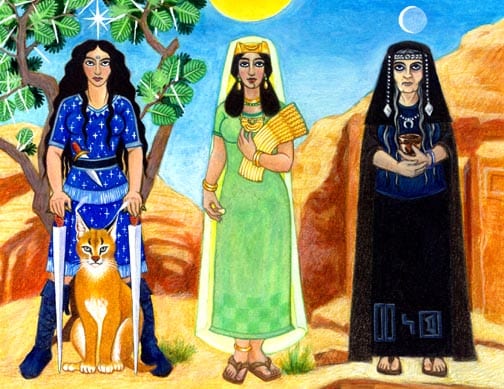
“I obviously gravitated towards Manat, the Old One, the Crone, the Goddess of time, fate, and death, but who exactly is she?” Image by Thalia Took. http://www.thaliatook.com/AMGG/arabtriple.php
The Three Daughters of Allah, Al-Uzza, Al-lat, and Manat are respectively the Maiden, Mother and Crone of the pre-Islamic world. After years of invoking the Greek Goddess Hekate, I obviously gravitated towards Manat, the Old One, the Crone, the Goddess of time, fate, and death, but who exactly is she?
It is said in pre-Islamic belief that Allah (“God” in Arabic) left his active role in the Universe after creating it, becoming a passive spectator from a distant, calm corner, in order to rest. His three daughters became intermediaries between humankind and Allah, who would only act in desperate times. Manat, sometimes spelled as Manah, is believed to be the first one Allah created, and so the oldest of his daughters. The Kitāb al-ʾAṣnām, or The Book of Idols, by Hisham Ibn Al-Kalbi, explains:
“The most ancient of all these idols was Manāt. The Arabs used to name [their children] ‘Abd-Manāt and Zayd-Manāt. Manāt was erected on the seashore in the vicinity of al-Mushallal in Qudayd, between Medina and Mecca. All the Arabs used to venerate her and sacrifice before her. The Aws and the Khazraj, as well as the inhabitants of Medina and Mecca and their vicinities, used to venerate Manāt, sacrifice before her, and bring unto her their offerings…
The Aws and the Khazraj, as well as those Arabs among the people of Yathrib and other places who took to their way of life, were wont to go on pilgrimage and observe the vigil at all the appointed places, but not shave their heads. At the end of the pilgrimage, however, when they were about to return home, they would set out to the place where Manāt stood, shave their heads, and stay there a while. They did not consider their pilgrimage completed until they visited Manāt.”
She is sometimes described as the mother, and other times the consort, of Hubal, a warrior God believed to control acts of divination. Quzah, the Meccan God of storms, thunder, and the clouds, has also been named as her consort. Her idol was a large outcrop of black marble. Also, Manat was believed to change the fate of those who displeased her for the worse, and so an oath sworn by Her was considered the most serious and sincere. Since she is a Goddess of death, Manat was called upon in Nabataean rituals, along with Qaysha, Taraha and Dhu-Shara, in order to protect tombs and curse those who disturbed them.
I have a prayer I say for her, which came naturally to me, and which I use when I feel the need to. Arabic changes a little depending on the country, so I prefer to translate the prayer to English and encourage you to pronounce it as you prefer. As long as our heart remains honest and we know who we’re talking to, Manat will listen to us.
Ya Manat, daughter of Allah
You that kiss the moon,
You that know what will happen to us,
Put your eyes in this house of ours,
Ya Manat, kiss these hands, kiss one and kiss two.
Allah bless you*, Ya Manat, may Allah permits you to stay with us., Ya Manat.
Another prayer shared by ‘Amr-Athtar Yunajjam was used to venerate the three sisters. I have used it a few times, and like how it sounds and feels:
‘Wa’l-Lāt-a wa’l Uzzā, wa Manāt-a al-thalithāta al-‘ukhrā, Tilk al-gharāniq al-‘ulā, wa inna shafā’ata-hunna la-turtajā.’
In English:
‘By al-Lāt and al-‘Uzzā, and Manāt, the third goddess, the other; Verily they are the most exalted cranes, and their intercession is to be hoped for.’
My most recent practice is to write her name in Arabic as a form of meditation: مناة. I do it just like that, without any protocol or ceremony, trying to memorize and understand what I’m writing, trying to feel the power of the letters as they appear. I would suggest you do the same, and of course I encourage you to share the results!
A vision from Manat
Once in a trance, I had a vision of my grandmother’s house, which is in my hometown. There was no one in there except for me and two figures. The first one was a green man with antlers that I strongly believe was the Celtic God Cernunnos. The other one was a woman, small, dressed in black, fine clothes and a white veil around her head not covering her face. You guessed it, it was Manat.
I still remember the compassion, love, and understanding in her face, especially her eyes, how smooth and clean her clothes were, and how warm her hands felt when she took mine. I won’t say I cried, I honestly cannot remember more than that, but when I came back I still felt her presence around me. She accepted me for who I was, am and would be, for she already knew.
The only problem I come up with over and over again is the lack of trustworthy information on Manat, but I prefer to look at this as my chance to be part of her myths and (who knows?) reconstruction. If we revel at the large amount of data about a deity, why not do the same when there is hardly anything known for sure?
I’m still working on my connection with Manat. She is a Goddess I keep learning about, a deity I cannot stop inviting to my rituals in general. Her energy is so feral, dense, and mysterious that is almost addictive. You develop a hunger, a liking for that unknown vibration, and if you’re as curious as I am, you will want to understand it. But to truly understand this long-forgotten Goddess of time, fate and death? Good luck with that!
* Another meaning is “May Allah be pleased with you”.
Article originally published in Spiral Nature. Slightly edited.

About Bader Saab
I’m an Arabic witch and journalist, also with a master’s degree about to be finished on digital research. I have worked as a book reviewer and written about pre-Islamic folklore. You can read more about the author here.
Previous Post
September 7, 2020
How an Arab Witch Honours and Contacts his Ancestors
Next Post
September 9, 2020 Al-Lat: the pre-Islamic Goddess of the Harvest, Fertility, and Love
Browse Our Archives
Select a Category Ancestors Book review Books Deities Divination Folklore History news Practice Spirits Uncategorized Wellbeing witchcraft Writing
Select a Month September 2026 July 2026 March 2026 December 2025 November 2025 August 2025 July 2025 June 2025 February 2025 January 2025 September 2024 July 2024 March 2024 February 2024 November 2023 September 2023 July 2023 May 2023 April 2023 February 2023 January 2023 December 2022 November 2022 October 2022 September 2022 July 2022 June 2022 May 2022 April 2022 March 2022 February 2022 January 2022 December 2021 October 2021 September 2021 August 2021 July 2021 June 2021 May 2021 April 2021 March 2021 February 2021 January 2021 December 2020 November 2020 October 2020 September 2020 August 2020
Follow Us!
TAKE THE
Religious Wisdom Quiz
What was the primary method of food preservation in Biblical times?
Select your answer to see how you score.
Pickling Smoking Drying Salting
Related posts from A Modern Day Sha'ir

No More Booklists. Enter the Fake Degree!


TRENDING AT PATHEOS Pagan

When we talk about Greek religion, we often begin with the dodekatheion—the...

I was recently chatting with someone on Instagram. She asked me what...

While there are many people who share their results, the end of...

On July 23, I saw Christopher Nolan's The Odyssey which is Homer’s...

As I write this two big events have just finished up. One...

Restoring the Watershed of Divine Love
Perhaps cooperation is not something we manufacture through legislation, ideology, or moral...
view all Pagan blogs
Ad-Free & Subscriber Log-In Subscription Support
- About Us
- 2026 Calendar
- Videos
- Podcasts
- Library of World Religions
- Faith In Media Tracker
- Advertise With Us
- Write for Us
- Privacy Policy
- Terms of Service
- Do Not Sell My Data
- Contact Us
- Radiant Digital
- Manage Newsletter Subscriptions
- Unsubscribe From Notifications
- Sitemap
Copyright 2008-2026, Patheos. All rights reserved.
Subscription Support Ad-Free & Subscriber Log-In
Follow Patheos