
BuddhistCatholicContemplativeEvangelicalGeneral ChristianHinduJewishLatter-day SaintMuslimNew VisionsProgressive Christian
Beliefs
- Buddhist
- Catholic
- Contemplative
- Evangelical
- General Christian
- Hindu
- Jewish
- Latter-day Saint
- More Voices
- Muslim
- New Visions
- Pagan
- Progressive Christian
Topics
- Religion News
- Food and Religion
- Sports and Religion
- Religious Art
- Religious Music and Entertainment
- Religious Events
- History and Religion
- Style and Religion
- Politics and Religion
- Women in Religion
- Recreation Outdoors and Religion
- Business Finance and Religion
- Careers Workplace and Religion
- Education and Religion
- Family Parenting and Religion
- Health Fitness and Religion
- Home and Religion
- Relationships and Religion
- Technology and Religion
- Travel and Religion
Columnists
- Buddhist Columnists
- Business Finance and Religion Columnists
- Careers Workplace and Religion Columnists
- Catholic Columnists
- Contemplative Columnists
- Education and Religion Columnists
- Evangelists Columnists
- Family Parenting and Religion Columnists
- General Christian Columnists
- Health Fitness and Religion Columnists
- Hindu Columnists
- History and Religion Columnists
- Home and Religion Columnists
- Jewish Columnists
- More Voices Columnists
- Latter Day Columnists
- Muslim Columnists
- New Visions Columnists
- Nonreligious Columnists
- Pagan Columnists
- Politics and Religion Columnists
- Progressive Columnists
- Recreation Outdoors and Religion Columnists
- Relationships and Religion Columnists
- Religion News Columnists
- Religious Art Columnists
- Religious Events Columnists
- Religious Music and Entertainment Columnists
- Sports and Religion Columnists
- Style and Religion Columnists
- Technology and Religion Columnists
- Travel and Religion Columnists
- Women in Religion Columnists
Resource Library
- 2026 Calendar
- Library of World Religions
- The 100 Most Holy Places on Earth
- Patheos Answers
- Podcasts
- Videos
- Faith Leaders Database
- Anglican Episcopalian
- Bahai
- Baptist
- Buddhism
- Christianity
- Confucianism
- Eastern Orthodoxy
- Hinduism
- Holiness and Pentecostal
- ISKCON
- Islam
- Judaism
- Lutheran
- Methodist
- The Church of Jesus Christ of Latter-day Saints
- New Age
- Paganism
- Presbytarian and Reformed
- Protestantism
- Religion Behind the Scenes
- Roman Catholic
- Scientology
- Shia Islam
- Sikhism
- Sufism
- Sunni Islam
- Taoism
- Zen
- See all religions
Research Tools
 Ad-Free & Subscriber Log-In Subscription Support
Ad-Free & Subscriber Log-In Subscription Support
Follow Patheos 

- Trending:
- Forgiveness
- |
- Marriage
- |
- Consciousness
- |
- Death Penalty
- |
- Election
- |
- Halloween
 American Buddhist Perspectives
- Home
- Buddhist
- Religion News
- The ongoing importance of Engaging with Buddhism
The ongoing importance of Engaging with Buddhism
Last updated on: May 27, 2019 at 8:20 am by Justin Whitaker
The ongoing importance of Engaging with Buddhism 2019-05-27T08:20:16-06:00 Justin Whitaker
Patheos Explore the world's faith through different perspectives on religion and spirituality! Patheos has the views of the prevalent religions and spiritualities of the world.
Nearly every week I encounter the idea that Buddhism should somehow be kept ‘pure’ and separate from our ordinary, mundane lives. For many, it seems, Buddhism must exist in an ethereal realm apart from the mess and muck of relationships, jobs, politics, the environment, etc, etc. Generally this seems to come from people who have lived comfortable lives of privilege. Buddhism for them is a little additional pillow of comfort.
Part of this is likely due to the romanticization of modernist Buddhism. This “Buddhism” is largely a product of well-off, comfortable white men, “discovered” in ancient texts (the way Columbus “discovered” America). In contrast to these pure texts, ordinary people practicing Buddhism have been seen as disappointing, purveyors of “superstition” that must have been imported later, or “cultural accretions” that could be safely peeled away to give way to something truer.
Another part of this is likely the ‘disembodied’ nature of many individuals today. How many of us work the soil where our vegetables are grown, or care for birthing livestock that provide our meat or dairy. We can, provided enough money, float like gods through the world (at least while we’re young). And yet again this applies most clearly to folks like me: white, male, at the moment financially comfortable. If I hadn’t been exposed to (and listened to) countless women, I might not know that few women feel this freedom. Recent abortion laws underscore this for some. Special restrictions put on women: women driving, women wearing certain clothes, the policing of women’s hair, the unfair scrutiny of women in politics on down throughout the whole workforce. People of color too face daily reminders in their own lives and in the news, reminders that the world has a hold on them.
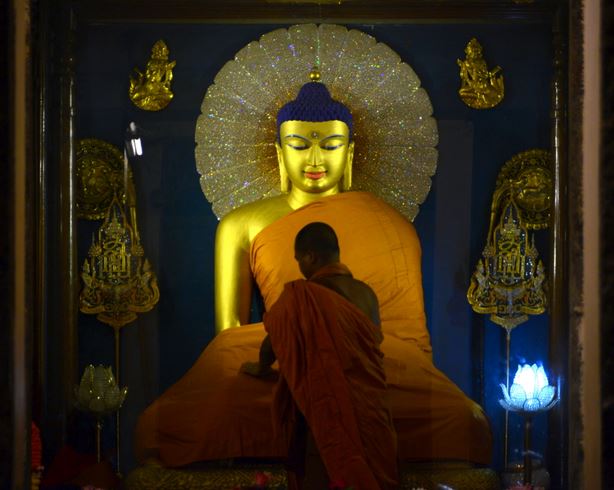
Redressing the Buddha inside the Mahabodhi stupa, Bodhgaya, India (photo by the author, 2014)
For those of us free of such added burdens, Buddhism can help challenge our ‘god-like’ floating ignorance of this suffering around us. But that takes work. And it takes getting into uncomfortable spaces. But if we are serious about practicing Buddhism, instead of merely placing it delicately on our mantle this is the work we must do. In this practice, we inevitably come into contact with others, with their perspectives, their sufferings (structural, individual, etc), and as Buddhism teaches that ultimately, suffering is suffering, we engage in the work of alleviating that suffering and understanding those perspectives.
William Edelglass offers a compelling discussion of this practice, setting perspectives of Buddhism into conversation with Western philosophy:
“Buddhism offers a vast tradition of philosophical and moral reflection. But traditions endure only to the degree to which they address the experience and concerns of each new generation. Our contemporary concerns include justice and inequality, navigating difference in multicultural societies, climate change, and the pervasiveness of information technology. Discerning how to speak, act, and think skillfully in our contemporary context requires us to engage with these concerns. As Buddhists, we should not be afraid of drawing on Western thought when it can help with this engagement.”
Any “Buddhism” kept separate from contemporary concerns will be like a delicate flower transported to an unsuitable environment, attractive, but stripped of context, meaning, and purpose – and with an inevitably short life.
But the discussion must go both ways: not just applying Buddhist wisdom to our contemporary concerns, but also allowing Buddhism to critique those concerns. Edelglass writes:
To appreciate the ways classical Buddhist texts can challenge our thinking, we should be aware of the interpretive frameworks through which we encounter them. For many of us, that means the cultural and philosophical orientations of Western modernity. Western thought can help us understand why we might find appealing a form of Buddhism that de-emphasizes tradition, mythology, and ritual and valorizes psychology, creativity, nature, social engagement, and the affirmation of this life and the present moment. Classical Buddhist texts speak to us from outside our own discourse and challenge us to think differently; if we don’t understand our interpretive frameworks, however, we may just see a projection of our own creation.
For Buddhism to work, it must work in people, in our frameworks, in our lives. But for Buddhism to work it must be understood: historically, contextually, critically, carefully. This is the dialectic, the discussion. For the idealized “scholar” there is no personal life brought to Buddhism. What is found and examined and understood is as lifeless and cold as a cadaver. For the overly naive practitioner, Buddhism is twisted into the “projection” Edelglass mentions. Sometimes the scholar encounters the naive beginner and, having failed to live even an ounce of the subject matter, pounce with scorn on the naivete and misunderstandings of the human being before them.
Somewhere the two ends of the discussion must meet, often slowly but surely. The scholar “discovers” that some of this is actually meaningful, or correct, or useful in their life, perhaps humbling them to sit beside the newcomer in meditation or at a retreat. The newcomer likewise must realize that Buddhism has existed for 2500 years outside of their head – in the lives of other people. Perhaps, having calmed some of their own mental wanderings, they can sit down and read a book, compare notes of scholar, examine some source material, etc. The two come together. Perhaps the experiential insights of the practitioner can be used to guide the scholar in their own journey of introspection, just as much as the historical and schematic data from the scholar can help guide the student.

Previous Post

May 8, 2019
I'm still here!
Next Post
June 7, 2019 Intersections between Buddhism, Health, and Diversity in an American City
Browse Our Archives
Select a Category Academia Activism American Buddhism Art Book review Buddhism Buddhism Today Buddhist Ethics Burma/Myanmar China Christianity Commodification Environment Gender Happiness Health Humor India Interfaith Islam Japanese Buddhism Kant Media / News Meditation mindfulness Photography Poetry Politics quicktakes Running Teaching Technology Thailand Theism/Atheism Theravada Tibet Tibetan Buddhism Travels Uncategorized Unitarian Universalism video Western Philosophy Zen
Select a Month June 2021 January 2021 November 2020 August 2020 July 2020 March 2020 January 2020 October 2019 August 2019 June 2019 May 2019 March 2019 February 2019 January 2019 December 2018 November 2018 October 2018 September 2018 August 2018 July 2018 June 2018 May 2018 April 2018 March 2018 February 2018 January 2018 December 2017 November 2017 October 2017 September 2017 August 2017 July 2017 June 2017 May 2017 April 2017 March 2017 February 2017 January 2017 December 2016 November 2016 October 2016 September 2016 August 2016 July 2016 June 2016 May 2016 April 2016 March 2016 February 2016 January 2016 December 2015 November 2015 October 2015 September 2015 August 2015 July 2015 June 2015 May 2015 April 2015 March 2015 February 2015 January 2015 December 2014 November 2014 October 2014 September 2014 August 2014 July 2014 June 2014 May 2014 April 2014 March 2014 February 2014 January 2014 December 2013 November 2013 October 2013 September 2013 August 2013 July 2013 June 2013 May 2013 April 2013 March 2013 February 2013 January 2013 December 2012 November 2012 October 2012 September 2012 August 2012 July 2012 June 2012 May 2012 April 2012 March 2012 February 2012 January 2012 December 2011 November 2011 October 2011 September 2011 August 2011 July 2011 June 2011 May 2011 April 2011 March 2011 February 2011 January 2011 December 2010 November 2010 October 2010 September 2010 August 2010 July 2010 June 2010 May 2010 April 2010 March 2010 February 2010 January 2010 December 2009 November 2009 October 2009 September 2009 August 2009 July 2009 June 2009 May 2009 April 2009 March 2009 February 2009 January 2009 December 2008 November 2008 October 2008 September 2008 August 2008 July 2008 June 2008 May 2008 April 2008 March 2008 September 2007 August 2007 July 2007 June 2007 May 2007 April 2007 March 2007 February 2007 January 2007 December 2006 November 2006 October 2006 September 2006 August 2006 July 2006 June 2006 May 2006 April 2006 March 2006 February 2006 January 2006 December 2005 November 2005 October 2005 September 2005 November 2004 September 2004 August 2004
Follow Us!
TAKE THE
Religious Wisdom Quiz
What happened to the first stone tablets of the Ten Commandments?
Select your answer to see how you score.
Pharaoh destroyed them Moses broke them They were placed in the Ark They were lost in battle
Support this
Column


Related posts from American Buddhist Perspectives

For Pride Month: Our 2015 Interview with La...
American Buddhist Perspectives

In strife and uncertainty: let us remember loving-kindness
American Buddhist Perspectives

In the rush to return to normal, can...
American Buddhist Perspectives

A Festival of Radical Awakening: Socially Engaged Buddhism...
American Buddhist Perspectives
TRENDING AT PATHEOS Buddhist

On Taking Refuge in the Dharma
(Here I continue the feature of sharing talks and essays by teachers...

(Continuing my intention to share talks and essays by other members of Empty...
The Subtle Art of Bowing: A Dharma Discourse
(This presentation was first offered by my dear friend Dharma Holder Tom...

Internal Family Systems Can Heal you Mentally &...
How IFS Helped Me Stop Fighting Myself Internal Family Systems (IFS) is...

The Bible No One Spoke About: A Family’s...
A mysterious family Bible, unspoken faith, and a journey from curiosity to...

How Uncertainty Can Transform Your Life in 2025
Embracing Uncertainty: A New Year’s Resolution for the Brave As 2025 approaches,...
view all Buddhist blogs
Ad-Free & Subscriber Log-In Subscription Support
- About Us
- 2026 Calendar
- Videos
- Podcasts
- Library of World Religions
- Faith In Media Tracker
- Advertise With Us
- Write for Us
- Privacy Policy
- Terms of Service
- Do Not Sell My Data
- Contact Us
- Radiant Digital
- Manage Newsletter Subscriptions
- Unsubscribe From Notifications
- Sitemap
Copyright 2008-2026, Patheos. All rights reserved.
Subscription Support Ad-Free & Subscriber Log-In
Follow Patheos