
BuddhistCatholicContemplativeEvangelicalGeneral ChristianHinduJewishLatter-day SaintMuslimNew VisionsProgressive Christian
Beliefs
- Buddhist
- Catholic
- Contemplative
- Evangelical
- General Christian
- Hindu
- Jewish
- Latter-day Saint
- More Voices
- Muslim
- New Visions
- Pagan
- Progressive Christian
Topics
- Religion News
- Food and Religion
- Sports and Religion
- Religious Art
- Religious Music and Entertainment
- Religious Events
- History and Religion
- Style and Religion
- Politics and Religion
- Women in Religion
- Recreation Outdoors and Religion
- Business Finance and Religion
- Careers Workplace and Religion
- Education and Religion
- Family Parenting and Religion
- Health Fitness and Religion
- Home and Religion
- Relationships and Religion
- Technology and Religion
- Travel and Religion
Columnists
- Buddhist Columnists
- Business Finance and Religion Columnists
- Careers Workplace and Religion Columnists
- Catholic Columnists
- Contemplative Columnists
- Education and Religion Columnists
- Evangelists Columnists
- Family Parenting and Religion Columnists
- General Christian Columnists
- Health Fitness and Religion Columnists
- Hindu Columnists
- History and Religion Columnists
- Home and Religion Columnists
- Jewish Columnists
- More Voices Columnists
- Latter Day Columnists
- Muslim Columnists
- New Visions Columnists
- Nonreligious Columnists
- Pagan Columnists
- Politics and Religion Columnists
- Progressive Columnists
- Recreation Outdoors and Religion Columnists
- Relationships and Religion Columnists
- Religion News Columnists
- Religious Art Columnists
- Religious Events Columnists
- Religious Music and Entertainment Columnists
- Sports and Religion Columnists
- Style and Religion Columnists
- Technology and Religion Columnists
- Travel and Religion Columnists
- Women in Religion Columnists
Resource Library
- 2026 Calendar
- Library of World Religions
- The 100 Most Holy Places on Earth
- Patheos Answers
- Podcasts
- Videos
- Faith Leaders Database
- Anglican Episcopalian
- Bahai
- Baptist
- Buddhism
- Christianity
- Confucianism
- Eastern Orthodoxy
- Hinduism
- Holiness and Pentecostal
- ISKCON
- Islam
- Judaism
- Lutheran
- Methodist
- The Church of Jesus Christ of Latter-day Saints
- New Age
- Paganism
- Presbytarian and Reformed
- Protestantism
- Religion Behind the Scenes
- Roman Catholic
- Scientology
- Shia Islam
- Sikhism
- Sufism
- Sunni Islam
- Taoism
- Zen
- See all religions
Research Tools
 Ad-Free & Subscriber Log-In Subscription Support
Ad-Free & Subscriber Log-In Subscription Support
Follow Patheos 

- Trending:
- Forgiveness
- |
- Marriage
- |
- Consciousness
- |
- Death Penalty
- |
- Election
- |
- Halloween
 American Buddhist Perspectives
- Home
- Buddhist
- Religion News
- Dalai Lama, Citing Progress, is Optimistic for Humanity
Dalai Lama, Citing Progress, is Optimistic for Humanity
Last updated on: March 5, 2018 at 3:00 pm by Justin Whitaker
Dalai Lama, Citing Progress, is Optimistic for Humanity 2018-03-05T15:00:36-07:00 Justin Whitaker
Patheos Explore the world's faith through different perspectives on religion and spirituality! Patheos has the views of the prevalent religions and spiritualities of the world.
The Dalai Lama has many interests. As a child in Tibet’s Potala Palace he studied Tibetan philosophy, meditation, and politics. He was, after all, being groomed to be the religious and temporal leader of the Tibetan people. A keen student of Tibetan Buddhism will remind you that there were several branches or schools of Buddhism there at the time, so the Dalai Lama’s leadership in that sense was not Pope-like. And a keen student of Tibetan politics will tell you that the Dalai Lama’s temporal authority, based in Lhasa and snaking through valleys and around affiliate temples outward toward several border crossings, was also quite limited and fragile, even in the 1930s and 1940s.
Nonetheless, while his temporal authority over Tibet was lost with the Chinese invasion and occupation of 1951-9, his spiritual authority has widened to embrace other schools of Tibetan Buddhism (unofficially) and to touch the lives of countless people around the world of different faiths or no faith at all.
The Dalai Lama also played with pocket watches, a car and a telescope (gifts to his predecessor from foreigners) in his youth. Later, when the opportunity arose to engage in deep and lasting conversations with Western scientists through the early and ongoing Mind and Life dialogues, he took it. He has also given invited talks to scientific organizations and stated, “If scientific analysis were conclusively to demonstrate certain claims in Buddhism to be false, then we must accept the findings of science and abandon those claims.”
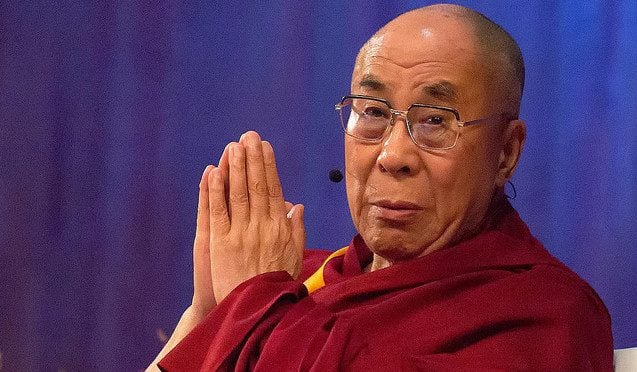
Tenzin Gyatso – 14th Dalai Lama (photo by Christopher Michel, flickr C.C.)
Last fall, when confronted with the overwhelming evidence of sexual misconduct on the part of popular Tibetan teacher Sogyal Lakar, head of a multi-national and multi-million dollar network of centers called Rigpa, he plainly said that this man is a “disgrace” and that such figures represent a threat to the institution of Tibetan Buddhism:
…very bad impression about monastery or monk – very bad. So we must pay more attention.
You should not say, “oh this is my guru, whatever the guru says I must follow” – that is totally wrong. The Buddha himself mentioned, “my teachings, you must examine.”
When one discovers “rotten institutions,” as he went on to describe Rigpa, one has a responsibility to reach out and contact the media, to publicise the problem in the hope of eradicating it.
And just last month he reiterated a secular stance to dealing with our human problems that he had voiced before, stating that, “Although I am a Buddhist monk, I am skeptical that prayers alone will achieve world peace. We need instead to be enthusiastic and self-confident in taking action.”
If there were to be a patron saint of Progressive Buddhism, it would be the current Dalai Lama, Tenzin Gyatso.
So it should come as little surprise that today, delivering remarks to foreigners in India, the Dalai Lama expressed continued optimism about humanity:
“On the future of humanity, I feel very much optimistic. So I make some effort as my share as one of the 7 billion human beings. My number one commitment is to promote the sense of oneness of the entire 7 billion human beings. We are same, physically, mentally and emotionally. Too much concern on nationality and religion is outdated.”
“We have [a] common responsibility towards the wellbeing of entire human beings,” he said.
“In the early part of the 20th century, when one nation declared war on the other, every citizen joined the war effort. This has no longer been the case from the later part of the 20th century. Many Americans were against the Vietnam War and during the Iraq War, millions expressed their desire for peace. So humans, I feel, are becoming more mature and reasonable in their thinking.”
(*lightly edited for grammar; from the Central Tibetan Administration)
This expression of optimism and progress is part of our shared human inheritance. It is found in the writings of Immanuel Kant, in the work of Unitarian abolitionist Rev. Theodore Parker, who first wrote about the “moral arc of the universe,” the life of Abraham Lincoln, who spoke of the better angels of our nature, Rev. Dr. Martin Luther King, Jr., who also spoke of the moral arc and of his dream for a better future, and numerous thinkers before and today.
This progress is not given to us, as these thinkers knew and those watching contemporary politics can see, but it seems evident in certain arcs of history and perhaps acts as a secular source of hope in the world today.
Support independent coverage of Buddhism by joining a community of fellow learners/practitioners at Patreon.
‘Like’ American Buddhist Perspectives on facebook.
Previous Post

February 22, 2018
Buddhism, Burma, and Politics via Religion Dispatches
Next Post

March 15, 2018 Got $12,000 to spend on a book? Murals of Tibet is Perfect for You
Browse Our Archives
Select a Category Academia Activism American Buddhism Art Book review Buddhism Buddhism Today Buddhist Ethics Burma/Myanmar China Christianity Commodification Environment Gender Happiness Health Humor India Interfaith Islam Japanese Buddhism Kant Media / News Meditation mindfulness Photography Poetry Politics quicktakes Running Teaching Technology Thailand Theism/Atheism Theravada Tibet Tibetan Buddhism Travels Uncategorized Unitarian Universalism video Western Philosophy Zen
Select a Month June 2021 January 2021 November 2020 August 2020 July 2020 March 2020 January 2020 October 2019 August 2019 June 2019 May 2019 March 2019 February 2019 January 2019 December 2018 November 2018 October 2018 September 2018 August 2018 July 2018 June 2018 May 2018 April 2018 March 2018 February 2018 January 2018 December 2017 November 2017 October 2017 September 2017 August 2017 July 2017 June 2017 May 2017 April 2017 March 2017 February 2017 January 2017 December 2016 November 2016 October 2016 September 2016 August 2016 July 2016 June 2016 May 2016 April 2016 March 2016 February 2016 January 2016 December 2015 November 2015 October 2015 September 2015 August 2015 July 2015 June 2015 May 2015 April 2015 March 2015 February 2015 January 2015 December 2014 November 2014 October 2014 September 2014 August 2014 July 2014 June 2014 May 2014 April 2014 March 2014 February 2014 January 2014 December 2013 November 2013 October 2013 September 2013 August 2013 July 2013 June 2013 May 2013 April 2013 March 2013 February 2013 January 2013 December 2012 November 2012 October 2012 September 2012 August 2012 July 2012 June 2012 May 2012 April 2012 March 2012 February 2012 January 2012 December 2011 November 2011 October 2011 September 2011 August 2011 July 2011 June 2011 May 2011 April 2011 March 2011 February 2011 January 2011 December 2010 November 2010 October 2010 September 2010 August 2010 July 2010 June 2010 May 2010 April 2010 March 2010 February 2010 January 2010 December 2009 November 2009 October 2009 September 2009 August 2009 July 2009 June 2009 May 2009 April 2009 March 2009 February 2009 January 2009 December 2008 November 2008 October 2008 September 2008 August 2008 July 2008 June 2008 May 2008 April 2008 March 2008 September 2007 August 2007 July 2007 June 2007 May 2007 April 2007 March 2007 February 2007 January 2007 December 2006 November 2006 October 2006 September 2006 August 2006 July 2006 June 2006 May 2006 April 2006 March 2006 February 2006 January 2006 December 2005 November 2005 October 2005 September 2005 November 2004 September 2004 August 2004
Follow Us!
TAKE THE
Religious Wisdom Quiz
Who is known for teaching that "faith without works is dead"?
Select your answer to see how you score.
Paul Peter Jude James
Support this
Column


Related posts from American Buddhist Perspectives

In strife and uncertainty: let us remember loving-kindness
American Buddhist Perspectives

In the rush to return to normal, can...
American Buddhist Perspectives

A Festival of Radical Awakening: Socially Engaged Buddhism...
American Buddhist Perspectives

The Coronavirus is coming - Some thoughts from...
American Buddhist Perspectives
TRENDING AT PATHEOS Buddhist

On Taking Refuge in the Dharma
(Here I continue the feature of sharing talks and essays by teachers...

(Continuing my intention to share talks and essays by other members of Empty...
The Subtle Art of Bowing: A Dharma Discourse
(This presentation was first offered by my dear friend Dharma Holder Tom...

Internal Family Systems Can Heal you Mentally &...
How IFS Helped Me Stop Fighting Myself Internal Family Systems (IFS) is...

The Bible No One Spoke About: A Family’s...
A mysterious family Bible, unspoken faith, and a journey from curiosity to...

How Uncertainty Can Transform Your Life in 2025
Embracing Uncertainty: A New Year’s Resolution for the Brave As 2025 approaches,...
view all Buddhist blogs
Ad-Free & Subscriber Log-In Subscription Support
- About Us
- 2026 Calendar
- Videos
- Podcasts
- Library of World Religions
- Faith In Media Tracker
- Advertise With Us
- Write for Us
- Privacy Policy
- Terms of Service
- Do Not Sell My Data
- Contact Us
- Radiant Digital
- Manage Newsletter Subscriptions
- Unsubscribe From Notifications
- Sitemap
Copyright 2008-2026, Patheos. All rights reserved.
Subscription Support Ad-Free & Subscriber Log-In
Follow Patheos