
BuddhistCatholicContemplativeEvangelicalGeneral ChristianHinduJewishLatter-day SaintMuslimNew VisionsProgressive Christian
Beliefs
- Buddhist
- Catholic
- Contemplative
- Evangelical
- General Christian
- Hindu
- Jewish
- Latter-day Saint
- More Voices
- Muslim
- New Visions
- Pagan
- Progressive Christian
Topics
- Religion News
- Food and Religion
- Sports and Religion
- Religious Art
- Religious Music and Entertainment
- Religious Events
- History and Religion
- Style and Religion
- Politics and Religion
- Women in Religion
- Recreation Outdoors and Religion
- Business Finance and Religion
- Careers Workplace and Religion
- Education and Religion
- Family Parenting and Religion
- Health Fitness and Religion
- Home and Religion
- Relationships and Religion
- Technology and Religion
- Travel and Religion
Columnists
- Buddhist Columnists
- Business Finance and Religion Columnists
- Careers Workplace and Religion Columnists
- Catholic Columnists
- Contemplative Columnists
- Education and Religion Columnists
- Evangelists Columnists
- Family Parenting and Religion Columnists
- General Christian Columnists
- Health Fitness and Religion Columnists
- Hindu Columnists
- History and Religion Columnists
- Home and Religion Columnists
- Jewish Columnists
- More Voices Columnists
- Latter Day Columnists
- Muslim Columnists
- New Visions Columnists
- Nonreligious Columnists
- Pagan Columnists
- Politics and Religion Columnists
- Progressive Columnists
- Recreation Outdoors and Religion Columnists
- Relationships and Religion Columnists
- Religion News Columnists
- Religious Art Columnists
- Religious Events Columnists
- Religious Music and Entertainment Columnists
- Sports and Religion Columnists
- Style and Religion Columnists
- Technology and Religion Columnists
- Travel and Religion Columnists
- Women in Religion Columnists
Resource Library
- 2026 Calendar
- Library of World Religions
- The 100 Most Holy Places on Earth
- Patheos Answers
- Podcasts
- Videos
- Faith Leaders Database
- Anglican Episcopalian
- Bahai
- Baptist
- Buddhism
- Christianity
- Confucianism
- Eastern Orthodoxy
- Hinduism
- Holiness and Pentecostal
- ISKCON
- Islam
- Judaism
- Lutheran
- Methodist
- The Church of Jesus Christ of Latter-day Saints
- New Age
- Paganism
- Presbytarian and Reformed
- Protestantism
- Religion Behind the Scenes
- Roman Catholic
- Scientology
- Shia Islam
- Sikhism
- Sufism
- Sunni Islam
- Taoism
- Zen
- See all religions
Research Tools
 Ad-Free & Subscriber Log-In Subscription Support
Ad-Free & Subscriber Log-In Subscription Support
Follow Patheos 

- Trending:
- Forgiveness
- |
- Marriage
- |
- Consciousness
- |
- Death Penalty
- |
- Election
- |
- Halloween
 American Buddhist Perspectives
- Home
- Buddhist
- Religion News
- Americans “Duped,” Burmese “Brainwashed” About Ongoing Violence in Burma / Myanmar
Americans “Duped,” Burmese “Brainwashed” About Ongoing Violence in Burma / Myanmar
Last updated on: March 30, 2018 at 10:24 am by Justin Whitaker
Americans “Duped,” Burmese “Brainwashed” About Ongoing Violence in Burma / Myanmar 2018-03-30T10:24:15-06:00 Justin Whitaker
Patheos Explore the world's faith through different perspectives on religion and spirituality! Patheos has the views of the prevalent religions and spiritualities of the world.
Burma continues to be an enigma in the minds of most Americans today. With a population that is nearly 90% Theravadin Buddhist, many Westerners imagine a land of peace and smiles, ancient pagodas, and silent lines of monks and nuns passing on alms rounds. And while these are real aspects of the country, there is much, much more beneath the surface.
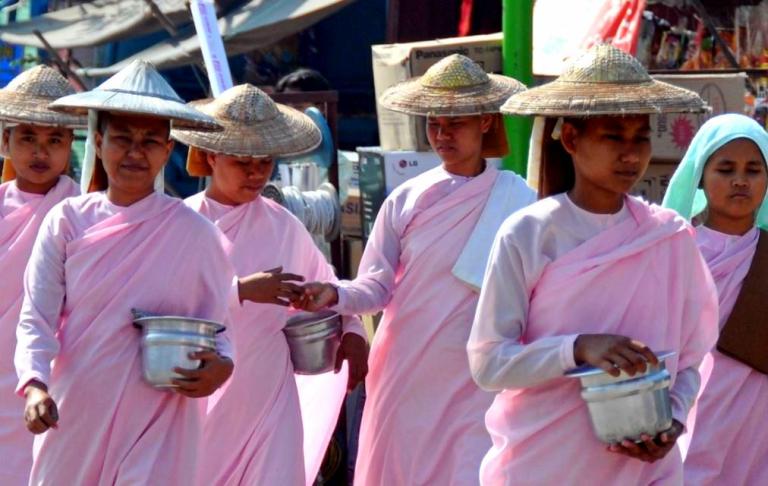
Burmese nuns on alms rounds, Burma 2011 (photo by author)
Stanley A. Weiss writes for the Diplomat about recent military-political factors shaping the country, summarized in a report called “Weaponizing U.S. Economic Engagement in Burma.” Weiss writes of the report that, “It has been widely shared across defense and intelligence networks worldwide the past two months, and with good reason: Its warning of a “Burma in crisis” is stark.” (emphasis added) The report goes on to suggest that U.S. policy-makers have been duped into thinking real reform was taking place, while military leaders continue to hold a tight grip on political and economic aspects of the country.
An example of the measured optimism can be found in this 2013 Department of State testimony to the House Committee on Foreign Affairs. There you see the positive: new peaceful elections, opposition party winning, revisions of economic and media policies to open; as well as the negative: communal violence and anti-Muslim discrimination in Rakhine State and beyond, ongoing ethnic violence elsewhere in the country, and a constitutional and legal infrastructure still firmly favoring military rule of the country.
However, this new report, written by former commander of the Green Berets, Colonel Tim Heinemann, emphasises a much less optimistic view of the country. He writes, “US government and businesses are being deceived by mischaracterizations of realities past and present in Burma. By the time the rules of this game are figured out, the US public and private sectors will be fully committed on the ground. It will then be too late, as has been the case in Iraq and Afghanistan.”
It is notable that Heinemann warned of problems in Iraq in 2003, a warning that was ignored at the time. Heinemman suggests several steps to avoid the failures of Iraq and Afghanistan, namely focusing on small-scale and ethical businesses and individuals and looking at the younger generation of change-makers who will not so easily succumb to older generation’s prejudices.
On the Buddhist front, Burmese American Buddhists have formed a group called Saddha, releasing a video plea to the world to end violence against the Rohingya last fall. As discussed here in October:
Recounting the facts of the last few months, surveying reports from both within and outside Burma, they say:
Our online and personal interactions have shown us that not many Burmese Buddhists express sympathy towards the Rohingya, even as fellow human beings.
Indeed, this is consistent with numerous reports from within the country, personified by Ashin Wirathu but not limited to him, of regarding the Rohingya, and Muslims more broadly, as “like dogs.” They continue:
The Rohingya have been dehumanized online in Burma as “illegal Bengali immigrants,” terrorists who breed like animals and convert Buddhist women in Rakhine state. …
There are Burmese people who believe the Rohingya’s presence in Burma risks the rise of Islamic fundamentalism in Rakhine state and threatens our Buddhist heritage.
Turning to the future of Burmese Buddhism, they express a shared concern, saying that, “we believe that what is happening now will jeopardize Buddhism far more than anything else… today, ‘our’ Buddhism has become the face of inhumanity to the rest of the world.”
Of particular help in Weiss’ article is this description of the ethno-religious political landscape of Burma:
Since most Americans aren’t familiar with the geography of Myanmar, let’s use the U.S. political map to demonstrate what Heinemann is talking about. As we all know, America is blue (referring to Democratic states) on each coast and red (Republican states) across the vast middle of the country. Now, imagine if this divide were even more stark: that there was a continuous belt of blue along both coasts connected by a long blue line across the top of the country, surrounding the red states like a horseshoe. Imagine if everyone in the red states were Christian and Caucasian and everyone in the blue states were people of color and of many different religions. Now, imagine if the vast majority of America’s economic resources were all in the blue states, but that the U.S. government was operated by and for the red states, with an all-powerful and unaccountable U.S. military that constantly exploited the resources of the blue states for its own gain while denying its people basic rights.
Along with this article by Weiss, see Matthew Gindin’s excellent recent discussion in Tricycle Magazine. In that article, Gindin recounts asking, Burmese dissidents and Rohingya survivors about potentials for resistance to the violence there,”The Burmese people at the event said resistance in Burma is very difficult and made rarer by the pervasive brainwashing of the Burmese Buddhist public, who have been largely convinced to regard reports of atrocities against the Rohingya as ‘fake news.'”
Gindin continues, quoting U Kyaw Win, an elder dissident of Burma and friend of Aung San Suu Kyi, “what happened at Dachau and Auschwitz is going on in Burma. It is a slow genocide. It is a way of getting rid of a certain group of people—you can do it quickly or very slowly.”
Another activist, Khin Mai Aung, a New York–based racial justice and immigration rights lawyer, is also quoted, saying, “The country has lived under military control for some time, and it doesn’t have a strong foundation for a civil society. People have difficulty distinguishing fact from state fiction, having lived under military propaganda for so long.”
So, internally the Burmese face government propaganda, sometimes in alignment with opportunistic Buddhist leaders, externally they face either a general lack of information or idealization. The road forward remains thus very uncertain. The growing connections of diasporic Burmese (notably not only Buddhists, but also Hindus, Christians, and Muslims in Gindin’s article) might generate a positive and lasting counterbalance to the military and Chinese and Russian forces who profit from the authoritarian state. But the road to democracy could be a very long one. As Weiss writes:
“Ethnic conflict in Myanmar has changed its dimension,” he tells me, “The young generation of Burmans blames the military and does not seek Burman dominance … we still have a chance to become a nation without internal armed conflict, but it may take another 20 years.”
Support independent coverage of Buddhism by joining a community of fellow learners/practitioners at Patreon.
‘Like’ American Buddhist Perspectives on facebook.
Previous Post

March 27, 2018
Violent Buddhists of the 20th Century (and beyond)
Next Post

April 13, 2018 Cut Military Spending: Fund Human Needs, a Buddhist Solution to Syria?
Browse Our Archives
Select a Category Academia Activism American Buddhism Art Book review Buddhism Buddhism Today Buddhist Ethics Burma/Myanmar China Christianity Commodification Environment Gender Happiness Health Humor India Interfaith Islam Japanese Buddhism Kant Media / News Meditation mindfulness Photography Poetry Politics quicktakes Running Teaching Technology Thailand Theism/Atheism Theravada Tibet Tibetan Buddhism Travels Uncategorized Unitarian Universalism video Western Philosophy Zen
Select a Month June 2021 January 2021 November 2020 August 2020 July 2020 March 2020 January 2020 October 2019 August 2019 June 2019 May 2019 March 2019 February 2019 January 2019 December 2018 November 2018 October 2018 September 2018 August 2018 July 2018 June 2018 May 2018 April 2018 March 2018 February 2018 January 2018 December 2017 November 2017 October 2017 September 2017 August 2017 July 2017 June 2017 May 2017 April 2017 March 2017 February 2017 January 2017 December 2016 November 2016 October 2016 September 2016 August 2016 July 2016 June 2016 May 2016 April 2016 March 2016 February 2016 January 2016 December 2015 November 2015 October 2015 September 2015 August 2015 July 2015 June 2015 May 2015 April 2015 March 2015 February 2015 January 2015 December 2014 November 2014 October 2014 September 2014 August 2014 July 2014 June 2014 May 2014 April 2014 March 2014 February 2014 January 2014 December 2013 November 2013 October 2013 September 2013 August 2013 July 2013 June 2013 May 2013 April 2013 March 2013 February 2013 January 2013 December 2012 November 2012 October 2012 September 2012 August 2012 July 2012 June 2012 May 2012 April 2012 March 2012 February 2012 January 2012 December 2011 November 2011 October 2011 September 2011 August 2011 July 2011 June 2011 May 2011 April 2011 March 2011 February 2011 January 2011 December 2010 November 2010 October 2010 September 2010 August 2010 July 2010 June 2010 May 2010 April 2010 March 2010 February 2010 January 2010 December 2009 November 2009 October 2009 September 2009 August 2009 July 2009 June 2009 May 2009 April 2009 March 2009 February 2009 January 2009 December 2008 November 2008 October 2008 September 2008 August 2008 July 2008 June 2008 May 2008 April 2008 March 2008 September 2007 August 2007 July 2007 June 2007 May 2007 April 2007 March 2007 February 2007 January 2007 December 2006 November 2006 October 2006 September 2006 August 2006 July 2006 June 2006 May 2006 April 2006 March 2006 February 2006 January 2006 December 2005 November 2005 October 2005 September 2005 November 2004 September 2004 August 2004
Follow Us!
TAKE THE
Religious Wisdom Quiz
Who said, "Let my tongue cling to the roof of my mouth if I do not remember you"?
Select your answer to see how you score.
Isaiah Elijah Psalmist Solomon
Support this
Column


Related posts from American Buddhist Perspectives

In strife and uncertainty: let us remember loving-kindness
American Buddhist Perspectives

The Coronavirus is coming - Some thoughts from...
American Buddhist Perspectives

Sogyal Lakar, well-known Tibetan Buddhist teacher and alleged...
American Buddhist Perspectives

Secular vs Religious, Buddhism vs Mindfulness, and a...
American Buddhist Perspectives
TRENDING AT PATHEOS Buddhist

On Taking Refuge in the Dharma
(Here I continue the feature of sharing talks and essays by teachers...

(Continuing my intention to share talks and essays by other members of Empty...
The Subtle Art of Bowing: A Dharma Discourse
(This presentation was first offered by my dear friend Dharma Holder Tom...

Internal Family Systems Can Heal you Mentally &...
How IFS Helped Me Stop Fighting Myself Internal Family Systems (IFS) is...

The Bible No One Spoke About: A Family’s...
A mysterious family Bible, unspoken faith, and a journey from curiosity to...

How Uncertainty Can Transform Your Life in 2025
Embracing Uncertainty: A New Year’s Resolution for the Brave As 2025 approaches,...
view all Buddhist blogs
Ad-Free & Subscriber Log-In Subscription Support
- About Us
- 2026 Calendar
- Videos
- Podcasts
- Library of World Religions
- Faith In Media Tracker
- Advertise With Us
- Write for Us
- Privacy Policy
- Terms of Service
- Do Not Sell My Data
- Contact Us
- Radiant Digital
- Manage Newsletter Subscriptions
- Unsubscribe From Notifications
- Sitemap
Copyright 2008-2026, Patheos. All rights reserved.
Subscription Support Ad-Free & Subscriber Log-In
Follow Patheos